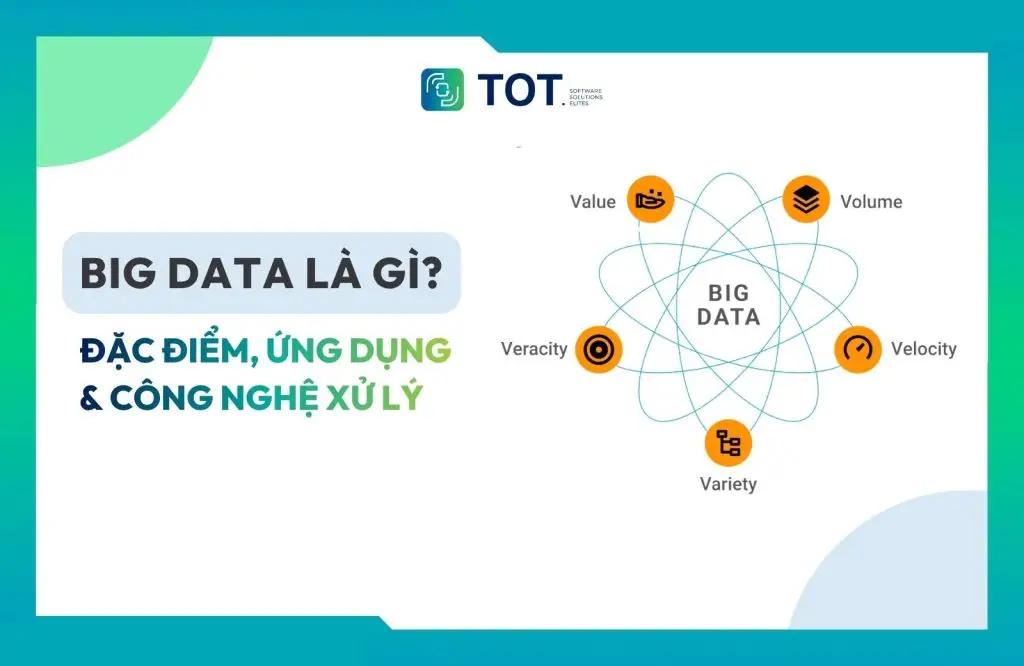
As digital transformation and artificial intelligence continue to advance, Big Data is becoming a crucial foundation that helps businesses leverage their data to make decisions and optimize operations. So what is Big Data, what are its characteristics, and how is it applied in practice? Let TOT walk you through the details in the article below.
>>> Learn more:
- Gesture recognition with Vision AI in real-world applications
- What is Phrase Grounding? Models and how it works
- AI data labeling: Trends, tools, and workflows
- Vertex AI – what is it? Google Cloud’s machine learning platform
What is Big Data?
Big Data refers to datasets that are large in scale, generated at high speed, and diverse in type or source, making them difficult or inefficient to collect, store, manage, and analyze using traditional data processing methods. For this reason, Big Data is not defined simply by a fixed storage threshold. Whether a dataset is considered Big Data also depends on the characteristics of the data and the technological capabilities used to collect, store, and process it.
The concept of Big Data is closely tied to the growth of the Internet, mobile devices, social media, e-commerce, IoT, and digital systems. According to the IDC Global DataSphere Forecast, the volume of data created and replicated worldwide is projected to reach approximately 394 zettabytes by 2028, up from around 181 zettabytes in 2025. This figure represents the amount of data created and replicated globally, not the total volume of data currently stored.
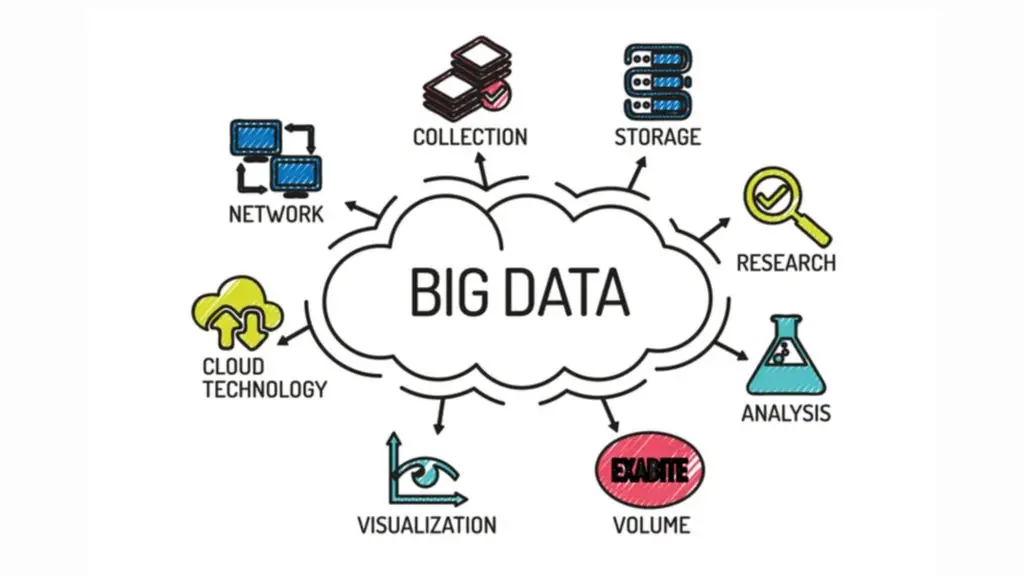
It is worth noting that Big Data is not limited to tables with millions of rows. A single system may simultaneously hold transaction data, search history, images, video, server logs, sensor data, emails, and social media content. As the number and types of data sources grow, businesses need an architecture capable of collecting, storing, processing, and integrating these sources to serve specific business goals.
Real-world examples of Big Data
- E-commerce: Platforms such as Shopee, Lazada, and similar services can generate data from search history, viewed products, clicks, shopping carts, orders, reviews, and post-purchase behavior.
- Content platforms: Netflix, YouTube, and other video services can record data on when users start, pause, rewind, skip, or rewatch content.
- Banking: Every transaction, login, transfer, or card payment generates data that can be analyzed to detect unusual transaction patterns.
- IoT: Sensors in factories, vehicles, or smart devices can continuously send data on temperature, vibration, pressure, location, and operating status.
>>> See more:
- Image recognition AI – what is it? Common algorithms and applications
- TOP 15 best AI code-writing tools of 2026
- Top 20+ best free AI image design software
What are the characteristics of Big Data? The 5V model
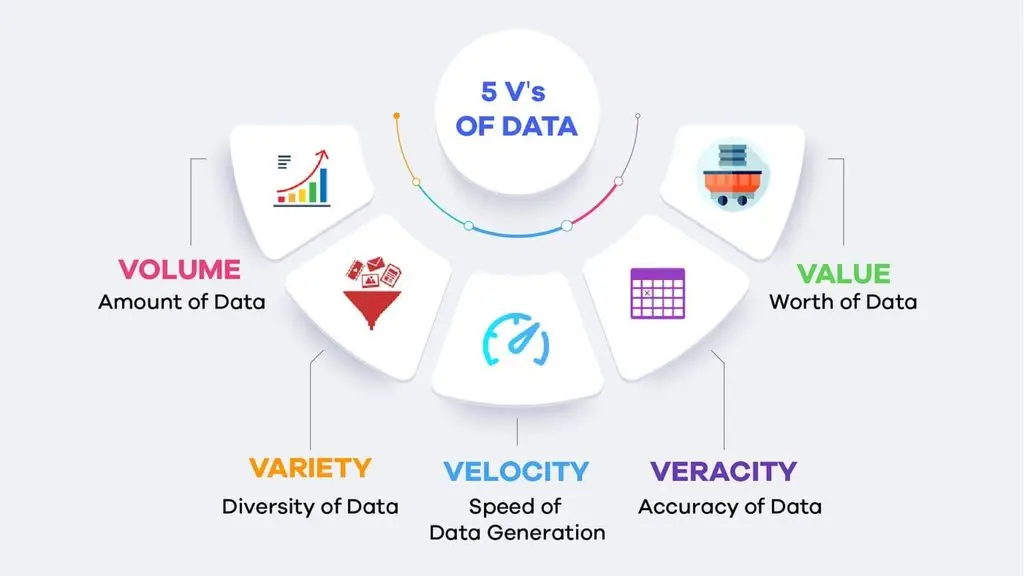
Big Data is often described through the 5V model, consisting of Volume, Velocity, Variety, Veracity, and Value. Of these, Volume, Velocity, and Variety are the three original attributes introduced by Doug Laney in the 2001 research paper 3-D Data Management: Controlling Data Volume, Velocity and Variety. Later, Veracity and Value became more widely used to emphasize the reliability of data and its ability to generate value.
Volume – Data volume
Volume reflects the scale of data an organization needs to collect, store, and process. This scale can range from gigabytes and terabytes to petabytes or more, depending on the industry and system. A retail chain with hundreds of stores, for example, may continuously generate data on invoices, products, inventory, customers, and interactions across multiple channels.
As data accumulates over long periods, traditional storage systems may face limitations in scalability and processing. Businesses can therefore use a Data Lake, Cloud Storage, or distributed storage systems to manage large data volumes more effectively.
Velocity – Data speed
Velocity reflects the speed at which data is generated, transmitted, and processed. Not all data needs to be processed instantly, but some use cases require real-time or near-real-time processing. For instance, a banking system can analyze transactions as they occur to detect signs of abnormal activity.
The ability to process data quickly helps businesses respond promptly to ongoing events. This is especially important in fields such as finance, e-commerce, manufacturing, and IoT, where the value of data can diminish if the information is processed too late.
>>> See more:
- Top 7 Best Open-Source Object Tracking Tools
- What is Visual Question Answering? Models and how it works
- What is Object Detection? How it works & real-world applications
Variety – Data diversity
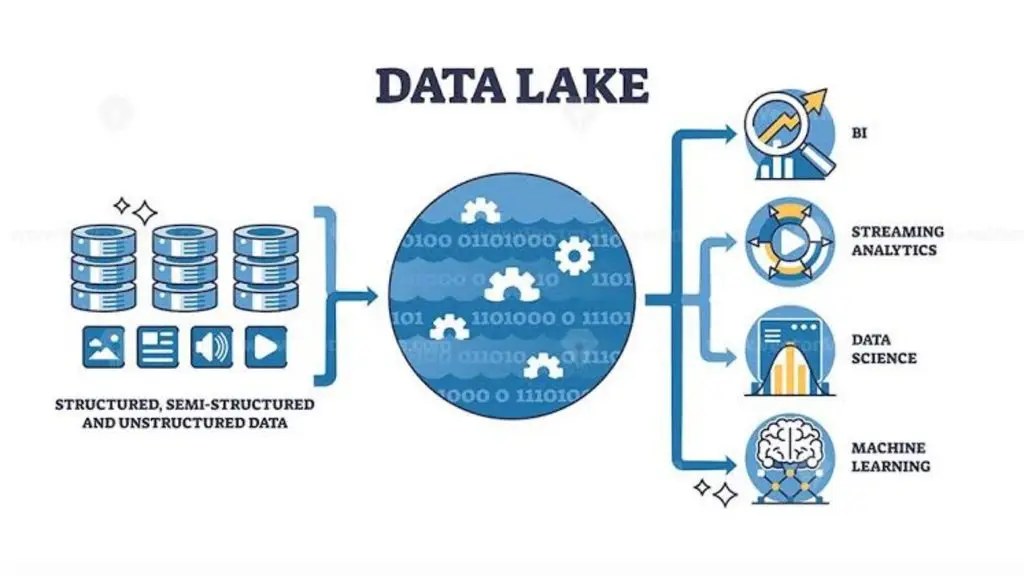
Variety describes the diversity of data origins and formats. Big Data can include structured data such as order tables, semi-structured data such as JSON from an API, and unstructured data such as emails, images, videos, or customer comments.
Combining multiple data types gives businesses a broader perspective on their customers and operations. For example, a business can combine transaction data with search history, interactions, and customer feedback to better understand the journey and needs of each customer segment.
Veracity – Data reliability
Veracity refers to the accuracy, consistency, and trustworthiness of data. In practice, data may contain duplicate records, incorrectly formatted information, missing values, or outdated information. If such data is used directly for analysis, the results can be distorted and affect business decisions.
Therefore, ensuring data quality is an important part of leveraging Big Data. According to Gartner, based on a 2020 study, poor data quality costs organizations an average of at least USD 12.9 million per year.
Value – Value from data
Value emphasizes the ability to turn data into useful information, insights, and business value. A customer’s purchase history on its own is just data; only when it is analyzed to identify shopping trends or groups of customers likely to be interested in a specific product does that data begin to create value.
This shows that the goal of Big Data is not simply to collect as much data as possible. More importantly, businesses need to leverage data to support decision-making, optimize operations, understand customers, and solve specific business problems.
>>> Reference:
- 18 highly effective ways to apply AI to e-commerce
- What is Predictive AI? Benefits and how predictive AI works
- A quick guide to creating a landing page with AI for free and effectively
- 29 standout AI website templates for SaaS, E-commerce, and multiple industries
What types of data does Big Data include?
Data in a Big Data system is typically classified by structure into three groups: Structured Data, Semi-structured Data, and Unstructured Data. Each group is organized, stored, and processed differently, as summarized below.
| Data type | Characteristics | Examples |
| Structured Data | Clearly structured, typically organized into rows and columns | Customers, orders, transactions |
| Semi-structured Data | Does not require a fixed table but contains metadata, keys, or tags | JSON, XML, some types of logs, API data |
| Unstructured Data | No fixed schema, usually not organized in table form | Images, video, audio, email |
Structured Data
Structured Data is clearly structured and typically organized into fields, rows, and columns. Each field has a predefined data type, making it easy for systems to store, query, and manage. Common examples include customer lists, invoices, bank transactions, payroll, and inventory data.
Structured Data is usually stored in relational databases and queried using SQL. It remains an important data type in Big Data systems because many analytical and business processes start from structured transaction data.
>>> See more:
- What is SQL injection? 4 effective ways to prevent SQL injection
- Security vulnerabilities – what are they? Hidden risks and how to prevent them
Semi-structured Data
Unlike Structured Data, Semi-structured Data does not require a fixed table structure but still contains metadata, keys, tags, or structural markers that help systems recognize the components within. JSON, XML, and certain types of system logs are common examples.
Thanks to its flexible structure, this data type often appears when applications exchange information through APIs or capture data from multiple different systems. Records may have different structures or field sets, so the data often needs to be normalized and transformed before analysis.
Unstructured Data
While Semi-structured Data retains some structural markers, Unstructured Data has no fixed schema and is usually not organized in table form. Images, video, audio files, emails, text documents, and social media comments are all common examples. This is also the data group that businesses are increasingly creating and collecting from digital channels.
To leverage unstructured data, businesses can combine AI and Machine Learning. NLP supports text analysis, Computer Vision processes images and video, while Speech Recognition can convert audio data into text. Thanks to these technologies, unstructured data can be turned into information that can be analyzed at scale, serving use cases such as behavioral analysis, forecasting, and AI application development.
>>> Learn more:
- What is an LLM? Understanding large language models
- How to create prompts for LLMs in computer vision to improve accuracy
How does Big Data work?
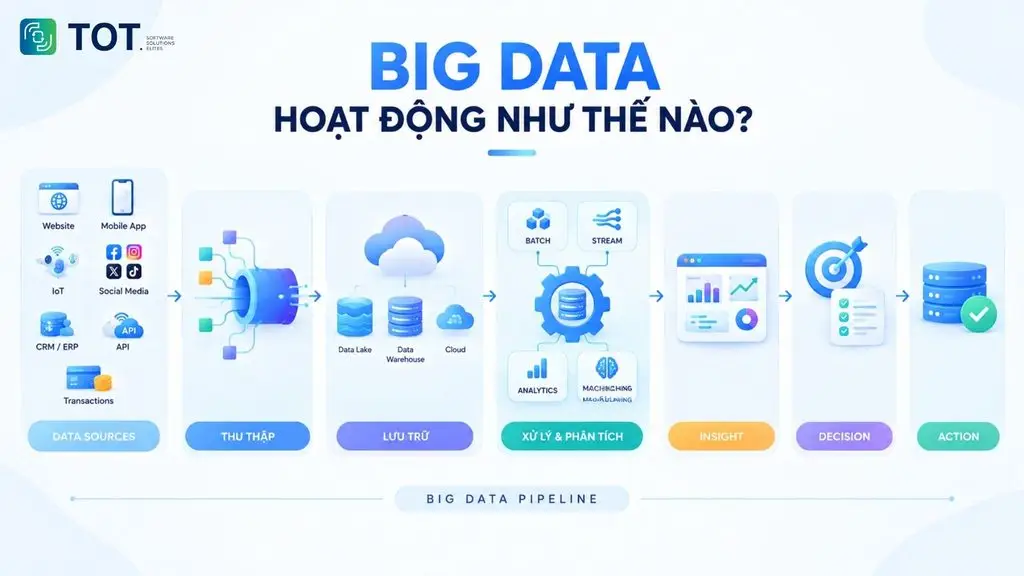
A Big Data system typically involves the steps of collecting, storing, processing, and analyzing data, then delivering the results to users or business systems. Depending on the architecture, some steps may run in parallel or in a different order, especially in real-time data processing systems.
Data collection
Data can come from many different sources such as websites, mobile apps, IoT, social media, CRM/ERP, transaction systems, APIs, and external platforms.
At this stage, businesses need to build a data pipeline to bring data from multiple sources into the processing system. The challenge lies not only in collecting data but also in connecting different sources, maintaining consistency, and ensuring the data is ready for subsequent processing steps.
>>> See more:
- CRM software – what is it? Top 15 CRM tools for businesses in 2026
- What is ERP? Top 10 popular and trusted ERP software in 2026
Data storage
Once collected, data can be stored in a Data Lake, Data Warehouse, Cloud Storage, or distributed storage systems, depending on the data type and intended use.
A Data Lake is generally suited to storing data in many formats, including raw data. A Data Warehouse, by contrast, is optimized for organized data and serves reporting and analytics needs. With Cloud infrastructure, businesses can flexibly scale storage resources and processing capacity on demand.
Data processing and analysis
Once data has been brought into the system, businesses can choose a processing method that matches their requirements for volume and response time:
- Batch Processing: processes data in batches, suitable for periodic reports and tasks that do not require immediate results.
- Stream Processing: processes data continuously as events occur, suitable for fraud detection, IoT monitoring, or systems that need to respond quickly.
Batch Processing and Stream Processing determine how data is processed over time, while Data Analytics and Machine Learning help extract information from the processed data. Businesses can use these methods to identify trends, segment groups, detect anomalies, or build forecasting models.
Visualization and extracting insights
Analysis results can be fed into dashboards, reports, or business systems so that users can easily access and use them. From there, data can be turned into insights that support businesses in decision-making and taking action.
The data value chain can be visualized as follows: Data → Insight → Decision → Action
The value of Big Data becomes clear when analysis results can help people or systems make decisions and take appropriate action.
>>> See more:
- Common workflows for AI Agents: How they work
- A guide on how to use Google AI Studio effectively and quickly
- How to create videos with AI: Top 15 free AI video tools
- How to build AI apps with vibe coding on Google AI Studio easily
The role of Big Data for businesses
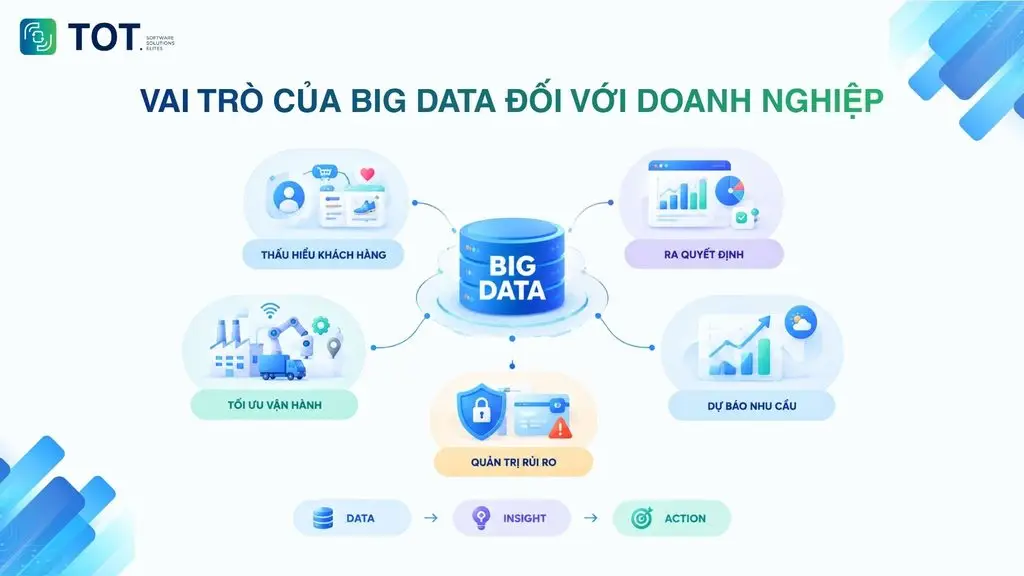
Big Data helps businesses leverage data at scale to generate insights that support a wide range of activities, from understanding customers and supporting decision-making to optimizing operations, managing risk, and forecasting demand.
Understanding and personalizing the customer experience
One of the most visible benefits of Big Data is its ability to help businesses better understand customer behavior and needs. Businesses can combine purchase history, website behavior, app interactions, and customer support data to gain a more comprehensive view of their customers.
From there, the system can segment customers, recommend products, personalize content, or identify the right moments to engage. However, the effectiveness of personalization still depends on data quality and how the business designs the experience.
>>> Read more:
- Build an online store with AI for free, SEO-friendly, and highly effective
- TOP 10 AI website design tools, free and paid, that deliver results
- TOP 20 best free AI tools for online sales
Supporting data-driven decision-making
Beyond understanding customers, Big Data also allows managers to combine data from multiple departments rather than relying on isolated reports. Dashboards and analytics systems can help track revenue, inventory, customer behavior, or operational performance.
This approach is especially useful for decisions that require weighing many variables, such as adjusting the product portfolio, forecasting demand, or allocating resources. Combining multiple data sources gives businesses a stronger basis for assessing the situation and choosing the right course of action.
Optimizing operations and costs
At the operational level, data can help businesses detect bottlenecks, forecast demand, and use resources more efficiently. In manufacturing, sensor data can be combined with AI and Machine Learning to implement predictive maintenance, detecting signs of abnormality before equipment fails.
In logistics, data on orders, vehicle locations, and delivery history can be analyzed to optimize routes and transport times. These improvements can help reduce downtime, limit waste, and optimize operating costs.
>>> See more:
- What is SHA? Commonly used SHA versions
- What is PKI? Common Public Key Infrastructure applications
Fraud detection and risk management
Beyond operational efficiency, Big Data also helps businesses detect anomalies and manage risk. Analytics systems can combine multiple signals from transactions and customer behavior to identify unusual or risky patterns.
In banking, insurance, and e-commerce, this is an important application of Big Data Analytics. For example, a transaction may be flagged for review when several unusual signals appear simultaneously, such as location, time, device, transaction frequency, and account history.
Forecasting market trends and demand
Based on historical data and new signals, businesses can build models to forecast demand, sales, or consumer trends. These forecasts can support inventory planning, resource allocation, and adjustments to business operations in response to market fluctuations.
However, forecasts are not automatically accurate simply because there is a lot of data. Data quality, variable selection, analytical methods, and market context can all affect the results. Big Data should therefore be seen as a foundation that provides data and insights for the forecasting process, rather than a guarantee of an accurate forecast.
>>> Learn more:
- What is SSO? How centralized SSO authentication works
- What is RSA? How RSA encryption works and its use in digital signatures
- What is WCAG? Principles for website content accessibility
Applications of Big Data across industries
Big Data is applied across many industries, from finance and e-commerce to healthcare, manufacturing, marketing, and transportation. The common thread is that data is leveraged to address a specific need or problem, rather than simply being stored at scale.
Big Data in finance and banking
In the finance and banking sector, Big Data is used for fraud detection, credit scoring, risk management, and customer segmentation. Systems can analyze transaction history, payment behavior, and many other signals to detect unusual patterns.
Use case: A fraud detection system can analyze transactions in near real time and raise alerts when behavior differs significantly from a customer’s transaction history.

Big Data in e-commerce
In e-commerce, Big Data is leveraged for product recommendations, customer behavior analysis, demand forecasting, and building dynamic pricing models. Businesses can combine transaction data with search behavior, product views, and on-platform interactions.
Use case: A product recommendation system can combine viewing, search, cart, and purchase history to identify the products most likely to suit each user.
>>> See more:
- What is 2FA? How to get codes & use two-factor authentication safely
- What is DNS over HTTPS? How DoH works
Big Data in healthcare
In healthcare, Big Data supports the analysis of electronic health records, medical imaging data, drug research, and the tracking of epidemiological trends. Combining multiple data sources helps healthcare organizations and researchers extract additional information to support diagnosis, treatment, and research.
Use case: An AI system can analyze X-ray images to help doctors identify areas that need closer examination. The analysis serves as professional support and does not replace the judgment of medical staff.
Big Data in manufacturing and IoT
In a manufacturing environment, data from sensors, machinery, and operational systems can be combined with activity history to predict maintenance needs, build smart factories, and optimize the supply chain.
Use case: Sensors can monitor the temperature and vibration of a motor. The system analyzes these metrics and their fluctuations to detect signs of abnormality, issuing maintenance alerts before a failure can occur.
>>> See more:
- Top 19 free task management apps for personal planning
- TOP 15 best low-code platforms
Big Data in marketing
Marketing can leverage Big Data to segment customers, analyze the customer journey, evaluate the effectiveness of touchpoints, and personalize marketing activities across multiple channels. Combining data from multiple sources gives businesses a more complete view of customer behavior and interactions.
Use case: Businesses can combine data from advertising, websites, CRM, and orders to analyze the customer journey and assess the role of each touchpoint in the conversion process.
Big Data in transportation
At the urban and transportation scale, location data, travel history, timing, and vehicle density can be used to forecast traffic conditions, optimize routes, and develop intelligent transportation systems.
Use case: A transportation platform can combine real-time location data with historical traffic data to estimate travel times and support vehicle dispatching.
>>> Read more:
- Generative AI – what is it? How it works & real-world applications
- What is OWASP? The OWASP Top 10 vulnerabilities and security risks

Common Big Data technologies
A Big Data system can combine multiple technologies for tasks such as storage, processing, data transmission, and analysis, depending on the data scale and the needs of the business. These technologies serve different roles and can be combined within the same system.
Hadoop
Apache Hadoop is an open-source framework that supports distributed data storage and processing across multiple servers. Hadoop includes components such as HDFS for distributed storage and MapReduce for parallel data processing. It is one of the technologies that have played an important role in the development of the Big Data ecosystem.
Hadoop is well suited to problems that require processing large volumes of data on distributed systems. In modern architectures, Hadoop can be combined with many other technologies depending on storage and processing requirements.

Apache Spark
Apache Spark is a distributed data processing engine that supports both batch and stream processing. Spark also provides capabilities for SQL querying, data analysis, and Machine Learning at scale.
As a result, businesses can use Spark for a wide range of needs, from data processing and querying to analysis and building Machine Learning models.
>>> See more:
- Standout GitHub repos of 2026: AI agents dominate every field
- What is HTTPS? The differences between HTTP and HTTPS

NoSQL Database
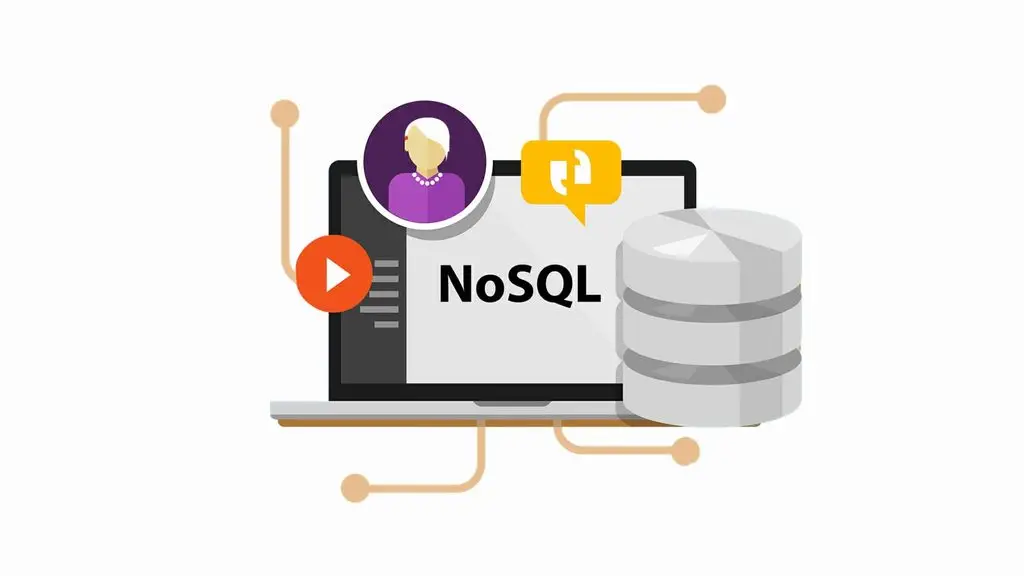
NoSQL is a group of databases that do not rely entirely on the traditional relational model. MongoDB, Cassandra, and HBase are some common examples.
NoSQL is generally suited to data with a flexible structure, systems that need to scale horizontally, or requirements for storing and retrieving data at scale. However, choosing between NoSQL and a relational database still depends on the characteristics of the data and the specific use requirements.
Apache Kafka
Apache Kafka is an event-driven data processing and streaming platform used to ingest, store, and distribute event streams across multiple systems. Kafka can process data as events occur and supports building systems that need to exchange data continuously.
For example, a transaction occurring in an application can be received by Kafka and routed to various systems such as fraud detection, data analytics, or the data warehouse.

Data Lake and Cloud infrastructure
A Data Lake allows businesses to store data in many formats within a flexible architecture, including raw data. A Data Lake can be deployed on on-premise or Cloud infrastructure, depending on the needs of the business.
When using the Cloud, businesses can flexibly scale storage resources and computing capacity on demand. This model suits systems with rapidly changing data volumes that need scalability without investing in all the physical infrastructure upfront.
>>> See more:
- How is AI applied in software development?
- How does AI-assisted programming affect coding skills?
- Will AI replace web development? How to adapt effectively
AI and Machine Learning
AI and Machine Learning help businesses extract value from data through predictive models, customer segmentation, anomaly detection, or processing text, images, and audio.
Big Data and AI have a mutually complementary relationship: large-scale data can provide diverse data sources for training and running AI models, while AI and Machine Learning help businesses identify patterns, trends, or information that are difficult to uncover using traditional analytical methods.
>>> See more:
- What is CSP? A complete overview of Content Security Policy from A to Z
- What is HSTS? How the HSTS security mechanism works
How is Big Data different from Data, Data Mining, and Data Analytics?
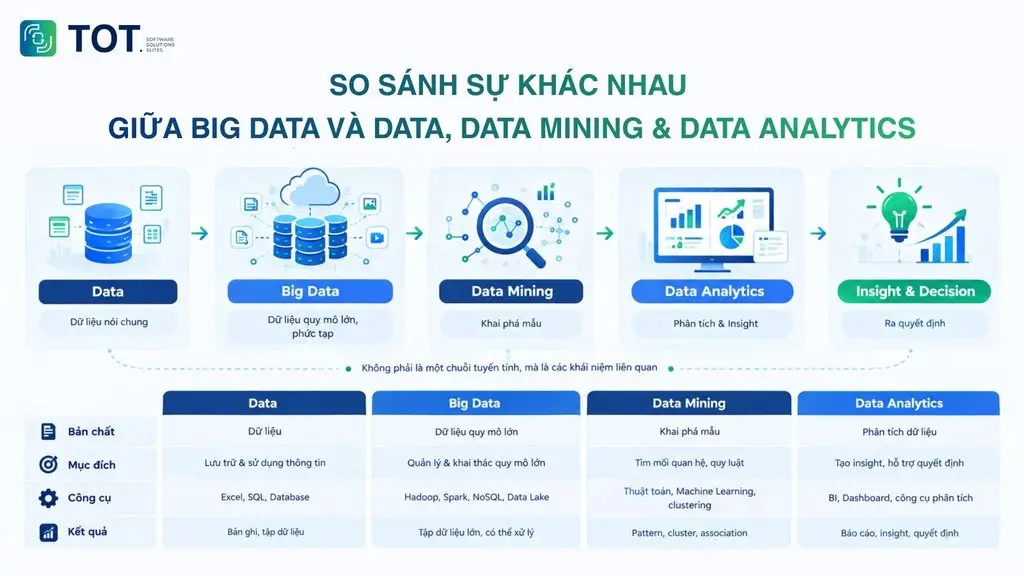
To better distinguish between Big Data, Data, Data Mining, and Data Analytics, the role of each concept can be summarized as follows:
- Data: Data in general, which can exist in many forms and scales.
- Big Data: Datasets with large scale, speed, diversity, or complexity that traditional management and processing methods struggle to handle effectively.
- Data Mining: A data mining technique focused on finding patterns, relationships, or rules within data.
- Data Analytics: The process of analyzing data to find insights, answer questions, and support decision-making.
To see the differences in nature, purpose, and use more clearly, below is a comparison table of Data, Big Data, Data Mining, and Data Analytics:
| Criteria | Data | Big Data | Data Mining | Data Analytics |
| Nature | Data in general | Data with large scale, speed, or complexity | A data mining technique | A data analysis process |
| Purpose | Serves as a basis for storing, processing, and using information | Managing and leveraging data at scale | Finding patterns, relationships, and rules | Finding insights and supporting decision-making |
| Common tools | Excel, SQL, Database | Hadoop, Spark, NoSQL, Data Lake | Statistical algorithms, Machine Learning, clustering | BI, dashboards, analytics tools |
| Results | Records, datasets | Large-scale datasets that can be processed and analyzed | Patterns, clusters, associations | Reports, insights, a basis for supporting decisions |
How are Big Data and Data different?
Data can be a spreadsheet of a few hundred rows, a transaction, a text file, or information that is collected and stored for use. Big Data is still data, but with a scale, speed, diversity, or complexity that makes conventional management and processing methods struggle to keep up effectively.
In other words, all Big Data is data, but not all data is Big Data.
How are Big Data and Data Mining different?
Big Data describes the characteristics and scale of data, while Data Mining is a technique for mining data to find meaningful patterns, relationships, or rules.
For example, a business can store billions of transactions in a Big Data system and then apply Data Mining to discover which products are frequently bought together. However, Data Mining can also be performed on smaller datasets and does not necessarily require Big Data.
How are Big Data and Data Analytics different?
Data Analytics is the process of analyzing data to find trends, relationships, or insights that answer questions and support decision-making. This activity can be carried out on a small dataset or on a Big Data processing system.
Simply put, Big Data concerns the scale, characteristics, and management of data, while Data Analytics focuses on extracting information from data. Data Analytics can use many different methods, among which Data Mining is one technique that can be applied to search for patterns in data.
>>> See more:
- What is SaaS? Pros and cons of the Software as a Service model
- Agentic AI – what is it? How it works & real-world applications
- Image analysis with AI: How it works & real-world applications
Challenges in deploying Big Data
Alongside its benefits for analysis and operational optimization, Big Data also presents a number of challenges in terms of cost, data quality, security, talent, and integration.
| Challenge | Cause | General solution |
| Infrastructure and storage costs | Rapidly growing data | Data tiering, Cloud |
| Data quality | Missing, duplicate, inconsistent data | Validation, cleaning, and normalization |
| Security and privacy | Large amounts of sensitive data | Authorization, encryption, access control |
| Talent shortage | Lack of data expertise | Training, recruitment, expert partnerships |
| Data integration | Data spread across many systems | APIs, data pipelines, data normalization |
Infrastructure and storage costs
The larger the volume of data, the higher the storage and processing requirements, which in turn drives up infrastructure costs. Businesses should classify their data, establish lifecycle policies, and choose Cloud or on-premise options that fit their needs.
Data quality
Missing, duplicate, or inconsistent data can affect reports and analysis results. Businesses need to build processes for validating, cleaning, and normalizing data rather than only addressing errors as they arise.
Security and privacy
Big Data can contain personal information, transactions, and internal data. Businesses need to control access, encrypt data, and clearly define which data may be collected, stored, and used.
Talent shortage
Building and operating a Big Data system may require expertise such as Data Engineers, Data Analysts, or Data Scientists. Businesses can develop their in-house team step by step and partner with technology providers when needed.
Integrating data from multiple sources
CRM, ERP, websites, mobile apps, and sales systems may use different data structures. Businesses therefore need processes to integrate and normalize data before deploying large-scale analytics.
>>> See more:
- Top 5 best code editors for computer vision
- AI Data Labeling: A guide to AI data labeling
- AI Agents for Startups: Benefits & real-world applications
Future Big Data trends
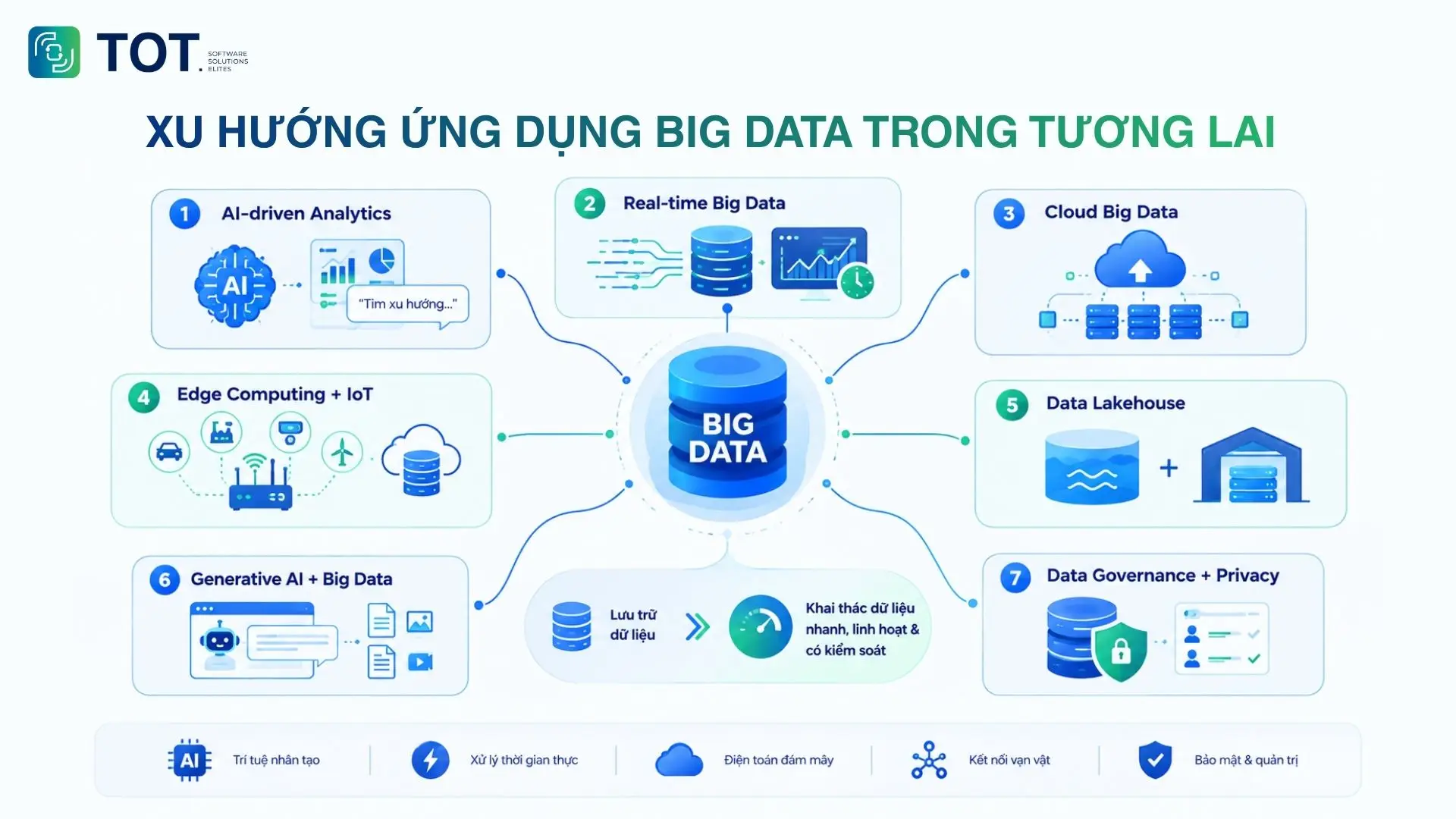
Big Data is shifting from a focus on storing large volumes of data toward the ability to leverage data quickly, flexibly, and in a controlled way. Some notable trends include:
AI-driven Analytics
AI is increasingly integrated into data analysis, allowing users to ask questions in natural language, generate queries, or explore trends without directly interacting with the data system. However, AI-generated results still need to be checked for accuracy and data sources.
Real-time Big Data
Transaction systems, IoT, fraud detection, and personalization have an increasing need for near-real-time data processing. Instead of waiting to aggregate data in batches, businesses can process events as they occur to respond more quickly.
Cloud Big Data
The Cloud continues to be widely used in Big Data architectures thanks to its flexible scalability in storage and computing capacity. Businesses can adjust resources on demand rather than investing in all the infrastructure upfront.
Edge Computing and IoT
As more and more IoT devices generate data at the point of use, Edge Computing enables part of the data to be processed close to its source. This approach can help reduce latency and the amount of data that must be transmitted to the central system, making it suitable for factories, vehicles, and systems that require fast responses.
>>> You may also be interested in: What is Edge AI? Advantages, how it works & real-world applications
Data Lakehouse
The Data Lakehouse aims to combine the flexible storage of a Data Lake with the governance and analytics features typically found in a Data Warehouse. This architecture helps businesses reduce data fragmentation and simplify large-scale data use.
Generative AI and Big Data
Generative AI opens up new ways to leverage unstructured data such as documents, emails, and text content. Businesses can build question-answering systems over internal data, summarize documents, or search for information using natural language. When AI accesses enterprise data, access rights, data sources, and security still need to be tightly controlled.
>>> See more: AI in UI/UX design: The power of Generative AI
Data Governance and Privacy
As data is increasingly used together with AI, Data Governance becomes an important part of data management. Businesses need to define data provenance, ownership, access rights, intended use, and retention periods to ensure that data is leveraged for the right purposes and kept secure.
>>> See more:
- What is Deep Learning? An overview of how it works and real-world applications
- What is Vertex AI? Google Cloud’s machine learning platform
What do businesses need to deploy Big Data effectively?
Deploying Big Data should not start with the question “which technology should we use?” but rather “what problem does the business need to solve?” From that objective, the business can determine the appropriate data, architecture, and technology.
1. Define business objectives
Businesses need to clearly define the problem they want to solve, such as reducing customer churn, optimizing inventory, detecting fraud, or forecasting demand.
2. Identify data sources and types
Next, businesses need to identify the available data sources, the type of data, and the quality and completeness of each source. This provides the basis for assessing which data can be used for the defined problem.
3. Build the data architecture
Based on scale and needs, businesses choose appropriate ways to store, connect, and manage data. Components may include a Data Lake, Data Warehouse, Cloud, and data pipeline.
4. Build the processing and analytics system
Technology should be chosen according to the actual requirements of each problem. Not every business needs Hadoop, Spark, Kafka, or Machine Learning from the very beginning.
5. Establish data governance and security
Businesses need to define access rights, data standards, storage policies, security, and the responsibilities of the relevant departments. These elements should be built in parallel with the system rather than addressed after deployment.
A practical approach is to start with a use case that has clear value, measure the results, and then expand step by step. TOT can accompany businesses throughout the process of building their technology systems, from data integration and custom software development to applying AI in operations.
>>> Read more:
- What is Kling AI? A guide to creating videos and images from text for free
- TOP 15 free AI meeting note-taking tools for 2026
- Custom software development in Hanoi – Professional, great value
- Get custom software development in Ho Chi Minh City – great value and professional
Conclusion
From the analysis above, it is clear that what Big Data is lies not only in the scale of data but also in how businesses collect, process, and leverage data to create value. To deploy it effectively, businesses need to start from a specific problem, choose the right architecture and technology, and pay close attention to data quality and security. When data is turned into insights and supports decisions, Big Data can become an important foundation for business operations.
Frequently asked questions
What is Big Data? What does Big Data (large-scale data) mean?
Big Data refers to datasets whose scale, speed, diversity, or complexity makes traditional storage and processing methods struggle to keep up effectively. Big Data can include structured transaction data, JSON and certain semi-structured logs, as well as unstructured images, video, audio, and text. The concept is not only about storage capacity but also about the ability to collect, store, process, and leverage data at scale.
Why is Big Data important?
Big Data helps businesses leverage data from customers, transactions, operational systems, and devices to support experience personalization, demand forecasting, operational optimization, fraud detection, and decision-making. Big Data also plays an important role in AI and Machine Learning, where suitable data is used to train, evaluate, and run models. However, more data does not mean better results if the data lacks quality or does not fit the problem.
What is Variety in Big Data?
Variety is one of the characteristics of Big Data, referring to the diversity of data types and sources. Data can be Structured Data such as transaction tables; Semi-structured Data such as JSON, XML, and certain logs; or Unstructured Data such as images, video, audio, emails, and social media content. Variety requires a Big Data system capable of ingesting, storing, and processing many different data types. Businesses can use a Data Lake and appropriate data processing tools to integrate and leverage these data sources.
What field is Big Data?
Big Data is not a single profession but an interdisciplinary field that combines information technology, data science, and data management to collect, store, process, and analyze data at scale. Positions commonly associated with this field include Data Engineer, Data Analyst, Data Scientist, and Data Architect. Each role carries a different responsibility, from building data systems and analyzing information to developing models and designing data architecture.
What are the three main elements of Big Data?
The three original elements commonly used to describe Big Data are Volume, Velocity, and Variety, referring to the volume, speed, and diversity of data, respectively. The 3V model was introduced by Doug Laney in the 2001 research paper 3-D Data Management: Controlling Data Volume, Velocity and Variety. Later, many sources expanded this model with elements such as Veracity and Value. The 5V model is therefore a common approach to describing Big Data, in which Volume, Velocity, and Variety are the three foundational attributes.