Unlike AI systems that mainly generate content or respond to user prompts, Agentic AI can proactively use data, tools, and software to plan, work through sequences of tasks, and take action. This capability is expanding AI’s role from a supporting tool into a component that participates directly in business operations. Join TOT to explore what Agentic AI is, its real-world applications, its benefits and challenges, and the adoption trends shaping 2026.
>>> See also:
- Top 15 best AI coding tools of 2026
- Top 50+ most popular free AI tools in 2026
- Top 20+ leading AI design tools for designers today
- How to build an app with AI: free, detailed, and simple
What is Agentic AI?
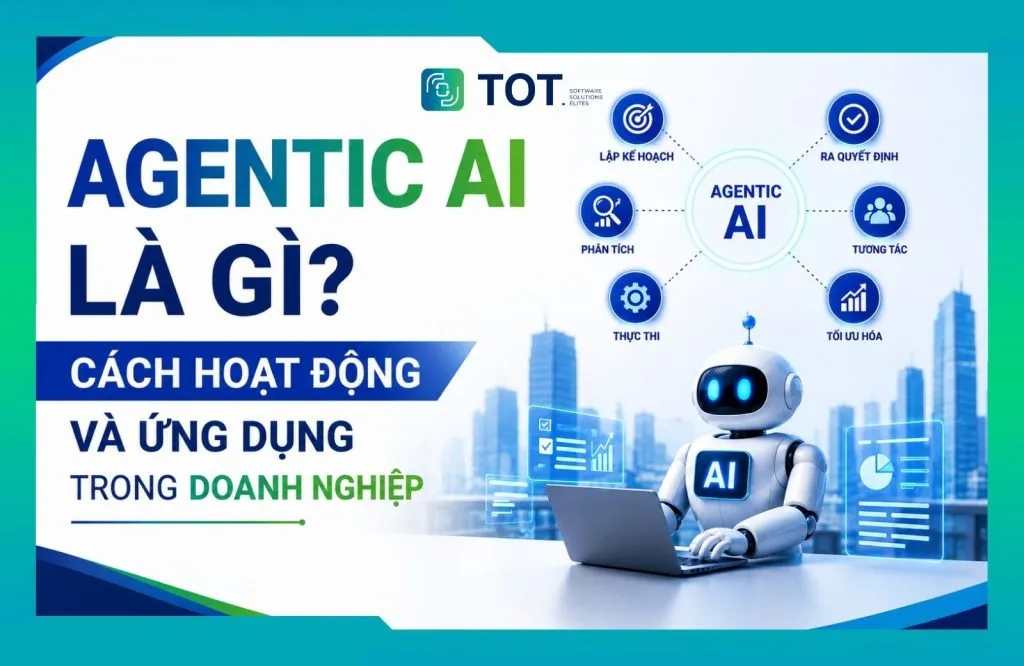
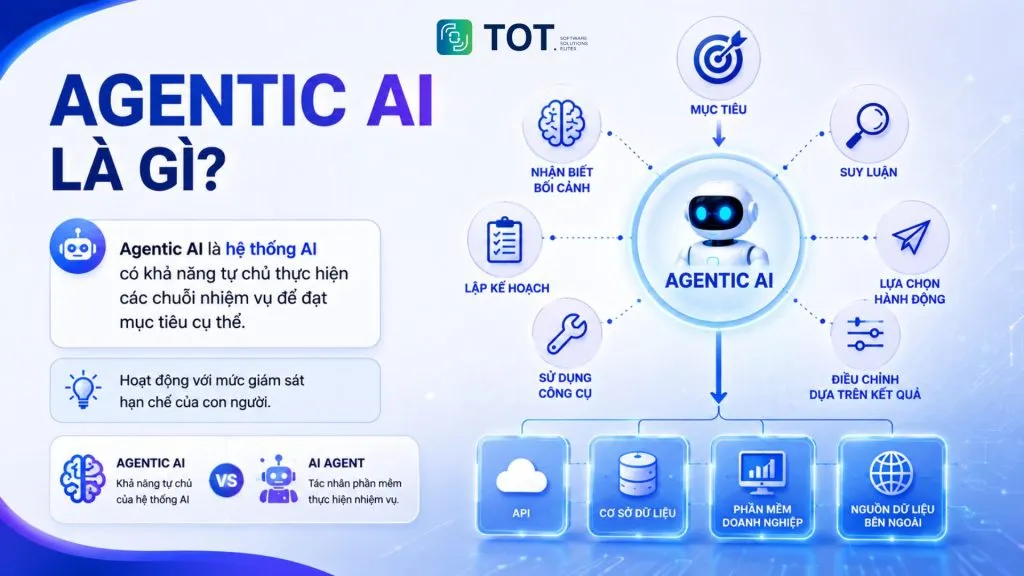
Agentic AI is an artificial intelligence system capable of autonomously carrying out sequences of tasks toward a specific goal, rather than simply responding to isolated requests. Its “agentic” nature lies in the ability to perceive context, reason, plan, choose actions, use tools, and adjust its approach based on the results it receives. According to IBM, Agentic AI can operate with limited human oversight to accomplish the goals it is given.
An Agentic AI system typically combines several components, such as an LLM (large language model), memory, planning mechanisms, tool-use capabilities, and specialized AI Agents. As a result, the system not only understands requests but can also connect to APIs, databases, enterprise software, or external data sources to take action. For example, instead of merely flagging that an order is at risk of late delivery, Agentic AI can check inventory, evaluate shipping options, choose the best one, and update the fulfillment process if it has been granted permission.
It is important to distinguish between Agentic AI and an AI Agent. Agentic AI usually describes the capabilities, behavior, or architecture of an AI system oriented toward autonomy, whereas an AI Agent is a specific software agent designed to perform a task. An Agentic AI system may include one or more AI Agents working together to reach a shared goal. Agentic AI is therefore not simply a standalone AI model, but a way of combining reasoning, planning, tool use, and execution to solve complex tasks.
>>> Learn more:
- How businesses build AI Agents
- How to build AI apps with vibe coding on Google AI Studio, made simple
How Agentic AI Works
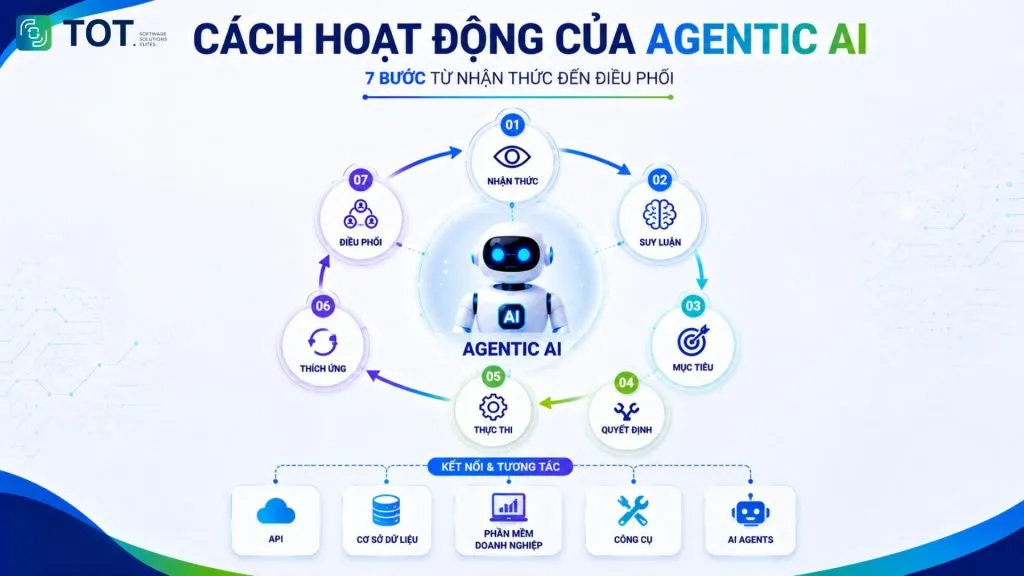
The way Agentic AI works can be described as a loop of seven stages, from taking in data all the way to coordinating multiple agents to accomplish a shared goal.
1. Perception
Perception is the step where Agentic AI gathers and consolidates data to understand the current state of its environment. The system can take in information from many sources, such as user requests, APIs, databases, sensors, enterprise software, or external data sources. Depending on the use case, this data may include text, images, audio, transaction records, or signals from IoT devices.
Once collected, the system processes and organizes the data into context to use in the following steps. In supply chain management, for example, Agentic AI can simultaneously ingest data on inventory, demand, orders, delivery times, and supplier status. Correctly understanding the current state gives the system enough information to make sound decisions, rather than reacting to a single data source alone.
>>> See more:
- Top 8 effective location-based warehouse management software for 2026
- Top 10 car showroom management software for businesses
2. Reasoning
Reasoning is the step where Agentic AI analyzes the data, understands the context, and identifies the problem to be solved. The system can draw on large language models (LLMs), natural language processing (NLP), computer vision, and other AI capabilities to interpret the information it receives.
At this step, Agentic AI not only determines what the user is asking for but also considers the underlying intent, conditions, and relevant constraints. For complex tasks, the system can break the problem into smaller subtasks to work out what needs to be handled and what information is still missing.
For instance, when a business asks it to handle an order at risk of late delivery, the system can pinpoint the cause, check inventory levels, evaluate shipping options, and determine what additional data it needs before acting.
>>> See more:
- Top 9 LLM monitoring tools to boost brand visibility
- Free computer vision software: easy-to-use platforms
3. Goal Setting
Goal setting is the step where Agentic AI defines the outcome to achieve based on the user’s request or a predefined objective. Once it understands the problem, the system identifies the overall goal and can break it down into smaller goals that are easier to execute.
From that goal, Agentic AI builds an approach by determining the steps to take, their priority order, the tools to use, and the criteria for evaluating results. For example, with the goal of maintaining appropriate inventory levels, the system might define tasks such as checking current stock, forecasting demand, identifying products at risk of running out, and selecting a replenishment option.
The goal acts as a guiding thread throughout the entire process. In practice, however, businesses still need to define the scope, rules, and limits on actions in advance to ensure the system optimizes toward the right business objectives.
4. Decision-Making
Decision-making is the step where Agentic AI evaluates the options available and selects the action best suited to the goal. The system can weigh the current data, constraints, resources, and expected outcome of each option before making a choice.
For example, when it detects a shipment at risk of late delivery, the system can consider several options, such as changing the carrier, switching to a different route, transferring goods from another warehouse, or notifying the customer. Agentic AI selects an option based on predefined criteria, such as delivery time, cost, and the order’s priority level.
This step clearly demonstrates the proactive capability of Agentic AI. Rather than responding according to a fixed script, the system can choose different ways of handling a situation depending on the data and the real-world circumstances.
>>> See more: How to integrate a chatbot into your website for free and sell more effectively
5. Execution
Execution is the step where Agentic AI turns decisions into actions through external tools and systems. The system can interact with APIs, databases, enterprise software, online platforms, robots, or any tools it has been authorized to use.
For example, after identifying a product that needs restocking, Agentic AI can look up supplier information, create a purchase request in the ERP system, and send a notification to the responsible team. In this way, the system does not stop at recommending an action but can directly carry out the next steps within its permitted scope.
The ability to execute is a key difference between Agentic AI and AI systems that only generate responses. However, because an agent’s actions can have real-world impact, businesses need to set up appropriate access permissions, tool limits, and approval mechanisms for high-risk tasks.
6. Learning and Adaptation
Learning and adaptation is the step where Agentic AI evaluates the results after taking an action and adjusts its approach when needed. The system can compare actual results against the original goal, take in feedback from data or people, and use that information to choose its next step.
For example, if the chosen shipping option fails to meet the expected delivery time, the system can assess the cause, gather more data, and select an alternative. When a similar situation arises, information from earlier processing can be used to support the decision.
It is worth noting that “learning” in Agentic AI does not necessarily mean the AI model automatically changes its weights after every task. Adaptability can come from updating context, memory, feedback, new data, or adjusting the plan within a workflow. This allows the system to respond more flexibly as its environment and requirements change.
7. Orchestration
Orchestration is the step where Agentic AI coordinates multiple AI Agents, workflows, tools, and data sources to accomplish a shared goal together. For simple tasks, a single agent can handle the entire process. But for complex processes, multiple specialized agents can be assigned different tasks.
In supply chain management, for example, one agent might handle demand forecasting, another might track supplier status, another might optimize shipping, and another might coordinate the entire process. The orchestration layer helps assign tasks, manage the order of execution, pass information between agents, and track results.
This is where the common workflows for AI agents come into play, keeping the chain of tasks consistent and controllable. Good orchestration is what allows a multi-agent model to run reliably at enterprise scale.
>>> Learn more:
- How to apply AI to optimize customer experience
- What is website optimization with AI? How to optimize SEO and the AI tools to use
Real-World Business Applications of Agentic AI
Agentic AI is applied across many fields where businesses need continuous monitoring, data analysis, and fast decision-making. What these fields have in common is an autonomy that links ingesting data, analyzing it, deciding, and taking action into a single chain, rather than stopping at a suggestion.
In Finance
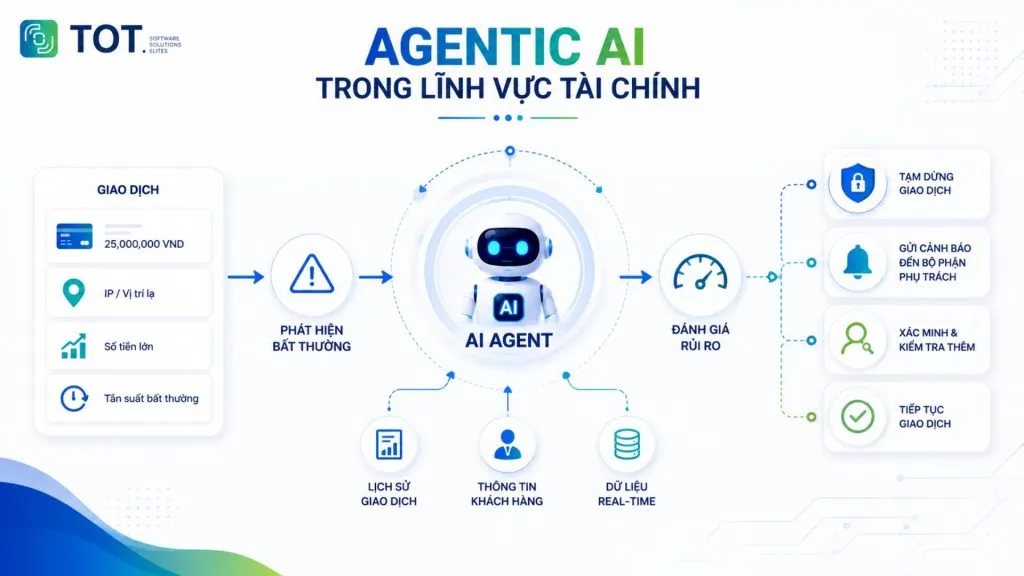
In finance, Agentic AI can automatically monitor transactions, assess risk, and take remediation actions according to predefined rules. The system can ingest transaction data in real time, analyze behavior, and identify transactions that show signs of anomalies. When it detects a risk, the agent can go on to check related information, evaluate the severity, and trigger the appropriate handling step.
For example, with a suspicious transaction, Agentic AI can review transaction history, cross-check customer information, assess the risk level, and, within its granted permissions, pause the transaction or escalate an alert to the responsible team. Beyond fraud detection, this technology can also support transaction reconciliation, handle customer requests, and automate certain financial processes.
In Autonomous Vehicles
In the field of autonomous vehicles, Agentic AI helps a vehicle perceive its environment, make decisions, and act to travel safely. The system can ingest data from cameras, radar, LiDAR, maps, and other sensors to determine its location, obstacles, surrounding vehicles, and road conditions. From that data, the AI analyzes the situation, chooses how to respond, and then controls the vehicle.
For example, when it detects an unexpected obstacle on the road, the system can recognize the obstacle, assess distance and speed, choose to brake or steer, and then carry out the corresponding action. This loop runs continuously so the vehicle can adapt to a changing environment. A similar approach is also used in autonomous warehouse robots, where agents can coordinate to choose routes, transport goods, and avoid collisions.
>>> See also: What is Edge AI? Benefits, how it works & real-world applications
In Healthcare
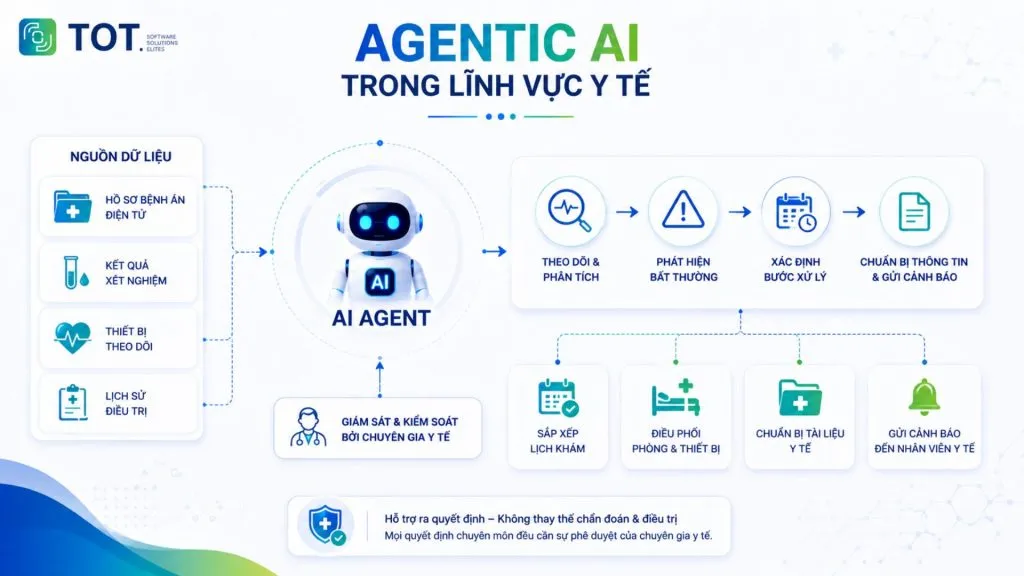
In healthcare, Agentic AI can help monitor data, coordinate workflows, and perform care tasks under the supervision of professionals. The system can consolidate information from electronic medical records, test results, treatment history, or monitoring devices to detect changes that need attention. The agent can then determine the next step, such as sending an alert, scheduling an appointment, or preparing information for medical staff.
For example, a patient management support system can monitor health data, detect abnormal indicators, check follow-up appointment schedules, and send alerts to medical staff when needed. Agentic AI can also support administrative tasks such as scheduling appointments, coordinating rooms, and preparing documents. However, for decisions directly related to diagnosis or treatment, Agentic AI should be deployed as a supporting tool and requires oversight from medical professionals.
In Cybersecurity
In cybersecurity, Agentic AI can proactively detect, analyze, and respond to threats rather than simply sending alerts to the security team. The system continuously collects data from servers, network devices, applications, and security tools to detect abnormal behavior. When it identifies a risk, the agent can analyze the cause, assess the impact, and choose a response measure.
For example, when it detects a device showing signs of compromise, Agentic AI can inspect activity logs, identify suspicious connections, isolate the device, and trigger an incident investigation process within its granted permissions. With a multi-agent model, specialized agents can take on different tasks such as monitoring, threat analysis, and incident response. This allows businesses to shorten the time from detection to resolution and reduce the manual workload for the security team.
>>> See more:
- 35 best website security and malware scanning tools
- What is Low Code? A software development approach and future trends
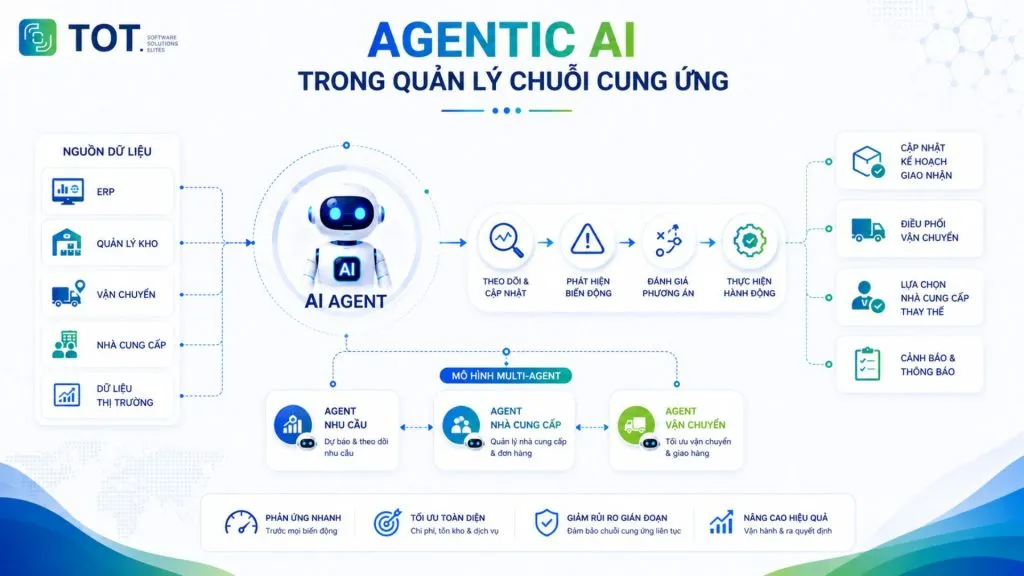
In Supply Chain Management
In supply chain management, Agentic AI can automatically track demand, inventory, suppliers, and shipping to make and carry out appropriate decisions. The system can connect data from ERP, warehouse management software, shipping systems, and supplier information to continuously update the state of the supply chain. When it detects a change or a risk of disruption, the agent can evaluate the options and take action within its granted permissions.
For example, when a supplier reports a delayed delivery, Agentic AI can check inventory levels, forecast the impact on orders, find alternative supply options, and update the delivery plan. In a multi-agent model, one agent can track demand, another can manage suppliers, and another can optimize shipping. Thanks to its ability to coordinate multiple systems and handle sequences of tasks, Agentic AI can help businesses respond more quickly to supply chain fluctuations.
Benefits and Challenges of Deploying Agentic AI
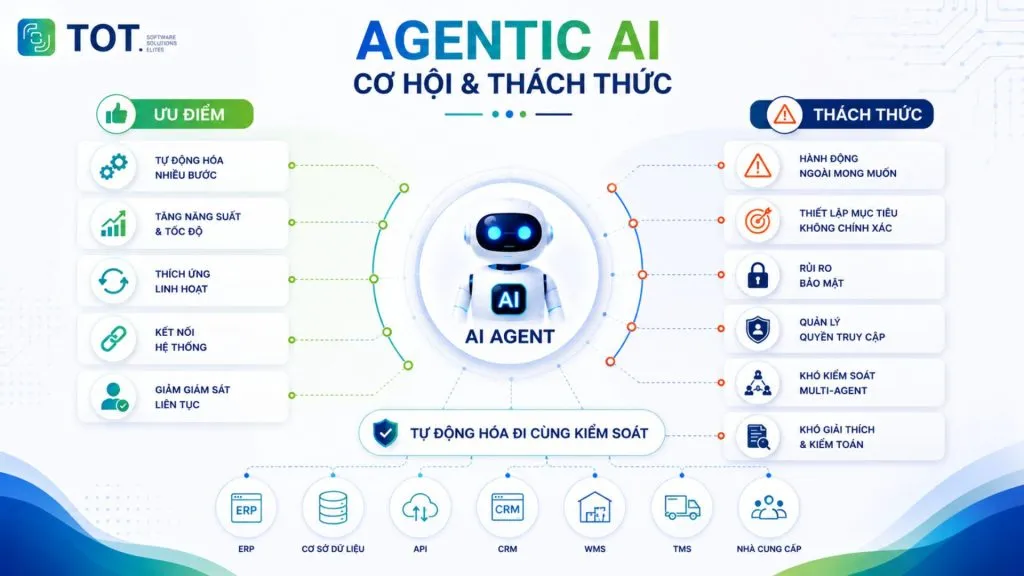
Agentic AI delivers significant value in automation and productivity, but it also raises challenges around control and security that businesses need to weigh before deployment.
Benefits of Deploying Agentic AI
The greatest advantage of Agentic AI is its ability to automatically handle a sequence of tasks rather than performing individual tasks one at a time. When connected to the necessary data, software, and tools, the system can proactively analyze a situation, choose an action, and continue processing without human guidance at every step.
Some standout benefits include:
- Automating multi-step processes: Agentic AI can handle workflows with many stages, conditions, and decisions instead of performing a single task.
- Reducing the need for constant oversight: People can focus on the cases that require judgment or approval, while the agent handles tasks within its granted permissions.
- Increasing productivity and processing speed: AI can operate continuously, process large volumes of data, and respond quickly to changes during operations.
- Adapting to new situations: The ability to evaluate results and adjust plans makes the system more flexible when data or real-world conditions change.
- Connecting multiple systems: Agentic AI can interact with APIs, ERP, CRM, databases, and other tools to form an end-to-end processing workflow.
>>> See more:
- 15 ways to apply AI in online sales to boost revenue
- 18 ways to apply AI for ecommerce with high impact
Challenges of Deploying Agentic AI
The biggest challenge of Agentic AI lies in the system’s ability to make its own decisions and take actions, which means a single error can create real-world impact. Businesses therefore need to focus not only on the accuracy of the AI but also on controlling how the agent is allowed to operate.
The challenges of deploying Agentic AI include:
- Unintended actions: An agent may misunderstand a request or context, or choose an action that does not match the business’s intent.
- Inaccurate goal setting: If the goal or optimization criteria are unclear, the system may reach the goal in a way that does not serve the business’s real interests.
- Security risks: An agent connected to many systems can become a new access point for attacks or expose sensitive data.
- Access management: Businesses need to clearly define which actions an agent is allowed to read, change, or perform on each system.
- Difficulty controlling multi-agent systems: When many agents work together, an error from one agent can affect the following steps and make tracing the root cause more complex.
- Difficulty explaining and auditing: An automated chain of decisions can make it hard for businesses to determine exactly why an action was taken.
>>> Learn more:
- How is AI applied in software development?
- Will AI replace web development? How to adapt effectively
- How does AI-assisted programming affect coding skills?
Agentic AI Adoption Trends in 2026
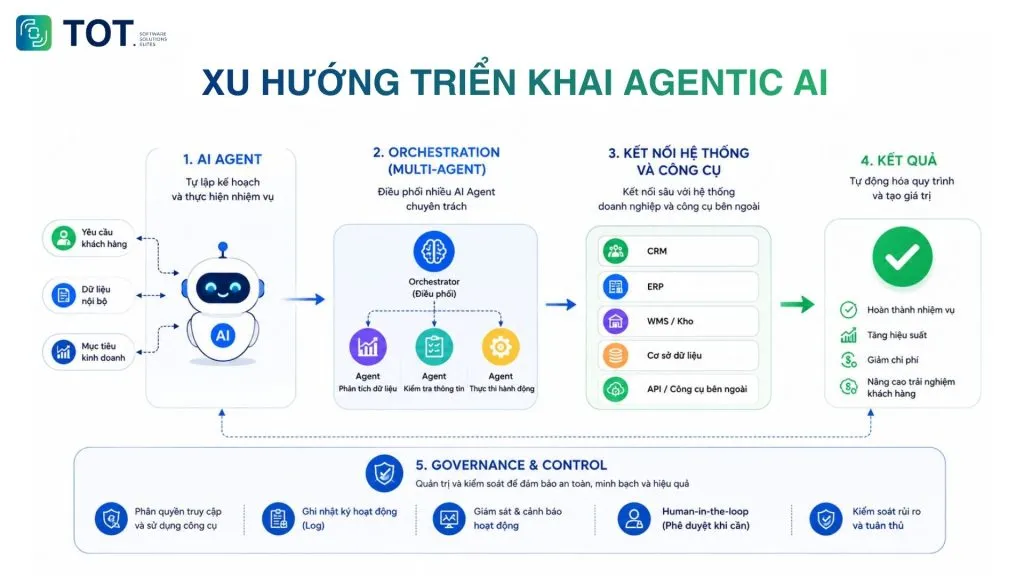
In 2026, Agentic AI is moving from the experimental stage into deployment within real business processes. Instead of using AI only to generate content or answer questions, businesses are beginning to build systems capable of planning on their own, using tools, and taking action to accomplish goals. Some notable trends include:
AI Agents Integrated into Business Workflows
Businesses are focusing on bringing AI Agents into specific workflows rather than using them as standalone tools. An agent can be connected to a CRM, ERP, warehouse management software, customer service system, or internal database to handle a sequence of tasks.
For example, instead of just answering a customer’s request, an agent can receive the request, check order information, identify the issue, perform operations in the system, and send the result to the customer. This approach helps Agentic AI create direct value in operations rather than only supporting content generation.
Multi-agent and AI Orchestration
As automation needs grow more complex, businesses tend to use multiple specialized AI Agents along with an orchestration layer to coordinate them. Each agent can take on a task such as analyzing data, checking information, planning, or executing an action.
The orchestration layer helps assign tasks, manage the order of processing, exchange data between agents, and track results. This model is especially well suited to processes that involve many stages and require multiple systems to participate.
>>> See more:
- What is open source? Top 15 best open-source platforms
- AI data labeling: trends, tools, and workflows
Agentic AI Connecting Deeply with Enterprise Systems and Tools
The ability to take action is becoming a critical factor in deploying Agentic AI. Instead of only reasoning and offering suggestions, agents are increasingly connected to APIs, databases, enterprise software, and external tools to carry out tasks directly.
This is driving demand for systems that can connect data and tools flexibly. Communication standards for AI Agents are also being developed to link agents with tools and to allow agents from different systems to work together.
Governance and Control of Agentic AI
As AI is given more autonomy, governance and control become an important part of deployment. Businesses need to clearly define which data an agent is allowed to access, which tools it can use, and which actions it can perform.
Mechanisms such as access control, logging, activity monitoring, and human-in-the-loop will help businesses control high-risk decisions. Rather than granting an agent full authority from the outset, the 2026 deployment trend is to start with workflows that have a clear scope, measure their effectiveness, and expand gradually once the system is stable enough.
>>> See more:
- Inference In Computer Vision: What is inference in computer vision?
- What are Vision AI Agents? How to build Vision AI Agents with Roboflow
Conclusion
Understanding what Agentic AI is helps businesses recognize how this technology is shifting AI from generating responses toward proactively reasoning, making decisions, and taking action to reach a goal. With its ability to connect data, tools, and multiple AI Agents, Agentic AI opens up many opportunities to automate complex business processes. That said, its autonomy also sets a high bar for security, access control, and oversight during deployment. Join TOT to explore and choose the right way to apply Agentic AI to your operational needs and digital transformation goals.
>>> See more:
- What is AI image recognition? Algorithms & applications
- Image analysis with AI: how it works & real-world applications
- Top 20 best chatbot software, free and popular today
- 29 standout AI website templates for SaaS, E-commerce, and beyond
Frequently Asked Questions About Agentic AI
How is Agentic AI different from an AI Agent?
Agentic AI describes the autonomous operating capability of an AI system, while an AI Agent is the specific agent that performs tasks within that system. Agentic AI focuses on how the system perceives, reasons, plans, and acts to reach a goal. An AI Agent, on the other hand, is a software component that can be designed to perform a specific task. An Agentic AI system may use just one agent or combine several AI Agents to accomplish a shared goal.
What is the difference between Agentic AI and Generative AI?
Generative AI mainly produces content based on an input prompt, whereas Agentic AI can use AI to plan and carry out a sequence of actions toward a goal. Generative AI can create text, images, source code, or other types of content, but it usually stops at the generated result. Agentic AI can leverage an LLM or Generative AI to reason, then use APIs, software, and external tools to continue carrying out the task.
How does Agentic AI work?
Agentic AI works through a seven-step loop: perception, reasoning, goal setting, decision-making, execution, learning & adaptation, and orchestration. The system first collects data to understand the situation, then analyzes it, defines the goal, and chooses an action. After execution, the system evaluates the results and adjusts its approach if needed. For complex tasks, multiple AI Agents can be orchestrated to accomplish the goal together.
How do you integrate an AI Agent into existing software?
Businesses should start by identifying a suitable workflow, then prepare the data, access permissions, and connections the AI Agent needs. The basic steps include defining the task, setting up an API or integration method, choosing a suitable framework, testing on a small scale, and deploying in a controlled way. Businesses should also establish monitoring, logging, and human approval points for high-risk actions.
TOT partners with businesses throughout their digital transformation journey, providing website design, mobile app, custom software, and artificial intelligence software solutions tailored to each business need.
Drawing on real-world consulting and implementation experience, TOT helps businesses build a digital transformation roadmap, apply AI, and automate processes to optimize operations and create a sustainable competitive advantage.
TOT contact information:
🌐 TOT Website
📞 Hotline/WhatsApp/Zalo: 0906 712 137
✉️ Email: long.bui@toponseek.com
🏢 Address: 31 Hoang Dieu Street, Xom Chieu Ward, Ho Chi Minh City, Vietnam