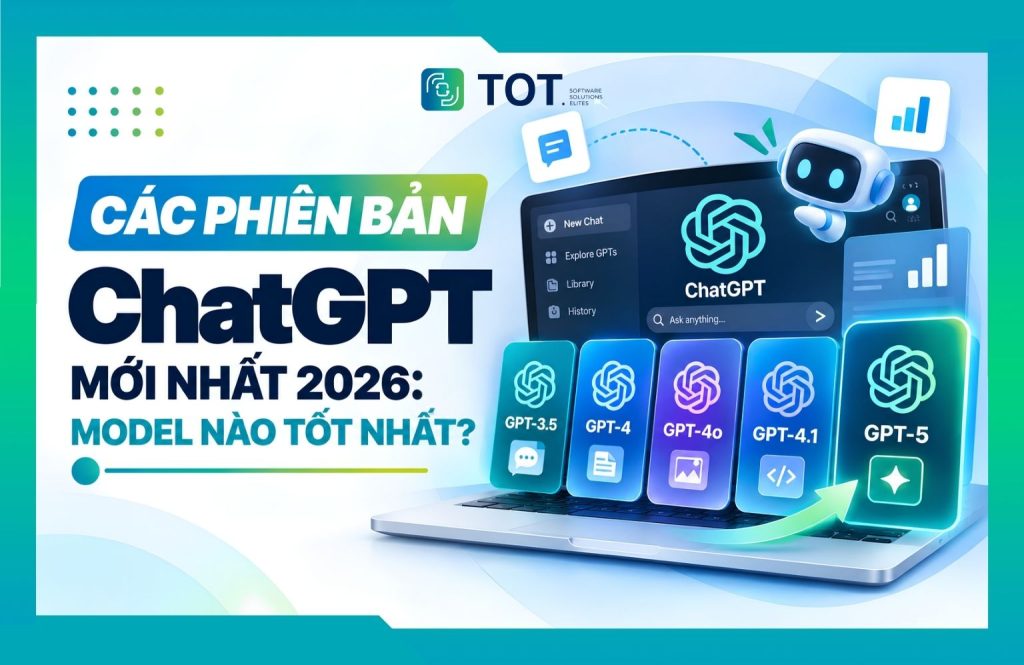
ChatGPT versions have evolved continuously from GPT-3.5 to newer model generations, bringing major improvements in reasoning, processing speed, multimodality, and support for professional work. Each model suits a different need, from everyday conversation, content writing, and programming to research and data analysis. In this article, TOT rounds up the development history, characteristics, capabilities, and subscription plans to help you understand the ChatGPT versions and choose the right model.
>>> See more articles:
- How does AI-assisted programming affect your coding skills?
- How to build apps with AI for free — detailed and simple
- TOP 18 AI architecture tools for architects
Quick summary
- ChatGPT is an AI assistant developed by OpenAI, launched publicly on November 30, 2022, and initially based on GPT-3.5.
- ChatGPT versions have progressed through many generations, from GPT-3.5, GPT-4, and GPT-4o, through the o-series and GPT-5.x, to the GPT-6 generation.
- GPT-6 Astra is currently positioned for complex tasks such as reasoning, programming, research, and professional work.
- GPT-6 Sol focuses on balancing capability and cost, making it a good fit for a wide range of professional workloads.
- GPT-6 Luna is geared toward speed and high-volume tasks, suitable when cost optimization is the priority.
- ChatGPT models differ in reasoning ability, speed, multimodality, context window, integrated tools, and task-handling capability.
- ChatGPT currently offers the main plans Free, Go, Plus, Pro, Business, and Enterprise, serving everything from individual to enterprise needs.
- There is no single best ChatGPT today for every situation; the right model depends on your goal, such as content writing, programming, research, data analysis, or professional work.
What is ChatGPT?
ChatGPT is a conversational AI assistant developed by OpenAI, designed to interact with users in natural language and perform many tasks such as answering questions, explaining concepts, writing content, programming, learning, and problem-solving. OpenAI introduced ChatGPT publicly on November 30, 2022 as a research preview.
The original model was fine-tuned from the GPT-3.5 line using Reinforcement Learning from Human Feedback (RLHF) to improve its ability to respond the way people want. Its conversational design allows ChatGPT to answer follow-up questions, acknowledge mistakes, and handle context within a conversation.
Since its launch, ChatGPT has grown from a GPT-3.5-based chatbot into an AI platform that supports many different task types and models. According to OpenAI, ChatGPT can now help users brainstorm, write and edit content, learn, plan, do math, program, and analyze images and files.
However, ChatGPT can still produce inaccurate or misleading information, so its output should be verified when used for important work. This continuous development has also created many different models and usage options, making it necessary to distinguish between the ChatGPT versions.
>>> See more:
- What is Kling AI? A guide to creating videos and images from text for free
- What is Kimi K3? Features, pricing, and a comparison with Claude & ChatGPT
- What is Hailuo AI? How to use Hailuo AI to create videos from text
History of ChatGPT versions
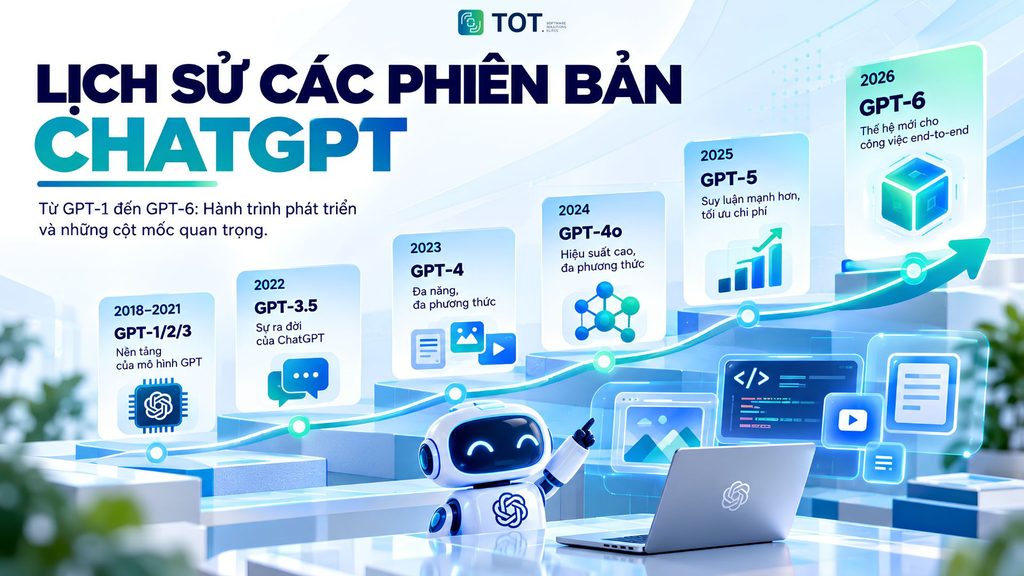
The history of ChatGPT versions is closely tied to the development of OpenAI’s GPT (Generative Pre-trained Transformer) model family. From GPT-1, GPT-2, and GPT-3, OpenAI progressively scaled up model size, language understanding, and task-handling ability. On November 30, 2022, ChatGPT was publicly introduced based on GPT-3.5, marking the shift from a language model aimed mainly at developers to a popular conversational AI product.
2018–2021: The foundation of the GPT model family
GPT-1 – Laying the groundwork for the GPT line
GPT-1 was the first generation in the Generative Pre-trained Transformer line, establishing the approach of pre-training a language model on large amounts of text data before fine-tuning it for individual tasks. This was the starting point for an approach that OpenAI continued to expand in later GPT generations.
GPT-2 – Scaling up the language model
GPT-2 significantly expanded both model scale and text-generation capability. OpenAI published the GPT-2 research in February 2019 and later released the largest version, with 1.5 billion parameters, in November 2019. The model was trained on 8 million web pages and showed the ability to generate coherent passages while performing many tasks such as question answering, summarization, and translation without task-specific training.
GPT-3 – A major leap in language processing
GPT-3 was introduced in research published in 2020 with 175 billion parameters, far larger than earlier models. GPT-3’s standout feature was few-shot learning: the model could perform a new task based on a few examples or instructions in the prompt without separate fine-tuning. GPT-3 became an important foundation for many AI language applications and was later made available through the OpenAI API.
2022: GPT-3.5 and the birth of ChatGPT
GPT-3.5 – The initial foundation of ChatGPT
On November 30, 2022, OpenAI announced ChatGPT as a research preview. The original ChatGPT version was built on the GPT-3.5 foundation and trained using Reinforcement Learning from Human Feedback (RLHF), which helped the model respond in a conversational format, handle follow-up questions, and carry out requests in natural language.
This launch brought GPT technology from an environment aimed mainly at developers to an AI product that everyday users could interact with directly. It is also a key milestone when answering the question “what year did ChatGPT launch”: ChatGPT was officially introduced in 2022.
2023: GPT-4 and the versatile ChatGPT generation
GPT-4 – A step forward in reasoning and multimodality
GPT-4 was introduced by OpenAI in March 2023, delivering a significant step forward in handling complex tasks compared with GPT-3.5. OpenAI stated that GPT-4 was developed with a strong focus on safety, the ability to follow instructions, and response quality.
GPT-4 became an important foundation for ChatGPT Plus and expanded ChatGPT’s use from everyday conversation to content writing, analysis, programming, and professional tasks.
GPT-4 Turbo – Longer context and greater efficiency
In November 2023, OpenAI introduced GPT-4 Turbo with a 128K-token context window, while improving performance and reducing cost compared with GPT-4. This was an important advance for tasks that need to process large amounts of text or long context.
2024: GPT-4o and the emergence of reasoning models
GPT-4o – A new-generation multimodal model
In May 2024, OpenAI introduced GPT-4o, where “o” stands for “omni.” The model was designed to process multiple data types and interact more naturally, with the ability to handle text, images, and voice. GPT-4o was also added to ChatGPT Free and Plus, making capabilities that were previously limited to paid accounts more widely available.
GPT-4o mini – A small, fast, and cost-efficient model
GPT-4o mini was introduced in July 2024, aimed at tasks that require high speed and lower cost. The model supported text and images in the API at launch, had a 128K-token context window, and was well-suited to applications that need to handle a large volume of requests quickly — for example, customer-support chatbots or systems that call the model many times. In ChatGPT, this model was added to Free, Plus, and Team, replacing GPT-3.5 at launch.
o1 – The start of the reasoning model line
2024 also marked the arrival of o1, a line of reasoning models designed to spend more time on the reasoning process before producing an answer. This was a different development direction from simply scaling up the language model, focusing more on logic, math, science, and programming problems.
2024–2025: The o-series reasoning line
o1 – Reasoning for complex tasks
o1 opened OpenAI’s reasoning-model development direction, particularly suited to requests that need many reasoning steps and verification before producing a result. This model expanded ChatGPT’s capabilities in math, science, and coding.
o1-mini – Efficient reasoning for STEM
o1-mini was introduced in September 2024 as a small, cost-optimized reasoning model, especially for STEM, math, and programming. OpenAI said o1-mini achieved performance close to o1 on some benchmarks but with more favorable speed and cost.
o1-pro – Enhanced reasoning ability
o1-pro is a mode that uses additional compute so the model can think longer about hard problems. OpenAI added o1-pro to ChatGPT Pro in December 2024, aiming at tasks that require greater reliability and depth.
o3 – Next-generation reasoning
o3 was introduced in April 2025, continuing to develop the reasoning line and designed for complex questions in coding, math, science, and image analysis. OpenAI said o3 can combine tools such as web search, Python, and file and image analysis during the problem-solving process.
o3-mini – Cost-optimized reasoning
o3-mini was released broadly on January 31, 2025, focusing on STEM reasoning with lower cost and latency than larger models. The model supports multiple reasoning-effort levels to balance speed and processing depth.
o3-pro – The o3 version with deeper reasoning
o3-pro was designed for more complex tasks, using additional compute to boost reasoning ability. This model was added to ChatGPT in June 2025.
o4-mini – Multimodal reasoning and tool use
o4-mini continued the trend of combining reasoning with image processing and tool use. OpenAI described it as a small, fast, and cost-efficient reasoning model, well-suited to math, coding, and image tasks.
2025: The GPT-4.x models and the transition to GPT-5
GPT-4.1 – Optimized for coding and instruction following
GPT-4.1 was developed with a focus on coding, instruction following, and long-context processing. Note, however, that OpenAI discontinued GPT-4.1 in ChatGPT as of February 13, 2026, although the model may still exist in the API under its own lifecycle policy.
GPT-4.1 mini – Balancing performance and cost
GPT-4.1 mini is a smaller version aimed at balancing performance, cost, and speed. The model suits applications that need to handle a large number of requests, or tasks that don’t necessarily require the largest model. This model was also discontinued on ChatGPT as of February 2026.
GPT-4.1 nano – A small model for high-speed tasks
GPT-4.1 nano targets workloads that need speed and cost efficiency. It is primarily an option within the API ecosystem rather than a standalone ChatGPT version.
GPT-4.5 – A transitional step before GPT-5
GPT-4.5 was announced on February 27, 2025, as a research preview. OpenAI described it as its large, powerful GPT model for chat at the time of launch, focusing on pattern recognition, knowledge, writing, programming, and natural interaction. GPT-4.5 was later replaced in its frontier-model role when GPT-5 arrived.
2025: GPT-5 and the unified model system
GPT-5 – A new GPT generation for ChatGPT
GPT-5 marked a change in how OpenAI designs ChatGPT. Instead of simply choosing between separate models, ChatGPT uses a system of reasoning, non-reasoning, and router models to select the processing approach best suited to the request. In the API, GPT-5 is offered alongside the GPT-5 mini and GPT-5 nano versions.
GPT-5 Pro – For in-depth reasoning tasks
GPT-5 Pro is a configuration/model for requests that need more compute. However, GPT-5 and GPT-5.1 were later retired from ChatGPT in 2026 as OpenAI moved on to newer generations.
GPT-5 mini and GPT-5 nano – Models optimized for speed and cost
GPT-5 mini and GPT-5 nano are smaller versions within the GPT-5 family, designed to balance capability with cost and latency. In the API, OpenAI positions mini for tasks that need good performance at lower cost, while nano suits simple, high-volume tasks.
2025–2026: The GPT-5.x upgrades
GPT-5.1 – Instant, Thinking, and Pro
GPT-5.1 was added to ChatGPT with the Instant, Thinking, and Pro configurations, where Instant prioritizes speed and the conversational experience, while Thinking and Pro are for tasks that need deeper reasoning. OpenAI discontinued all of GPT-5.1 Instant, Thinking, and Pro from ChatGPT on March 11, 2026.
GPT-5.2 – Instant, Thinking, and Pro
GPT-5.2 launched in December 2025, with a strong focus on professional work, coding, spreadsheet creation, presentations, image processing, long context, and multi-step tasks. The GPT-5.2 line includes modes such as Instant and Thinking, while the Pro configurations are aimed at needs that require higher compute.
GPT-5.3 Instant – Optimized for the conversational experience
GPT-5.3 Instant was released by OpenAI on March 3, 2026, focusing on the everyday conversational experience. The model improves its ability to synthesize information when using the web, writing, accuracy, and more natural responses.
GPT-5.4 – Thinking and Pro
GPT-5.4 was introduced by OpenAI with a focus on reasoning, coding, agentic workflows, and tool-use ability. In ChatGPT, GPT-5.4 Thinking is aimed at complex work such as research, programming, document analysis, and handling multi-step workflows.
GPT-5.4 mini and GPT-5.4 nano – Small models for large workloads
GPT-5.4 mini and nano were released in March 2026. GPT-5.4 mini targets coding, computer use, subagents, and high-volume workloads, while GPT-5.4 nano is optimized for simple, high-speed tasks such as classification, data extraction, and ranking. GPT-5.4 mini is available in ChatGPT, while nano is primarily for the API.
GPT-5.5 and GPT-5.5 Pro – Upgrades for professional work
GPT-5.5 was introduced on April 23, 2026, focusing on real-world work such as writing code, online research, data analysis, and creating documents and spreadsheets, while also being able to use tools to complete multi-step processes. GPT-5.5 Pro uses a higher parallel-compute configuration to serve complex tasks. In addition, OpenAI introduced GPT-5.5 Instant, an AI model that is smarter, clearer, and better personalized.
GPT-5.6 – Sol, Terra, and Luna
GPT-5.6 was released by OpenAI in July 2026 with three tiers: Sol, Terra, and Luna. Sol is the premium tier, Terra balances capability and cost, and Luna prioritizes speed and cost efficiency. This is also how OpenAI shifted from using version numbers alone to combining model generation + capability tier.
2026: The GPT-6 generation
GPT-6 Astra – A new model generation for end-to-end work
GPT-6 significantly expands the GPT system’s capabilities, with Astra as the flagship model for complex tasks such as reasoning, coding, browsing, computer use, science, and professional work. OpenAI currently describes GPT-6 Astra as the most capable model in the GPT-6 line.
GPT-6 Sol and GPT-6 Luna – Models in the GPT-6 family
After Astra, OpenAI continued to expand the GPT-6 family with Sol and Luna. Sol aims for a balance between capability and cost, while Luna prioritizes speed and high-volume workloads. These models are also deployed across ChatGPT, Codex, and the API, depending on the plan and product.
>>> Learn more:
- TOP 15 best AI code-writing tools
- TOP 50+ most popular free AI tools today
- How is AI in software development applied?
Current ChatGPT models and discontinued models
Models currently available in ChatGPT
As of 2026, the ChatGPT ecosystem is no longer simply a single model. Users may encounter models and configurations from the GPT-5.x and GPT-6 generations depending on the product, plan, and rollout timing. Because OpenAI continuously updates the model picker, when people talk about the “latest ChatGPT,” it’s important to check when each model was launched.
Models OpenAI has retired from ChatGPT
OpenAI discontinued GPT-4o, GPT-4.1, GPT-4.1 mini, and o4-mini from ChatGPT as of February 13, 2026. By March 11, 2026, GPT-5.1 Instant, Thinking, and Pro were also discontinued. Some older models may still exist in the API, since the lifecycles of ChatGPT and the API are managed separately.
Overview table of ChatGPT versions and models by stage
| Model name | Model line | Launch date | Key highlights | Speed | Multimodal support | Memory | API | Integrated tools | Best for |
|---|---|---|---|---|---|---|---|---|---|
| GPT-3.5 | GPT-3.5 | 2022 | The original foundation of ChatGPT; strong at conversation and text processing | Fast | Text | Yes | Yes | Conversation, text processing | General users |
| GPT-4 | GPT-4 | 03/2023 | Improved reasoning, programming, and handling of complex requests | Medium | Text, images | Yes | Yes | Analysis, programming | Professional users |
| GPT-4 Turbo | GPT-4 | 11/2023 | 128K-token long context, higher performance than GPT-4 | Fast | Text, images | Yes | Yes | Function calling, document processing | Developers, enterprises |
| GPT-4o | GPT-4o | 05/2024 | Multimodal model, natural interaction with text, images, and audio | Very fast | Text, images, audio, voice | Yes | Yes | Vision, voice, tools | General users, content |
| GPT-4o mini | GPT-4o | 07/2024 | Small, fast, and cost-efficient | Very fast | Text, images, audio | Yes | Yes | Vision, tools | Developers, large workloads |
| o1 | o-series | 09/2024 | Focused on multi-step reasoning, math, science, and programming | Slow | Text, images | Yes | Yes | Reasoning, tools | Research, STEM, developers |
| o1-mini | o-series | 09/2024 | Lightweight reasoning, optimized for STEM and cost | Faster than o1 | Text | Yes | Yes | Reasoning | STEM, developers |
| o3 | o-series | 04/2025 | Advanced reasoning for math, science, coding, and complex tasks | Medium–slow | Text, images | Yes | Yes | Web, Python, tools | Research, coding |
| o3-mini | o-series | 01/2025 | Fast, economical reasoning for technical tasks | Fast | Text | Yes | Yes | Reasoning, tools | STEM, developers |
| o4-mini | o-series | 04/2025 | Fast reasoning with image support and tool use | Fast | Text, images | Yes | Yes | Web, Python, tools | STEM, developers |
| GPT-4.1 | GPT-4.x | 04/2025 | Strong at programming, instruction following, and long context | Fast | Text, images | Yes | Yes | Function calling, tools | Developers, enterprises |
| GPT-4.1 mini | GPT-4.x | 04/2025 | Balances capability, speed, and cost | Fast | Text, images | Yes | Yes | Function calling, tools | Developers |
| GPT-4.1 nano | GPT-4.x | 04/2025 | Small model, optimized for speed and cost | Very fast | Text, images | Yes | Yes | API tools | Large workloads |
| GPT-4.5 | GPT-4.x | 02/2025 | Improved conversation, knowledge, and natural interaction | Medium | Text, images | Yes | Yes | Conversation, tools | Content, research |
| GPT-5 | GPT-5 | 08/2025 | Combines standard processing and reasoning in the GPT-5 system | Fast–medium | Text, images, audio | Yes | Yes | Web, programming, tools | General to professional |
| GPT-5 mini | GPT-5 | 08/2025 | Smaller version, balancing capability and cost | Fast | Text, images | Yes | Yes | API tools | Developers |
| GPT-5 nano | GPT-5 | 08/2025 | Optimized for speed and cost for large workloads | Very fast | Text, images | Yes | Yes | API tools | Developers, enterprises |
| GPT-5.2 | GPT-5.x | 12/2025 | Strong at professional work, coding, long documents, and analysis | Medium | Text, images, files | Yes | Yes | Tools, programming, document processing | Professional, developers |
| GPT-5.3 Instant | GPT-5.x | 03/2026 | Optimized for conversation, speed, and handling everyday requests | Very fast | Text, images, files | Yes | Yes | Web, tools | Everyday users |
| GPT-5.4 | GPT-5.x | 03/2026 | Reasoning, coding, research, and multi-step task workflows | Medium | Text, images, files | Yes | Yes | Web browsing, programming, computer use, tools | Developers, researchers |
| GPT-5.4 mini | GPT-5.x | 03/2026 | Small model for coding, computer use, and large workloads | Fast | Text, images | Yes | Yes | Tools, computer use | Developers |
| GPT-5.5 | GPT-5.x | 04/2026 | Focused on coding, research, data analysis, and multi-step work | Medium | Text, images, files | Yes | Yes | Web, coding, tools | Experts, enterprises |
| GPT-5.6 Sol | GPT-5.x | 07/2026 | Flagship model for coding, research, science, and professional work | High | Text, images, files | Yes | Yes | Web browsing, coding, computer use, tools | Developers, researchers, professionals |
| GPT-5.6 Terra | GPT-5.x | 07/2026 | Balances capability, speed, and cost | Fast–medium | Text, images, files | Yes | Yes | Tools, coding, web | Everyday work, enterprises |
| GPT-5.6 Luna | GPT-5.x | 07/2026 | Prioritizes speed and cost efficiency | Very fast | Text, images, files | Yes | Yes | Tools, automation | General users, large workloads |
| GPT-6 Astra | GPT-6 | 2026 | Premium model for reasoning, coding, research, and end-to-end work | High | Text, images, files | Yes | Yes | Web browsing, file search, computer use, tools | Professionals, developers, researchers |
| GPT-6 Sol | GPT-6 | 09/2026 | Complex coding, automated task workflows, and a capability–cost balance | Fast–high | Text, images | Yes | Yes | Web browsing, file search, computer use, tools | Developers, enterprises |
| GPT-6 Luna | GPT-6 | 09/2026 | Optimized for focused tasks and high-volume workloads | Very fast | Text, images | Yes | Yes | Web browsing, file search, computer use, tools | Developers, large workloads |
Current ChatGPT plans and pricing
ChatGPT currently offers many plans for individuals, businesses, and organizations, differing in models, usage limits, and bundled tools. The individual plans include Free, Go, Plus, and Pro, while businesses have Business and Enterprise. Beyond the ChatGPT plans, developers can use the OpenAI API and pay separately based on token usage. Pricing and model access may change depending on the timing, region, and OpenAI’s rollout policies.
>>> See also:
- 18 highly effective ways to apply AI to ecommerce
- A simple guide to deploying AI in mobile apps
- A guide on how to use Google AI Studio effectively and quickly

Which models does free ChatGPT include?
The Free plan costs USD 0/month and currently allows unlimited text chat with GPT-5.6 Luna, plus limited access to some features such as file uploads, image generation, voice, deep research, and Codex. OpenAI’s pricing page also shows that Free has memory and context at a limited level.
| Item | ChatGPT Free |
|---|---|
| Price | USD 0/month |
| Main model | GPT-5.6 Luna |
| Text messages | Unlimited |
| File uploads | Limited |
| Image generation | Limited |
| Voice | Limited |
| Deep research | Limited |
| Memory | Limited |
| Codex | Limited |
How much does ChatGPT Go cost?
ChatGPT Go is a low-cost paid subscription designed for users who want to use ChatGPT more regularly but don’t yet need the advanced features of ChatGPT Plus or Pro. OpenAI currently offers ChatGPT Go in all countries supported by ChatGPT; the reference price is USD 8/month, while some markets may apply localized pricing.
| Criteria | ChatGPT Go |
|---|---|
| Price | USD 8/month; price may be localized by market |
| Model | GPT-5.6 Luna; Think access uses GPT-5.6 Luna |
| Messages | Higher than Free |
| Image generation | Higher than Free |
| File uploads | Higher than Free, supports working with more documents |
| Data analysis | Expanded access to tools such as Python |
| Memory & context | Longer than Free |
| Projects, tasks, custom GPTs | Yes, depending on current availability and limits |
| API | Not included, the API is billed separately |
How much does ChatGPT Plus cost?
ChatGPT Plus costs USD 20/month, billed monthly. This plan expands model and feature limits compared with Free, including advanced reasoning options, image generation, file uploads and analysis, voice, and deep research. OpenAI notes that models and limits may change from time to time.
| Item | ChatGPT Plus |
|---|---|
| Price | USD 20/month |
| Model | GPT-6 Astra, GPT-5.6, and other available models |
| Advanced reasoning | Yes |
| Image generation | Expanded |
| File uploads & analysis | Expanded |
| Deep research | Expanded |
| Memory & context | Expanded |
| Codex | Expanded |
How much does ChatGPT Pro cost?
ChatGPT Pro currently has two usage tiers: USD 100/month and USD 200/month. Both tiers have similar core Pro features but differ mainly in usage limits. According to OpenAI, Pro at USD 100 has limits roughly 5 times higher than Plus, while Pro at USD 200 is roughly 20 times higher. However, as of September 10, 2026, OpenAI is pausing new sign-ups and upgrades to Pro at USD 200; those already on this plan can continue to use it.
| Plan | Price | Usage level |
|---|---|---|
| Pro 100 | USD 100/month | About 5× Plus |
| Pro 200 | USD 200/month | About 20× Plus* |
* Pro 200 is currently paused for new sign-ups.
How much do ChatGPT Business and Enterprise cost?
Business is for companies, with a dedicated workspace, centralized administration, and security features for organizations. The Business price is currently USD 20/user/month billed annually or USD 25/user/month billed monthly, with a minimum of 2 users. Enterprise does not publish a fixed price on its public page; businesses need to contact OpenAI’s sales team.
| Plan | Reference price | Audience |
|---|---|---|
| Business | USD 20/user/month (annual) | Teams and businesses |
| Business | USD 25/user/month (monthly) | Teams and businesses |
| Enterprise | Contact OpenAI | Large organizations |
What is the API pricing for the GPT models?
The OpenAI API is not included in the ChatGPT subscription fee and is billed separately based on input and output tokens. The current API pricing for the newer models — GPT-6 Astra, GPT-6 Sol, and GPT-6 Luna — is as follows:
| Model | Input / 1 million tokens | Output / 1 million tokens |
|---|---|---|
| GPT-6 Astra | USD 10 | USD 50 |
| GPT-6 Sol | USD 2 | USD 10 |
| GPT-6 Luna | USD 0.10 | USD 0.50 |
| GPT-5.6 Sol | USD 4 | USD 20 |
| GPT-5.6 Terra | USD 2 | USD 12 |
| GPT-5.6 Luna | USD 0.20 | USD 1.20 |
Therefore, buying ChatGPT Plus/Pro does not mean the API is free. If you integrate a GPT model into your own website, application, or software, the API cost is calculated independently based on usage.
>>> See more:
- How to create videos with AI: Top 15 free AI video-generation tools
- TOP 20+ leading AI design tools that support designers today
- TOP 15+ effective, super-easy AI app-building tools
Which ChatGPT is the best today?
There is no single ChatGPT model that is best for every need. Users should choose based on the level of reasoning, speed, cost, and the type of work they need to handle. According to current OpenAI documentation, GPT-6 Astra is for the most complex tasks, GPT-6 Sol balances capability and cost, and GPT-6 Luna is geared toward high-volume tasks.
For that reason, questions like which ChatGPT is best today, which ChatGPT is the smartest, or the most powerful ChatGPT right now need to be understood case by case. A model that is strong at reasoning isn’t necessarily the right choice when speed or cost is the priority.
The best ChatGPT for everyday use
For conversation, Q&A, summarizing, or simple work support, GPT-5.6 Luna is a good choice for Free users. OpenAI currently offers Luna for unlimited text chat on the Free plan, along with separate limits on file uploads, image generation, voice, and deep research.
Users who need higher limits can consider Go. This plan expands messages, file uploads, image generation, voice, and memory compared with Free.
The best ChatGPT for writing content
Content-writing tasks often require the ability to understand requests, maintain context, and adjust tone. GPT-5.6 Sol suits in-depth writing workflows, especially when the content needs to combine research, argumentation, and multiple rounds of editing.
For simple articles, Luna can handle requests such as writing outlines, editing sentences, or creating drafts. When you need to process long documents, analyze multiple sources, or build complex content, models with high reasoning capability are a better fit.
The best ChatGPT for programming
For programming, GPT-6 Astra is positioned by OpenAI for complex reasoning tasks, programming, and multi-step processes. Astra supports the use of tools such as web search, file search, and computer use in the API.
GPT-6 Sol is also designed for complex programming and automated task workflows. For projects that need more cost optimization, Sol can be a suitable option.
The best ChatGPT for research
Research tasks often require synthesizing information, comparing sources, multi-step reasoning, and handling documents. GPT-6 Astra is described by OpenAI as a model for complex work, research, and multi-step processes.
In ChatGPT, Plus provides expanded access to deep research and advanced reasoning models. Pro further expands deep-research limits, memory, and context.
The best ChatGPT for data analysis
Data analysis often requires combining files, reasoning, information processing, and result verification. For complex workloads, GPT-6 Astra or GPT-5.6 Sol is a better fit than models optimized for high-volume tasks.
Your ChatGPT plan also affects the experience. Free has limited data-analysis access, while Go, Plus, and Pro provide broader usage limits depending on the plan.
The best ChatGPT for professional work
For professional work such as document analysis, programming, research, handling multi-step processes, or working with tools, GPT-6 Astra is the model with the broadest range of capabilities in the current GPT-6 group. OpenAI positions Astra for difficult end-to-end work, including programming, research, science, computer use, and professional tasks.
GPT-5.6 Sol is another option for professional work. OpenAI describes Sol as a flagship model for complex professional workloads.
The best ChatGPT for free users
Free users can currently use GPT-5.6 Luna for unlimited text chat, but features such as file uploads, image generation, voice, deep research, and Codex are limited.
If your needs exceed the Free limits, ChatGPT Go expands messages, file uploads, image generation, voice, and memory. Users who need advanced reasoning models and higher limits can consider Plus or Pro.
Comparison table of popular ChatGPT versions today
| Model | Key strengths | Relative speed | Reasoning ability | Best for |
|---|---|---|---|---|
| GPT-6 Astra | Complex reasoning, programming, research, computer use | Medium | Very high | Professional work, research, complex coding |
| GPT-6 Sol | Complex programming and task workflows | High | High | Coding, professional tasks, workloads that need a cost balance |
| GPT-6 Luna | Focused, high-volume tasks | Very high | Good | Repetitive tasks, applications that need cost optimization |
| GPT-5.6 Sol | Complex professional work | High | High | Coding, analysis, research, in-depth content |
| GPT-5.6 Terra | Balances capability and cost | High | Fairly high | Regular work that needs cost control |
| GPT-5.6 Luna | High-volume and cost-sensitive tasks | Very high | Basic to good | Q&A, content writing, everyday tasks |
OpenAI currently recommends choosing GPT-6 Astra for complex reasoning and coding, GPT-6 Sol to balance capability and cost, and GPT-6 Luna for high-volume workloads. Within GPT-5.6, Sol is positioned for flagship capability, Terra balances capability and cost, and Luna is optimized for cost-sensitive workloads.
Therefore, the best ChatGPT today depends on your usage goal. If you prioritize capability for complex work, Astra is the standout model in OpenAI’s documentation. If you prioritize a balance of cost and capability, Sol or Terra is a better fit. For Free users, GPT-5.6 Luna is the main model for text chat right now.
>>> See also:
- 10 best AI website design tools of 2026 with a detailed comparison
- How businesses build AI Agents
- What is AI image recognition? Algorithms & applications
Conclusion
The ChatGPT versions have evolved rapidly, from the original GPT-3.5 to newer models with ever-expanding capabilities in reasoning, multimodality, programming, and support for professional work. Each ChatGPT model and plan targets different needs, so users should weigh their goals, usage frequency, and budget before choosing. TOT hopes the information compiled in this article helps you understand the current models, features, and ChatGPT plans, so you can choose the option that best fits your real-world needs.
Frequently asked questions
Which ChatGPT version is the most powerful today?
At present, GPT-6 Astra is the most powerful model OpenAI has announced and is positioned for the most complex tasks, such as reasoning, programming, research, computer use, and professional work. OpenAI describes Astra as the most capable model in its current lineup. However, “most powerful” does not mean “most suitable”: GPT-6 Sol is designed to balance capability and cost, while GPT-6 Luna is optimized for high-volume tasks.
Should you use ChatGPT Go or ChatGPT Plus?
Choosing between ChatGPT Go and ChatGPT Plus depends on your usage needs. Go suits people who want higher usage limits than Free at a low cost, while Plus is aimed at users who need advanced reasoning models and higher limits for research, file uploads, image generation, memory, and in-depth tools. If you mainly do Q&A, content writing, and everyday tasks, Go can serve you well; if you frequently do in-depth work, Plus is a better fit.
Which is the latest ChatGPT version?
If we look at the latest model family, GPT-6 is OpenAI’s current generation. GPT-6 Astra was released on September 3, 2026, and is the top-tier model in this line. On September 22, 2026, OpenAI went on to release GPT-6 Sol and GPT-6 Luna, aimed at needs that balance capability, speed, and cost. Because models are updated continuously and access depends on your ChatGPT plan, users should check the model picker or OpenAI’s official information to see which model is currently available.
What plans does ChatGPT have?
ChatGPT’s current plans include Free, Go, Plus, Pro, Business, and Enterprise. Free is for basic needs with usage limits; Go provides higher limits at a low cost; Plus is for individual users with advanced needs; Pro is aimed at users who need higher limits and capability. Business and Enterprise are for organizations, with administration and security features for enterprise environments. Model and tool access may differ between plans.
What types of ChatGPT are there today?
ChatGPT can be classified by model and plan. In terms of models, the GPT-6 group currently includes GPT-6 Astra, GPT-6 Sol, and GPT-6 Luna. In addition, OpenAI still offers the GPT-5.6 models for various needs. In terms of plans, users have Free, Go, Plus, Pro, Business, and Enterprise. Beyond the GPT models, ChatGPT also has specialized models for images, audio, and voice. Because the models are updated frequently, the list of available options may change over time and by plan.
How do I use ChatGPT on a phone?
You can use ChatGPT on a phone through the official apps for iOS and Android. On iPhone, open the App Store and search for “openai chatgpt”; on Android, open Google Play and search for “openai chatgpt.” Check that the publisher is OpenAI before installing, to avoid confusing it with an unofficial app. After signing in, you can continue your conversations and use the models and features supported by your account.
How much does a 1-year ChatGPT Plus subscription cost?
Currently, ChatGPT Plus does not have a 1-year payment plan. OpenAI applies a rate of USD 20/month billed monthly, so you cannot pay a year in advance or sign up for an official 12-month Plus plan. If you keep Plus active continuously for 12 months, the total cost at the current rate is USD 240/year, not including taxes or exchange-rate differences. Users should subscribe directly through ChatGPT to avoid unofficial third-party services.
Reference sources:
- ChatGPT Pricing – OpenAI
- ChatGPT Release Notes – OpenAI
- Retiring GPT-4o and other ChatGPT models – OpenAI
- OpenAI Models – Developers
- OpenAI Model Guidance – Developers
- OpenAI API Pricing – Developers