Kimi K3 is an open-source AI model from Moonshot AI, notable for its Mixture-of-Experts (MoE) architecture, a scale of 2.8 trillion parameters, and the ability to handle context windows of up to 1 million tokens. The model is geared toward coding, reasoning, knowledge work, and AI agents, and it also supports multimodal data processing. In this article, TOT will help you understand what Kimi K3 is, its standout features, pricing, how to use it, and its real-world applications.
>>> See more articles:
- What is Kling AI? A guide to creating videos and images from text for free
- What is Hailuo AI? How to use Hailuo AI to create videos from text
- How does AI coding assistance affect your coding skills?
- The TOP 15 best AI code-writing tools
Quick summary
- Kimi K3 is an open-weight AI model from Moonshot AI, notable for its 2.8 trillion parameters, a context window of up to 1 million tokens, and multimodal processing. The model is optimized for coding, reasoning, knowledge work, and AI agents.
- K3 can help write and debug code, analyze long documents, conduct research, process images, work with large codebases, and run multi-step workflows. Users can access K3 through Kimi, Kimi Code, and the Kimi API.
- On cost, the K3 API starts at $0.30/MTok (~7,900 VND) for cache-hit input; Kimi plans start at ¥49 (~180,000 VND)/month. That said, K3 also requires substantial infrastructure for self-hosting, and costs can rise with long-running tasks.
- Overall, Kimi K3 is a good fit for use cases that demand large context, intensive coding, and AI agents, but the choice should be based on your actual workload, budget, and infrastructure requirements.
What is Kimi K3?
Kimi K3 is an open-weight AI model developed by Moonshot AI, released in July 2026, with a scale of 2.8 trillion parameters. The model uses a Mixture-of-Experts (MoE) architecture made up of 896 experts, activating only part of its parameters for each inference. Kimi K3 is built with the ability to see and understand images, a context window of up to 1 million tokens, and support for tasks such as programming, in-depth reasoning, knowledge work, and building AI agents. Moonshot AI also applies Kimi Delta Attention (KDA) and Attention Residuals (AttnRes) in the model’s architecture.
Kimi K3 quick specs
| Specification | Details |
|---|---|
| Model name | Kimi K3 |
| Developer | Moonshot AI |
| Release date | July 2026 |
| Model type | Open-weight, multimodal |
| Total parameters | 2.8 trillion (2.8T) |
| Architecture | Mixture-of-Experts (MoE) |
| Number of experts | 896 |
| Activated parameters | 104 billion |
| Attention technology | Kimi Delta Attention (KDA) |
| Additional architecture | Attention Residuals (AttnRes) |
| Context window | Up to 1 million tokens |
| Multimodal capability | Supports understanding images and visual data |
| Core tasks | Programming, reasoning, knowledge work, AI agents |
| Access methods | Kimi platform, Kimi Code, and Kimi API |
With its 2.8 trillion parameters, Kimi K3 belongs to the group of AI models with a very large total parameter count. However, not all 2.8T parameters are used in every inference. The Mixture-of-Experts architecture lets the model select the experts best suited to each request, with roughly 104 billion parameters activated. This design reduces the amount of computation required compared with activating all parameters on every pass.
Another noteworthy aspect of the Kimi K3 model is its context window of up to 1 million tokens. This capacity lets the model process large volumes of information within a single session, such as the source code of a large project, multiple research papers, or long sets of documents. Moonshot AI also positions Kimi K3 for programming, in-depth reasoning, knowledge work, and multi-step AI agent processes, rather than serving only ordinary question-and-answer conversations.
>>> Read more:
- Image analysis with AI: How it works & real-world applications
- The TOP 18 architecture AI tools for architects
Standout features of Kimi K3
Moonshot AI positions Kimi K3 as an AI model for long-horizon programming, knowledge work, and reasoning, rather than one that serves only question-and-answer conversations. The model’s standout points lie in its scale of 2.8 trillion parameters, its 1 million token context window, its multimodal capability, and its ability to perform multi-step tasks.
2.8 trillion parameters with a Mixture-of-Experts architecture
Kimi K3 has a total of 2.8 trillion parameters, but that number does not mean all 2.8T parameters are active in every inference. The model uses a Mixture-of-Experts (MoE) architecture, in which the system comprises 896 experts and selects only a suitable subset to process each request. According to Moonshot AI, Kimi K3 activates 16 of its 896 experts per inference, corresponding to roughly 104 billion activated parameters.
This design lets Kimi K3 maintain a very large parameter count without having to compute across the entire model on every pass. As a result, the model can scale up its processing capability while still optimizing resource efficiency. Kimi K3 also combines Kimi Delta Attention (KDA) and Attention Residuals (AttnRes) to improve scalability when processing long sequences of information.
A context window of up to 1 million tokens
One of the most notable features of Kimi K3 is its context window of up to 1 million tokens. Put simply, the context window determines how much information the model can take in and use within a single processing session. With this capacity, Kimi K3 can hold on to more information when working on complex, extended tasks. Moonshot AI says K3 is designed for long conversations and complex projects.
In practice, this capability is useful when analyzing a long set of documents, reading multiple reports at once, or researching a topic that requires cross-referencing many sources. For programming, the model can work with large codebases, track multiple files, and maintain context across continuous cycles of debugging, testing, and optimization. For AI agents, a large context also helps the system retain more information within a multi-step workflow, reducing the need to break tasks into smaller pieces or to repeatedly feed data back to the model.
Multimodal capability and image understanding
Kimi K3 is a multimodal model with native vision. According to Kimi’s official information, the model can understand text, images, and video, and it can process visual data such as screenshots and documents.
This capability broadens the range of uses for Kimi K3 compared with a text-only model. Users can submit a screenshot of an interface for the model to analyze, identify issues in a design, or help write code based on a visual interface. With charts, images, and documents, the model can combine visual information with text content to perform analysis. Moonshot AI also illustrates K3’s ability to use screenshots in a loop between code and rendered output, continuously refining the product in game and interface development tasks.
Reasoning, coding, and AI agent capabilities
Kimi K3 is designed around three core capability groups: reasoning, coding, and agentic workflows. In coding, K3 can sustain long working sessions, handle large code repositories, and orchestrate command-line tools with less human supervision.
For reasoning, the model is geared toward tasks that require multi-step analysis rather than simply producing an answer from a single prompt. And for AI agents, Kimi K3 can combine planning, tool calling, execution, checking results, and adjusting based on feedback. Kimi describes K3 as able to understand large codebases, orchestrate terminal tools, and continuously change its approach based on the results it receives. For this reason, the Kimi K3 model is positioned more as a platform for completing complex work than as a mere question-and-answer chatbot.
Open-weight and self-deployment
Open-weight means the model’s weights are published so users can download and deploy it under the terms of the accompanying license. With Kimi K3, Moonshot AI has released the full model weights and allows users to run, deploy, fine-tune, and modify the model in compliance with the Kimi K3 License.
This benefits businesses and technical teams that need control over their deployment environment or data. However, self-deploying Kimi K3 requires very large compute infrastructure because of the model’s 2.8T parameter scale. Moonshot AI recommends a deployment configuration with 64 or more accelerators in a supernode environment to serve the model efficiently.
For coding, Kimi K3 is also designed to work with large codebases, use terminal tools, and run multiple rounds of write code → test → receive feedback → adjust. This is an important factor when deploying the model for extended engineering workflows rather than using it only for one-off code generation requests.
>>> See more:
- What is Pika AI? A guide to creating videos from images & text
- The top 20+ best, free AI image design software
- What is Agentic AI? How it works & real-world applications

What can Kimi K3 do?
Kimi K3 is designed for tasks that go beyond ordinary question-and-answer, especially programming, research, knowledge work, and multi-step workflows. Moonshot AI has published numerous use cases showing that K3 can combine reasoning, coding, image processing, and tool use to carry out complex projects with less human intervention.
Kimi K3 supports programming and software development
K3 can handle long-horizon programming tasks such as optimizing GPU kernels, developing GPU compilers, and building software. In one experiment, Kimi K3 developed MiniTriton, a Triton-style compiler with an intermediate representation (IR) layer, optimization passes, and a PTX code-generation pipeline.
Moonshot AI also published a case in which K3 took part in optimizing GPU kernels during model development. K3 can work in a test environment, measure performance, rewrite source code, and evaluate results across testing rounds.
Kimi K3 supports research and knowledge work
K3 can combine research papers, information search, programming, and data analysis to carry out complex research processes. One case published by Moonshot AI showed that K3 cross-referenced more than 20 research papers, implemented a computational pipeline, evaluated more than 300 equations of state, and generated more than 3,000 lines of Python code in an astrophysics study.
For industry research, K3 was also used to create an interactive report on 42 years of the ASIC AI chip industry. The process used more than 2,800 searches and data-collection runs, 1,100 data-retrieval calls through command-line tools, and processed data from more than 11,000 pages.
Kimi K3 supports multi-step AI agent tasks
K3 can carry out processes that require planning, tool calling, executing multiple steps, and checking results. One standout case published by Moonshot AI is K3 independently designing, optimizing, and verifying a chip for a nano-scale model in an automated working session lasting 48 hours, using open-source electronic chip design tools.
In another study of 391 gravitational-wave events, K3 used more than 20 sub-agents to perform tasks in parallel while generating visual charts, data tables, and document summaries.
These cases show that K3 can coordinate multiple tools and processing steps to complete a task, rather than simply producing a single answer.
Kimi K3 processes images, video, and visual content
K3 can combine text, images, and video in creative and technical processes. Moonshot AI showcased a case in which K3 built an interactive 3D open world by combining spatial reasoning, programming, and image processing.
In this process, K3 could find reference materials, create 3D assets, write game logic, and use screenshots to keep refining the product.
K3 was also used to edit an intro video from 56 source clips, including scene selection, motion-based cuts, beat synchronization, audio processing, and multiple rounds of editing. These cases show that K3 can be applied to game development, visual design, and video editing.
>>> See more:
- How to build an app with AI: free, detailed, and simple
- 7 ways to apply AI to optimize customer experience
- 18 highly effective ways to apply AI to ecommerce

Evaluating Kimi K3 through benchmarks
Benchmarks are one of the most common ways to evaluate an AI model’s capabilities on specific task groups. According to the results published by Moonshot AI, Kimi K3 achieves competitive results in coding, agent tasks, research, and reasoning. However, benchmarks do not fully represent performance in real-world deployment. Results can vary with the dataset, prompt, reasoning level, tools, and agent harness used.
How does Kimi K3 perform?
Moonshot AI evaluated Kimi K3 across a range of benchmarks for coding, agent tasks, and reasoning. Some representative results include:
| Evaluation group | Benchmark | Kimi K3 | Main significance |
|---|---|---|---|
| Coding | DeepSWE | 67.5 | Handling software engineering tasks |
| Coding | Terminal-Bench 2.1 | 88.3 | Performing tasks through the terminal |
| Coding | FrontierSWE | 81.2 | Coding on complex software tasks |
| Coding | Program Bench | 77.8 | Solving programming problems |
| Coding | SWE Marathon | 42.0 | Coding over long-running processes |
| Agent | BrowseComp | 91.2 | Task-based research and web browsing |
| Agent | DeepSearchQA | 95.0 | Searching for and synthesizing information |
| Agent | Automation Bench | 30.8 | Automating multi-step tasks |
| Reasoning | GPQA-Diamond | 93.5 | Reasoning on expert-level questions |
| Multimodal | MMMU-Pro | 81.6 | Reasoning on multimodal data |
| Multimodal | OmniDocBench | 91.1 | Understanding documents that combine text and images |
Note: These scores are compiled from Moonshot AI’s benchmark announcements; some benchmarks use different harnesses, so the table above should not be used to produce an overall ranking across models.
The results above were produced at maximum reasoning level, but not all models were evaluated in the same environment. Moonshot AI says Kimi K3 used Kimi Code, Claude Code, or Codex depending on the benchmark, while other models’ results may come from different harnesses. For this reason, taking a single benchmark score to conclude which model is more powerful overall can lead to misinterpretation.
Benchmarks also do not fully reflect production performance. In practice, a business must also consider latency, stability, token cost, tool integration, API limits, and workload characteristics. A model with a high benchmark score does not necessarily deliver equivalent results in every real-world process.
Where is Kimi K3 strongest?
Looking at the benchmark structure and the use cases Moonshot AI has published, Kimi K3 stands out in workflows that require many processing steps and sustained context over a long period. Coding agents are a clear example: K3 can navigate large code repositories, use the terminal, run tests, and keep adjusting code across extended working sessions.
Long-context is another notable strength. With a 1 million token window, Kimi K3 can take in large volumes of documents or information within a single workflow without having to continuously break up the input data. However, context size does not mean the model always makes effective use of 100% of the information supplied.
For the AI agent group, the BrowseComp, DeepSearchQA, and Automation Bench results show that K3 has notable capabilities in tasks that require searching, using tools, and performing multiple steps. Moonshot AI has also published experiments in which K3 carried out research with thousands of searches and data retrievals, then synthesized the findings into a visual report.
Does Kimi K3 really surpass GPT and Claude?
This question cannot be answered with a simple “yes” or “no.” Even in its own announcement, Moonshot AI notes that Kimi K3’s overall performance is still below the strongest proprietary models it included in the comparison, even though K3 reaches very high performance across many evaluations.
Kimi K3 can be viewed by individual criterion:
- Coding: K3 posts strong results across many benchmarks, but does not lead on all of them. For example, K3 scored 88.3 on Terminal-Bench 2.1, while GPT-5.6 Sol scored 88.8 according to Moonshot AI’s benchmark table; on FrontierSWE, K3 scored 81.2 while Claude Fable 5 scored 86.6.
- Long-context: the 1 million token window is a notable specification, especially for research, large codebases, and multi-step workflows. However, how effectively that context is used should be evaluated per task type.
- Open-weight: Kimi K3 has an advantage in access to the model weights and deployment in a private environment, unlike closed models that are provided only through the developer’s service.
- General-purpose AI assistant: effectiveness depends on the specific task. A model with a high coding-agent score does not necessarily lead for every conversational, creative, or document-processing need.
- Cost: model pricing should be evaluated alongside input token volume, output token volume, cache-hit rate, and the number of model calls. Kimi K3’s API pricing, as published by Moonshot AI, is 3 USD per 1 million non-cached input tokens and 15 USD per 1 million output tokens, while cache-hit input is 0.30 USD per 1 million tokens.
Therefore, when choosing between Kimi K3, ChatGPT, and Claude, the more appropriate approach is to define the specific workload and then compare benchmarks, output quality, latency, cost, and deployment requirements. Benchmarks provide useful quantitative data, but they do not replace testing on your business’s real data and processes.
>>> Read more:
- A simple guide to deploying AI in mobile apps
- A guide to using Google AI Studio effectively and quickly
- How to create videos with AI: the top 15 free AI video-generation tools
How much does Kimi K3 cost?
How much Kimi K3 costs depends on how you use it: through the Kimi platform or via the API. For the version used on Kimi, K3 draws on the shared credit allowance of your membership plan, rather than having a separate price for each use. According to the current official pricing, Kimi has four membership plans ranging from 49 to 699 Chinese yuan/month (about 180,000–2.53 million VND/month).
| Kimi plan | Monthly price | Some K3-related benefits |
|---|---|---|
| Andante | ¥49/month (~190,000 VND/month) | Kimi Code, Agent, document processing, Deep Research |
| Moderato | ¥99/month (~383,000 VND/month) | More Agent allowance, Agent Swarm, Kimi Code |
| Allegretto | ¥199/month (~770,000 VND/month) | Advanced Agent, Agent Swarm, Goal Mode, Kimi Code |
| Allegro | ¥699/month (~2.71 million VND/month) | Highest allowance, support for long K3 conversations up to 1 million tokens, Kimi Code |
The membership plans use a single shared credit allowance across many features such as K3, Agent, Deep Research, Kimi Code, Kimi Work, and others. Credits are deducted based on actual token consumption, so usage cost depends not only on the plan name but also on the length and complexity of the task. Annual plans offer greater savings, with the maximum discount published by Kimi being ¥1,680 (about 610,000 VND).
How much does Kimi K3 cost when using the API?
If you use the Kimi K3 API, the model is billed by input and output token volume. According to Kimi’s official information, the current pricing is 0.30 USD per 1 million cached input tokens (about 7,900 VND), 3 USD per 1 million non-cached input tokens (about 79,000 VND), and 15 USD per 1 million output tokens (about 395,000 VND). Kimi K3 has a 1 million token context window, but cost is still calculated based on the actual number of tokens used.
| Kimi K3 API usage type | Price |
|---|---|
| Input – cache hit | $0.30 / 1 million tokens (~7,900 VND) |
| Input – cache miss | $3.00 / 1 million tokens (~79,000 VND) |
| Output | $15.00 / 1 million tokens (~395,000 VND) |
For businesses or software development teams, the Kimi K3 API is a better fit when you need to integrate the model into an application, an AI agent system, or an automated coding process. When estimating cost, you should account for input tokens, output tokens, cache-hit rate, and the number of model calls rather than looking only at the price per million tokens. Kimi also offers a Context Caching mechanism to reduce costs when you frequently resend the same portion of context.
Note: Kimi may adjust membership/API pricing and benefits by time period or region. When signing up or integrating for production, you should check the pricing shown directly on the Kimi site at the time of payment.
>>> Read more:
- A quick guide to creating a landing page with AI for free and effectively
- The TOP 15+ effective, super-easy tools for building apps with AI
- AI Data Labeling: a guide to labeling AI data
How to use Kimi K3
Kimi K3 can be used in several ways, from the Kimi platform for general users to Kimi Code for developers and the Kimi API for applications that need to integrate the model. The choice depends on your purpose, context requirements, and how much system control you need. For Kimi Code, the official documentation currently confirms that K3 has two model IDs, k3 and k3-256k, corresponding to maximum context windows of 1 million and 256,000 tokens.
How to use Kimi K3 on the web
To use Kimi K3 on the web platform, you can follow these steps:
- Go to the Kimi platform and sign in to your account with your phone number.
- Open the chat area or the feature that supports the K3 model.
- Select Kimi K3 if your account plan supports it.
- Enter your request in the chat box, optionally including relevant documents or image data.
- Send the prompt and wait for Kimi to process it.
- For tasks that require deep reasoning or multiple steps, choose the appropriate reasoning/Agent level if the interface offers the option.
>>> Learn more:
- Common workflows for AI agents: working processes
- What is website optimization with AI? How to optimize SEO content
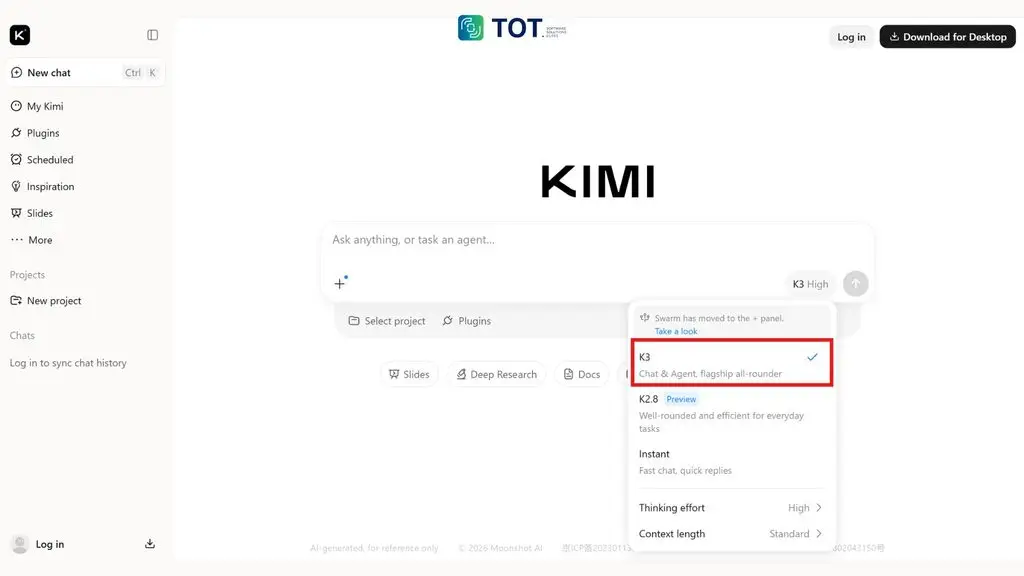
Access to K3 and the 1 million token context window depends on your membership plan. According to the current Kimi Code documentation, K3 is available from Plus/Moderato and above, while access to the 1 million token context requires Pro/Allegretto and above.
How to use Kimi K3 on the mobile app
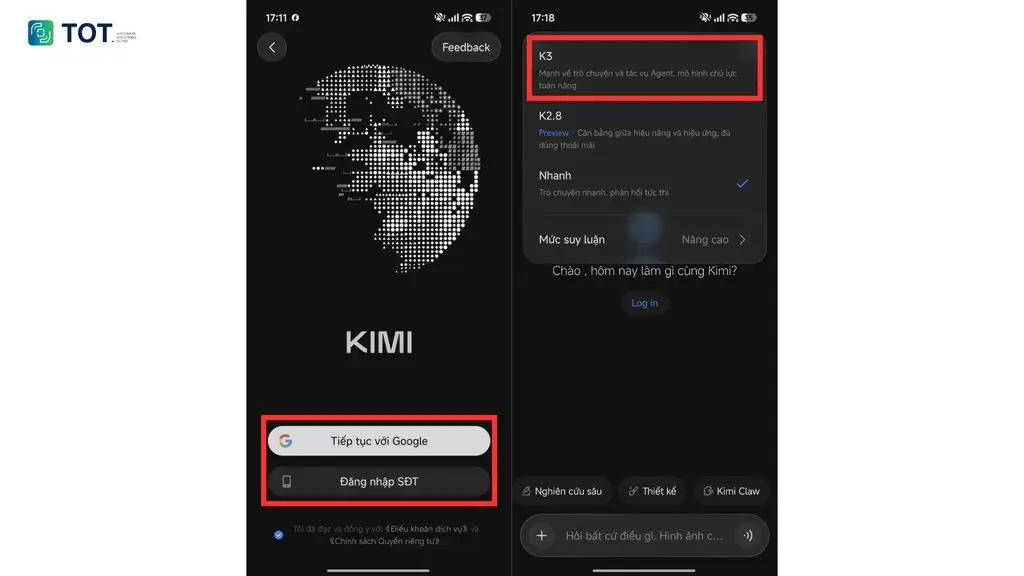
Kimi offers a mobile app that lets users access its AI features on Android and iOS. After installing the Kimi app from a supported platform, users sign in to their account, open the chat interface, and select the model or feature that matches their account’s access.
The models shown and the usage allowance can vary by membership plan, region, and app version. For this reason, users should check for the K3 model directly in the app at the time of use.
>>> Read more:
- How to build a WordPress website with AI: a detailed guide from A to Z
- How businesses build AI agents
How to use Kimi K3 for coding
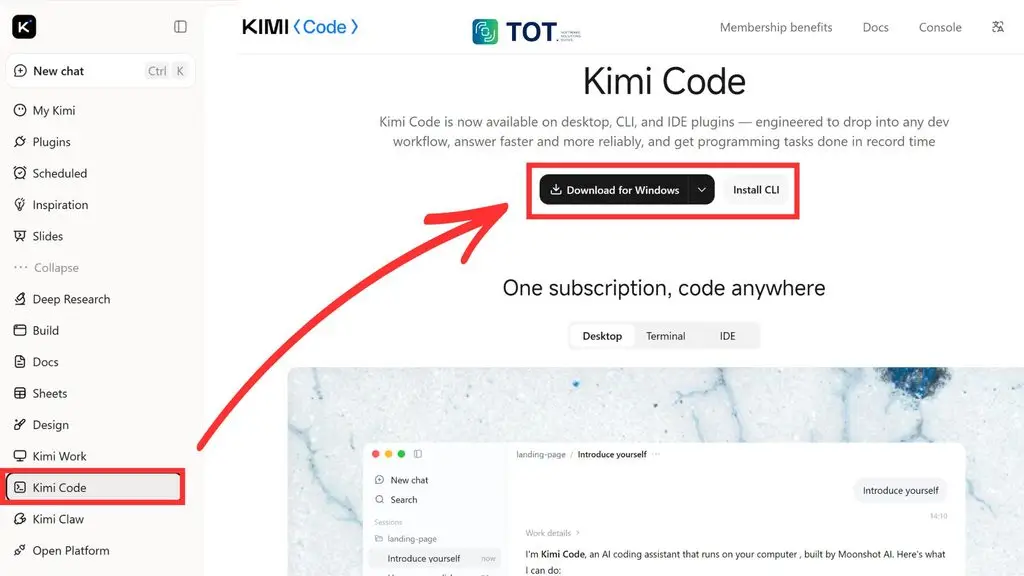
For developers, Kimi Code is a good choice for bringing Kimi K3 into the software development process. Kimi Code supports Desktop, CLI, and VS Code, and it lets you switch models directly in the interface.
Kimi Code currently offers two model IDs for K3:
k3: the K3 version with a maximum context of 1,048,576 tokens on supported plans.k3-256k: the K3 version with a fixed context of 262,144 tokens.
Both models support the low, high, and max reasoning levels. When using the CLI, you can type /model to switch models; on VS Code, the model is selected from the list in the input bar.
>>> Learn more:
- Standout GitHub repos of 2026: AI agents dominate every field
- The 10 best website design AI tools of 2026, with a detailed comparison
How to use the Kimi K3 API
To integrate Kimi K3 into an application, an AI agent system, or a programming tool, developers need to create an API key, configure the API address, and specify the correct Model ID. The Kimi Code API currently supports protocols compatible with OpenAI and Anthropic.
With the OpenAI-compatible protocol, the endpoint for the international market is https://api.kimi.ai/coding/v1; the model can be set to k3 or k3-256k. After a request is sent, the system returns the output content and the number of tokens used to calculate the allowance/cost under the corresponding policy. For a real deployment, you need to check the API key, model ID, token limits, context window, and API pricing before going to production.
Comparing Kimi K3 with other AI models
Kimi K3 belongs to the group of AI models with a clear focus on coding, AI agents, reasoning, and long-context processing. When comparing it with other models, you need to consider the architecture, context window, multimodal capability, agent tooling, and API cost all at once. The specifications below are compiled from each developer’s official documentation; API pricing may change by time period and region.
Kimi K3 compared with AI models in the US
Kimi K3 vs ChatGPT
In the table below, GPT-5.4 is used to represent the current GPT line for a direct comparison with Kimi K3. GPT-5.4 has a 1.05 million token context window and supports reasoning, images, computer tools, and MCP; the API is priced at 2.50 USD per 1 million input tokens and 15 USD per 1 million output tokens.
| Criterion | Kimi K3 | GPT-5.4 |
|---|---|---|
| Developer | Moonshot AI | OpenAI |
| Release date | 16/07/2026 | 05/03/2026 |
| Open weights | Yes | No |
| Context window | 1 million tokens | 1.05 million tokens |
| Reasoning | Strong, focused on multi-step reasoning | Supports reasoning at multiple levels |
| Programming | Coding agent, large codebases, terminal | Coding, Codex, development tools |
| Multimodal | Native vision | Text + images |
| AI Agent | Agentic coding, tool use, long workflows | Responses API, computer use, MCP, hosted shell |
| API pricing | $0.30–$3 input; $15 output per 1M tokens | $2.50 input; $15 output per 1M tokens |
| Notable applications | Coding agent, knowledge work, reasoning | Coding, professional work, agents |
Kimi K3 has a clear advantage in being open-weight and is designed from the ground up for long coding workflows. GPT-5.4 has a broad ecosystem of tools and APIs, and it also supports context windows above 1 million tokens.
Kimi K3 vs Claude
Claude Opus 4.6 is a suitable representative for comparison in the coding and agent task group. Anthropic states that Opus 4.6 has a 1 million token context in beta, along with coding, agentic task, and large-codebase capabilities; its standard API pricing is 5 USD per 1 million input tokens and 25 USD per 1 million output tokens.
| Criterion | Kimi K3 | Claude Opus 4.6 |
|---|---|---|
| Developer | Moonshot AI | Anthropic |
| Release date | 16/07/2026 | 05/02/2026 |
| Open weights | Yes | No |
| Context window | 1 million tokens | 1 million tokens (beta) |
| Reasoning | Multi-step reasoning | Extended/adaptive thinking |
| Programming | Agentic coding, large codebases | Coding, debugging, code review |
| Multimodal | Native vision | Vision |
| AI Agent | Agent, tool calling, terminal | Agent teams, computer/tool use |
| API pricing | $0.30–$3 input; $15 output per 1M tokens | $5 input; $25 output per 1M tokens |
| Notable applications | Coding agent, knowledge work | Coding, research, enterprise workflows |
>>> See more:
- Claude Opus 4.7 – Anthropic’s latest AI version
- How to use Claude Opus 4.7 with Claude Code most effectively
- A review of Claude 4.5 Sonnet in security and cyber defense
Kimi K3 compared with AI models in China
Kimi K3 vs DeepSeek
DeepSeek is a notable group of models to compare with Kimi K3 on open-weight, reasoning, and coding. However, Kimi K3 stands out with its 1 million token context, while DeepSeek’s versions need to be considered individually by model and time of use. Because DeepSeek’s pricing and model IDs change fairly quickly, businesses should check the official pricing table before deploying.
| Criterion | Kimi K3 | DeepSeek |
|---|---|---|
| Developer | Moonshot AI | DeepSeek |
| Open weights | Yes | Yes for the published models |
| Context window | 1 million tokens | Depends on the version |
| Reasoning | Multi-step reasoning | Strong reasoning |
| Programming | Coding agent, terminal, large codebases | Coding and reasoning |
| Multimodal | Native vision | Depends on the model |
| AI Agent | Agentic coding, tool use | Tool/API support by model |
| API pricing | $0.30–$15 per 1M tokens by token type | Varies by model |
| Notable applications | Coding agent, long workflows | Reasoning, coding, applied AI |
Kimi K3 vs Qwen
Qwen3-Max is a commercial model from Alibaba Cloud, supporting reasoning, agent tooling, web search, and fine-tuning. Qwen3-Max has a 262,144 token context on QwenCloud; its published international pricing starts at 1.20 USD per 1 million input tokens and 6 USD per 1 million output tokens for requests under 32K tokens.
| Criterion | Kimi K3 | Qwen3-Max |
|---|---|---|
| Developer | Moonshot AI | Alibaba Cloud/Qwen |
| Open weights | Yes | No for Qwen3-Max |
| Context window | 1 million tokens | 262K tokens |
| Reasoning | In-depth reasoning | Thinking/Non-thinking |
| Programming | Coding agent | Coding and agents |
| Multimodal | Native vision | Depends on the Qwen model |
| AI Agent | Agent, tool calling | Web search, agents, tool use |
| API pricing | $0.30–$15 per 1M tokens | From $1.20/$6 per 1M tokens |
| Notable applications | Coding, knowledge work, long workflows | Applied AI, agents, enterprise |
Kimi K3 vs GLM-5.2
GLM-5.2 from Z.ai is a model designed for long tasks, with a 1 million token context, advanced coding capability, and multiple reasoning levels. Z.ai says GLM-5.2 supports coding tools such as ZCode, Claude Code, and OpenCode.
| Criterion | Kimi K3 | GLM-5.2 |
|---|---|---|
| Developer | Moonshot AI | Z.ai |
| Release date | 16/07/2026 | 16/06/2026 |
| Open weights | Yes | Yes |
| Context window | 1 million tokens | 1 million tokens |
| Reasoning | Multi-step reasoning | Multiple reasoning levels |
| Programming | Coding agent, terminal | Coding, long-horizon tasks |
| Multimodal | Native vision | Depends on the deployment/model |
| AI Agent | Agentic workflow | Coding agent, agent tooling |
| API pricing | $0.30–$15 per 1M tokens | Depends on the deployment platform |
| Notable applications | Coding, knowledge work, agents | Coding and long tasks |
On the whole, Kimi K3, GPT-5.4, Claude Opus 4.6, and GLM-5.2 have all moved toward long workflows and AI agents, so the differences do not lie in benchmark scores alone. Kimi K3 stands out with its open weights, 1 million token context, and coding-agent focus; GPT-5.4 and Claude have their own tool/API ecosystems; Qwen and DeepSeek offer other choices within the Chinese AI ecosystem. The model you choose should be based on your specific workload, deployment requirements, integration capability, latency, and total operating cost rather than on a single criterion alone.
>>> See more:
- A guide to designing a website with AI for free and effectively
- 29 standout AI website templates for SaaS, e-commerce, and multiple industries
What limitations does Kimi K3 have?
Kimi K3 has a scale of 2.8 trillion parameters, a context window of up to 1 million tokens, and is designed for long-horizon coding, reasoning, knowledge work, and AI agent tasks. However, these advantages also come with some limitations to weigh in real-world use.
First, it requires large infrastructure if self-hosted. Moonshot AI recommends deploying Kimi K3 on a supernode configuration with 64 or more accelerators to achieve suitable inference efficiency. As a result, businesses that want to self-host the model need to invest significantly in GPUs, memory, networking, and an inference system.
Second, not every task needs a 2.8T model. For requests such as short Q&A, simple content writing, code completion, or editing a few files, a smaller model may meet the need with lower resource usage. Kimi Code also offers a K3-256K version, in which K3 1M consumes roughly twice the quota of the 256K version.
Third, costs can rise quickly with long workflows. The Kimi K3 API is priced at $0.30/MTok for cache-hit input, $3/MTok for cache-miss input, and $15/MTok for output. Agents that run many rounds, handle large codebases, or use long context can generate a significant number of tokens.
Fourth, benchmarks do not reflect all of production performance. K3’s benchmark results were produced with different reasoning and agentic harness setups depending on the test, so the scores should not be treated as an absolute representation of every workload.
Finally, 1 million tokens does not mean every application effectively uses the full context. Prompt quality, context management, agent tooling, and application architecture still have a major impact on results. For businesses, you also need to assess data security, infrastructure control, operating cost, and integration capability before deploying Kimi K3 at scale.
Conclusion
Kimi K3 is a standout AI model with a scale of 2.8 trillion parameters, a 1 million token context, and capabilities in coding, reasoning, multimodal processing, and building AI agents. Beyond its performance on complex tasks, Kimi K3 also offers an advantage through its open-weight nature and support for multiple ways of using it, from the Kimi platform to the API and Kimi Code. That said, token cost, infrastructure requirements for self-hosting, and the ability to exploit the large context still need to be weighed per workload. For businesses and development teams, the decision to choose Kimi K3 should be based on actual needs, budget, and security requirements.
Frequently asked questions
What is Kimi AI?
Kimi AI is an AI assistant developed by Moonshot AI that supports chat, web search, reasoning, multimodal content processing, and agent tasks. Users can access Kimi on the web or the mobile app, while developers can use Kimi Code and the Kimi API to integrate AI into products, tools, or software development processes.
What’s new in Kimi K3 compared with previous versions?
Kimi K3 is a significant upgrade in scale and long-task processing compared with previous generations. The model has 2.8 trillion parameters, a Kimi Delta Attention and Attention Residuals architecture, native vision, and a context of up to 1 million tokens. K3 also strengthens coding, reasoning, and agentic coding, allowing it to work with large codebases, use terminal tools, and perform multi-step workflows.
What API features does Kimi K3 offer to support developers?
The Kimi K3 API lets developers integrate the model into applications through an API compatible with the OpenAI format. The Kimi API supports text generation, multi-turn conversations, file analysis, and web search, and it provides the model ID kimi-k3 for K3. With Kimi Code, developers can also use an OpenAI- or Anthropic-compatible API, along with the model IDs k3 and k3-256k.
How much does Kimi K3 cost?
How much Kimi K3 costs depends on how you use it. For the API, the pricing is $0.30/MTok (~7,900 VND) for cache-hit input, $3.00/MTok (~79,000 VND) for cache-miss input, and $15.00/MTok (~395,000 VND) for output. If you use Kimi through a membership plan, the current tiers are ¥49/month (~180,000 VND), ¥99 (~360,000 VND), ¥199 (~720,000 VND), and ¥699 (~2.53 million VND).
Is Kimi K3 free?
Kimi K3 is not always free. Access to K3 depends on your membership plan and current credit allowance. According to the Kimi Code documentation, K3 can be called from the Moderato/Plus plan and above, while access to the 1 million token context requires Allegretto/Pro or higher. The Kimi API is also billed by the volume of tokens used. For this reason, you should check your current plan and allowance before using K3 for a large workload.
Is Kimi K3 more powerful than GPT and Claude?
You should not conclude that Kimi K3 is more powerful than GPT or Claude on every task. Moonshot AI says K3 reaches frontier-level performance on its own evaluation suite, but its overall performance is still below the strongest proprietary models it compared against at launch, namely Claude Fable 5 and GPT 5.6 Sol. Because benchmarks, prompts, and agent harnesses can differ, K3 should be evaluated by specific workloads such as coding, long context, agents, and cost.