
Over the past year, the ranking of standout GitHub repos has changed hands completely. Among the 1,549 repos created between July 2025 and July 2026 that surpassed 2,000 stars, almost the entire leading group belongs to AI agent tools — there is no longer room for web frameworks or traditional programming libraries. More striking still, what dominates is not models or AI applications, but repos that package skills for agents. This article reviews the most notable repos across the five problem categories they actually solve, along with a screening method for filtering out projects that inflate their metrics. TOT also shares its perspective from firsthand experience bringing these tools into its internal software development workflow.
Quick summary
- Between July 2025 and July 2026, 1,549 new repos surpassed 2,000 stars; within the top 30, almost none are unrelated to AI agents.
- The largest category is repos that package skills for agents — five such repos already account for more than 860,000 stars combined.
- Spec-Driven Development has emerged as a serious direction: github/spec-kit reached 121,663 stars — write the specification first, then let the agent handle the coding.
- The second most heavily invested problem is cutting token costs and preserving memory across working sessions, not making agents smarter.
- A high star count does not equal trustworthiness: this article filters out repos with abnormal fork ratios, and explains why filtering by topic loses most of the data.
The big picture: AI agents own the leaderboard
Data from the GitHub Search API shows that 1,549 repos created after July 16, 2025 have crossed the 2,000-star mark, of which 195 exceeded 15,000 stars. The surprise lies not in the volume but in the uniformity: scan the entire top 30 and nearly every project revolves around AI agents.
This dominance spreads even into fields that seem unrelated. The most-starred marketing repo is a skill set for AI agents. The leading finance repo is a platform for multiple agents to coordinate with one another. To find a pure web project untouched by AI, you have to filter specifically for self-hosted options before names like a PDF tool or a trip-planning app begin to appear.
All figures were pulled from the GitHub API on July 16, 2026 and will change over time.
Our selection method and common mistakes
Before the list, it is worth being clear about how the selection was made — because most repo roundups make at least one of the two mistakes below.
Trap 1: filtering by topic loses most of the data
The most common approach is to filter by topic label, for example topic:llm. The problem is that only 187 of the 1,549 repos carry this label — meaning the filter skips roughly 88% of the data. Worse, the larger a repo is, or the bigger the organization that released it, the more likely it is to leave the label field empty.
The consequence is concrete: anthropics/skills (161,523 stars) carries only the single agent-skills label, while github/spec-kit (121,663 stars) carries no developer-tools label at all. Both sit in the top 11 yet would vanish entirely under a conventional search. The list below was therefore drawn from a query with no label filter, then grouped by hand.
Trap 2: stars and forks can be inflated
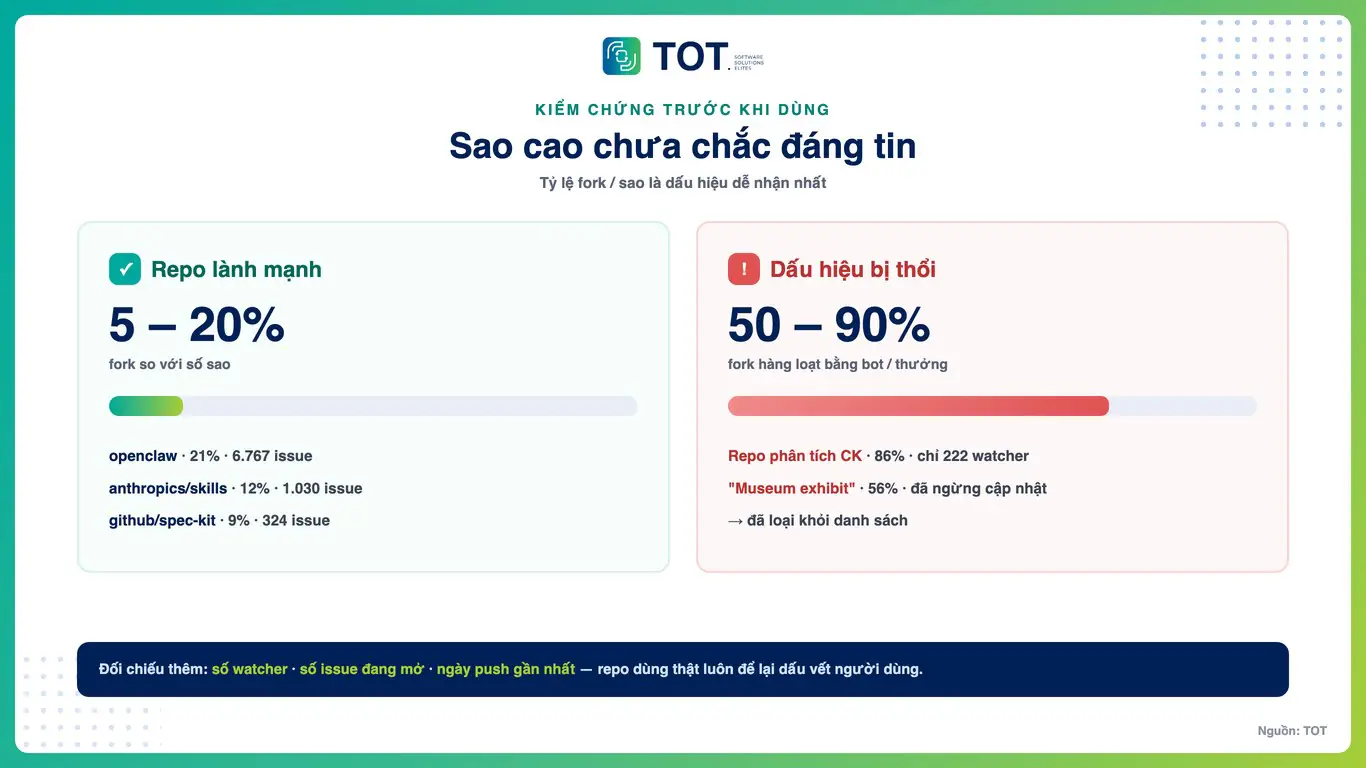
The easiest metric to verify is the fork-to-star ratio. A healthy repo usually has forks amounting to about 5–20% of its stars, since most users only star a project for reference. When that ratio jumps to 50–90%, mass forking by bots or bounty programs is almost certain.
Applying this filter, two repos were dropped despite very high star counts: one project with 194,784 stars but 109,637 forks (a 56% ratio), self-described as an “agent-run museum exhibit” and no longer updated; and a stock-analysis project with 57,424 stars and 49,398 forks (an 86% ratio) but only 222 watchers.
Conversely, trustworthy repos tend to reveal real usage through their issue counts: OpenClaw has 6,767 open issues, while Hermes Agent reaches 23,010 — figures that only appear when the user community is genuinely large.
Category 1: Packaging skills for agents — the largest group
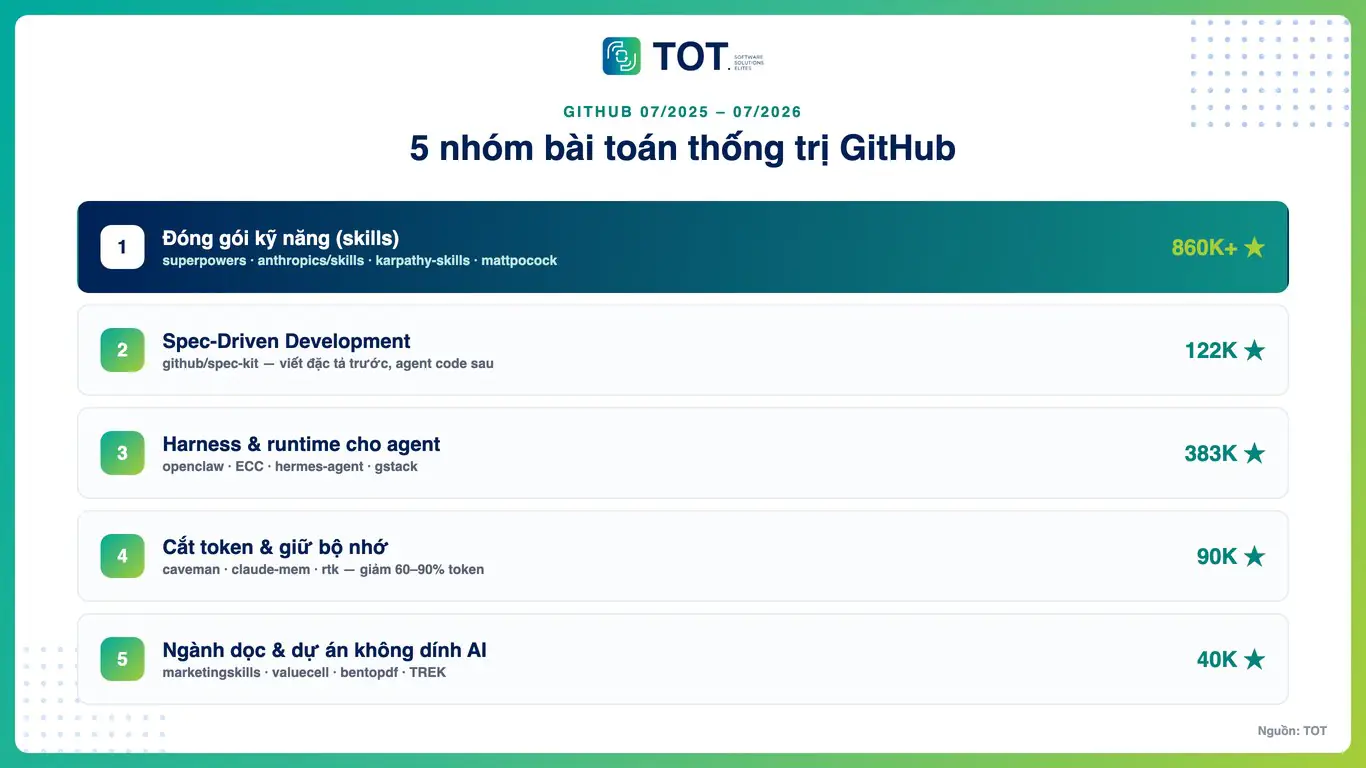
This is the most defining phenomenon of the past year. Instead of writing software, the community packages ways of working into skills that agents load and execute. The five repos below add up to more than 860,000 stars combined.
| Repo | Stars | What problem it solves |
|---|---|---|
| obra/superpowers | 255,600 | A skill framework for agents that bundles in a full software development methodology, not just a loose set of commands |
| multica-ai/andrej-karpathy-skills | 192,964 | Packs all of Andrej Karpathy’s observations on how LLMs write code into a single guidance file |
| mattpocock/skills | 172,883 | Shares directly the skill set an experienced engineer uses every day, rather than empty theory |
| anthropics/skills | 161,523 | The first-party skill repository from Anthropic — the reference standard for how a skill should be written |
| addyosmani/agent-skills | 78,624 | A set of production-grade technical skills for coding agents, aimed at real-world source-code quality |
What all five projects share: the value lies not in the source code but in systematized knowledge. They answer a very practical question — agents are already powerful enough, but how do you guide one to produce usable results? The fact that a single guidance file can attract nearly 200,000 stars shows that the biggest gap today is methodology, not technology.
Category 2: Spec-Driven Development — write the spec first, code later
If the skills category answers “how do you guide an agent,” this one answers a bigger question: how do you keep an agent from drifting off course over a long-running project.
| Repo | Stars | What problem it solves |
|---|---|---|
| github/spec-kit | 121,663 | Turns the specification (spec) into the project’s single source of truth: describe the requirements clearly first and the agent codes to them, instead of issuing scattered commands and patching afterward |
Spec-Driven Development addresses an inherent weakness of working with agents: the longer the conversation runs, the more the agent drifts from the original goal, and the user loses control of scope. By locking down the specification first and only then generating the plan and the code, this process restores what software engineering has always relied on: clear requirements that can be reviewed and traced.
The fact that spec-kit was released by GitHub itself and reached more than 121,000 stars in roughly a year shows this is no passing fad, but the engineering community’s response to the hard-to-control practice of improvising commands and then leaving everything to the agent.
Category 3: Platforms for running agents
This is the foundational layer: the environment where agents operate, connecting models with tools and users. Put simply, if the skills category is about knowing what to do, this category is where the doing happens. It is also home to the most-starred repos on the entire board.
| Repo | Stars | What problem it solves |
|---|---|---|
| openclaw/openclaw | 383,082 | A personal AI assistant that runs on any operating system, avoiding lock-in to a single vendor |
| affaan-m/ECC | 230,211 | Optimizes the performance of the agent runtime framework: skills, memory, security, and a research step before any code is written |
| NousResearch/hermes-agent | 215,611 | An agent that accumulates knowledge and grows with the user instead of starting from scratch each session |
| msitarzewski/agency-agents | 131,893 | Stands up an entire multi-role “agency,” from frontend to management, rather than a single lone agent |
| garrytan/gstack | 122,150 | Publishes a well-known investor’s complete 23-tool configuration for immediate reuse |
| farion1231/cc-switch | 117,699 | A desktop app that brings everything into one place, switching configurations quickly between environments |
Category 4: Reducing tokens and preserving memory — the cost problem
This is the category that most clearly reflects operational pain. None of the repos below make agents smarter; they only help agents spend less money and remember what they have already done.
| Repo | Stars | What problem it solves |
|---|---|---|
| JuliusBrussee/caveman | 89,965 | Cuts roughly 65% of tokens by trimming phrasing to the bare minimum when communicating with the model |
| thedotmack/claude-mem | 87,431 | Preserves context across sessions, sparing you from re-explaining the project background every time you start up |
| rtk-ai/rtk | 71,294 | A middleware layer between the command line and the model, cutting 60–90% of tokens for common coding commands |
| code-yeongyu/oh-my-openagent | 65,928 | A coding agent purpose-built for people who optimize tokens down to the last cent |
| DeusData/codebase-memory-mcp | 31,961 | Indexes the entire codebase into a knowledge graph, helping the agent understand and remember the project over the long term |
That tools doing nothing but compressing input data attract tens of thousands of stars is a clear signal: once agents enter daily use, token cost becomes a real operating expense, large enough that users actively look for ways to cut it.
Category 5: Industry-specific applications — and the few projects outside AI
This category contains two very different types. The first is agents tailored to a specific industry — marketing or finance; they are still AI, differing only in being packaged around a business function. The second is far rarer: projects that use no AI at all, winning by letting users self-host and keep control of their data.
| Repo | Stars | What problem it solves |
|---|---|---|
| coreyhaines31/marketingskills | 39,933 | Packages CRO, copywriting, SEO, and analytics skills into agent skills — marketing gets “skill-ified” too |
| ValueCell-ai/valuecell | 10,934 | A community-developed platform for multiple agents coordinating within financial applications |
| alam00000/bentopdf | 14,084 | Processes PDFs locally on your machine, so sensitive documents never go up to a third-party service |
| rmyndharis/OpenWA | 11,340 | A self-hosted WhatsApp API gateway that replaces commercial solutions charging per message |
| mauriceboe/TREK | 10,390 | Self-hosted trip planning with real-time collaboration |
The common denominator of bentopdf, OpenWA, and TREK is data control. Users choose them not for superior features, but because they do not want to put their data on someone else’s servers — a need that keeps growing as cloud services raise prices and tighten limits.
The TOT perspective: what we are using
The list above is not merely an outside observation. At TOT, the top two tool categories in this article have already been brought into our daily software development workflow.
Spec-kit and the Spec-Driven Development approach solve exactly the problem our team runs into when working with agents: requirements must be locked down clearly before code is generated, otherwise the output gradually drifts from the goal and reviewing it becomes more expensive than writing it yourself. For projects with multiple stakeholders, a specification that can be read and reviewed is a hard requirement.
Claude’s skill set is used to standardize how agents handle repetitive tasks — from code review and testing to documentation. The greatest value is not speed but consistency: the same process and the same output standard, no matter who on the team is doing the work.
The lesson from adopting them: open-source tools solve the technical part, but the hard part lies elsewhere — standardizing internal processes, controlling token costs as you scale, and ensuring enterprise data does not leak through model calls.
Four trends businesses should note
- Knowledge matters more than tools. The most-starred repo category is not complex software but systematized skills and methods. Businesses can package their own internal processes in exactly the same way.
- Specifications are back. The rise of Spec-Driven Development shows that the more you use AI, the more clear requirements matter — not the other way around.
- Token cost is an operating expense. Factor it into the equation right from the design stage, rather than letting it pile up and dealing with it later.
- Community metrics must be verified. When choosing a library to adopt into your systems, look at the fork/star ratio, issue counts, and update frequency instead of the star count alone.
Bring AI into your software development workflow with TOT
The gap between installing an open-source tool and running AI reliably inside a business is large: you need to standardize processes, control token costs, secure data, integrate with existing systems, and train the team.
TOT is a technology company within the TOS group of companies, a pioneer in applying AI to its own management and software development processes. TOT works alongside businesses from technology assessment and solution selection to custom software development and integrating AI into systems already in production.
If your business is weighing whether to bring AI agents into its internal workflow but is unsure where to start, the TOT team is ready to advise on a roadmap that fits your real infrastructure and budget.
Frequently asked questions about the standout GitHub repos of the past year
Which GitHub repo had the most stars over the past year?
As of July 16, 2026, OpenClaw leads with 383,082 stars and 80,449 forks — a personal AI assistant that runs on any operating system. The project has 6,767 open issues, a sign of a very large real-world user base.
What is Spec-Driven Development, and why does spec-kit stand out?
Spec-Driven Development is an approach that makes the specification the source of truth: describe the requirements clearly first, and only then does the agent generate the plan and the code. This fixes the problem of an agent drifting off goal as the conversation drags on. The github/spec-kit repo was released by GitHub itself and reached 121,663 stars in about a year.
Why do so many “skills” repos have such high star counts?
Because agents are now powerful enough, the bottleneck has shifted elsewhere: how to guide one to produce usable results. Skill repos package experience and methods into something an agent can load, so the value lies in the knowledge rather than the source code. The five leading skill repos alone add up to more than 860,000 stars combined.
Why doesn’t a high star count guarantee a good repo?
Stars and forks can be inflated by bots or bounty programs. The easiest sign to spot is the fork-to-star ratio: a healthy repo usually sits at 5–20%, while an inflated one can reach 50–90%. It is worth cross-checking the watcher count, the number of open issues, and the most recent update date as well.
Should businesses use these open-source repos directly?
You can use them for experimentation, but evaluate carefully before putting them into production: how well the project is maintained, its usage license, the security risk of granting permissions to an agent, and token costs as you scale. For critical systems, have a technical team vet them or partner with an experienced implementation provider.