Artificial intelligence (AI) is becoming one of the most important technologies, profoundly shaping how people work, do business and interact with technology. From chatbots and image recognition to data analysis, forecasting and automation, AI can perform many tasks that previously required human cognitive abilities. So what is artificial intelligence, how does it work and how is it applied in practice? In this article, TOT will help you clearly understand the concept, its development history, foundational technologies, applications, benefits, risks and the most notable AI trends today.
>>> See more articles:
- Optimizing a website with AI: What is it? How to optimize SEO and the AI tools to use
- Building an online store with AI for free: SEO-friendly and highly effective
- Model Context Protocol: What is it? How to connect AI to the world
- Vertex AI: What is it? Google Cloud’s machine learning platform
Quick summary
- Artificial intelligence (AI) is the field of computer science that enables machines to perform tasks usually requiring human cognitive abilities.
- The history of AI has gone through several major phases, from the Turing Test, the coining of the term AI, and the AI Winter to Deep Learning, Generative AI and AI Agents.
- AI works on the basis of data, algorithms, models, training, inference and feedback to produce suitable results.
- Common types of AI include Narrow AI, AGI and ASI, as well as the Reactive Machines, Limited Memory, Theory of Mind and Self-aware AI groups.
- The foundational technologies of AI include Machine Learning, Deep Learning, NLP, Computer Vision, Robotics and knowledge representation systems.
- AI applications span enterprises, customer service, marketing, finance and banking, healthcare, manufacturing, education, transportation and logistics, and everyday life.
- AI also carries risks such as generating inaccurate information, data bias, impacts on privacy and copyright, and changes to how work is organized.
- AI trends focus on Generative AI, Multimodal AI, AI Agents, AI Coding, Edge AI, personalization, Responsible AI and the integration of AI into enterprise software.
What is artificial intelligence?
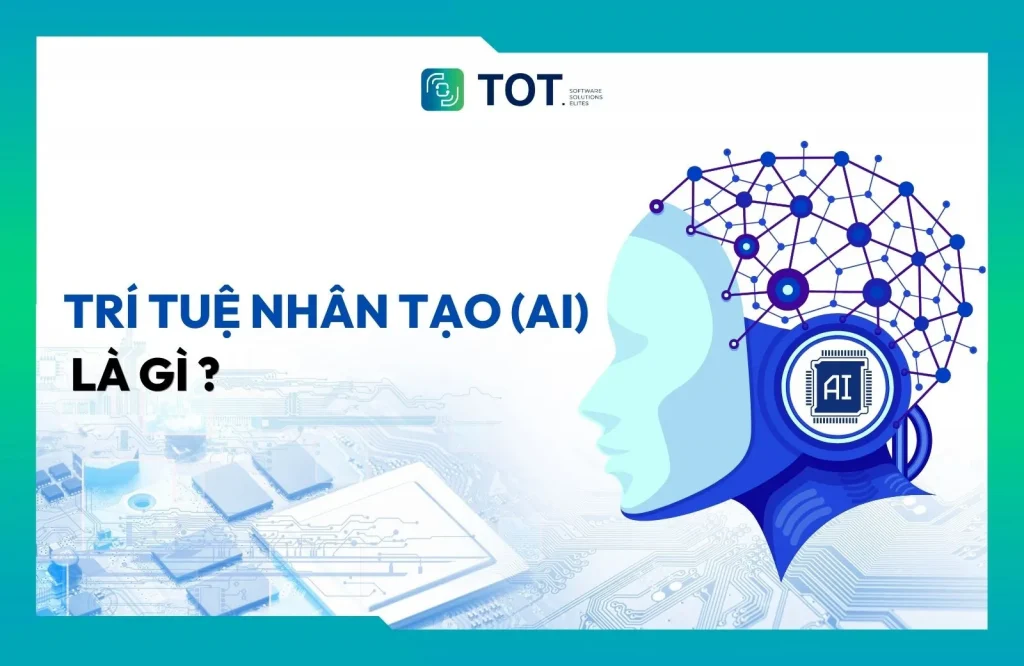
Artificial intelligence (AI) is the field of computer science focused on building systems capable of performing tasks that usually require human cognitive abilities. These abilities can include learning, reasoning, problem-solving, understanding language, recognizing images, analyzing data, making predictions and supporting decision-making.
However, the concept of artificial intelligence is not limited to chatbots or content-creation tools. AI also encompasses many methods, algorithms and models that help machines process information, recognize patterns and perform increasingly complex tasks. AI technology can handle many types of data such as text, images, audio, video and business data.
In practice, AI is used to recognize faces, convert speech to text, understand natural language, analyze big data, detect fraud and predict trends. Machine Learning and Deep Learning are key technologies that enable AI systems to learn from data and improve their processing over time.
Thanks to its analytical and automation capabilities, AI is increasingly applied across many fields such as finance, healthcare, manufacturing, education, transportation and business management. Put simply, artificial intelligence is technology that enables machines to learn, analyze, perceive and perform tasks that usually require human intelligence.
>>> Read more:
- Building a Vision pipeline for AI in scientific research
- AI in UI/UX design: The power of Generative AI
Examples of artificial intelligence in practice
| Application | What AI does | Example |
| Virtual assistant | Recognizes speech, understands requests and responds in natural language | Phone assistants, smart speakers |
| Facial recognition | Analyzes facial features from images or video to identify or verify identity | Unlocking devices, identity verification |
| Content recommendation | Analyzes behavior and preferences to predict relevant content | Suggesting films, music or products |
| Fraud detection | Analyzes transactions and looks for unusual behavioral patterns | Flagging suspicious bank transactions |
| Chatbot | Understands questions and generates responses in natural language | Customer service chatbots |
| Image analysis | Recognizes objects, features or patterns in images | Inspecting product defects, assisting medical image analysis |
The development history of artificial intelligence
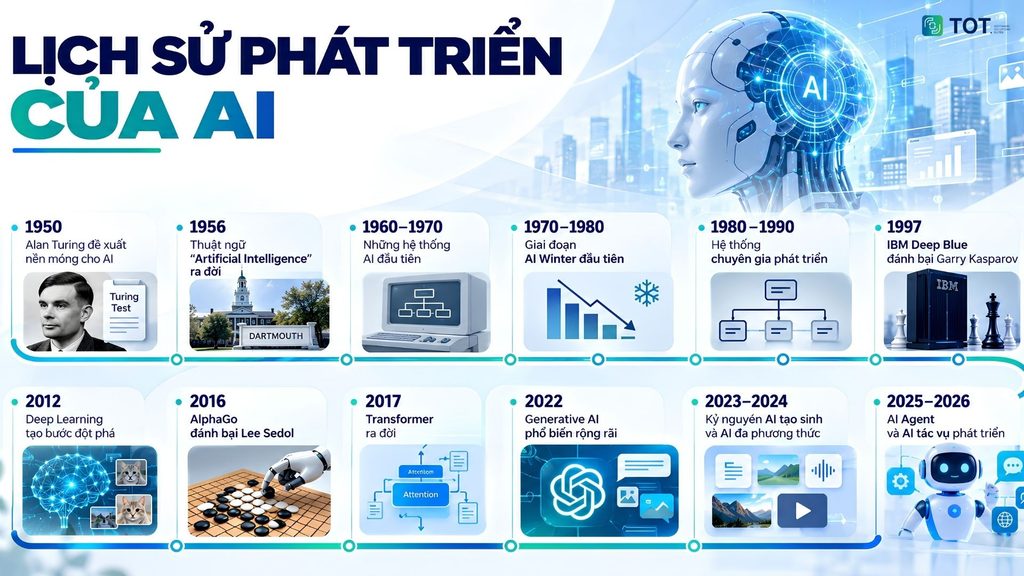
The history of artificial intelligence has gone through many stages, from the earliest ideas about thinking machines to today’s generative AI and AI Agent models. Each advance has been tied to progress in algorithms, data and computing power.
1950 – Alan Turing lays the foundations for AI
In 1950, mathematician Alan Turing published the paper Computing Machinery and Intelligence, raising the question of whether machines could exhibit intelligent behavior. He proposed the Turing Test, in which a machine’s capability is assessed by whether a human can distinguish the machine’s responses from those of a person. This proposal became one of the key foundations for discussions about machine intelligence.
1956 – The term “Artificial Intelligence” is born
In 1956, the Dartmouth Summer Research Project on Artificial Intelligence was held in the United States. John McCarthy, together with Marvin Minsky, Nathaniel Rochester and Claude Shannon, introduced the term “Artificial Intelligence”. This event is often regarded as the birth of the modern AI field. During this period, the first programs also began experimenting with solving problems through computational methods.
1960–1970 – The first AI systems
During the 1960s, researchers developed many programs aimed at simulating human reasoning and problem-solving. AI was tested in language processing, theorem proving, mathematics and logic problems. Artificial neural networks also began to be studied, notably the Perceptron by Frank Rosenblatt, opening an approach for systems able to learn from data.
1970–1980 – The first AI Winter
After the great initial expectations, AI ran into many limitations in computing power, data and research methods. Some of the stated goals were not achieved as expected, causing funding and interest in AI research to decline. This period is often called the AI Winter, reflecting a time when the pace of development and investment in AI slowed down.
1980–1990 – Expert systems flourish
In the 1980s, Expert Systems became a notable direction of development. These systems used knowledge bases and inference rules to help solve problems within specific areas of expertise. AI began to focus more on practical problems rather than solely on simulating general intelligence.
1997 – IBM Deep Blue defeats Garry Kasparov
In 1997, the IBM Deep Blue supercomputer defeated world chess champion Garry Kasparov in a six-game match under standard tournament conditions. Deep Blue could evaluate around 200 million chess positions per second, demonstrating the power of computing combined with search algorithms and strategy. This was a landmark moment in the history of AI and computing.
2012 – Deep Learning achieves a breakthrough
The year 2012 marked an important advance for Deep Learning. The AlexNet model, developed by a research team at the University of Toronto, achieved outstanding results on ImageNet with an error rate of about 16%, a significant improvement over the previous year’s best result. This success showed that a Deep Neural Network could be highly effective when combined with large data and GPU computing power, driving the subsequent wave of Deep Learning research.
2016 – AlphaGo defeats Lee Sedol
In 2016, DeepMind’s AlphaGo defeated Go player Lee Sedol 4–1 in a five-game match. Unlike chess, Go has an extremely large number of possible moves, making traditional search methods difficult. AlphaGo’s success demonstrated the potential of Deep Neural Networks and Reinforcement Learning for complex problems.
2017 – The Transformer is born
In 2017, the paper Attention Is All You Need introduced the Transformer architecture, using an attention mechanism in place of the sequential architectures common until then. The Transformer could process data in parallel more efficiently and quickly became a key foundation for many large language models as well as modern Generative AI systems.
2022 – Generative AI becomes widely popular
In 2022, Generative AI entered a phase of rapid growth and reached a broad user base. On November 30, 2022, ChatGPT was introduced as a research preview, allowing users to interact with AI through natural conversation. ChatGPT’s rapid popularity helped move generative AI from a topic mainly confined to research and technology into a tool widely used in work and everyday life.
>>> Read more: The latest ChatGPT versions in 2026: Which model is best?
2023–2024 – The era of generative AI and multimodal AI
In 2023–2024, large language models continued to advance in their ability to process and generate content. AI was no longer limited to text and increasingly combined text, images, audio and video. Multimodal models expanded AI’s scope of application in content creation, programming, data analysis and many business processes.
2025–2026 – The rise of AI Agents and task-performing AI
By 2025–2026, AI continued to shift from primarily answering questions and generating content toward the ability to carry out sequences of tasks. AI Agents can take in a goal, plan, use tools, interact with software and perform multiple steps to complete work. This trend is driving the development of Agentic AI, in which AI not only produces output but can also take actions within a specific process.
>>> Learn more:
- Top 20+ best free AI image design software
- TOP 20+ AI design software that best supports designers today
- TOP 20 best free AI tools for online sales
How does artificial intelligence work?
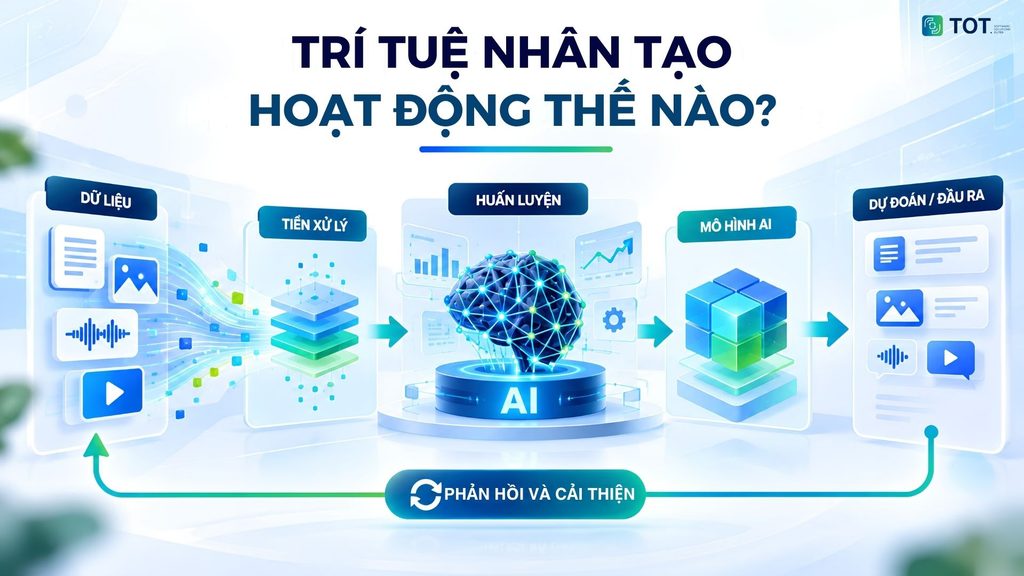
At its core, artificial intelligence works by taking in data, processing it, learning patterns from it and using the trained model to produce predictions or output. The process can be pictured as a flow: Data → Preprocessing → Training → AI model → Prediction/output → Feedback and improvement. The quality of the data, the algorithm and the model all directly affect the final result.
Data
Data is the essential input for AI to learn and perform tasks. Depending on the application, data may include text, images, audio, video or business data such as customer information, transactions and activity history. Before being fed into the system, data is usually checked, cleaned and converted into a suitable format. The more relevant and higher-quality the data is for the problem, the better the model can recognize patterns and produce accurate results.
Algorithms and AI models
An algorithm is a set of methods and rules that help a computer process data and find a way to solve a problem. From this process, a model is built to perform a specific task such as classification, prediction or content generation.
A key component is the Neural Network, designed based on how information-processing nodes connect to one another. With Deep Learning, a neural network with many layers can learn complex features and relationships from large amounts of data. Training is the process of feeding data to the model to adjust its parameters and improve results.
>>> See more: What is a Convolutional Neural Network? Understanding convolutional neural networks
Training and inference
Training and Inference are two distinct stages in how AI works. Training is the stage in which the model learns from data. During this process, the model makes predictions, compares them with the desired results and adjusts its parameters to reduce error.
After being trained, the model moves to the Inference stage. When a user provides new data, the model uses what it has learned to analyze it and produce a result. For example, an image recognition model trained on many labeled images can use that knowledge to recognize a new image.
How does AI learn and improve its results?
AI improves its processing through pattern recognition (Pattern Recognition) in data. Given enough data, a model can detect recurring features and relationships. From these patterns, AI performs Prediction to produce results for new data.
The results can then be evaluated through Feedback. If the results are not yet satisfactory, Optimization can adjust the model or related parameters to reduce error. This process is repeated throughout the development and operation of the system, helping the model perform better on the problem it was designed for.
>>> See more:
- Building a Vision Language Model with Next.js & Roboflow
- The best object detection models on iOS today
- Top 7 best open-source object tracking tools
Common types of artificial intelligence
There are several ways to classify artificial intelligence, the most common being by scope of capability and by function. The first is based on the level of tasks AI can perform, from specialized systems to concepts of AI with capabilities far beyond humans. The second is based on the ability to use information and experience to handle situations.
Classifying AI by scope of capability
Narrow AI (ANI)
Narrow AI (ANI) is the most common form of AI today, designed to perform a single task or a specific group of tasks. Such systems can be highly effective within their designed scope but cannot flexibly handle every kind of intellectual task. Typical examples include image recognition tools, chatbots, content recommendation systems and fraud detection software.
Artificial General Intelligence (AGI)
Artificial General Intelligence (AGI) is the concept of a system capable of performing many kinds of intellectual tasks at a level comparable to humans. Unlike narrow AI, AGI is envisioned as able to learn, reason and adapt to many different problems without being designed specifically for each task. AGI remains a research concept and has not yet become a widely realized AI technology.
Artificial Super Intelligence (ASI)
Artificial Super Intelligence (ASI) is a hypothetical concept of an AI system with capabilities surpassing humans across many fields, including learning, reasoning, problem-solving and creativity. ASI does not yet exist as a real AI system and is mainly discussed in research and forecasts about the future of artificial intelligence.
Classifying AI by function
Reactive Machines
Reactive Machines are a form of AI that only react based on current data or situations. The system does not store experience for use in future situations. As a result, this type of AI is limited to the information it is currently receiving and the task it was designed for.
Limited Memory
Limited Memory AI can use data or information from the past to help make predictions and decisions. This is a common form in many AI systems today. For example, AI can analyze historical data to recognize trends or predict behavior based on the information it has been given.
Theory of Mind
Theory of Mind aims at AI’s ability to understand human emotions, intentions, beliefs and mental states in order to interact more appropriately. This remains largely a direction of research and development rather than a complete capability of today’s AI systems.
Self-aware AI
Self-aware AI is a hypothetical concept of an AI system capable of being aware of itself and its own state. This type of AI is envisioned as having a level of awareness far beyond current systems. Self-aware AI does not yet exist as a real AI system and is mainly used to describe a hypothetical future capability.
>>> See more:
- Top 5 best code editors for computer vision
- The best object detection models
- Free computer vision software: easy-to-use platforms
The foundational technologies of artificial intelligence
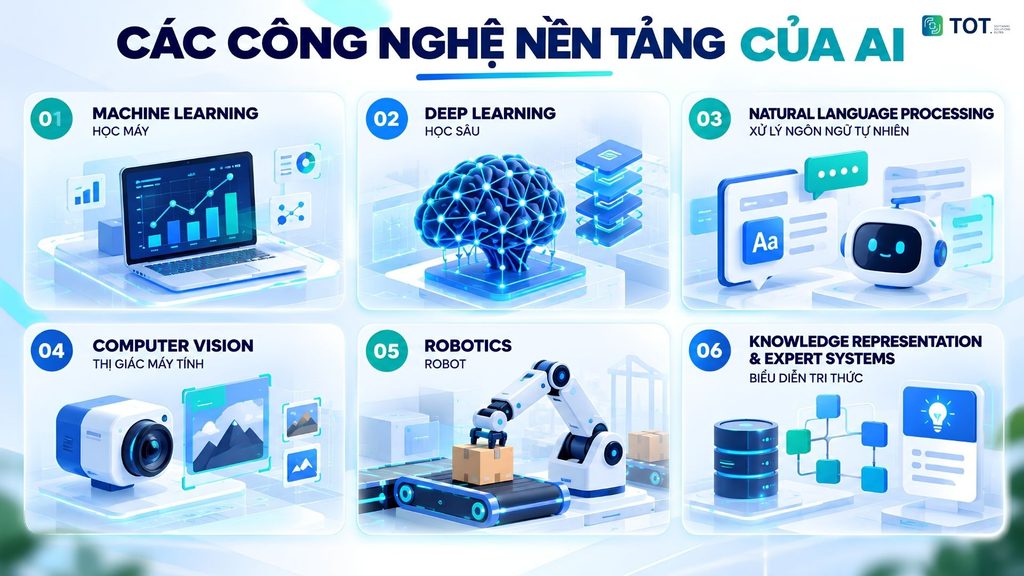
Artificial intelligence is built from many different technologies and methods, each responsible for a particular group of capabilities. From machine learning and deep learning to language processing and computer vision, these technologies enable AI to learn from data, recognize information, understand language and help automate many real-world tasks.
Machine Learning
Machine Learning (ML) is a method that enables computers to learn from data to recognize patterns and make predictions or decisions without being programmed for each individual case. A model is trained on data and then uses what it has learned to handle new data. Machine Learning is applied to many problems such as demand forecasting, data classification, fraud detection, product recommendation and customer behavior analysis.
Deep Learning
Deep Learning is a branch of Machine Learning that uses Neural Networks with many layers to learn complex features from data. Multi-layer neural networks can automatically detect important characteristics during training. This technology plays a key role in image recognition, speech recognition, natural language processing and many modern AI applications.
Natural Language Processing
Natural Language Processing (NLP) enables computers to process and work with human language. NLP can be used to understand, analyze and generate language from text or speech data. Common applications include chatbots, machine translation, sentiment analysis, natural-language search, speech-to-text and content generation. It is also the foundational technology behind many AI systems that communicate through language.
Computer Vision
Computer Vision gives computers the ability to analyze and understand visual information from images or video. This technology can recognize objects, faces, symbols and features in images. OCR (Optical Character Recognition) is also an important application, allowing handwriting or text in images to be recognized and converted into processable data. Computer Vision is applied in manufacturing, healthcare, retail, security and quality inspection.
>>> Read more:
- The best computer vision tools
- The best locally run vision language models for offline AI
Robotics
Robotics combines AI with robotic systems so that machines can sense their environment, process information and take action. When combined with Computer Vision, Machine Learning and control technologies, robots can perform more tasks autonomously. In manufacturing, robots are used for assembly, inspection and transport; in logistics, robots can help sort, move and manage goods.
Knowledge Representation & Expert Systems
Knowledge Representation is a method of representing knowledge in a form that a computer can store, process and use for reasoning. This technology can be combined with Expert Systems, in which domain expertise is organized into rules and logic to help solve problems. Instead of only learning from data, the system can use predefined knowledge and rules to draw conclusions or make recommendations in specific fields.
>>> See more:
- AI data labeling: trends, tools and workflows
- What is a Foundation Model? An overview of foundation models in AI
- How to build a WordPress website with AI: a detailed A-to-Z guide
How do AI, Machine Learning and Deep Learning differ?
AI, Machine Learning (ML) and Deep Learning (DL) have a nested relationship with one another. AI is the broadest scope, referring to technologies that enable machines to perform tasks requiring cognition, analysis or decision-making. Machine Learning is a branch of AI focused on enabling computers to learn from data. Deep Learning, in turn, is a specialized branch of Machine Learning that uses multi-layer neural networks to tackle complex problems.
| Criterion | AI (Artificial Intelligence) | Machine Learning | Deep Learning |
| Scope | The broadest, covering many methods and technologies | A branch of AI | A branch of Machine Learning |
| How it works | Can use rules, logic, algorithms or learning from data | Learns patterns and rules from data to predict or make decisions | Uses multi-layer neural networks to automatically learn complex features |
| Data | Depending on the method, may not need large amounts of data | Usually needs data to train the model | Usually needs large amounts of data and high computing power |
| Applications | Chatbots, recommendation systems, robots, automation | Fraud detection, forecasting, classification, content recommendation | Image recognition, speech, NLP, Generative AI |
This relationship can be pictured as the structure: AI → Machine Learning → Deep Learning. However, not every AI system uses Machine Learning, and not every Machine Learning model is Deep Learning. The choice of technology depends on the problem, the data, the required accuracy, processing speed and computing resources.
>>> Learn more:
- What is AI image recognition? Algorithms & applications
- TOP 18 AI architecture tools for architects
Real-world applications of artificial intelligence
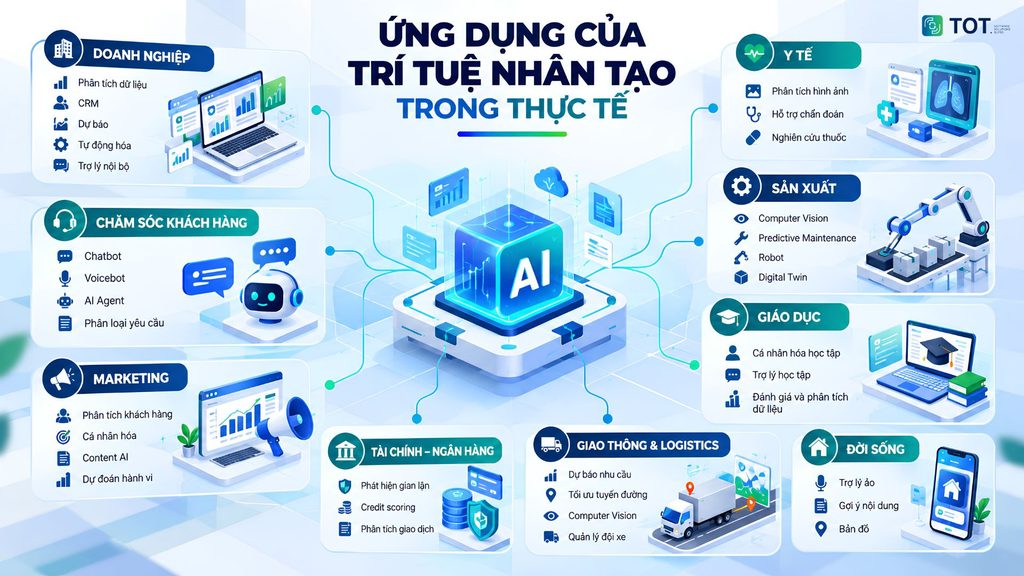
Artificial intelligence is being applied across many fields such as business, customer service, marketing, finance, healthcare, manufacturing and education. AI systems not only support data analysis but can also automate processes, predict trends, personalize experiences and help people make decisions.
AI in business
In business, AI can analyze data, identify trends and detect anomalies across large volumes of information. When integrated with a CRM system, AI helps analyze customers’ interaction history and needs. At the same time, businesses can use AI to forecast revenue, demand and inventory, automate repetitive tasks and build an internal AI assistant to search for and synthesize information.
For example, Microsoft has integrated AI capabilities into the Dynamics 365 ecosystem to support sales, customer service, marketing and many operational activities. In this way, AI is brought directly into enterprise software to help employees handle work and make better use of data.
>>> Learn more: 18 highly effective ways to apply AI to ecommerce
AI in customer service
AI is changing how businesses interact with customers through chatbots, voicebots and AI Agents. Chatbots can handle common questions, while voicebots support voice-based interaction. For more complex processes, AI Agents can combine language understanding with enterprise data and tools to handle multiple steps.
In addition, AI helps classify requests, identifying the topic or priority of each case before routing it to the responsible staff member. A notable example is Klarna, which deployed an AI assistant to support customer service and handle requests in multiple languages.
>>> Read more: How to apply AI to optimize customer experience
AI in marketing
In marketing, AI helps analyze customers, segment audiences and recognize behavioral patterns. From this data, businesses can personalize content, products and offers for each user group.
In addition, generative AI is applied in Content AI, helping create and transform text, images or advertising variations. Predictive models also help businesses analyze the likelihood of purchase, churn or response to a campaign.
This approach can be seen clearly with Netflix. The platform uses a recommendation system to personalize content for each user based on many signals such as viewing history, ratings, content, the device used and the behavior of users with similar tastes. The system also continuously updates based on feedback from viewing behavior to improve its recommendations.
>>> See more: Common workflows for AI Agents: how they work
AI in finance and banking
In finance and banking, AI is used to detect fraud, analyze transactions and identify unusual behavior. Machine Learning models can process large volumes of transaction data to support real-time risk assessment.
AI is also applied in credit scoring, helping analyze many factors related to creditworthiness and providing additional information for the assessment process. Notably, Mastercard uses AI and Machine Learning in its Decision Intelligence solutions to analyze transactions and help financial institutions assess fraud risk.
>>> See more: AI agents in financial services: how they work & practical applications
AI in healthcare
AI is applied in medical image analysis, helping detect abnormal signs on X-rays, CT or MRI scans. In the diagnostic process, AI can provide additional information for medical experts to reference, rather than automatically replacing professional judgment.
Beyond that, AI opens up many applications in drug research, especially analyzing biological data and predicting the structure or interactions of molecules.
A notable example is AlphaFold from Google DeepMind, developed to predict the 3D structure of proteins. The AlphaFold Database has provided more than 200 million protein structure predictions, creating a data resource for biological and pharmaceutical research.
>>> Read more: AI Agents in healthcare and life sciences: how to build & apply them
AI in manufacturing
In manufacturing, Computer Vision can be used to inspect quality, detect product defects and monitor production lines. AI also supports Predictive Maintenance, analyzing machine data to detect signs of deterioration and warn of potential breakdowns.
When combined with robots, AI helps automate certain production stages. Meanwhile, a Digital Twin can combine real-world data with a digital model to monitor, simulate and optimize the operation of equipment or production lines.
A notable case is BlueScope, which deployed Siemens’ Senseye Predictive Maintenance solution at its manufacturing facilities. According to Siemens, this solution helped BlueScope avoid about 2,000 hours of unplanned downtime over three years by using machine data and AI-based analysis to detect early signs of equipment deterioration.
AI in education
In education, AI supports personalized learning by analyzing each learner’s progress and needs. AI can also act as a learning assistant, explaining concepts, asking guiding questions and helping learners find answers on their own.
At the same time, learning data can be analyzed to help teachers assess progress, identify content learners find difficult and adjust their teaching.
A concrete example is Khanmigo from Khan Academy. This tool was developed as an AI tutor, supporting learners across many subjects through guidance and hints during the learning process. Khanmigo also provides AI tools for teachers, such as help with building lesson plans and teaching activities.
>>> Learn more: How to use chatbots for education in universities and learning
AI in transportation and logistics
In transportation and logistics, AI is applied to forecast demand, analyze traffic and optimize routes. Systems can process data from many sources to help choose routes, allocate vehicles and plan transport.
In addition, Computer Vision helps analyze images from cameras, recognize vehicles and monitor traffic. In logistics, AI can also support fleet management, forecast maintenance needs and optimize transport operations.
For example, UPS developed the ORION (On-Road Integrated Optimization and Navigation) system to help drivers choose delivery routes. The system uses optimization algorithms to determine the order of stops and routes that fit the delivery data, supporting logistics operations at large scale.
AI in everyday life
AI has become part of many familiar products such as virtual assistants, content recommendation systems, maps, facial recognition and language translation. These systems analyze data and user behavior to deliver more relevant results.
In practice, Google Maps uses AI and Machine Learning to analyze traffic data, predict road conditions and help choose routes. Similarly, machine translation systems such as Google Translate apply AI to translate text and support communication across many languages.
These applications show that artificial intelligence no longer appears only in research labs but has been integrated into enterprise software, online services, production systems and many products that users interact with every day.
>>> See more:
- How does AI-assisted programming affect coding skills?
- Claude 4.5 Sonnet: A breakthrough in AI for cybersecurity defense
- What is Predictive AI? The benefits and how predictive AI works
Benefits of artificial intelligence
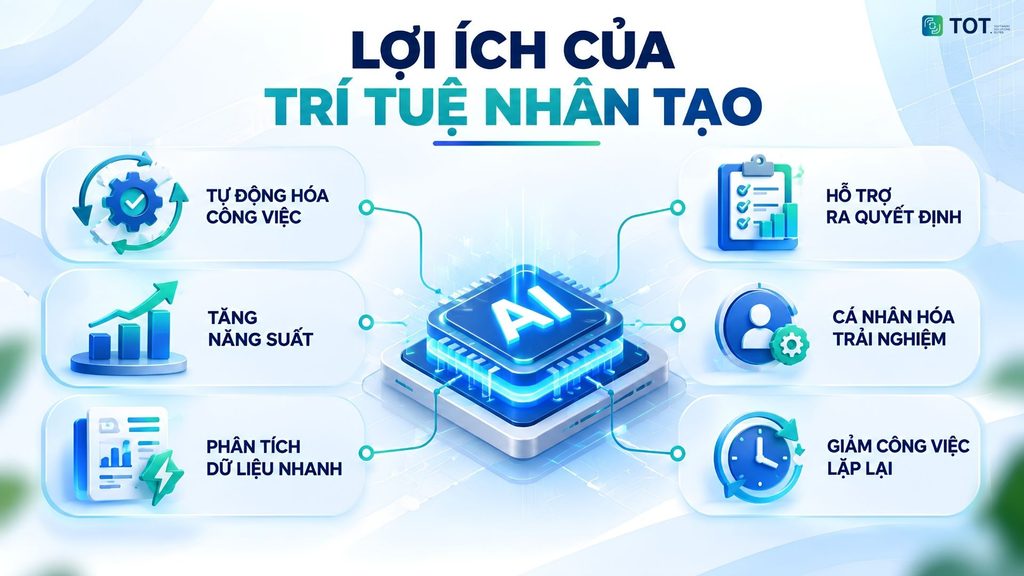
Artificial intelligence brings many benefits to businesses and everyday life thanks to its ability to process data, recognize patterns and perform tasks at high speed. When deployed appropriately, AI can help optimize resources, improve operational efficiency and enhance the user experience.
Automating work
AI can automatically perform many tasks based on rules or input data, from document processing and information classification to answering customers and generating reports. As a result, businesses can reduce time spent on manual processes and focus resources on work that requires expertise or creative thinking.
Boosting productivity
By taking on part of the routine work, AI helps employees complete more tasks in the same amount of time. For example, an AI assistant can help search for information, summarize documents or draft content, shortening processing time and helping employees work more effectively.
Fast data analysis
AI can process large volumes of data in a short time while recognizing patterns and relationships that are hard for humans to detect through manual analysis. Businesses can leverage this to analyze customer behavior, forecast demand, detect anomalies or monitor operational performance.
Supporting decision-making
AI does not entirely replace humans in decision-making but provides additional data and analysis to serve as a reference. For example, a system can aggregate business data, assess trends and make forecasts, giving managers more information before choosing a suitable option.
Personalizing experiences
AI can analyze each user’s behavior, preferences and needs to deliver suitable content or services. This underpins many forms of personalization such as product recommendations, entertainment content, advertising or learning paths.
Reducing repetitive work
Repetitive tasks such as data entry, email sorting, information checking or answering common questions can be supported or automated by AI. This not only saves time but also helps employees reduce manual workload and spend more time on high-value tasks.
>>> See more:
- How do you use AI in software development?
- Image analysis with AI: how it works & real-world applications
- TOP 15+ effective and super-easy tools for building apps with AI
Limitations and risks of artificial intelligence
Alongside its benefits, artificial intelligence still has some limitations related to accuracy, data, security and intellectual property. Understanding these risks helps businesses choose a suitable way to deploy AI and build effective control processes.
AI can generate inaccurate information
AI can produce hallucinations, meaning information that sounds plausible but is actually inaccurate or nonexistent. The cause may come from the data, the way the model processes information or the system’s limitations.
For example, AI may fabricate document titles, figures, events or citations. Therefore, for important information, users still need to verify the facts and cross-check against reliable sources before using it.
Data bias
AI results can be affected by bias in the training data. If the data contains imbalances or reflects certain prejudices, the model may learn and reproduce those tendencies in its output.
Therefore, the quality and diversity of data are important factors when building an AI system. Evaluating results across multiple data groups should also be done to detect and reduce unwanted biases.
Privacy and security
Feeding data into an AI system places high demands on privacy and security, especially when the data contains personal information, customer information or a company’s internal data.
If not managed properly, input data can create a risk of leaks or unauthorized access. Therefore, businesses need to clearly define which data may be used, control access rights and apply appropriate data protection measures.
Copyright and intellectual property
Generative AI also raises many questions related to copyright and intellectual property, from the data used during training to the content produced by the model.
When using AI to create text, images, audio or source code, users need to consider usage rights, the tool’s terms and the origin of the data. In particular, generated content should not automatically be assumed to be free of usage restrictions.
Impact on jobs
AI can automate some tasks that people currently perform, thereby changing how work is organized in many industries. However, AI replacing a task does not mean AI replacing an entire profession.
A job usually comprises many different tasks, some of which can be automated and some of which still require human communication, thinking, judgment or responsibility. Therefore, AI’s impact on jobs should be considered by each profession, type of task and level of technology adoption, rather than drawn as an absolute conclusion.
>>> See more:
- Will AI replace web development? How to adapt effectively
- Standout GitHub repos in 2026: AI agents dominate every field
What is generative artificial intelligence?
Generative AI is a branch of artificial intelligence capable of creating new content based on a user’s request or input data. Unlike many traditional AI systems that mainly analyze data, recognize patterns or make predictions, Generative AI can produce text, images, audio, video and source code.
The development of deep learning models and foundation models has significantly expanded the capabilities of Generative AI. Users can interact with the system through a prompt in natural language and then receive content generated based on the patterns and relationships the model learned from its training data.
How does Generative AI work?
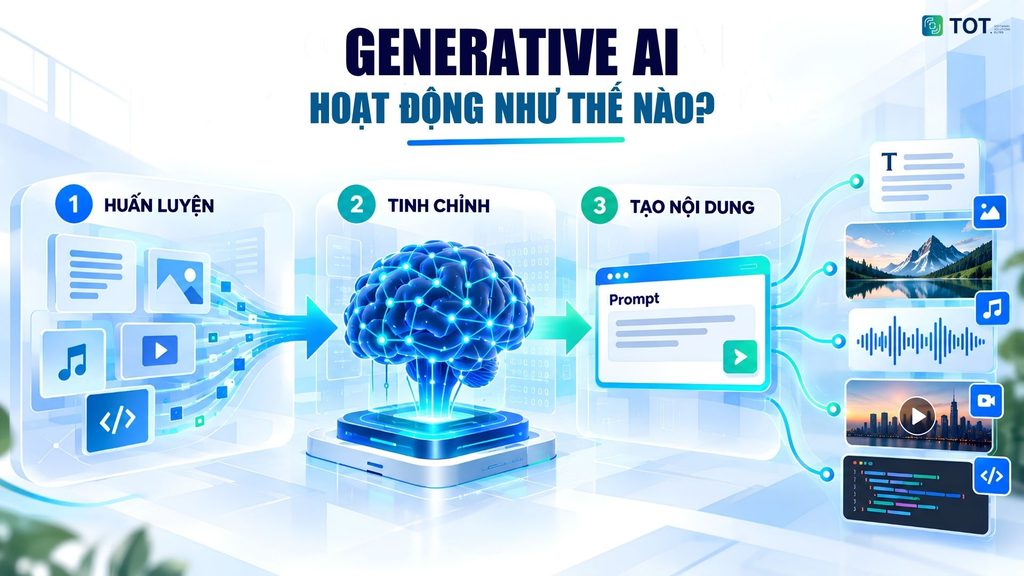
Generative AI typically goes through three main stages: training, fine-tuning and content generation. In the training stage, a deep learning model is trained on large amounts of data to recognize patterns and relationships among the elements in the data. For example, a language model learns to predict the next element in a sequence of text.
After that, the model can be fine-tuned for specific purposes. When a user enters a prompt, the system analyzes the request and uses what it has learned to generate suitable content. The results can be further evaluated and improved through fine-tuning.
>>> Read more:
- TOP 15 best AI report-writing tools
- TOP 15 free AI meeting note-taking tools
What can Generative AI create?
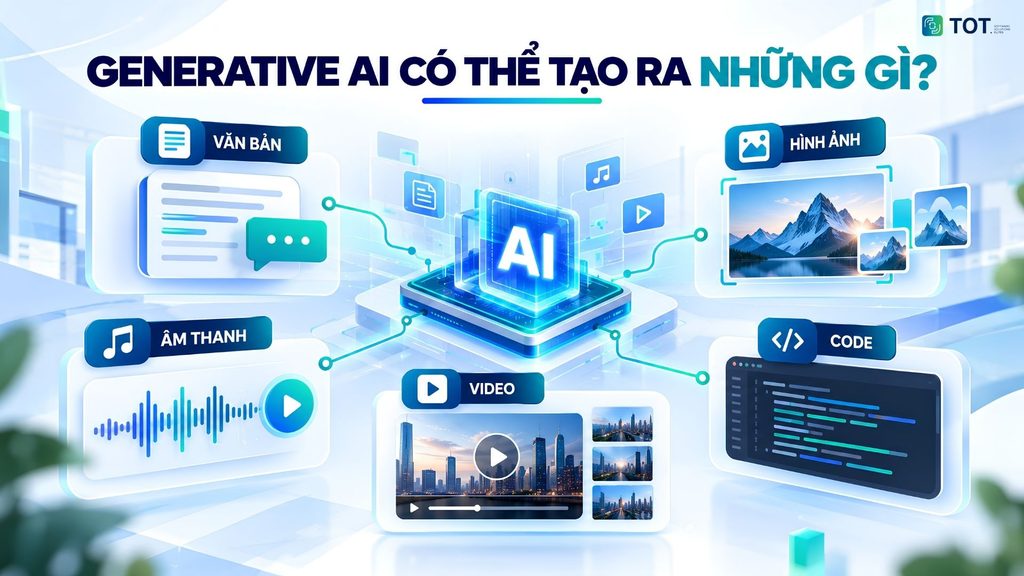
Generative AI’s content-creation capabilities are increasingly diverse:
- Text: Writing articles, summarizing documents, translating, answering questions or creating marketing content.
- Images: Generating images from text descriptions, editing or transforming images.
- Audio: Generating speech, sound and music.
- Video: Creating videos or motion scenes based on input content.
- Code: Generating source code, completing code snippets, converting between programming languages and assisting with debugging.
Thanks to their ability to handle many types of data, multimodal AI models can also take in one form of data and produce another. For example, a user can provide an image and ask the system to describe or analyze its content.
>>> Read more:
- How to compare computer vision models visually
- Vision language models & object detection: advantages & how to use them
How do Generative AI and traditional AI differ?
Generative AI still falls within the scope of artificial intelligence, but its goals and use have some notable differences:
| Criterion | Traditional AI | Generative AI |
| Goal | Classifying, recognizing, predicting or supporting decision-making | Creating new content based on data and input requests |
| Output | Labels, predictions, scores or decisions | Text, images, audio, video, code |
| Usage | Usually handles one specific problem or task | Can handle many types of requests and create many types of content |
| Example | Fraud detection, facial recognition, demand forecasting | Text-generating chatbots, AI image generation, AI video generation, AI code generation |
| Interaction | Usually based on predefined input data | Can interact through prompts in natural language |
Put simply, traditional AI usually answers the question “What is happening or might happen?”, while Generative AI focuses on “What content can be created from this request?”. However, the boundary between the two groups is not entirely absolute, since a modern system can combine analysis, prediction and generation within a single process.
>>> See more:
- An AI solution for recognizing customers at showrooms
- What is Kling AI? A guide to creating videos and images from text for free
- A simple guide to deploying AI in mobile apps
How do LLMs and AI Agents relate to artificial intelligence?
LLMs and AI Agents are both important concepts in the development of artificial intelligence, especially as AI shifts from handling individual tasks toward understanding language, generating content and carrying out multi-step processes. Although they are closely related, LLMs and AI Agents are not synonymous.
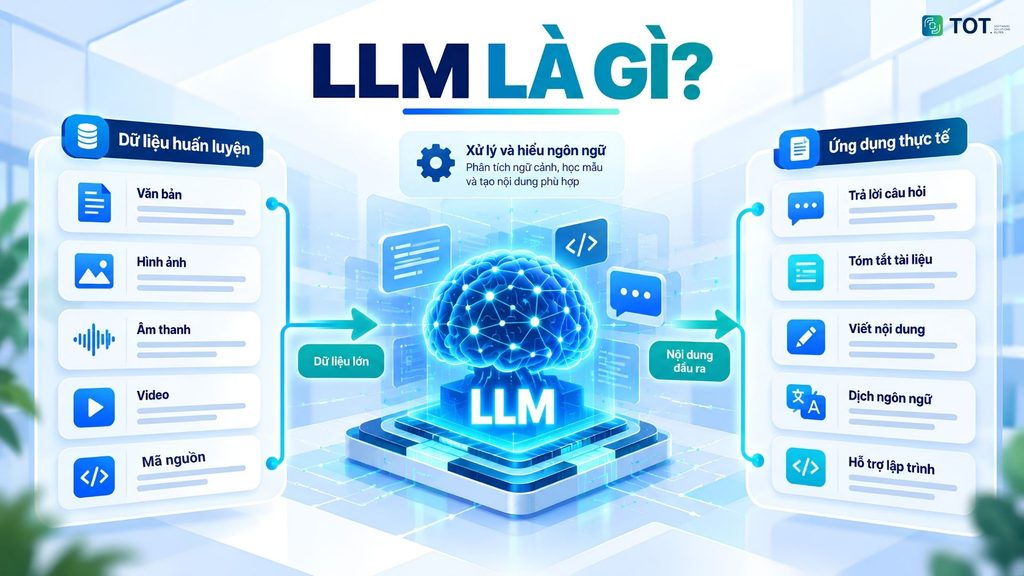
What is an LLM?
An LLM (Large Language Model) is an AI model trained on large amounts of data so that it can process and generate natural language. An LLM can understand text-based requests, analyze context and create suitable content.
Thanks to this capability, LLMs are applied to many tasks such as answering questions, summarizing documents, translating languages, writing content and assisting with programming. Modern LLMs can also be combined with data, tools and other interaction methods to extend their processing capabilities.
>>> See more:
- What is LLMs.txt? Should you use it?
- How to create prompts for LLMs in computer vision to improve accuracy
- Top 9 LLM monitoring tools to boost brand visibility
What is an AI Agent?
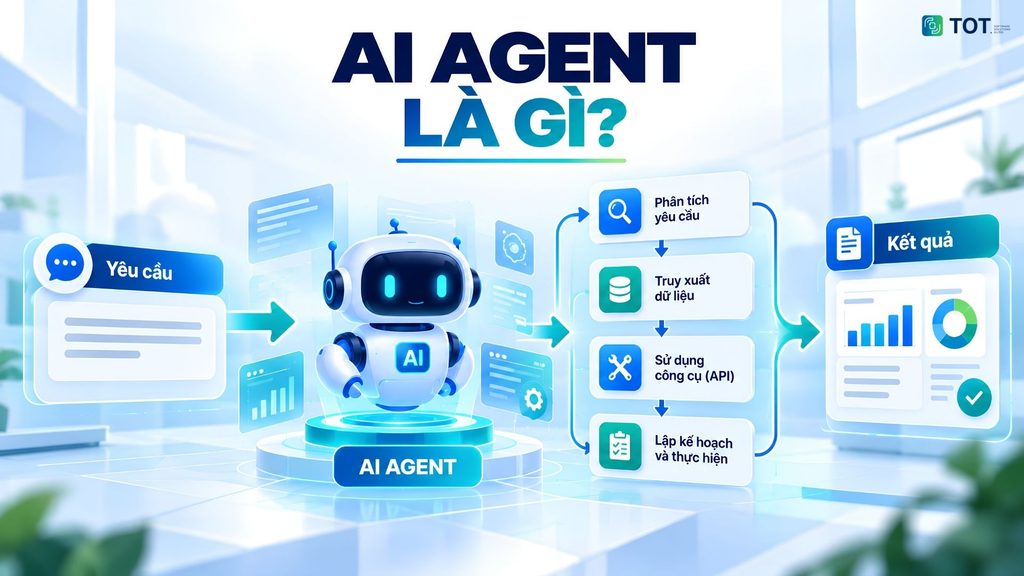
An AI Agent is an AI system designed to take a goal, analyze the request, plan, use the necessary tools and perform multiple steps to complete a task.
Instead of only generating an answer to a prompt, an AI Agent can break a task into smaller steps, retrieve data, call an API, interact with software or take actions according to the permissions granted. After each step, the system can take in the result and adjust its approach to continue working toward the goal.
For example, when asked to compile a revenue report, an AI Agent can retrieve data from the system, analyze the metrics, create the report and send the result to the person in charge.
>>> Read more:
- AI Agents for startups: benefits & real-world applications
- How businesses build AI Agents
The relationship between AI, Generative AI, LLMs and AI Agents
The relationship between these concepts can be pictured as the structure:
AI → Generative AI → LLM → AI Agent
However, this is a simplified way of picturing it rather than an absolute nested relationship. AI is the broadest scope, encompassing many different methods and technologies. Generative AI focuses on the ability to create new content. An LLM is a type of model able to process and generate language, and it can be used in Generative AI applications.
An AI Agent, meanwhile, is a system or architecture that can use an LLM together with memory, data and tools to carry out multi-step tasks. Thus, an LLM can be seen as the “language brain” of some AI Agents, while the Agent is responsible for orchestrating the process from goal to action to result.
>>> See more:
- What is human-in-the-loop? Applying HITL in high-risk AI
- How to easily build an AI app with vibe coding on Google AI Studio
Development trends in artificial intelligence
Artificial intelligence is shifting from specialized systems toward the ability to generate content, interact across multiple modalities, perform multi-step tasks and integrate deeply into business processes. Some notable trends include:
Generative AI continues to expand
Generative AI continues to be applied in content creation, data analysis, customer support, marketing and software development. Beyond generating text, AI can also produce images, audio, video and code, expanding its scope of application across many industries.
Multimodal AI
Multimodal AI can process multiple types of data at once, such as text, images, audio and video. This lets users interact with AI more naturally, for example by providing an image along with a question or asking the system to analyze content from multiple sources.
AI Agents and Agentic AI
AI is gradually shifting from answering individual requests toward carrying out sequences of tasks. AI Agents can take in a goal, plan, use tools, interact with systems and adjust their actions based on the results they receive.
AI Coding and AI Software Development
AI is increasingly being brought into the software development process to generate code, explain source code, detect bugs, write tests and support technical documentation. This trend helps developers reduce repetitive tasks and focus more on design, architecture and problem-solving.
Edge AI
Edge AI brings AI processing closer to where data is generated, such as IoT devices, cameras, phones or machines. This approach helps reduce latency, limit the transmission of data to central systems and support applications that need fast responses.
Personalized AI
AI will continue to be used to create experiences tailored to each user based on behavior, needs and context. From content recommendations to personal AI assistants, systems can increasingly adapt to each person’s goals.
AI Governance and Responsible AI
As AI is applied more widely, businesses need to focus on AI governance, security, privacy, transparency, risk control and responsibility in the use of AI. This is the foundation for deploying AI safely and sustainably.
AI deeply integrated into enterprise software
AI is gradually becoming a direct component of CRM, ERP, customer service software, data analytics systems and operational platforms. Rather than using AI as a standalone tool, businesses tend to integrate AI into existing processes to automate and improve operational efficiency.
>>> Learn more:
- AI search trends for 2026 and strategies to adapt
- 29 standout AI website templates for SaaS, e-commerce and many other fields
How can businesses apply artificial intelligence?
To apply artificial intelligence effectively, businesses should not start by choosing a specific AI tool but rather from their business problem, data and existing processes. A deployment process can include the following steps:
Identify the problem to apply AI to
First, a business needs to identify which processes consume a lot of time or staff, or are hard to handle manually. This could be customer service, data analysis, demand forecasting, document processing, quality inspection or automating repetitive tasks. The more specific the goal, the easier it is to choose an AI solution and evaluate its effectiveness.
Standardize the data
Data is the foundation of an AI system. Businesses need to identify the data they have, check its quality, remove duplicate data and build suitable management processes. For customer data or internal data, access control and security must be maintained throughout its use.
Choose the model and technology
Depending on the problem, a business can choose Machine Learning, Generative AI, Computer Vision, NLP or AI Agents. Not every case requires building an AI model from scratch. Using an existing model, fine-tuning a model or developing a custom model should be weighed based on data, accuracy, cost and security requirements.
Integrate AI into existing systems
AI should be integrated into the processes and software a business already uses rather than operating separately. For example, AI can connect to CRM, ERP, websites, mobile apps or internal systems through an API or a dedicated module. This approach helps businesses leverage existing data and infrastructure and makes it easier to scale.
Evaluate effectiveness and scale up
After deployment, businesses need to track metrics such as processing time, operating cost, accuracy, productivity or customer satisfaction. Based on real results, the system can be optimized and expanded to other processes.
If your business is looking for ways to apply AI to its processes or develop custom AI software, TOT can help with everything from analyzing the problem and building the solution to integrating and operating the system. Explore TOT’s AI software development service to find an approach that fits your business’s real needs.
>>> See more services from TOT:
- Website design with AI
- Mobile app design with AI
- UI/UX design and CRO optimization with AI

Conclusion
Artificial intelligence is becoming an important technology, applied ever more widely from data analysis, automation and customer service to software development and optimizing business operations. Alongside benefits in productivity and efficiency, AI also raises requirements around data, security, accuracy and risk management. Therefore, businesses need to identify the right problem, choose suitable technology and deploy AI in stages to create real, sustainable value.
Frequently asked questions about artificial intelligence
What is the concept of artificial intelligence?
Artificial intelligence (AI) is the field of computer science focused on developing systems capable of performing tasks that usually require human cognitive abilities. AI can process data, recognize images, understand language, analyze information, make predictions and support decision-making. Today, AI is applied in many fields such as customer service, finance, healthcare, marketing, manufacturing, education and software development.
What does artificial intelligence do?
Artificial intelligence helps machines perform or support tasks that require analysis, recognition, prediction and decision-making. Depending on its purpose, AI can analyze data, recognize faces, process language, detect fraud, forecast demand or create content. In business, AI is also used to automate repetitive work, support employees and personalize the customer experience.
What is artificial intelligence programming?
Artificial intelligence programming is the process of building software and systems that can learn from data, recognize patterns, make predictions or perform intelligent tasks. This work usually uses languages such as Python along with suitable AI libraries and platforms. Depending on the problem, developers can build Machine Learning or Deep Learning models, natural language processing or Computer Vision, or integrate existing AI models into software.
What is artificial intelligence used for?
Artificial intelligence is used to automate work, analyze data, predict trends and support human decision-making. AI can help businesses handle customer requests, detect fraud, forecast revenue, personalize content and optimize operational processes. In everyday life, AI appears in virtual assistants, content recommendation systems, maps, language translation, image recognition and many other familiar applications.
What do you study in an artificial intelligence program?
An artificial intelligence program focuses on knowledge of programming, mathematics, data and AI technologies. Students usually learn foundations such as data structures and algorithms, probability and statistics, Machine Learning, Deep Learning, natural language processing and Computer Vision. Beyond theory, the curriculum may also include building models, processing data and developing real-world AI applications.
How does artificial intelligence show up in everyday life?
Artificial intelligence appears in many products and services people use every day. Some common examples include virtual assistants, film and music recommendation systems, maps and traffic forecasting, facial recognition, language translation, chatbots and content-generation tools. In these applications, AI can analyze data and user behavior to deliver results, predictions or responses suited to each situation.
Can artificial intelligence replace humans?
Artificial intelligence can replace some specific tasks but does not mean it will replace humans entirely. AI is especially well suited to repetitive work, processing large volumes of data or tasks that need fast responses. Meanwhile, many tasks still require human judgment, creativity, communication, responsibility and contextual understanding. Therefore, AI’s impact usually depends on each job, task and how the business deploys the technology.
References:
- What is Artificial Intelligence (AI)? | Google Cloud
- What Is Artificial Intelligence (AI)? | IBM