
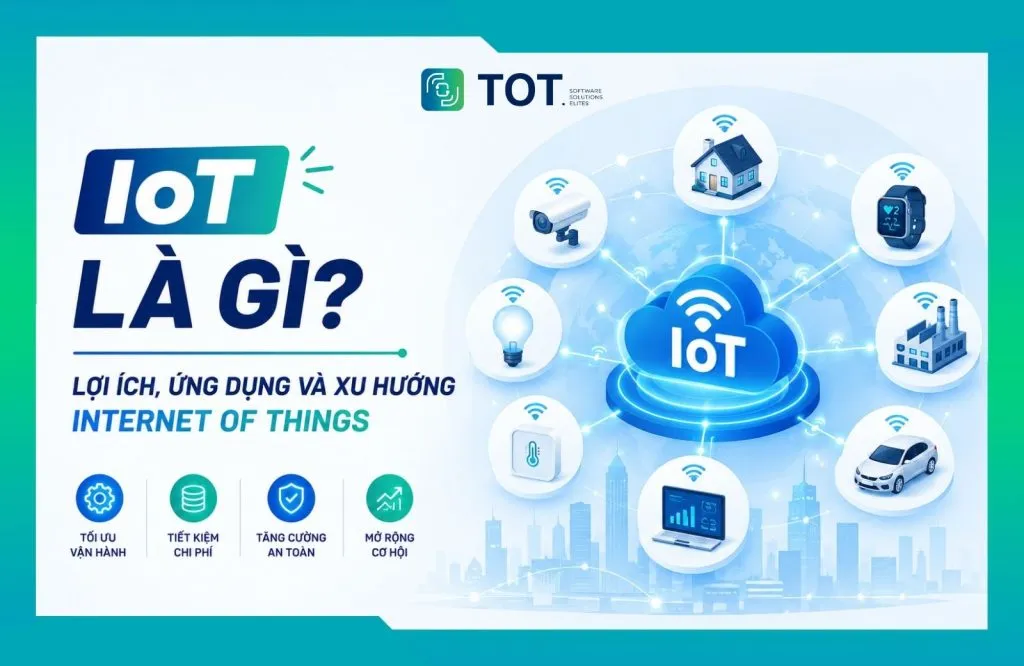
What is IoT? IoT (Internet of Things) is a network of devices connected to the Internet to collect, transmit and exchange data. From smart homes, factories and healthcare to logistics, this technology is laying the foundation for automation and data-driven operations. In this article, TOT helps you clearly understand the concept, how it works, its benefits, its applications and the IoT trends worth watching.
>>> See more articles:
- TOP 15+ large, reputable software companies in Vietnam
- 15+ free, easy-to-use Android app design software tools
- Top 15 free, effective manufacturing warehouse management software solutions
- 9+ of the easiest-to-use free mobile app design tools
Quick summary
- What is IoT? IoT (Internet of Things) is a network of physical devices connected to the Internet to collect, transmit, exchange and process data. These devices can be sensors, cameras, smartwatches, home appliances, vehicles or industrial machinery.
- A basic IoT architecture typically consists of 4 components: devices and sensors → gateway and connectivity system → Edge/Cloud platform → software and user interface.
- How does IoT work? The basic process is: Data collection → Data transmission → Processing and analysis → Taking action. Sensor data can be processed in the Cloud, with Edge Computing, Big Data or AI/ML before the system sends alerts, controls devices or automates processes.
- The core technologies behind IoT include sensors and connectivity technologies such as RFID, Bluetooth, Zigbee, LoRaWAN and 5G, along with Cloud Computing, Edge Computing, Big Data, AI and security solutions.
- Real-world applications of IoT are highly diverse, ranging from Smart Home, Smart Factory, healthcare and smart agriculture to transportation, logistics, retail and smart cities.
- The benefits of IoT include process automation, optimized operating costs, real-time data monitoring, higher productivity, support for data-driven decision-making and a better customer experience.
- Future IoT trends will be more closely tied to AIoT, Edge AI, 5G, Smart Factory, Digital Twin, Big Data and Cloud. IoT systems will gradually shift from a model that only connects and monitors to one that can predict and act automatically.
What is IoT?
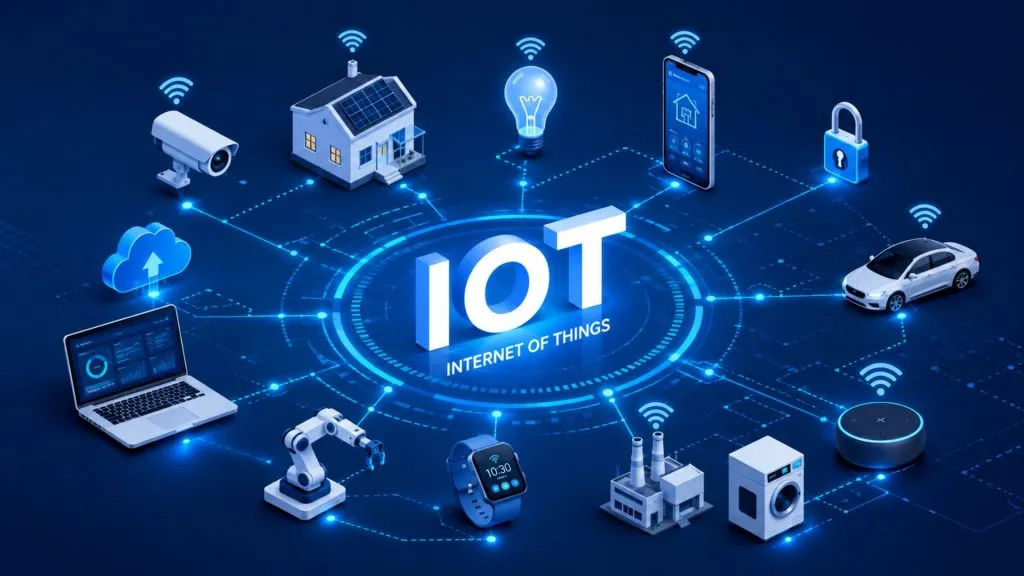
IoT stands for Internet of Things, a network of physical devices fitted with sensors and connected to the Internet to collect, transmit and exchange data. The term Internet of Things describes an ecosystem in which everyday objects no longer operate in isolation but can communicate with one another and with a central system.
The word “Things” in the name refers to any object that can be digitized and connected, such as a wristwatch, a camera, a car, machinery on a factory floor or an environmental sensor. According to definitions commonly used by international organizations, IoT creates a connected environment linking physical objects, systems and services through information and communication technology.
The fundamental difference between IoT and the traditional Internet lies in what is being connected. The traditional Internet mainly serves people exchanging information via computers and phones, whereas IoT aims to let the devices themselves automatically sense, send and receive data without constant manual intervention.
An IoT device or system typically has four basic characteristics: it can sense its environment through sensors, connect to a network, process data to some degree and carry out actions. As a result, IoT creates a closed-loop flow from Things to the Internet, then to Data and finally to Action.
>>> See more:
- 10 free 3D house design software options for phones and computers
- Top 20+ best free AI image design software tools
The history and development of IoT
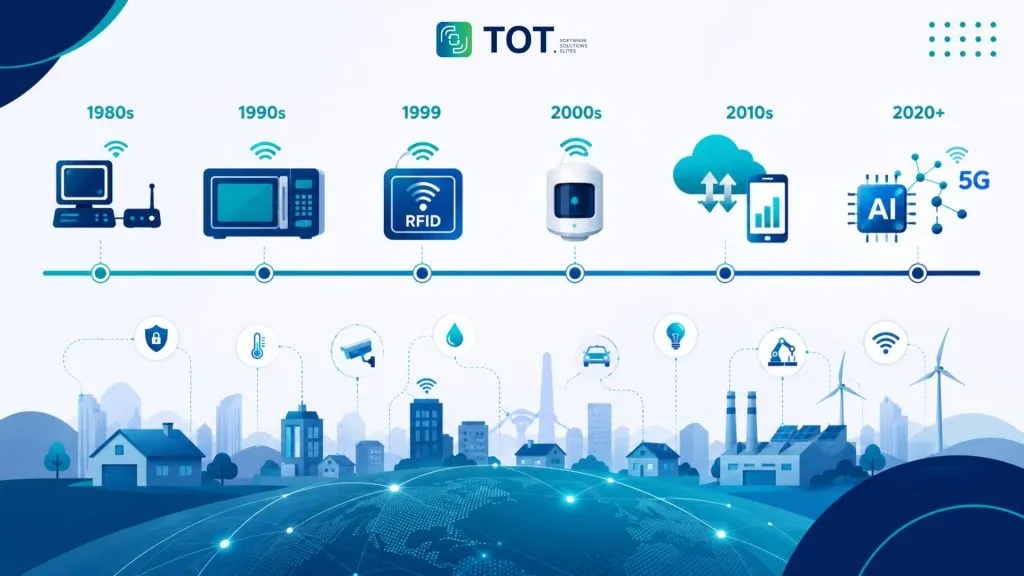
The history of the Internet of Things (IoT) began with the idea of connecting physical devices to computer networks so they could exchange information automatically. Over several decades, advances in the Internet, sensors, cloud computing and artificial intelligence have taken IoT from an experimental concept to a key foundation of digital transformation.
- The 1980s: The first rudimentary networked devices appeared. One frequently cited example is a vending machine at Carnegie Mellon University that could report its status and the temperature of its drinks remotely.
- 1990: Scientist John Romkey introduced a toaster that could be controlled over the Internet, demonstrating the ability to connect to and control a device remotely.
- 1999: Kevin Ashton first used the term Internet of Things in the context of research on RFID and supply chains. This is regarded as a key milestone in shaping the modern concept of IoT.
- The 2000s: RFID, sensors, wireless networks and microprocessors advanced steadily, making it more feasible to connect devices and expanding IoT applications into many fields.
- The 2010s: Cloud Computing, smartphones and Big Data gave IoT a major boost. Businesses could connect and manage millions of devices and analyze data at large scale.
- From the 2020s to today: IoT is integrating more deeply with AI, Edge Computing and 5G. This convergence gives rise to AIoT, enabling systems not only to collect data but also to analyze, predict and make decisions automatically and more quickly.
From its beginnings as standalone connected devices, IoT has become an important technology ecosystem that supports building smart homes, smart factories, smart cities and data-driven operating models.
>>> See more:
- Top 17 graphic design apps leading the way for professionals
- Top 20 most reputable app design companies, No. 1 in Vietnam
What does the architecture of an IoT system consist of?
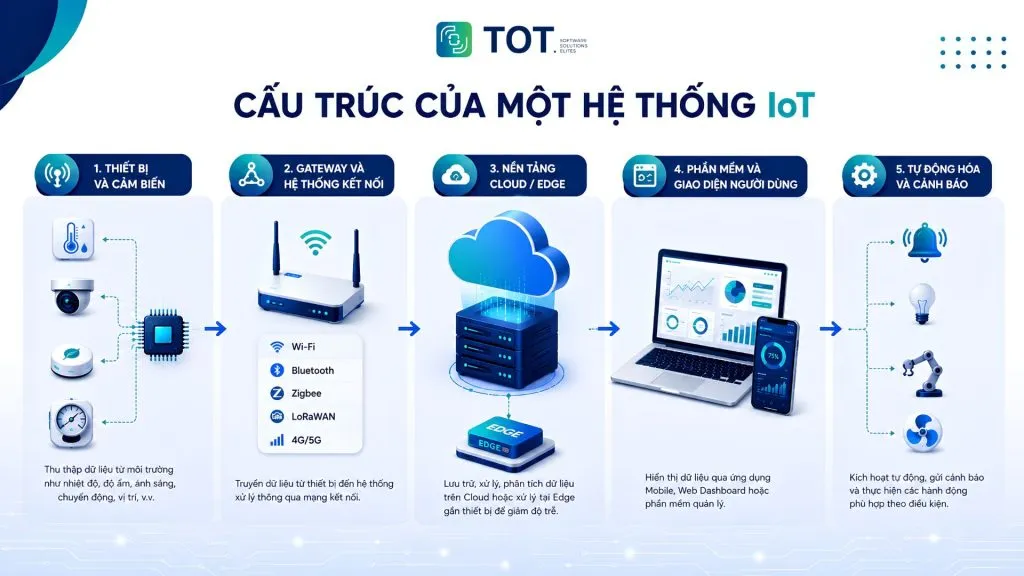
A complete IoT system is organized into several layers, each with its own role, working together to turn data from the real world into concrete actions. In essence, an IoT architecture consists of four layers: devices and sensors; gateway and connectivity; the Cloud or Edge platform; and finally software and the user interface.
Devices and sensors
This is the first layer of an IoT system, where data is generated or physical actions are carried out. A sensor is responsible for collecting information from the environment, such as temperature, humidity, light, motion, location or air quality. This data is converted into signals that the system can process.
Conversely, an actuator executes commands from the system, such as turning on the air conditioner, closing a water valve, adjusting a motor or switching on a light. The microcontroller is the device’s central controller, responsible for reading data from sensors, handling basic tasks and sending information over the network.
Depending on the application, an endpoint device may be a temperature sensor, a motion sensor, a surveillance camera, a smartwatch, a home appliance or industrial machinery. These are the “things” in the Internet of Things.
Gateway and connectivity system
Once collected, data needs to be transmitted to the processing system over a network. The gateway acts as the bridge between endpoint devices and the central platform. A gateway can aggregate data from multiple devices, convert protocols, perform preliminary processing and forward data to the Cloud or an Edge system.
Depending on distance, speed, power consumption and the deployment environment, an IoT system can use a variety of connectivity technologies. Wi-Fi suits environments with existing network infrastructure that need relatively high data transfer rates. Bluetooth is commonly used for short-range, low-power devices.
Zigbee is well suited to networks with many devices, especially in smart homes. LoRaWAN, meanwhile, supports long-range data transmission with low power consumption, making it a good fit for agriculture, smart cities and asset monitoring. 4G/5G lets IoT devices connect over wide areas, particularly vehicles, mobile devices or systems that require low latency.
Cloud/Edge platform
The Cloud and Edge platform is where data is stored, processed and analyzed, and where devices are managed. The Cloud offers virtually unlimited storage along with powerful computing capacity for analyzing historical data and training models. Edge Computing processes data close to the device to reduce latency and save bandwidth, which is especially useful in situations that demand an immediate response. Beyond storage and analytics, this layer also handles device lifecycle management, remote software updates, access control and monitoring the connection status of the entire system.
Software and user interface
The final layer lets people interact with the entire IoT system. Once processed, data can be displayed through a Mobile App, a Web Dashboard or a dedicated management system.
Users can track device status, view real-time data, analyze operating history and control devices remotely. For example, a factory manager can use a dashboard to monitor machine performance, while a smart home user can turn on the lights or adjust the air conditioning from a phone app.
The software can also set up automation rules and automatic alerts. When the temperature exceeds a threshold, a machine behaves abnormally or a device loses its connection, the system can send a notification and trigger the appropriate response process.
Overall, an IoT architecture follows this flow: sensors → connectivity → Edge or Cloud → software, forming a closed loop from collection to action. The right architecture helps businesses collect data effectively, automate operations and gradually build a data-driven decision-making model.
>>> See more:
- Construction ERP explained: features & the top 10 construction ERP software solutions
- Top 10 best maintenance booking system software for car service
How does IoT work?
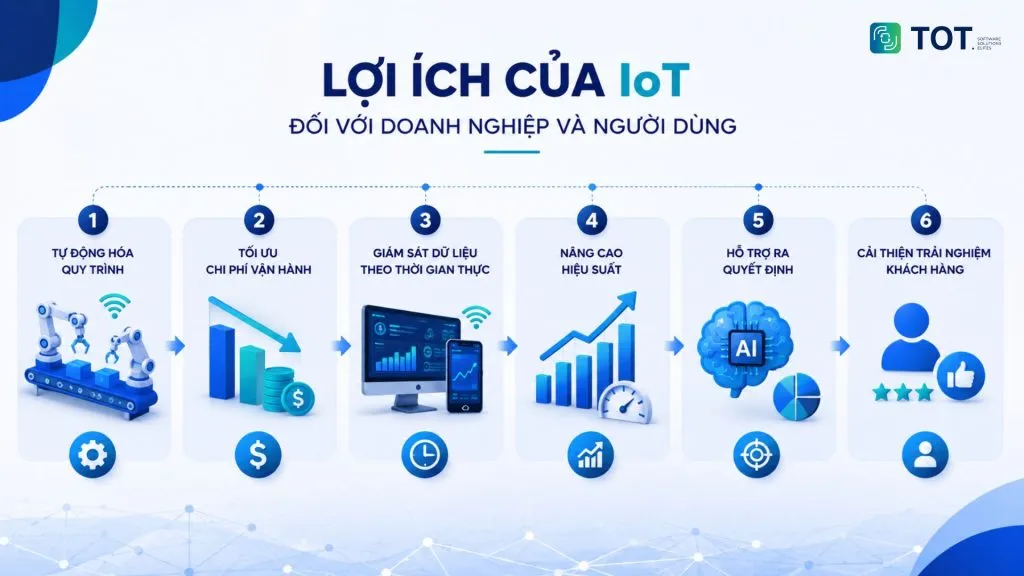
IoT operates through a closed-loop process of 4 steps that turns data from the real world into concrete actions. This process repeats continuously, allowing the system to respond in real time to changes in the environment.
Step 1 – Collecting data
In the first step, sensors on the device collect data from the surrounding environment. Depending on the application, the data may be temperature, humidity, location, motion, images, sound or the device’s operating status. This is the raw data that reflects actual conditions and serves as the input for the entire process. The quality and accuracy of the sensors at this step directly affect the value of the analysis that follows.
Step 2 – Transmitting data
Once collected, the data is transmitted over the network to a gateway, Edge or Cloud. Transmission uses the connectivity standards suited to each scenario, from Wi-Fi, Bluetooth and Zigbee for short range to LoRaWAN, 4G and 5G for long distances. At this step, stability, bandwidth and transmission security are crucial, because the data must reach the processing point intact and secure.
Step 3 – Processing and analyzing data
Once the data reaches the processing point, the system analyzes it to extract valuable information. This process can rely on Cloud Computing to handle large volumes, Edge Computing for fast on-site responses, Big Data to aggregate data at scale, or AI and Machine Learning to identify trends and make predictions. The result of this step is insight that helps detect anomalies, forecast incidents or optimize operations, rather than just disconnected numbers.
Step 4 – Taking action
Based on the analysis results, the system takes the appropriate action. This may mean sending an alert to an operator, controlling an actuator, automating a process or providing information to support human decision-making. It is this step that closes the IoT loop, turning data into real value and helping the system operate more and more intelligently over time.
Example of how IoT works in practice
A simple example is a smart air conditioner. A temperature sensor continuously measures the room temperature and sends the data to a gateway or directly to the Cloud. The system analyzes the data, compares it with the temperature the user has set and then sends a control command back to the device.
Temperature sensor → Gateway → Cloud → Data analysis → Air conditioner adjusts itself
If the room temperature rises above the set level, the air conditioner can automatically start cooling. Once the temperature reaches the desired threshold, the system reduces power or switches operating mode. This cycle keeps repeating, allowing the device to run automatically and more efficiently.
In short, how IoT works can be understood simply as turning data from the physical world into information that can be analyzed, then turning the results of that analysis into real-world action. This is the foundation that enables IoT to support automation and build smart operational systems.
>>> See more:
- Mobile app design costs and app maintenance: what are the latest prices in 2026?
- Professional custom software development in Ho Chi Minh City at a fair price
- Professional custom software development in Hanoi services
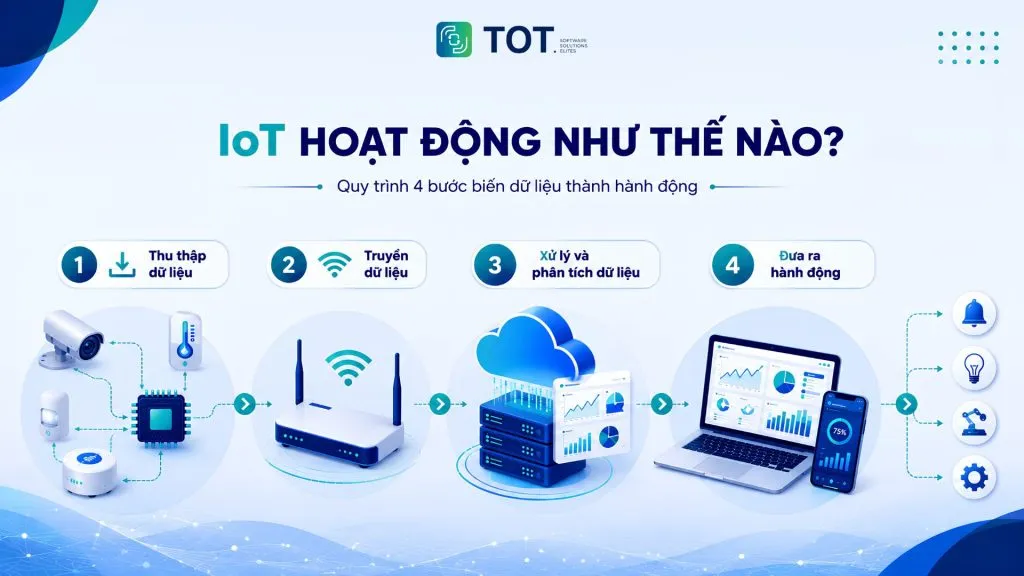
The core technologies behind IoT
IoT is not a single technology but the convergence of several technology groups. The four foundational groups below work together to form a complete system, from data collection to analysis and protection.
Sensor and connectivity technologies
Sensor and connectivity technologies are the foundation that enables IoT devices to collect and transmit data. Sensors convert physical quantities into digital signals, while RFID allows objects to be identified and tracked. Connectivity standards such as Bluetooth, Zigbee, LoRaWAN and 5G handle data transmission, each with different characteristics in terms of range, speed and power consumption.
For example, sensors combined with LoRaWAN are often used for wide-area monitoring in agriculture or cities, while 5G suits applications that require high bandwidth and low latency, such as connected vehicles.
Cloud and Edge Computing
Cloud and Edge Computing handle data storage and processing at two complementary locations. The Cloud serves as the central hub for storing big data, managing devices and running complex analytics on historical data. Edge Computing processes data right next to the device, helping reduce latency and ease the load on the network.
This combination allows the system to respond instantly on-site while also tapping into the powerful computing capacity of the cloud. In many solutions, moving processing to the edge is the deciding factor for scenarios that require real-time performance.
AI and Big Data
AI and Big Data are the technology group that moves IoT from monitoring to intelligent analysis. Big Data helps collect and process the enormous volumes of data generated by large numbers of devices, while artificial intelligence and Machine Learning help identify trends, detect anomalies, make predictions and make decisions automatically.
When AI capabilities are brought into an IoT system, it is called AIoT, or the Artificial Intelligence of Things. This combination allows devices not only to report their status but also to proactively suggest actions, for example, predicting when machinery needs maintenance before a breakdown occurs.
IoT security technologies
IoT security technologies protect data and devices against the risk of cyberattacks. The core measures include encrypting data at rest and in transit, authenticating devices so that only valid devices can connect, controlling access rights and securing the network infrastructure. Because IoT involves countless distributed devices, each of which can become a weak point, security must be designed into the architecture from the start rather than added later.
Viewed as a whole, the IoT technology ecosystem operates as a linked chain: sensors → connectivity → Edge or Cloud → Big Data and AI → applications, with security spanning every layer.
>>> See more:
- Free computer vision software: easy-to-use platforms
- Top 5 home design apps that are free, high-quality and the best around
- Professional, reputable custom software development services
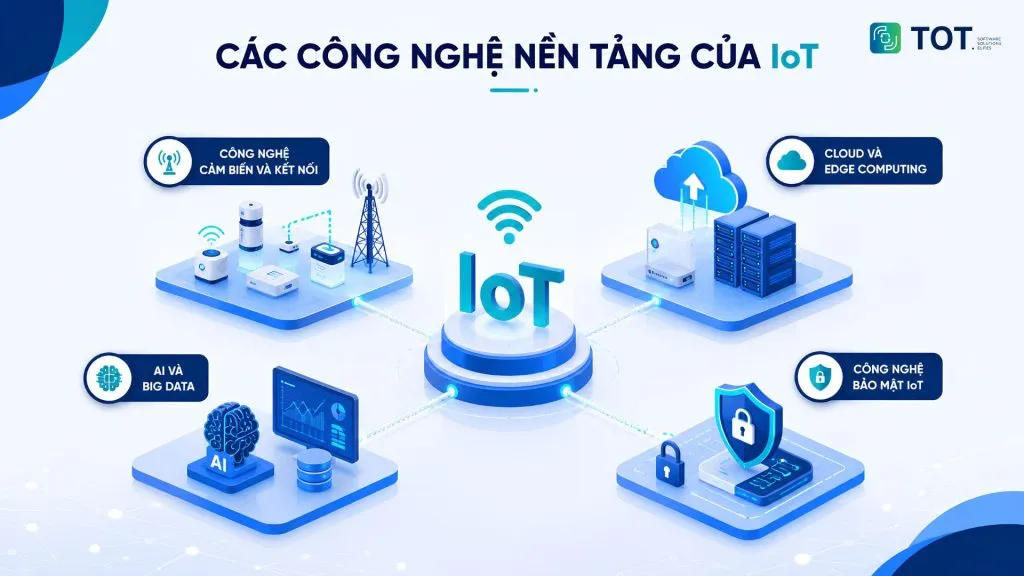
Real-world applications of IoT
IoT is present across many fields and creates clear value for both businesses and users. Below are the most representative application areas, along with illustrative examples.
Smart home
In a smart home, IoT connects devices to create a more convenient and secure living experience. Users can control cameras, smart door locks, lights, air conditioners and security sensors from their phones, and set up automated scenarios.
For example, when a sensor detects that someone has arrived home, the system can automatically turn on the lights, unlock the door and adjust the temperature. If a security sensor detects unusual movement while no one is home, the system immediately sends an alert with images to the homeowner’s app.
Manufacturing – smart factories
In manufacturing, IoT is the foundation of smart factories and Industry 4.0. Sensors mounted on machinery help monitor operating conditions, support predictive maintenance, track production lines and control quality in real time. IoT data is often connected to a manufacturing execution system (MES) to manage production operations closely.
For example, when a sensor detects someone entering a room, the system can automatically turn on the lights and adjust the air conditioning to the preset temperature. Cameras and door sensors can also send alerts as soon as they detect unusual activity.
Healthcare
In healthcare, IoT supports continuous health monitoring and remote care. Wearables and connected medical devices can measure heart rate, blood pressure, blood oxygen levels or blood glucose, then send the data to doctors. The Remote Patient Monitoring model helps detect early warning signs without requiring patients to visit a medical facility frequently.
For example, a wristband monitoring a patient with a chronic condition can alert family members and medical staff when a reading exceeds a safe threshold.
Smart agriculture
In smart agriculture, IoT enables precision farming and helps conserve resources. Sensors that measure soil moisture, temperature and weather conditions supply the data automated irrigation systems need to run at the right time with exactly the right amount of water. As a result, farmers can monitor their crops and field conditions right from their phones.
For example, when sensors register low soil moisture, the system automatically starts irrigation and stops once the appropriate level is reached, saving water and improving yields.
Transportation and logistics
In transportation and logistics, IoT optimizes the management of vehicles and goods. Fleet Management solutions use GPS to track vehicle location, routes and condition, while sensors help track goods, manage containers and control temperature during transport.
For example, for frozen goods, temperature sensors installed inside containers continuously send data back to a central hub and raise an alert the moment the temperature drifts outside the allowed range, so the issue can be handled promptly and product quality is protected.
Retail
In retail, IoT supports merchandise management and helps retailers understand customer behavior. Smart Shelves combined with RFID technology track inventory in real time, send alerts when items are running low and reduce stock-counting errors. Sensor data also helps analyze shopping behavior so products can be arranged more effectively.
For example, an RFID system automatically updates the quantity of goods on shelves and in the warehouse, helping stores restock on time and avoid both stockouts and excess inventory.
Smart city
In a smart city, IoT is used to improve quality of life and the efficiency of urban management. Sensors and connected devices help regulate traffic, manage public lighting, monitor air quality, guide drivers to parking spaces and manage energy.
For example, smart streetlights automatically adjust their brightness to the flow of people and vehicles, while parking sensors help drivers quickly find an open space, easing congestion and saving energy across the whole city.
>>> See more:
- How to build an app with AI for free: a simple, detailed guide
- TOP 15 best AI coding tools
- TOP 20+ leading AI design tools for designers today
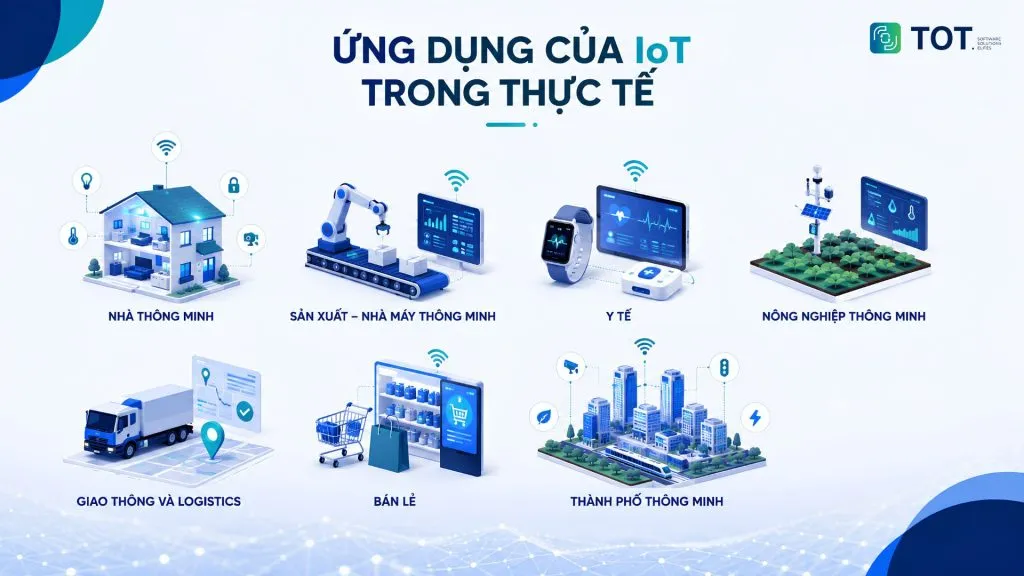
Benefits of IoT for businesses and users
IoT delivers many practical benefits, helping businesses operate more efficiently and giving users a better experience. The six benefits below are the most notable.
Process automation
IoT makes it possible to automate many tasks that used to be done manually. When devices can sense and respond on their own according to predefined rules, businesses cut down on repetitive work and reduce human error.
For example, sensors can automatically trigger the irrigation system when soil moisture drops or adjust the temperature when environmental conditions change. Within a business, automation makes operating processes faster and more consistent.
Optimizing operating costs
IoT helps cut costs by using resources efficiently and preventing waste. Energy monitoring, predictive maintenance and operational optimization reduce consumption and help avoid costly incidents.
For example, energy sensors detect equipment with abnormal power consumption, allowing businesses to make timely adjustments and save on their monthly electricity bills.
Real-time data monitoring
IoT makes it possible to track status anytime, anywhere. With a continuous stream of data, managers know how operations are running the moment something changes and can respond quickly to incidents.
For example, a dashboard displays the status of an entire production line in real time, so bottlenecks are spotted as soon as they appear instead of at the end of the shift.
Improving performance and productivity
IoT helps improve performance by pinpointing what needs to be optimized and reducing downtime. When machinery and processes are closely monitored, businesses can run smoothly and make full use of their capacity.
For example, operational data shows which stage is running slowly, so managers can allocate resources appropriately to increase output.
Supporting data-driven decision-making
IoT provides real-world data as a basis for decisions. Instead of relying on gut feeling, businesses can analyze objective data to plan and adjust their strategies.
For example, data on equipment usage and seasonal demand helps businesses forecast output and prepare resources more accurately.
Improving the customer experience
IoT helps businesses understand and serve their customers better. Device data makes it possible to personalize services, respond quickly and maintain consistent quality.
For example, an equipment provider can reach out with support as soon as it detects that a customer’s device is about to malfunction, delivering proactive care instead of waiting for the customer to report a problem.
>>> See more:
- TOP 15+ AI app builder tools that are effective and super easy to use
- TOP 50+ most popular free AI tools today
Limitations and challenges of IoT
Alongside its benefits, deploying IoT also comes with a number of challenges that businesses need to weigh carefully. Below are the most common limitations.
- Security and privacy risks: every connected device is a potential point of attack, and the data collected is often sensitive. Without proper protection, an IoT system can easily become a target for hackers and lead to data leaks.
- Deployment and maintenance costs: the upfront investment in devices, infrastructure and integration can be substantial, not to mention the cost of maintaining, updating and replacing devices throughout the system’s lifecycle.
- Compatibility between devices: the IoT market has many manufacturers and different connectivity standards, which makes integrating heterogeneous devices and platforms complex.
- Managing large volumes of data: IoT systems generate enormous amounts of data, requiring matching storage, processing and analytics capacity for that data to deliver real value.
- Dependence on network infrastructure: IoT relies on continuous connectivity, so when the network goes down, monitoring and control can be disrupted.
- Difficulty scaling the system: managing anywhere from thousands to millions of devices requires an architecture built to scale from the outset; otherwise, scaling up later will be costly and complex.
These challenges do not negate the value of IoT, but they show that businesses need a clear strategy and an experienced implementation partner to minimize risk.
Distinguishing between IoT, IIoT and AIoT
IoT, IIoT and AIoT are three closely related concepts, but they differ in scope and objectives.
- IoT (Internet of Things) is the broadest concept, covering devices connected to the Internet to collect, transmit and exchange data. IoT can be applied in smart homes, healthcare, retail, agriculture, transportation and many other fields.
- IIoT (Industrial Internet of Things) is a branch of IoT focused on industrial environments. IIoT systems typically connect machinery, production lines and industrial equipment to enable real-time monitoring, reduce downtime and optimize operational performance.
- AIoT (Artificial Intelligence of Things) is the combination of IoT and artificial intelligence. While IoT mainly helps collect data, AIoT helps systems understand and make use of that data to identify trends, detect anomalies, make predictions and take automated action. This is also one of the most important directions in which IoT technology is developing today.
The table below compares the three concepts by scope, objective, technology and examples to make the differences clear.
| Criteria | IoT | IIoT (Industrial IoT) | AIoT (AI + IoT) |
|---|---|---|---|
| Scope | Consumer and household devices in general | Industrial environments, factories, infrastructure | IoT systems integrated with artificial intelligence |
| Objective | Connectivity, convenience and basic automation | Optimizing operations, boosting productivity and ensuring production safety | Intelligent analysis and automated decision-making |
| Technology | Sensors, Wi-Fi, Bluetooth, Zigbee, Cloud | Industrial sensors, industrial networks, SCADA, Edge | IoT combined with AI, Machine Learning and Edge AI |
| Examples | Smart homes, wearables, smart lights | Machine monitoring, predictive maintenance in factories | AI cameras for image analysis, smart predictive maintenance |
Future development trends in IoT
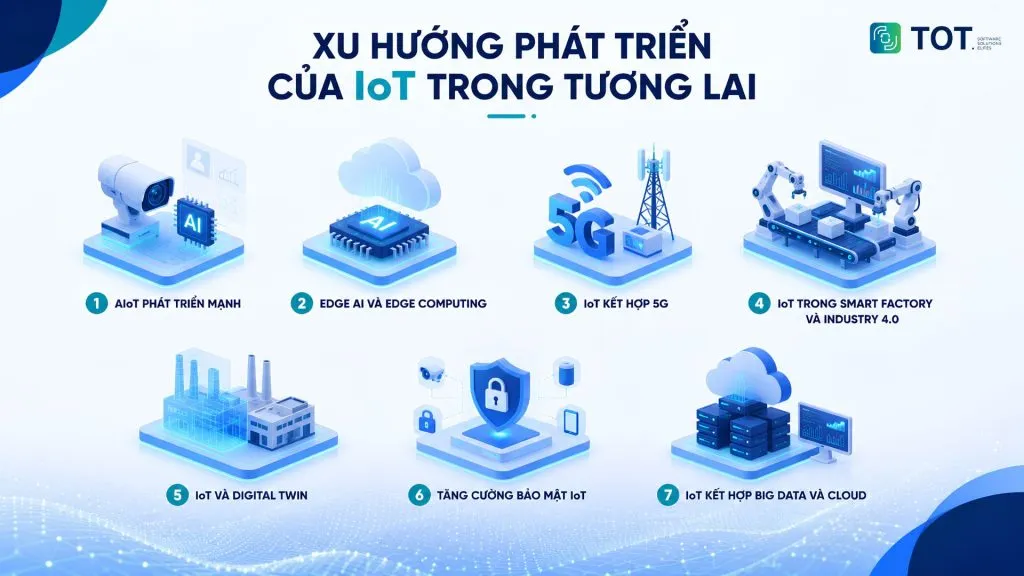
IoT continues to evolve rapidly and is closely tied to many emerging technologies. The trends below are shaping the future of the Internet of Things, each presented with its impact and a concrete application example.
AIoT is growing strongly
AIoT combines IoT with artificial intelligence, making the data from devices more valuable. AI/ML can recognize patterns, detect anomalies and predict trends.
For example, an AIoT camera in a factory can automatically detect product defects instead of simply capturing images for a human to inspect.
Edge AI and edge computing
The shift toward processing at the edge is becoming increasingly clear, as it reduces latency and improves privacy. Edge AI makes it possible to run artificial intelligence models directly on a device or gateway, enabling instant responses and reducing reliance on the cloud.
For example, a monitoring device can analyze images on-site and send only the important results to the Cloud, saving bandwidth and better protecting data.
IoT combined with 5G
5G networks make it possible to connect more devices with low latency and high bandwidth. This accelerates applications that require instant responses and a high density of devices.
For example, in smart cities and connected vehicles, 5G can transmit large volumes of sensor data in near real time, supporting traffic coordination and safe operations.
IoT in smart factories and Industry 4.0
IoT will remain a key foundation of the Smart Factory and Industry 4.0. Sensors and connected devices help businesses monitor machinery, track production lines and implement predictive maintenance.
For example, combining IoT data with a manufacturing execution system lets a factory track the performance of each production stage and optimize its production plan based on actual demand.
IoT and digital twins
A digital twin is a virtual model that mirrors a real device or system and is continuously updated with IoT data. This allows businesses to simulate, predict and optimize before making changes in the real world.
For example, a digital twin of a production line makes it possible to test new ways of operating in a virtual environment, reducing risk when they are applied on the ground.
Stronger IoT security
As the number of devices grows rapidly, IoT security is receiving more and more attention and has become a mandatory requirement. The trend of designing security into the architecture from the start, combined with encryption, strong authentication and continuous monitoring, helps minimize risk.
For example, modern IoT systems automatically detect unknown devices connecting to the network and isolate them to stop an attack from spreading.
IoT combined with Big Data and the cloud
IoT remains closely tied to Big Data and Cloud to get the most value out of data. Cloud platforms provide flexible storage and computing capacity, while Big Data makes it possible to analyze large-scale data from countless devices.
For example, a business aggregates data from multiple factories in the Cloud to analyze overall trends and make operational decisions at the level of the entire system.
>>> Learn more:
- AI Agents for Startups: Benefits & Real-World Applications
- Common workflows for AI Agents: How the work gets done
Should businesses adopt IoT?
Businesses should consider adopting IoT when their operations have a clear need for monitoring, data collection and automation. IoT works best when it solves a specific problem and delivers measurable value, rather than being adopted just to follow a trend. The checklist below helps assess whether it is a good fit.
- You have many devices or machines whose operating status needs to be monitored.
- You need to collect real-time data to support day-to-day management.
- You want to automate processes that are still done manually.
- You need predictive maintenance to reduce breakdowns and downtime.
- You need to optimize energy use and operating costs.
- You want to build data-driven operations to make more accurate decisions.
If a business ticks several of the boxes above, it can start deploying IoT in three basic steps.
- Step 1 – Define the problem: Clarify the problem to be solved, the business objectives, the types of data to collect and the metrics used to evaluate effectiveness.
- Step 2 – Build the IoT architecture: Select the devices, sensors, connectivity methods, gateways, Edge/Cloud platform and security requirements.
- Step 3 – Integrate and measure: Connect the IoT system with existing software, run a pilot, track KPIs and make adjustments before scaling up.
Following the roadmap of defining the problem → building the IoT architecture → integrating and measuring helps businesses control risk and scale sustainably.
Conclusion
What is IoT? It is no longer an unfamiliar concept but has become an important foundation of digital transformation. As this article shows, IoT spans smart homes, manufacturing and healthcare as well as agriculture, transportation and cities, and it is closely intertwined with AI, Big Data, Edge Computing and 5G. Alongside the benefits of automation, cost optimization and data-driven decision-making, businesses also need to keep in mind the challenges around security, cost and scalability.
With a clear strategy and a sensible implementation roadmap, IoT becomes a tool that helps businesses improve operational efficiency and build a sustainable competitive advantage. TOT works alongside businesses to advise on and build IoT solutions tailored to their real-world needs.
Frequently asked questions
What is IoT?
IoT stands for Internet of Things and refers to a network of physical devices equipped with sensors, software and Internet connectivity to collect, transmit and exchange data with one another or with a central system. These devices can automatically sense their environment, send data to a processing platform and receive control commands in return. The core idea of IoT is turning ordinary objects into smart devices that can communicate, thereby supporting monitoring, automation and decision-making based on real-world data.
What does an IoT system consist of?
An IoT system typically consists of four main layers. The first layer is the devices and sensors that collect data and execute commands. The second layer is the gateway and connectivity infrastructure, such as Wi-Fi, Bluetooth, Zigbee, LoRaWAN, or 4G and 5G, that transmits data. The third layer is the Cloud or Edge platform used to store, process and analyze data as well as manage devices. The fourth layer is the software and user interface, including mobile apps, web dashboards and alerting mechanisms, which let people monitor and control the system.
What kinds of devices are IoT devices?
An IoT device is any object fitted with a sensor or controller that can connect to a network to exchange data. In everyday life, that might be a security camera, a smart door lock, smart lights, a health-tracking watch or wristband, a smart speaker or a thermostat. In industry and agriculture, IoT devices include temperature and humidity sensors, vibration sensors on machinery, GPS tracking devices, energy meters and automatic controllers. What they all have in common is that they connect and send data back to a system.
What is an IoT solution?
An IoT solution is a combination of hardware, connectivity, a data platform and software designed to solve a specific business problem. A complete solution usually includes sensor devices, data transmission infrastructure, a Cloud or Edge platform for storing and analyzing data, and an application that presents the results to users. For example, a factory monitoring solution tracks machine condition in real time and gives early warning of breakdowns. An effective IoT solution must be tied to operational goals and able to integrate with existing systems.
How does IoT work?
IoT works in four basic steps. First, sensors on the device collect data from the environment, such as temperature, humidity, location or operating status. Next, the data is transmitted over the network to a gateway, Edge or Cloud using the appropriate connectivity standards. Then the system processes and analyzes the data using Cloud Computing, Edge Computing or AI to extract valuable information. Finally, the system takes action, such as sending an alert, controlling a device, automating a process or supporting human decision-making.