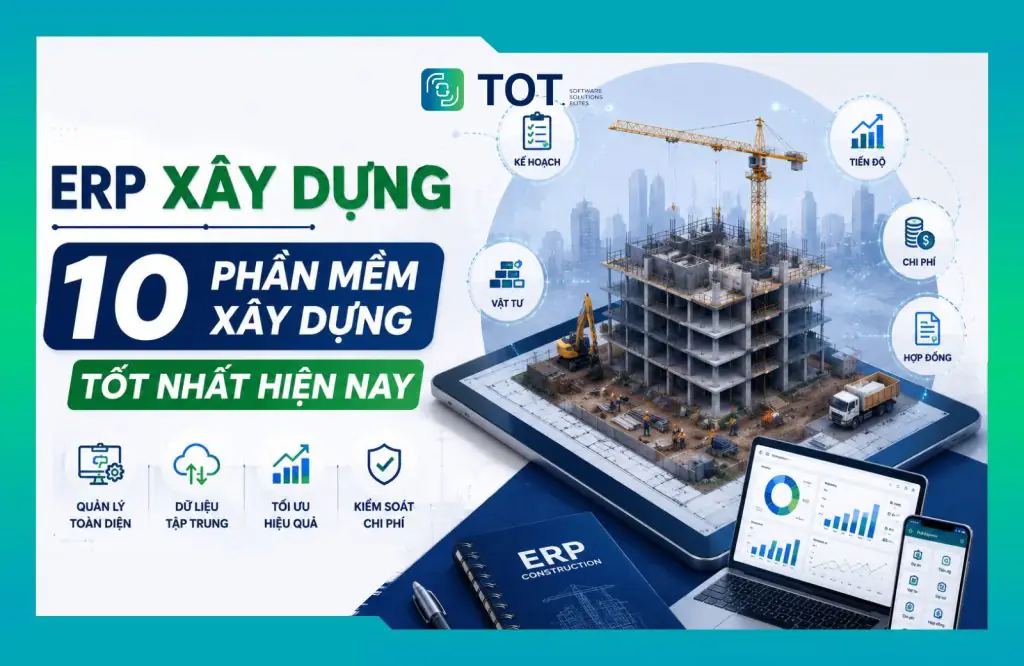
Construction ERP helps businesses centrally manage projects, construction progress, materials, contracts, and finances on a single unified platform. Instead of running operations through many separate Excel files or disconnected software, ERP synchronizes data in real time, helping to control costs, streamline processes, and improve management efficiency. In this article, TOT will help you understand what construction ERP is, its standout features, and the Top 10 construction ERP software worth considering in 2026.
>>> Learn more:
- TOP 15+ large, reputable software companies in Vietnam
- Top 15 most popular car garage management software in 2026
- What is CRM for car showrooms? A comprehensive customer management solution
What is construction ERP?
Construction ERP is an Enterprise Resource Planning system designed specifically for the construction industry, helping to manage construction progress, materials, contracts, finances, and resources on a single unified platform.
Instead of managing operations through many Excel files or disconnected software, construction ERP connects data between the job site and the office within the same system. Whenever information is updated, departments such as accounting, procurement, warehousing, and management can track it in real time, thereby reducing errors and improving management efficiency.
What sets construction ERP apart is its ability to manage by individual project and individual site. An ERP system allows businesses to control the budget, costs, materials, contracts, and progress of each work item, rather than only tracking consolidated financial figures like conventional accounting software.
Many businesses often confuse ERP, CRM, and project management software. In reality, each solution serves a different purpose, as follows:
- Construction ERP: Manages all company resources such as projects, materials, contracts, finances, and personnel.
- CRM: Manages customers, business opportunities, and the sales process.
- Project management software: Manages progress, tasks, and construction resources.
Among these, CRM for construction companies is often integrated with ERP to synchronize customer and project data, forming a management system that spans everything from sales to operations.
In essence, construction ERP shares many similarities with an ERP system in manufacturing, as both aim to centrally manage company resources. However, construction ERP is further developed with industry-specific functions such as cost estimation, work acceptance, subcontractor management, and project costing to meet the unique requirements of the construction sector.
>>> See more:
- Digital transformation in construction: Current state, benefits & solutions
- What is an MES system? Its role, functions, and how to apply it effectively
Standout features of construction ERP software
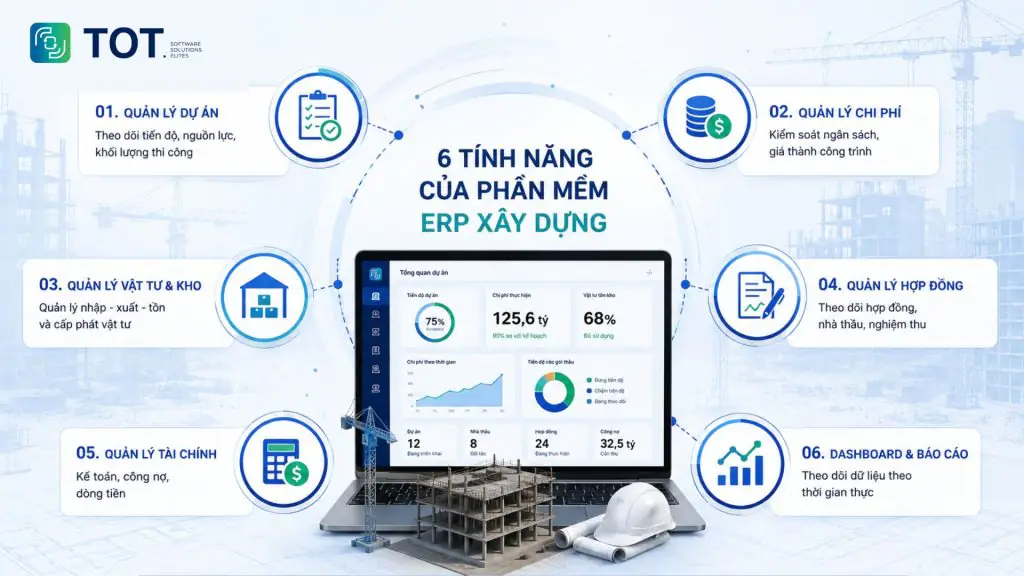
A complete construction ERP system typically integrates 6 core features, helping businesses centrally manage key operations on a single platform. Specifically, those 6 features include:
Project and construction progress management
Project management is the core module of construction ERP, helping businesses track the entire lifecycle of a project from planning to acceptance.
The system allows you to create projects, break down tasks, set schedules, allocate personnel, and track construction volume by individual work item. All data is updated directly from the job site and synchronized back to the office, making it easy for managers to control the progress of each project.
Through this module, businesses can track:
- The progress of each site and work item.
- Planned versus actual progress.
- Completed construction volume.
- Resources and personnel assigned to the project.
- Gantt and Kanban charts.
- Alerts for work items at risk of falling behind schedule.
Cost and budget management
Construction ERP helps businesses control costs on a per-project basis, from the cost-estimation stage all the way to project completion.
Every expense is recorded by work item and cost code, while the system automatically reconciles actual costs against the approved budget. As a result, businesses can easily track cost fluctuations and detect additional expenses early.
The system helps businesses control:
- The budget of each project.
- Actual costs by individual work item.
- Project costing.
- Projected profit margins.
- Additional incurred expenses.
- Budget-overrun alerts.
>>> See more:
- 18 highly effective ways to apply AI to ecommerce
- Build a sales website with AI: free, SEO-friendly, and highly effective
Materials and inventory management
Materials management is the feature that helps businesses control the entire process of purchasing, storing, and issuing raw materials for each site.
ERP fully records the process from purchase requisition, goods receipt, and goods issue to the release of materials in line with construction progress. As a result, businesses always know the inventory level and material requirements of each project.
The materials operations that can be managed include:
- Materials catalog.
- Goods receipt – issue – inventory.
- Material usage norms.
- Procurement planning.
- Issuing materials by individual site.
- Tracking material loss and waste.
Contract and contractor management
Construction ERP supports the centralized management of contracts with investors, suppliers, and subcontractors within the same system.
Besides storing contract information, the system also tracks contract values, payment progress, amendment annexes, and acceptance records. This helps businesses reduce errors during management and coordination with partners.
This module helps businesses manage:
- Contracts with investors.
- Supplier contracts.
- Subcontractor contracts.
- Contract annexes.
- Payables and payment schedules.
- Acceptance records.
Finance and accounting management
The finance and accounting module helps synchronize financial data with all activities of the construction business.
Instead of entering data manually from multiple sources, ERP automatically consolidates data from modules such as procurement, materials, contracts, and projects and updates it into the accounting system. This helps reduce reconciliation time and improve the accuracy of financial reports.
ERP supports the tracking and management of:
- The general ledger.
- Accounts receivable and payable.
- Cash flow.
- Costing by individual site.
- Revenue based on progress.
- Financial reports.
Real-time reporting and progress tracking
The dashboard is a tool that helps leadership monitor all business activities through visual, real-time reports.
ERP automatically consolidates data from all modules to display key metrics on progress, costs, revenue, and the performance of each project. Managers can view an overview report or drill down into details for each site with just a few clicks.
The metrics and reports that can be tracked include:
- Executive dashboard.
- Progress across projects.
- Costs by individual site.
- Cash flow and revenue.
- Profit margins.
- The performance of each department.
- Real-time KPIs.
>>> Related:
- What is application software? Common types of application software
- Top 15 production management software for businesses in 2026
Why do businesses need construction ERP software?
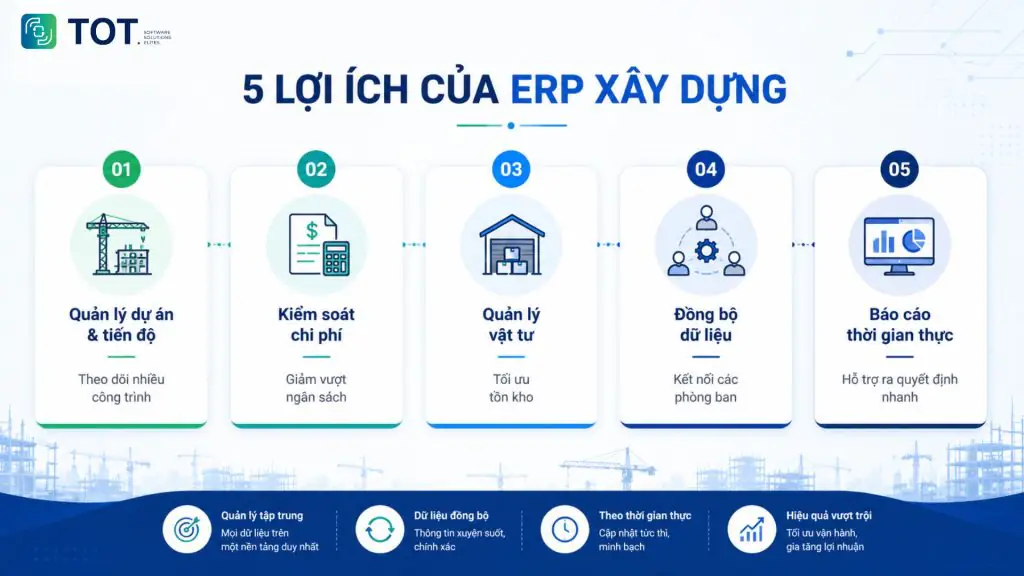
Managing multiple projects at once with Excel or disconnected software easily leaves businesses struggling to control progress, costs, and resources. Construction ERP was created to solve these problems by connecting data on a single unified platform. Below are the standout benefits that construction ERP software delivers:
Optimizing project and construction progress management
Construction ERP helps businesses track the progress of each site on a single unified system. Instead of consolidating data from many Excel files or manual reports, ERP updates progress, completed volume, and resources in real time. As a result, managers can oversee multiple projects at once, quickly identify work items falling behind schedule, and allocate the right personnel, helping to keep the construction plan on track.
Controlling costs and limiting budget overruns
Construction ERP helps businesses control costs by individual site and work item. The system automatically records expenses, reconciles them against the approved budget, and issues alerts when there are signs of exceeding the estimate. As a result, businesses can easily track project costing, limit additional expenses, and use their capital more efficiently.
Improving the efficiency of materials and resource management
ERP supports the management of materials, equipment, and personnel on a single platform. Data on goods receipt and issue, inventory levels, material issuance, and equipment usage is updated in real time, helping businesses proactively coordinate resources according to construction progress. This helps reduce material loss, optimize inventory, and limit disruptions during project execution.
Synchronizing data across departments
ERP connects data between the job site and the office, creating a single source of information for the entire business. All data from accounting, warehousing, procurement, HR, and projects is updated on the same system. As a result, departments coordinate more effectively, reduce duplicate data entry, and minimize errors during operations.
Supporting decision-making with real-time data
ERP provides visual, real-time dashboards and reports, helping leadership make faster and more accurate decisions. Instead of waiting for manual report consolidation, businesses can track progress, costs, cash flow, and the performance of each project right on a single platform. This helps detect risks early, assess operational efficiency, and make data-driven decisions.
>>> Learn more:
- Top 5 best code editors for computer vision
- Gesture recognition with Vision AI in real-world applications
Top 10 best construction ERP software in 2026
There are currently many construction ERP software options on the market, ranging from international solutions for large enterprises to flexible platforms suited to small and medium-sized businesses. Below are 10 construction ERP software options chosen by many businesses for their ability to comprehensively manage projects, finances, materials, and resources.
Quick comparison table of the Top 10 construction ERP software:
| Software | Strengths | Best suited for | Deployment |
| SAP Business One | Comprehensive management, strong ecosystem | Medium and large enterprises | Cloud / On-premise |
| Oracle Fusion Cloud ERP | Corporate management, AI and data analytics | Large enterprises | Cloud |
| Microsoft Dynamics 365 | Integration with Microsoft 365 and Power BI | Medium and large enterprises | Cloud |
| Acumatica Construction Edition | Purpose-built for the construction industry | Contractors, construction businesses | Cloud |
| Sage 300 Construction | Financial and project management | Medium and large construction businesses | On-premise / Cloud |
| Trimble Viewpoint | Construction and field management | Construction contractors | Cloud |
| PENTA ERP | In-depth ERP for the construction industry | General contractors, large enterprises | Cloud / On-premise |
| Odoo | Flexible, easy to customize | Small and medium-sized businesses | Cloud / On-premise |
| Bravo ERP | Domestic ERP, suited to Vietnamese businesses | Medium and large enterprises | On-premise / Cloud |
| CMiC ERP | Management of the entire project lifecycle | General contractors, construction groups | Cloud |
Source: compiled by TOT
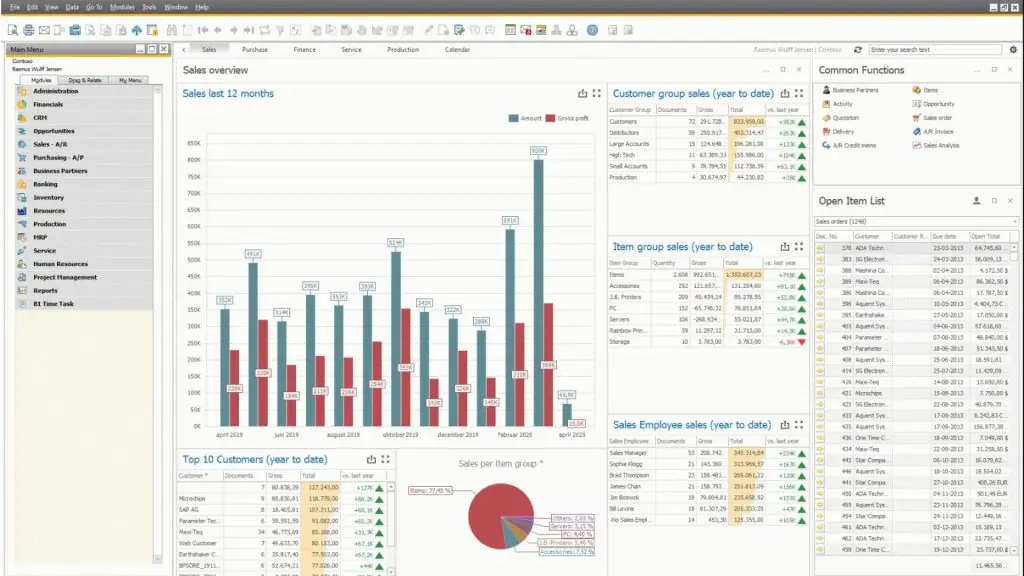
1. SAP Business One
SAP Business One is SAP’s ERP solution for medium and large enterprises, supporting the centralized management of activities from projects, materials, procurement, and warehousing to finance and HR. With a strong ecosystem and high scalability, it is a fitting choice for construction businesses aiming to standardize their management processes.
Standout features:
- Project and construction progress management.
- Materials, inventory, and procurement management.
- Finance, accounting, and payables management.
- Real-time dashboards and reports.
- Integration with other solutions in the SAP ecosystem.
Advantages:
- A world-leading ERP ecosystem.
- High scalability and integration capabilities.
- Strong data security that meets the needs of growing businesses.
Best suited for: Medium and large construction businesses, especially those that need to standardize management processes and plan to expand in the future.
C
2. Oracle Fusion Cloud ERP
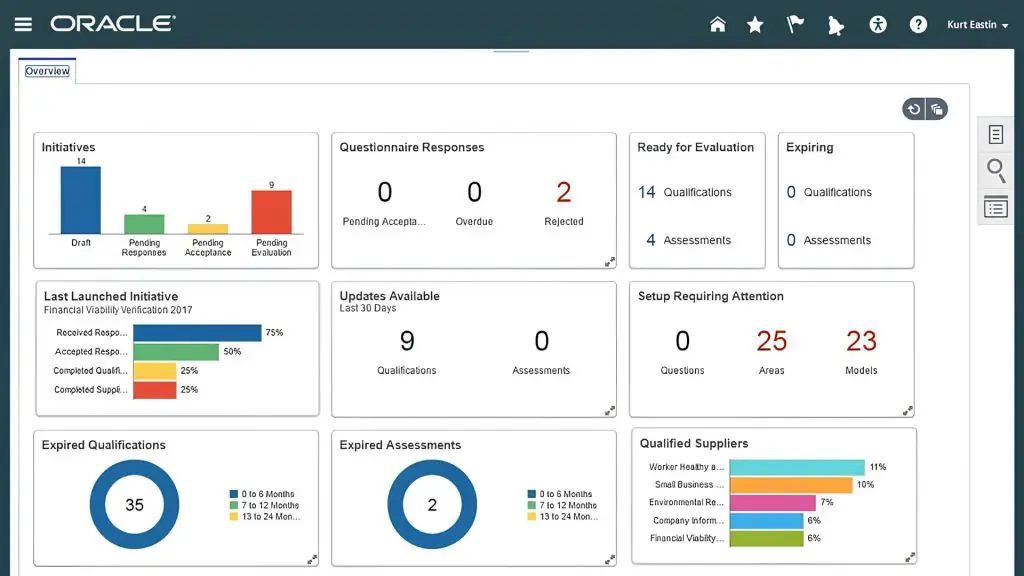
Oracle Fusion Cloud ERP is Oracle’s cloud-based ERP solution, designed to help businesses centrally manage finance, projects, supply chain, and operations on a single unified system. With integrated AI and real-time data analytics, the software helps construction businesses improve forecasting, control costs, and make faster decisions.
Standout features:
- Finance, budget, and cash flow management.
- Project management and construction progress tracking.
- Procurement and supply chain management.
- Real-time dashboards and reports.
- Data analytics and forecasting with AI.
Advantages:
- Fully deployed on the Cloud, easy to scale as the business grows.
- Integrated AI supports cost forecasting, performance analysis, and the automation of many management processes.
- Suitable for businesses managing multiple projects or multiple member units.
Best suited for: Large construction businesses, general contractors, or corporate groups that need to centrally manage multiple projects and leverage data for executive decision-making.
3. Microsoft Dynamics 365
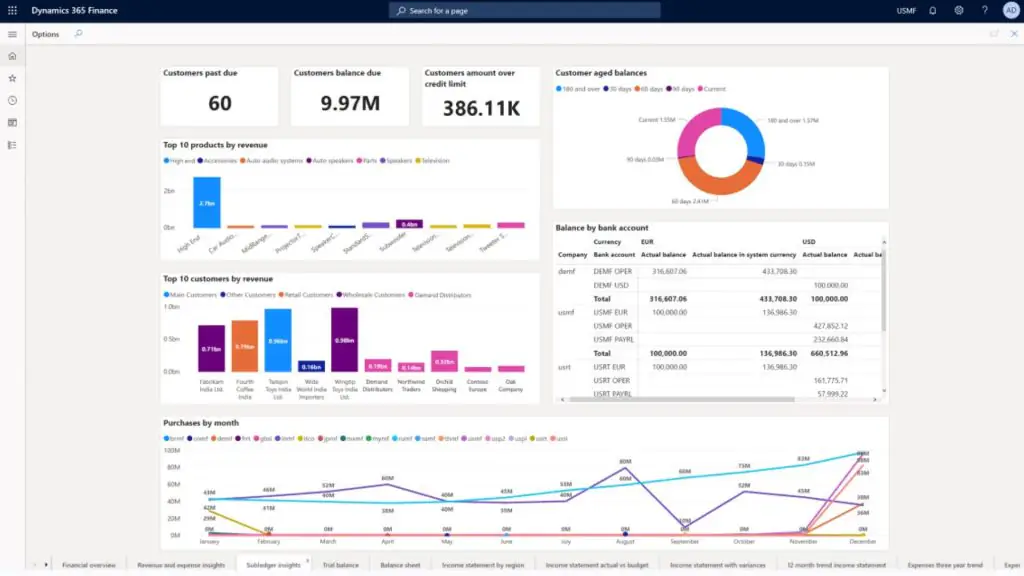
Microsoft Dynamics 365 is Microsoft’s ERP solution, combining finance, project, supply chain, and operations management on a single platform. The software integrates tightly with Microsoft 365, Power BI, and the Power Platform, helping construction businesses leverage data effectively and automate many workflows.
Standout features:
- Project and construction progress management.
- Finance and accounting management.
- Procurement and supply chain management.
- Visual dashboards with Power BI.
- Workflow automation.
Advantages:
- Seamless integration with the Microsoft ecosystem, including Excel, Outlook, Teams, and Power BI.
- A modern, user-friendly interface.
- Easy to scale and connect with other applications as the business grows.
Best suited for: Medium and large construction businesses, especially those already using Microsoft solutions in their management operations.
4. Acumatica Construction Edition
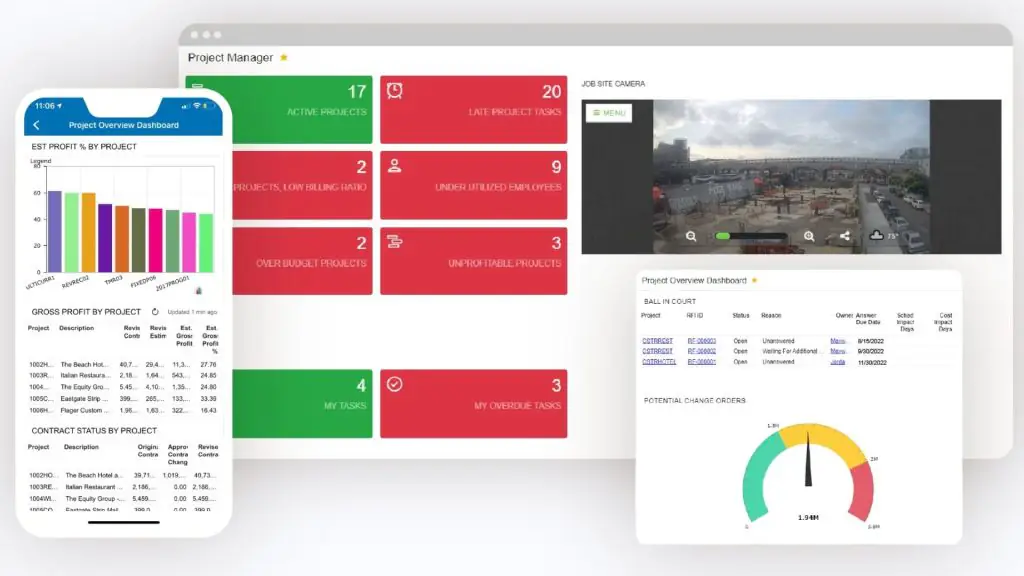
Acumatica Construction Edition is an ERP version developed specifically for the construction industry, helping businesses manage operations from projects, materials, and contracts to finance in a synchronized way on a cloud platform. The software is highly regarded for its ability to connect data between the office and the job site in real time.
Standout features:
- Project and construction progress management.
- Materials and inventory management.
- Contract and contractor management.
- Finance and accounting management.
- Real-time reporting and dashboards.
Advantages:
- Purpose-built for construction businesses and contractors.
- Synchronizes data between the job site and the office on a single platform.
- Easy to scale and integrate with other management solutions.
Best suited for: Construction businesses and contractors looking to deploy an in-depth ERP to comprehensively manage projects and operations.
5. Sage 300
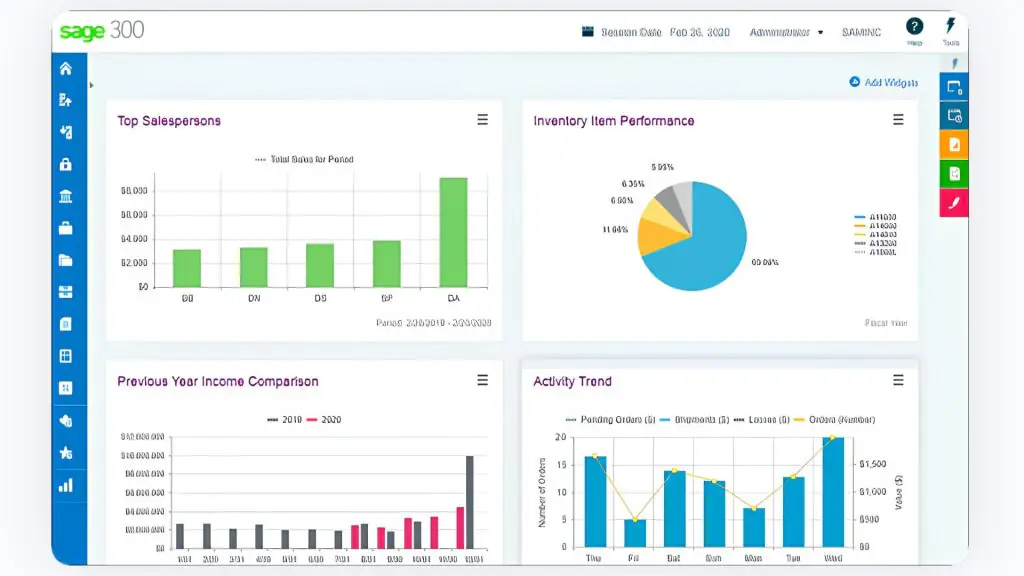
Sage 300 Construction is an ERP solution developed specifically for the construction industry, standing out for its financial, accounting, and project cost management capabilities. The software helps businesses control budgets on a per-project basis while also supporting the management of contracts, payables, and cash flow on a centralized system.
Standout features:
- Finance and accounting management.
- Cost estimation and project cost management.
- Contract and payables management.
- Cash flow and budget tracking.
- Real-time financial reporting.
Advantages:
- Strength in financial and project cost management.
- Supports budget control on a per-project basis.
- Suitable for businesses that need to standardize accounting processes in the construction field.
Best suited for: Medium and large construction businesses that need to manage finance and accounting and control project costs.
6. Trimble Viewpoint
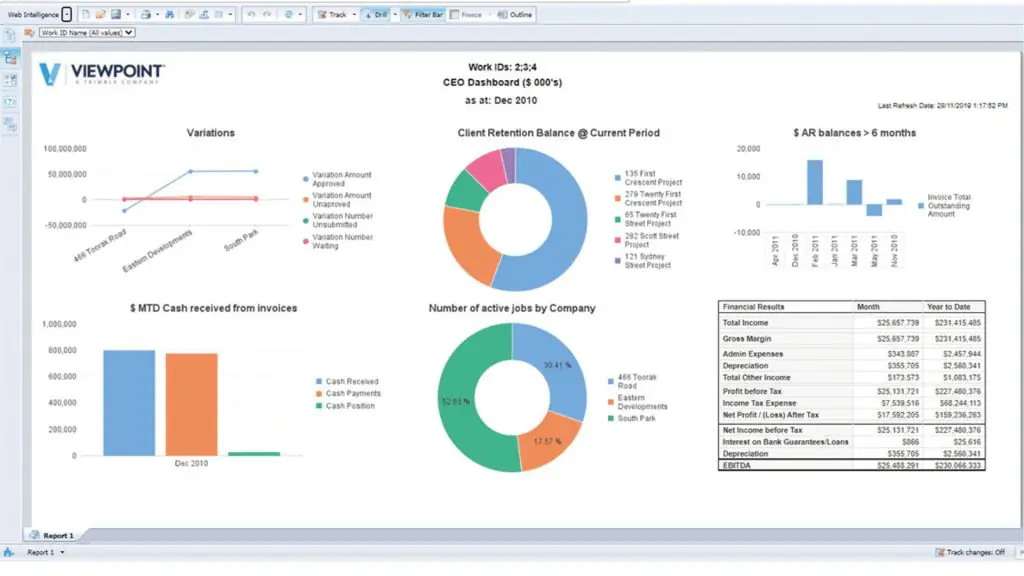
Trimble Viewpoint is an ERP solution purpose-built for the construction industry, supporting comprehensive management from the job site to the office. The software helps businesses track construction progress, resources, equipment, and finances in real time, contributing to more effective project management.
Standout features:
- Project and construction progress management.
- Workforce and equipment management.
- Contract and payment management.
- Financial management.
- Real-time dashboards and reports.
Advantages:
- Strength in job site and construction operations management.
- Synchronizes data between the field and the office.
- Supports resource coordination across multiple projects at once.
Best suited for: Construction contractors and businesses that need to manage multiple sites simultaneously.
>>> See more: Top 20 most reputable and professional app design companies
7. PENTA ERP
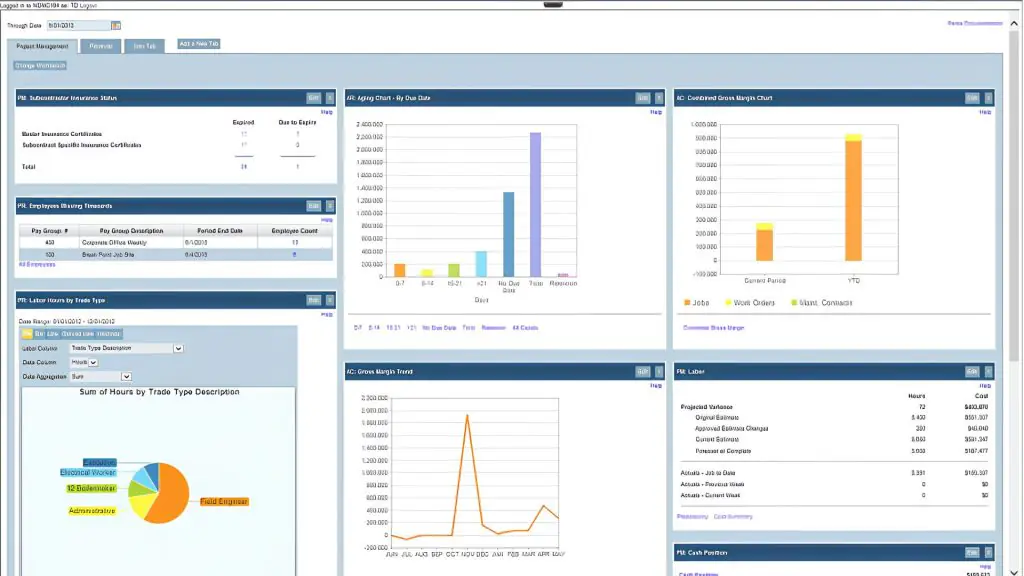
PENTA ERP is an ERP solution designed specifically for construction and engineering businesses, supporting the management of the entire project lifecycle from bidding and planning to construction and acceptance. The software integrates multiple modules on a single platform, helping businesses improve management efficiency and operational control.
Standout features:
- Project and progress management.
- Finance and accounting management.
- HR and payroll management.
- Equipment and asset management.
- Management dashboards and reports.
Advantages:
- Developed in depth for the construction and engineering fields.
- End-to-end management across the entire project lifecycle.
- The ability to integrate data across departments.
Best suited for: General contractors and large construction businesses running multiple projects.
8. Odoo
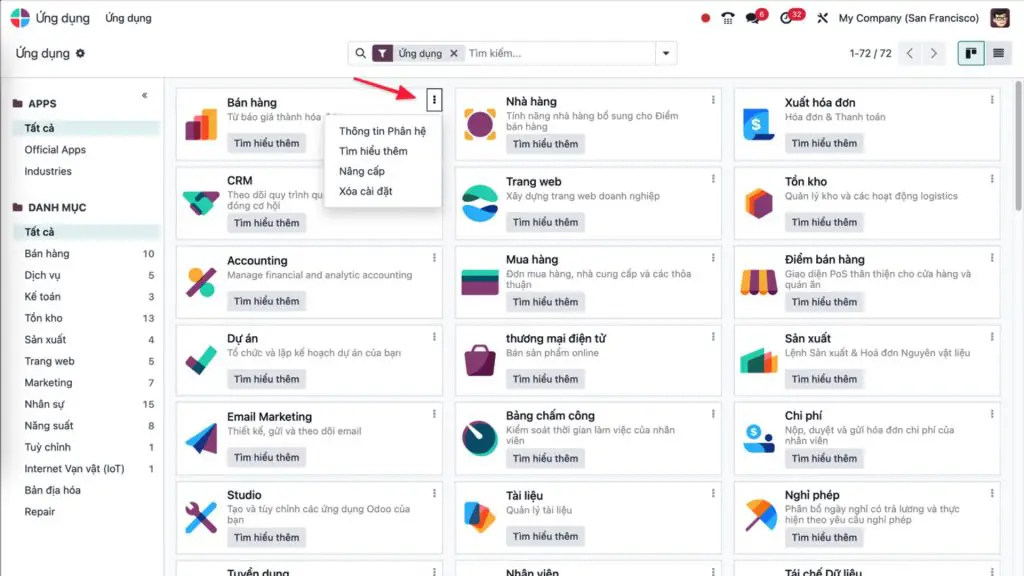
Odoo is an open-source ERP platform renowned for its flexible customization and rich application ecosystem. Construction businesses can choose to deploy individual modules such as project management, CRM, materials, accounting, or HR, and expand as their needs grow.
Standout features:
- Project and progress management.
- CRM and customer management.
- Purchasing and inventory management.
- Accounting and finance management.
- HR and time-tracking management.
Highlights:
- Open source, easy to customize to your business processes.
- Flexible deployment on a module-by-module basis.
- A rich application ecosystem that is easy to scale as the business grows.
Best suited for: Small and medium-sized construction businesses that need a flexible, easy-to-customize ERP solution with optimized deployment costs.
9. Bravo ERP
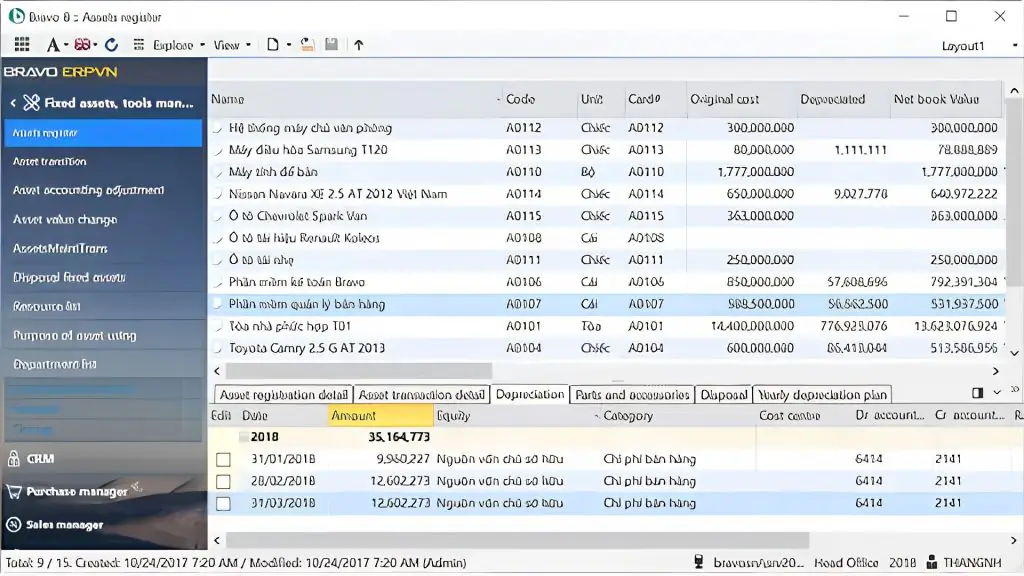
Bravo ERP is an ERP solution developed in Vietnam, chosen by many construction businesses for its ability to be customized to real-world management processes. The solution supports the synchronized management of operations from projects, materials, and finance to HR, helping businesses optimize operations and improve management efficiency.
Standout features:
- Construction project management.
- Materials and inventory management.
- Finance and accounting management.
- Procurement and contract management.
- Management dashboards and reports.
Advantages:
- Suited to the management processes of Vietnamese businesses.
- Can be customized to the specific characteristics of each business.
- A domestic deployment and support team.
Best suited for: Medium and large construction businesses in Vietnam that want to deploy a custom ERP aligned with their real-world operational processes.
10. CMiC ERP
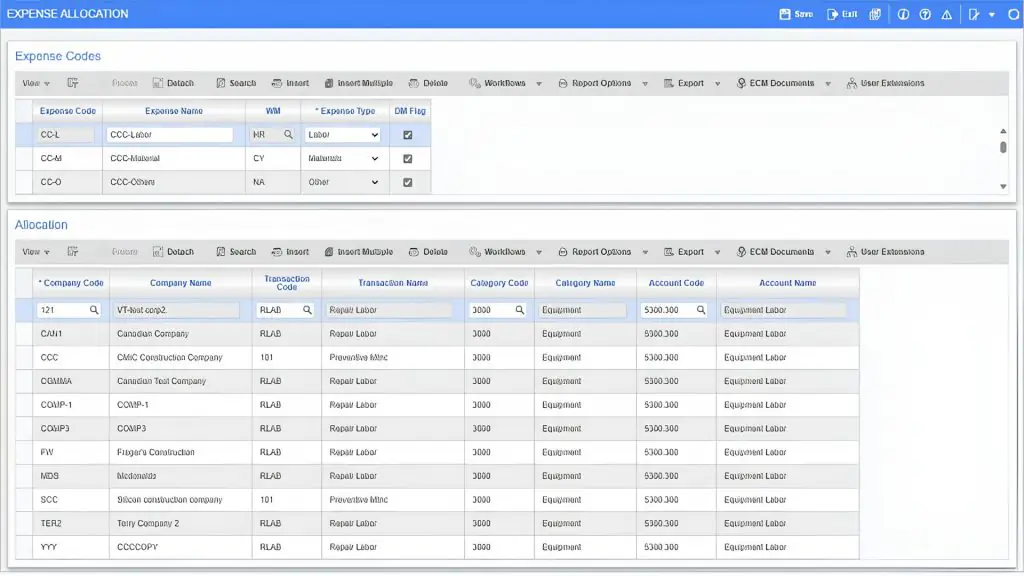
CMiC ERP is an ERP solution developed specifically for the construction industry, supporting businesses in managing the entire project lifecycle from planning, bidding, and construction to post-handover maintenance. The software integrates project management, finance, contract, and BIM functions on a single platform to improve management efficiency.
Standout features:
- Project and construction progress management.
- Contract and acceptance record management.
- Finance and accounting management.
- BIM integration and document management.
- Real-time dashboards and reports.
Advantages:
- An in-depth ERP solution dedicated to the construction industry.
- End-to-end management of the entire project lifecycle on a single unified platform.
- Supports BIM integration and many other management systems.
Best suited for: General contractors and large construction groups that need to manage multiple projects, multiple departments, and complex operational processes.
>>> See more:
- A comprehensive guide to the YOLO model
- 29 outstanding AI website templates for SaaS, E-commerce, and multiple industries
Criteria for choosing the right construction ERP software
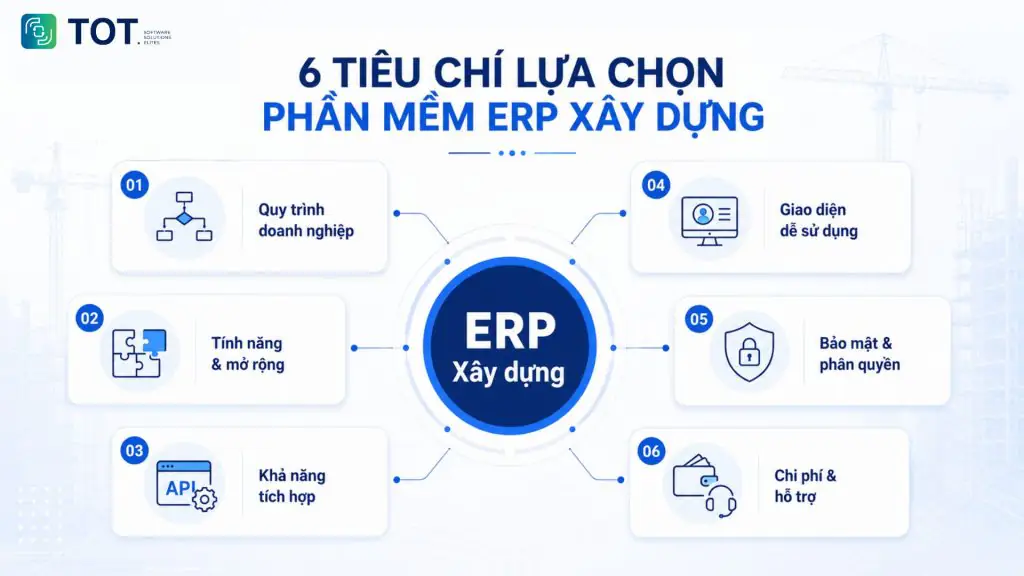
Choosing construction ERP software depends not only on how popular the solution is, but also on how well it fits the operational processes, scale, and growth goals of the business. Below are 6 important criteria to help businesses evaluate and choose the right ERP system, avoiding wasted investment and ensuring effective long-term deployment.
Fits the processes and specifics of the business
ERP software only delivers value when it matches the business’s operational processes. Every construction business has its own way of managing projects, materials, acceptance, or coordination between departments. Therefore, businesses should prioritize a solution that can be customized to their real-world processes rather than having to change the way they operate to fit the software.
Full features and scalability
Construction ERP needs to cover core functions such as project management, construction progress, materials, contracts, finance, and reporting. In addition, businesses should also consider the ability to expand with modules such as CRM, HR, AI, or BI as their operations grow, allowing the system to serve them over the long term without needing to be replaced.
The ability to integrate with existing systems
In many businesses, ERP needs to connect with systems already in use such as accounting software, CRM, BIM, IoT, or other management platforms. Strong integration capabilities help data stay synchronized on a single unified platform, reducing manual data entry and improving management efficiency.
A friendly and easy-to-use interface
A feature-rich system that is hard to use forces employees to spend a lot of time learning it and reduces deployment efficiency. Therefore, businesses should prioritize software with an intuitive interface, simple operations, and support across multiple devices so that both office and field teams can work conveniently.
Data security and access control
ERP stores a great deal of important data such as contracts, finances, project records, and customer information. Therefore, the software needs a granular, role-based access control mechanism while also meeting security standards to limit the risk of leaks or unauthorized access.
Deployment costs and support services
ERP investment costs include not only licensing fees but also expenses such as deployment, training, maintenance, and upgrades. Businesses should evaluate the total cost of ownership (TCO) as well as the support capabilities of the implementation partner to ensure the system runs stably and can scale when needed.
The AI trend in construction management with ERP software
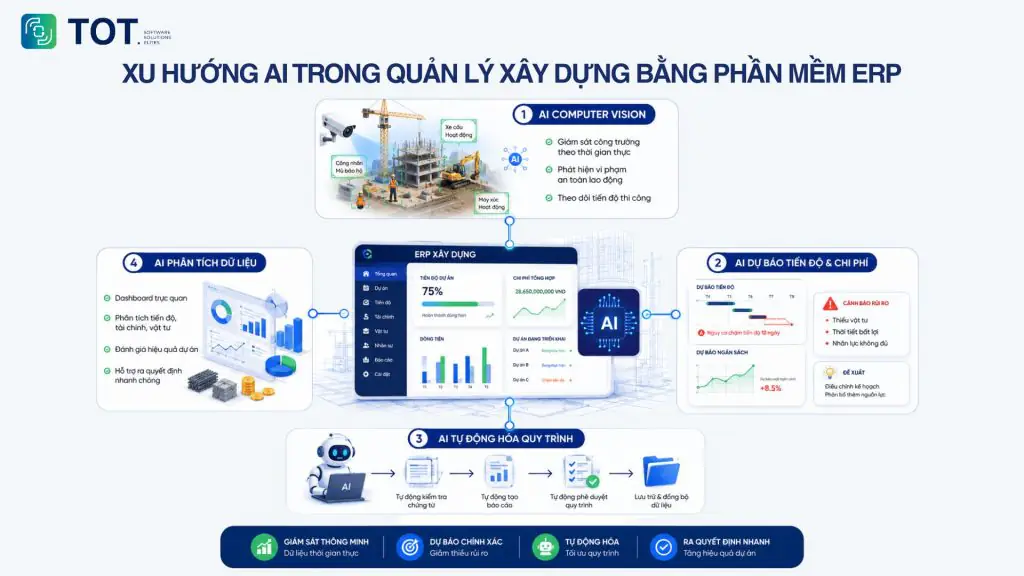
AI is helping construction ERP go far beyond the role of a traditional data management system. Instead of merely storing and consolidating information, an AI-integrated ERP can analyze data in real time, forecast risks, and automate many operational processes. Below are 4 standout AI trends that many construction businesses are paying attention to.
AI Computer Vision for automated job site monitoring
AI Computer Vision combines cameras and artificial intelligence to monitor activities at the job site, detect occupational safety violations, supervise equipment, or update construction progress. When integrated with ERP, the data is synchronized in real time, helping managers monitor the site remotely.
AI for progress forecasting and cost control
AI can analyze data from projects to forecast the risk of schedule delays or budget overruns. The system issues early warnings, helping businesses proactively adjust their plans and allocate resources appropriately.
AI data analytics to support decision-making
Instead of consolidating reports manually, AI automatically analyzes data on progress, finance, and materials to create visual dashboards. This helps leadership assess the performance of each project and make decisions faster.
AI process automation
AI helps automatically handle repetitive tasks such as checking documents, generating reports, or approving processes. As a result, businesses reduce the volume of manual work, limit errors, and improve operational efficiency.
Integrating AI into ERP is clearly more than a passing trend; it is becoming a competitive advantage for many construction businesses. However, for AI to be effective, the system needs to be designed to fit the existing operational processes and technology infrastructure.
AI is becoming an important part of modern ERP systems, but its value is only realized when the solution is designed to fit the business’s operational processes. TOT provides consulting and development services for custom AI-integrated ERP, helping businesses gradually adopt AI without having to overhaul their entire existing infrastructure.
>>> See more:
- A detailed guide on how to prepare and optimize WordPress for AI search
- WordPress’s AI assistant: A smart writing support tool
- What is an AI chip? Its standout features and applications
Construction management solutions with ERP software from TOT
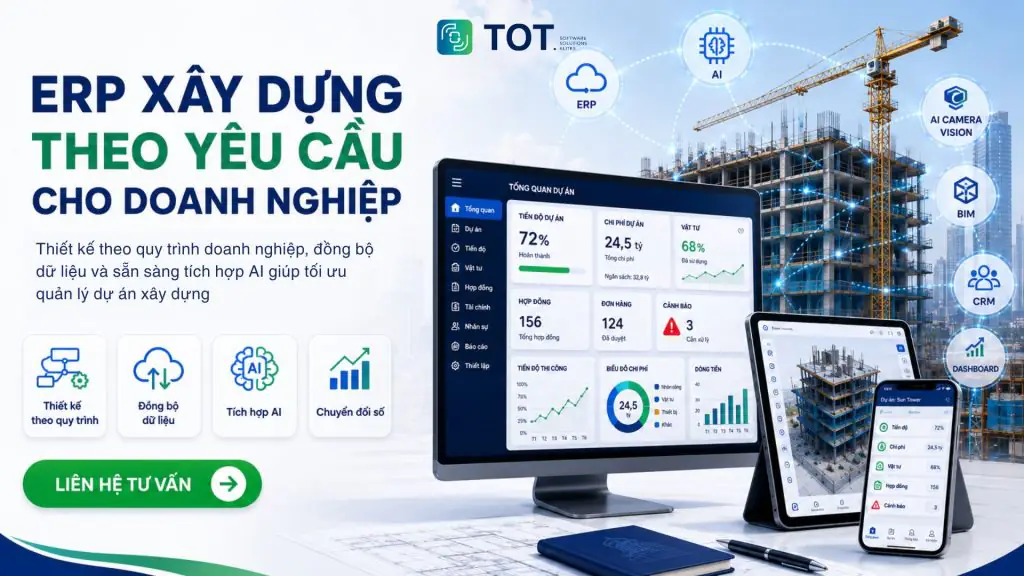
TOT develops custom ERP solutions that help construction businesses centrally manage data, standardize processes, and build a foundation for digital transformation. Instead of adopting an off-the-shelf software package with many unsuitable features, businesses can build an ERP system that closely follows their real-world operational processes, is easy to scale, and can integrate with technologies such as AI as needs grow in the future.
Designing ERP around the business’s operational processes
Every construction business has its own management model and operational processes. Therefore, TOT begins by surveying the current situation, analyzing business processes, and identifying the problems that need to be solved before designing the ERP system.
The solution is developed to order, allowing modules such as project, materials, contract, finance, and approval-process management to be customized to the specifics of each business. As a result, the system meets current needs while also being able to scale as the business grows.
Synchronizing data and optimizing management processes
The ERP developed by TOT helps connect data between the job site and the office on a single platform. Information about construction progress, materials, contracts, and finances is updated in real time, helping departments coordinate more effectively and reducing fragmented data.
Standardizing processes and synchronizing data not only helps businesses save processing time but also creates a foundation for integrating other systems, meeting management needs as the scale of projects continues to expand.
Integrating AI to improve construction management efficiency
In addition to ERP, TOT also has experience developing AI solutions for automation and operational optimization. A prime example is the AI Camera E-Service project, which applies AI Computer Vision technology to automatically recognize vehicles, reconcile data, and support real-time management. This solution helps reduce manual operations, improve accuracy, and optimize operational processes.
From that foundation, AI Computer Vision can be integrated into an ERP system to support construction businesses with challenges such as job site monitoring, vehicle and equipment recognition, tracking occupational safety compliance, or analyzing image data to help managers make faster and more accurate decisions.
Experience accompanying construction businesses in digital transformation
TOT has accompanied many businesses in the construction sector through digital platform development projects such as AI Computer Vision, Unicons, Coteccons Global, and Sinh Nam. These projects focused on building modern corporate websites, optimizing the user experience, and enhancing the brand image in the digital environment.
Through these implementations, TOT has built up experience in analyzing requirements, designing solutions that fit the specifics of construction businesses, and accompanying them on their digital transformation journey. This is also the foundation for TOT to continue developing custom ERP systems that meet the management and growth needs of businesses.
>>> See more:
- Custom software design with great pricing and a professional process
- Professional custom software development services in Hanoi
- Custom software development in HCMC: professional design across a wide range of platforms
Conclusion
Construction ERP not only helps businesses centrally manage projects, materials, contracts, and finances on a single unified platform but also creates a foundation for digital transformation and the application of AI in construction management. Choosing the right ERP solution helps businesses optimize their operational processes, improve management efficiency, and increase their competitiveness over the long term. If you are looking for an ERP system designed around your real-world processes and able to scale with your needs, your business should consider a partner with implementation experience to ensure a strong return on investment and stable long-term operation.
Frequently asked questions about construction ERP
What is ERP in construction?
Construction ERP is an enterprise resource planning system developed specifically for the construction industry. The software helps centrally manage operations such as projects, construction progress, materials, contracts, finance, and HR on a single platform, while synchronizing data between the job site and the office to improve management efficiency.
Which businesses should deploy construction ERP software?
Construction ERP is suitable for contractors, investors, and construction businesses that need to manage multiple projects or multiple departments at once. In particular, businesses struggling to control progress, costs, and materials, or those wanting to standardize their operational processes, will gain significant value from deploying ERP.
How does construction ERP differ from project management software?
Project management software mainly supports planning, tracking progress, and assigning tasks. Construction ERP, on the other hand, offers more comprehensive management by additionally integrating functions such as finance, accounting, materials, contracts, HR, and management reporting on a single system, helping businesses control all of their operations.
How do ERP and CRM differ?
ERP and CRM serve different purposes but can complement each other. ERP focuses on managing resources and internal processes such as projects, finance, materials, and accounting. CRM for construction companies, meanwhile, focuses on managing customers, business opportunities, nurturing investors, and helping the sales team improve its performance.
Should businesses choose a custom construction ERP?
If a business has unique management processes or needs to integrate with existing systems, a custom ERP is a worthwhile option. This solution allows features to be customized to real-world needs, while also being easy to scale and integrate with technologies such as AI, IoT, or BIM in the future.
Roughly how much does deploying construction ERP cost?
The cost of deploying construction ERP depends on many factors such as the size of the business, the number of users, the scope of features, the degree of customization, and the requirements for integrating with other systems. With custom solutions, businesses should work directly with the implementation partner to receive advice and build a roadmap that fits their budget and growth goals.
TOT is a trusted partner on the digital transformation journey, providing website design, mobile app, custom software, and artificial intelligence software solutions tailored to each business need. With real-world consulting and implementation experience, TOT helps businesses build a digital transformation roadmap, apply AI, and automate processes to optimize operations and create a sustainable competitive advantage.
TOT contact information:
- 🌐 Website: topon.tech
- 📞 Hotline/WhatsApp/Zalo: 0906 712 137
- ✉️ Email: long.bui@toponseek.com
- 🏢 Address: 31 Hoang Dieu Street, Xom Chieu Ward, Ho Chi Minh City, Vietnam