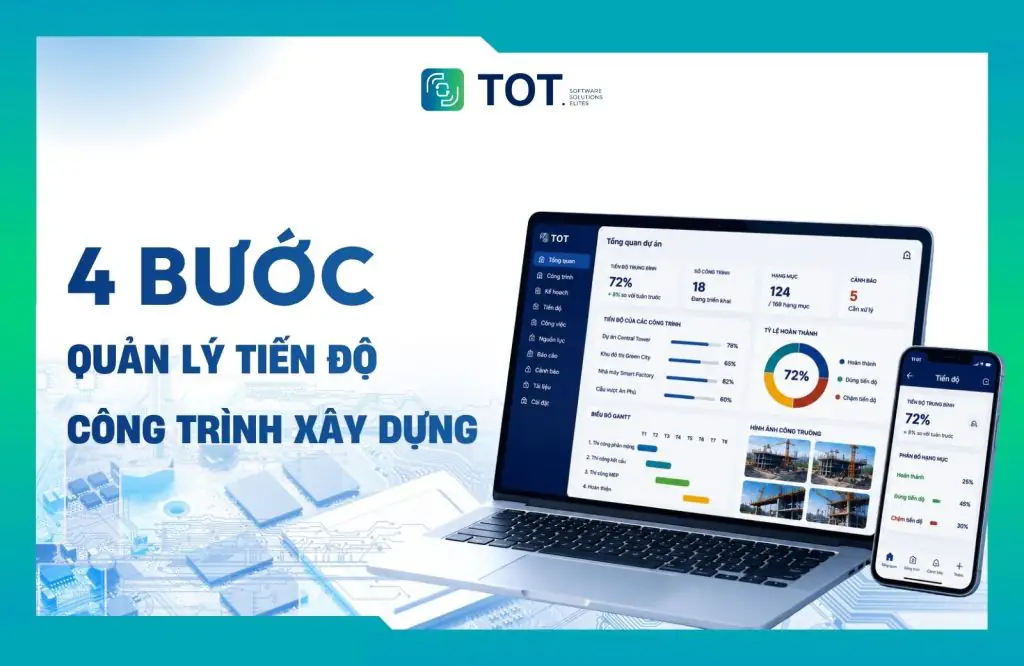
As the construction industry undergoes rapid digital transformation, construction progress management is no longer limited to scheduling work on site. It has become a comprehensive management discipline that combines real-time data, dedicated software, and artificial intelligence (AI) to improve operational efficiency. In this article, TOT will help businesses understand the construction progress management process, the most common methods, the criteria for choosing the right software, and the trend of applying AI to optimize project schedule, cost, and quality.
>>> Further reading:
- Top 15 production management software tools for businesses in 2026
- What is an ERP system in manufacturing? Benefits, features, and how to use it
- Top 15 most popular auto garage management software tools in 2026
What is construction progress management?
Construction progress management is the process of planning, monitoring, and controlling the time spent executing construction work packages to ensure that the project is completed by the committed deadline. It is one of the key activities in construction project management, helping businesses track actual progress against the plan and address delay risks promptly.
The goal of progress management is not only to complete the project on time but also to optimize the use of resources, limit cost overruns, and ensure that construction proceeds in the correct sequence. To achieve this, a business needs to build a schedule, define the key milestones, allocate the right people, equipment, and materials, and monitor progress regularly so it can adjust when conditions change.
An effective construction progress management process
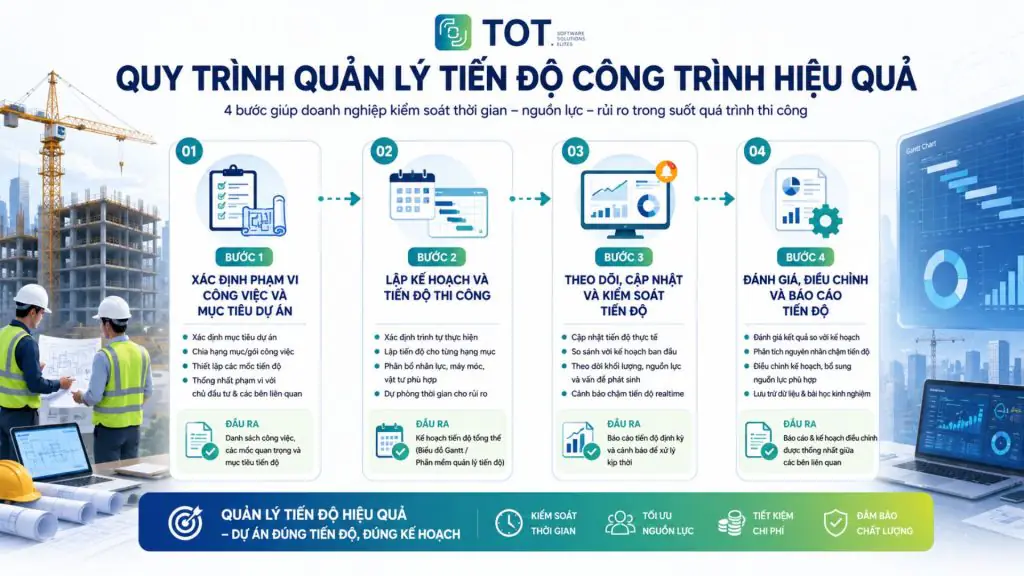
The construction progress management process is the foundation that helps businesses control time, resources, and risks during construction. Below are the 4 steps in the construction progress management process that are widely applied today:
Step 1: Define the scope of work and project objectives
Before getting started, a business needs to clearly define the scope of work, the objectives, and the schedule milestones of the project. The project should be broken down into specific work items or work packages so that it is easier to monitor and allocate resources.
The output of this step is a list of tasks, the key milestones, and the schedule objectives for the entire project. To limit factors that could affect the schedule, the business should agree on the scope of work with the investor and the relevant parties right from the start.
Step 2: Build the construction plan and schedule
After defining the scope of work, the business builds the construction plan by determining the sequence of execution, the time required for each work item, and the appropriate allocation of people, machinery, and materials.
The output is an overall schedule, usually presented as a Gantt chart or in progress management software. In addition, it is wise to build in buffer time for risks such as weather, delayed materials, or design changes in order to limit their impact on the entire project.
Step 3: Monitor, update, and control progress
During construction, the business needs to regularly update actual progress and compare it against the original plan in order to promptly detect work items that are falling behind. Monitoring can be based on the volume of work completed, the resources used, or the issues arising on site.
The output of this step is a periodic progress report along with alerts that help the management team quickly decide on a course of action. Using management software helps update data in real time and makes control more effective.
Step 4: Evaluate, adjust, and report on progress
After each phase, the business needs to evaluate the actual results against the plan to identify the causes of any delay and decide on the appropriate adjustments, such as adding resources or changing the construction sequence.
The output of this step is an updated progress report and an adjustment plan agreed upon by the relevant parties. Beyond handling the immediate issues, the business can store the data and lessons learned from each project to optimize the construction progress management process for future works.
Why do businesses need construction progress management?
Construction progress management helps businesses control construction time, optimize resources, and limit risks throughout project delivery. When progress is monitored and updated regularly, a business can proactively handle issues as they arise and ensure the project is completed as planned. Specifically:
- Improved coordination between parties: A clear schedule makes it easy for the investor, contractors, supervision consultants, and other relevant parties to track the project, coordinate on resolving issues, and make timely decisions.
- Control over construction time: Regular progress monitoring helps a business quickly detect work items that are behind schedule and take action before they affect the entire project.
- Fewer cost overruns: Well-controlled progress helps reduce added costs such as labor, equipment rental, material storage, or management costs caused by extended construction time.
- Efficient resource management: Based on the schedule, a business can allocate people, equipment, and materials appropriately for each phase, avoiding shortages or surpluses of resources.
- Ensured handover schedule: Completing the project on time helps a business meet its commitments to the investor, reduce the risk of breaching the contract, and enhance its reputation in the market.
Common construction progress management methods
Depending on the size and complexity of each project, a business can choose the right progress management method to improve construction efficiency. Below are the most common construction progress management methods:
Gantt chart
The Gantt chart is a visual progress management method that represents work items as time bars. This makes it easy for a manager to track the start date, end date, and completion level of each task.
- Advantages: Easy to use, visual, and well suited to planning as well as day-to-day progress tracking.
- Limitations: Hard to show the dependency relationships between many work items in large projects.
- Best suited to: Small and medium-sized projects or works with a simple construction process.
CPM (Critical Path Method)
CPM is a method for identifying the critical path – the chain of tasks that determines the completion time of the entire project. If a task on the critical path is delayed, the overall construction schedule is affected as well.
- Advantages: Helps a business identify the key work items so it can prioritize resources and reduce the risk of delays.
- Limitations: Requires accurate data on execution times and on the relationships between tasks.
- Best suited to: Large-scale projects or those with many interdependent work items.
PERT
PERT is a planning method based on multiple execution-time scenarios used to estimate a project’s completion time. This approach helps a business be more proactive when delivering projects that involve many uncertain factors.
- Advantages: Supports risk assessment and schedule forecasting under highly variable conditions.
- Limitations: Building the time scenarios is relatively complex and depends on the experience of the management team.
- Best suited to: New projects, research projects, or works with many hard-to-predict factors.
BIM 4D
BIM 4D is a method that combines the building information model (BIM 3D) with the dimension of time to simulate the entire construction process. A business can visually observe the progress of each work item, detect conflicts, and optimize the construction sequence before actual execution.
- Advantages: Visual, supports coordination between parties, and reduces errors during construction.
- Limitations: High implementation cost, and it requires a business to have a BIM foundation and a specialized team.
- Best suited to: Large-scale projects, complex works, or businesses undergoing digital transformation in construction.
>>> See also:
- Top 7 best open-source object tracking tools
- Free computer vision software: Easy-to-use platforms
The 5 best construction progress management software tools of 2026
Instead of managing everything manually, many businesses have adopted software to track progress, optimize resources, and improve operational efficiency. Below are 5 construction progress management software tools worth considering:
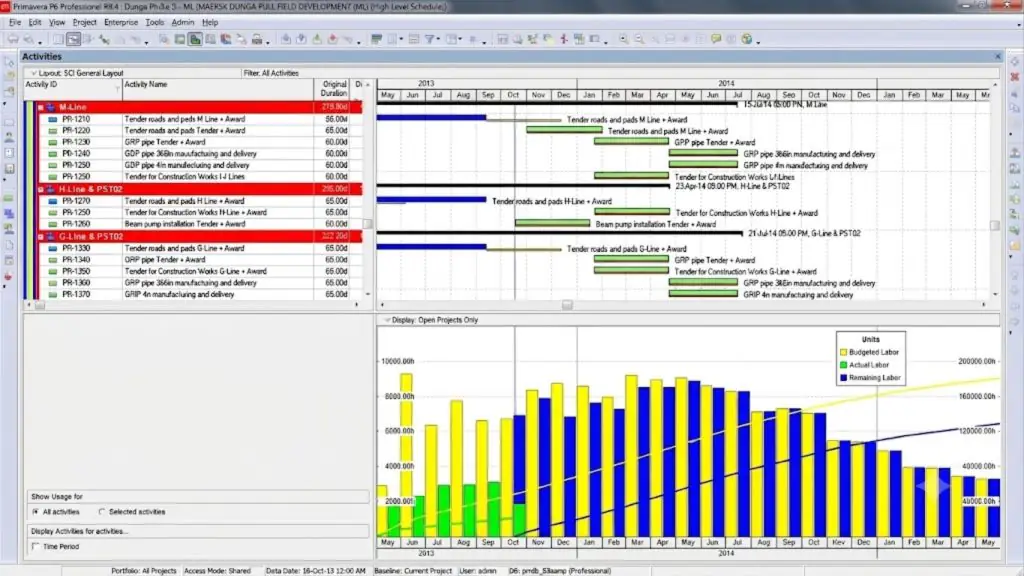
1. Oracle Primavera P6 construction progress management software
Oracle Primavera P6 is project and schedule management software widely used in large-scale construction, infrastructure, and EPC projects. It stands out for its ability to schedule in detail and manage thousands of tasks within a single project.
Key features:
- Planning and schedule management using the CPM (Critical Path Method).
- Management of resources, costs, and work volume.
- Critical path analysis to identify the work items that directly affect the project schedule.
- Real-time progress monitoring, reporting, and forecasting.
Advantages:
- Handles large-scale projects with many complex work items efficiently.
- Supports in-depth analysis, planning, and schedule control.
- Trusted by many construction businesses and investors around the world.
Points to consider:
- The software has many in-depth features, so users need time to become familiar with it and use it effectively.
- The implementation and training costs are relatively high, making it a better fit for large-scale businesses.
Best suited to: Large contractors, EPC businesses, and large-scale infrastructure, industrial, or construction projects.
2. Microsoft Project construction progress management software
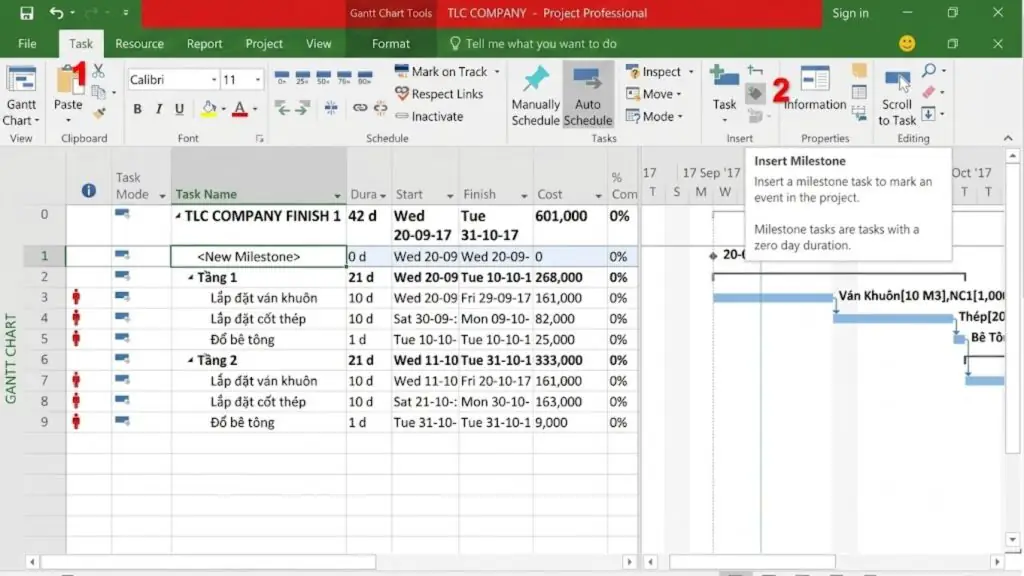
Microsoft Project is a familiar project management tool that suits many businesses thanks to its intuitive interface and its ability to integrate with the Microsoft 365 ecosystem.
Key features:
- Planning and progress tracking with Gantt charts.
- Management of resources, budget, and work volume.
- Tracking actual progress and comparing it against the plan.
- Integration with Microsoft Teams, Excel, and Power BI.
Advantages:
- Intuitive interface that is easy to get used to.
- Integrates well with the Microsoft ecosystem.
- Suitable for many types of projects and business sizes.
Points to consider:
- Its ability to manage very large construction projects is not as strong as Primavera P6.
- Some advanced features are available only in the paid plans.
Best suited to: Small and medium-sized businesses, construction contractors, or medium-scale projects.
3. Autodesk Construction Cloud construction progress management software
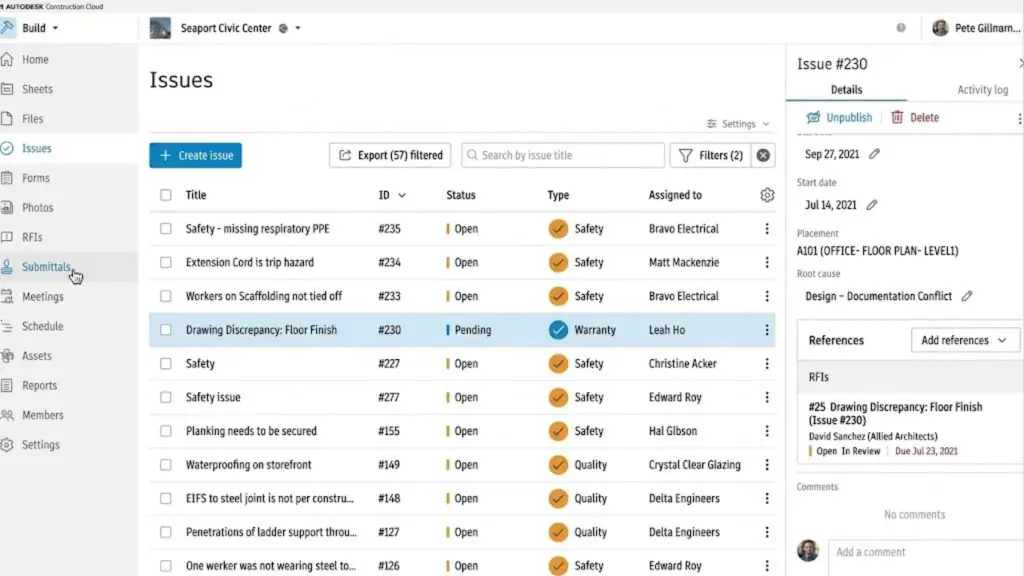
Autodesk Construction Cloud is a cloud-based construction management platform that helps connect design, construction, and operation. It is a good fit for businesses that have already adopted BIM.
Key features:
- Progress management combined with the BIM model.
- Tracking of documents, drawings, and RFIs on a single platform.
- Real-time updates of progress and site data.
- Support for collaboration between the investor, consultants, and contractors.
Advantages:
- Synchronizes data on a cloud platform.
- Increases the effectiveness of coordination between project participants.
- Integrates well with the Autodesk ecosystem.
Points to consider:
- The implementation cost is relatively high.
- A business needs a BIM process and a trained team to use it effectively.
Best suited to: Construction businesses that are adopting BIM and large-scale, complex projects.
4. Procore construction progress management software
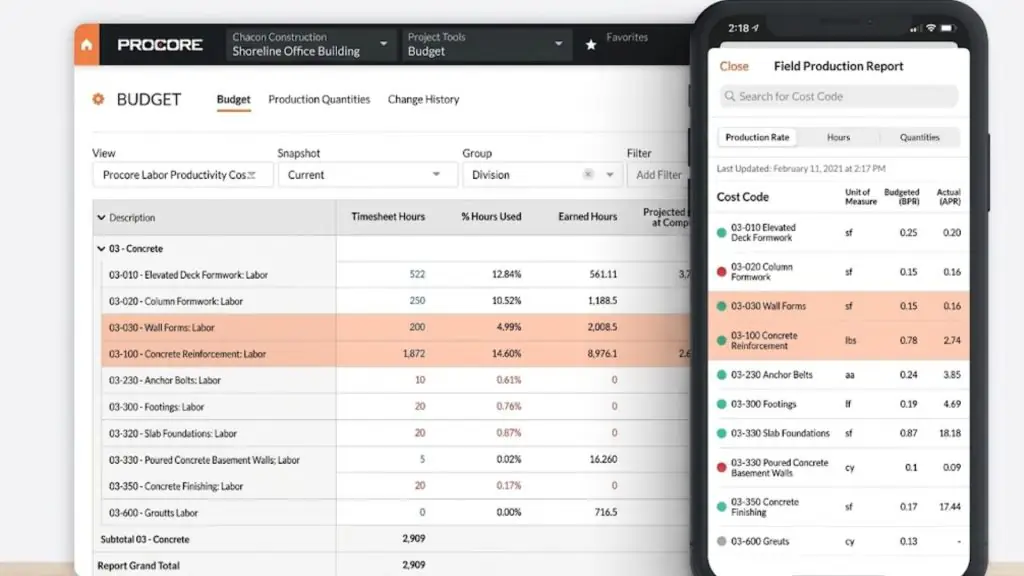
Procore is a comprehensive construction management platform that helps businesses track progress and manage finances, quality, and documents within a single system.
Key features:
- Management of progress and the construction log.
- Tracking of quality, safety, and project documents.
- Real-time updates of field data.
- Connecting and sharing information between the relevant parties.
Advantages:
- Centralized management on a single platform.
- Supports effective collaboration between the office and the site.
- Has an ecosystem that integrates with many other software tools.
Points to consider:
- The implementation cost is quite high for small businesses.
- It is not yet widely used in the Vietnamese market.
Best suited to: Medium and large contractors, and businesses managing many construction projects at the same time.
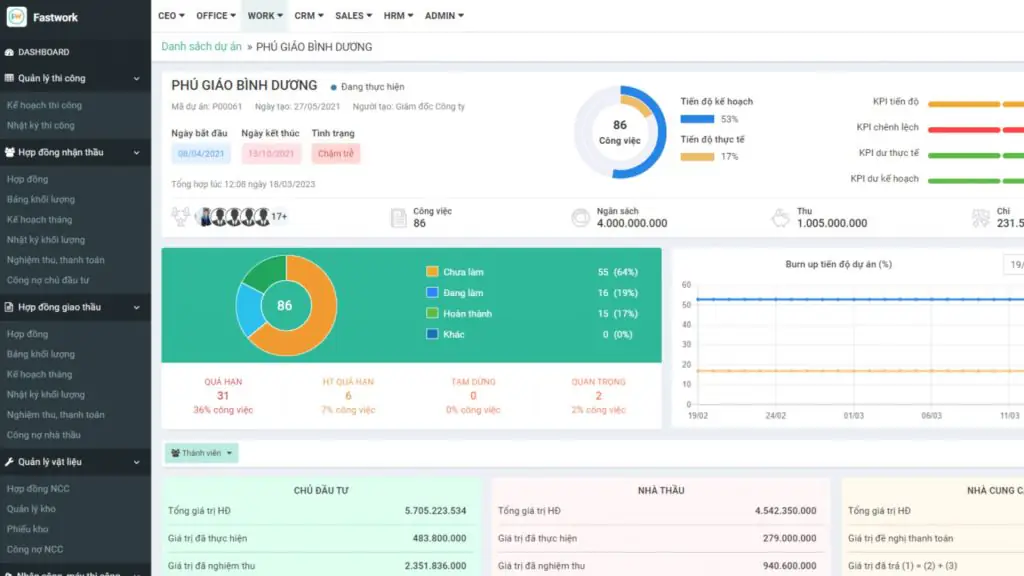
5. FastCons construction progress management software
FastCons is construction management software developed by a Vietnamese company that handles progress, materials, labor, and construction log management well. It offers a Vietnamese-language interface and workflows tailored to the specifics of the domestic construction industry.
Key features:
- Management of progress, work volume, and the construction log.
- Management of materials, equipment, and labor.
- Real-time progress tracking on the web and a mobile app.
- Consolidated reporting to support project management.
Advantages:
- Vietnamese-language interface that is easy to use.
- Suited to the management processes of Vietnamese businesses.
- Easy to deploy, with domestic technical support.
Points to consider:
- The in-depth planning and analysis features are not as varied as those of some international software.
- Its ability to integrate with international platforms is still limited.
Best suited to: Small and medium-sized construction contractors, or businesses that want to deploy software aligned with their operating processes in Vietnam.
>>> See also:
- Top 10 free, online, professional logo design software tools
- Top 10 free 3D home design software tools for phone and computer
- Top 10 free, online, high-quality poster design software tools
Applying AI in construction progress management
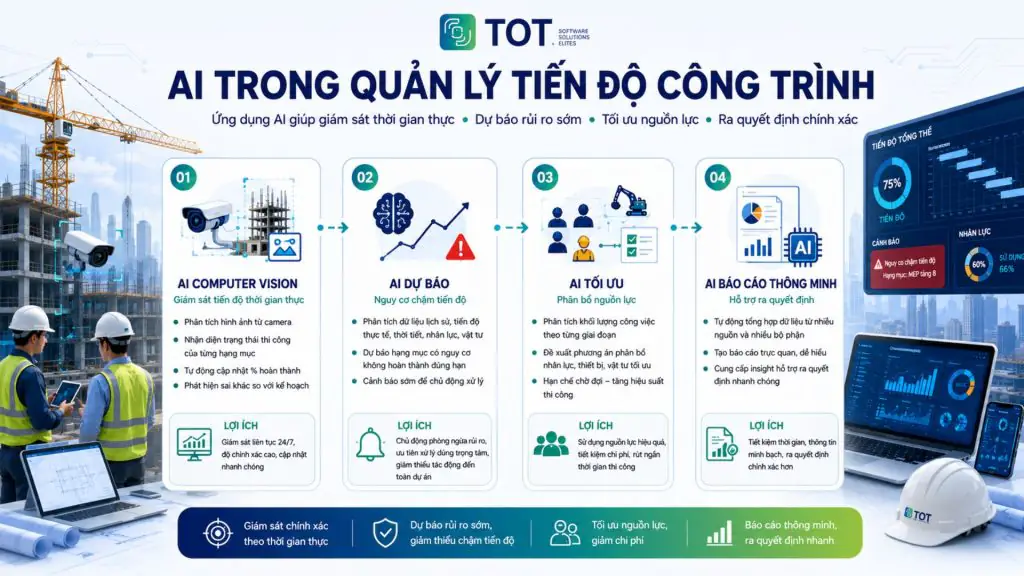
AI is becoming an important trend in construction progress management, helping businesses monitor construction in real time, forecast risks, and optimize decision-making. Instead of relying entirely on manual reports, a business can leverage data from cameras, sensors, IoT devices, and management software to automatically update progress, detect emerging issues, and issue early warnings.
AI Computer Vision helps monitor site progress in real time
One of the challenges for construction businesses is that updating field progress often relies on manual reports, which are prone to delays or inaccuracies. AI Computer Vision helps overcome this by analyzing camera images to automatically recognize the construction status of each work item.
AI forecasts the risk of delays before an incident occurs
Instead of waiting until the project is already behind schedule to react, AI can analyze historical data, actual progress, weather conditions, labor, and materials to forecast which work items are at risk of not being completed on schedule.
AI optimizes resource allocation during construction
Poor coordination of labor, equipment, and materials can leave many work items waiting on one another, extending construction time. AI helps analyze the workload of each phase to recommend an appropriate resource allocation plan.
AI automatically compiles reports and supports decision-making
A construction project usually generates a large volume of data from many different departments. AI can automatically compile this information into visual reports, helping managers quickly grasp the status of the project without spending much time processing data.
>>> See also: How is AI in software development applied?
In short, AI does not replace the manager but acts as a supporting tool, helping businesses monitor progress more accurately, forecast risks early, and optimize project management. To deploy it effectively, a business needs to choose a solution that fits its size, technology infrastructure, and existing operating processes.
TOT works alongside businesses to build a roadmap for applying AI to construction progress management, from solution consulting and custom software development to deploying AI Computer Vision that helps monitor the site, automate processes, and improve project management efficiency.
Custom construction progress management solutions from TOT
Every construction business has its own management process and operating requirements. Instead of using off-the-shelf software, TOT develops custom construction progress management solutions that help businesses optimize their processes, improve management efficiency, and scale easily in the future.
- Planning and assigning work: TOT builds a system that helps businesses plan construction, break work down by work item, and assign tasks to each individual or construction team. All information is managed centrally, making it easier to track progress.
- Real-time progress updates: The software supports updating progress directly from the site and automatically alerts you when a work item falls behind schedule. As a result, managers can quickly adjust resources and limit the impact on the entire project.
- Managing multiple projects on one platform: A business can monitor many projects simultaneously through a visual dashboard, helping leadership grasp progress, compare the status of different projects, and make timely decisions.
- Applying AI Computer Vision: TOT integrates AI Computer Vision to support site monitoring, analyze camera images, and provide data for progress management. This solution helps reduce reliance on manual reports and improves remote monitoring capabilities.
- Customization to the business’s process: Each solution is designed based on the business’s actual operating process and can integrate with existing systems such as ERP, CRM, or accounting software, helping to optimize management and operational efficiency.
This capability is demonstrated through TOT’s real-world projects in construction and technology, notably the AI Computer Vision application solution, along with website projects for Coteccons Global, Unicons, and Sinh Nam. TOT understands the specifics of the construction industry and accompanies businesses from consulting through deployment and operation.
>>> Learn more:
- 2026 custom software development services
- Top 20 most reputable, high-quality app design companies in Vietnam
TOT’s process for deploying construction progress management software
TOT applies a 6-step deployment process to ensure the software meets the business’s exact needs and can operate effectively once put into use.
Step 1: Survey and requirements analysis
TOT works with the business to understand its current management process and to define the needs, objectives, and problems to be solved before deployment.
Step 2: Solution consulting
Based on the survey results, the team of experts proposes the system architecture, the features to be developed, and a deployment roadmap that fits the business’s budget and objectives.
Step 3: UI/UX and system design
TOT builds an intuitive, easy-to-use interface and designs the system architecture to ensure performance, scalability, and security.
Step 4: Development and integration
The technical team develops the requested features and, where needed, integrates them with existing systems such as ERP, CRM, or other management platforms.
Step 5: Testing and training
The software is tested before actual deployment. At the same time, TOT trains the business’s team to use the system to ensure smooth operation.
Step 6: Handover and ongoing support
After handover, TOT continues to support maintenance, upgrades, and optimization of the system based on real needs, helping the business get the most out of the software over the long term.
>>>> See also:
- Professional custom software development in Hanoi
- Professional custom software development in HCMC at a great price
Conclusion
Effective construction progress management is the key that helps a construction business control time, cost, and quality while protecting its reputation and profits. From applying the right 4-step process and choosing the appropriate method (Gantt, CPM, PERT, BIM 4D) to leveraging software and AI, a business can shift from reactive management to proactively forecasting and optimizing. If a business has a unique process, a custom, AI-integrated construction progress management solution from TOT will be an investment that delivers a sustainable competitive advantage.
Frequently asked questions about construction progress management
What steps does the construction progress management process include?
The basic construction progress management process includes 4 steps: Step 1. Define the scope of work and project objectives; Step 2. Build a detailed construction plan and schedule; Step 3. Monitor, update, and control actual progress against the plan; Step 4. Evaluate, adjust, and report. Carrying out the steps in sequence and updating data from the site in time helps a business detect delays early and intervene while the problem is still small.
Should you manage construction progress with Excel?
Excel is suitable for small projects with few work items and a limited budget. However, for large works with many parallel work items, Excel reveals limitations such as difficulty showing the critical path, no real-time updates, susceptibility to errors, and difficulty coordinating multiple parties. As the scale grows, a business should switch to dedicated software to manage progress accurately and transparently and to receive automatic delay alerts.
Which software is suitable for construction progress management?
The choice depends on the scale and budget. Large infrastructure projects should use Oracle Primavera P6; small and medium projects are a good fit for Microsoft Project; businesses adopting BIM can choose Autodesk Construction Cloud or Procore; Vietnamese contractors tend to prefer domestic software such as FastCons. If you have a unique process or want to integrate AI, a custom solution from TOT is the optimal choice so that the software matches your way of operating completely.
When should a business use progress management software?
A business should use progress management software when it: manages many projects at once, has works with many work items and subcontractors, frequently faces delays that are hard to control, or needs transparent reporting for the investor. When tracking with Excel and manual methods can no longer keep up, investing in software will quickly pay off by reducing delays and optimizing resources.
TOT is your partner on the digital transformation journey, providing website design, mobile app, custom software and artificial intelligence software solutions tailored to each business need.
With hands-on consulting and implementation experience, TOT helps businesses build a digital transformation roadmap, apply AI, and automate processes to optimize operations and create a sustainable competitive advantage.
TOT contact information:
🌐 TOT Website
📞 Hotline/WhatsApp/Zalo: 0906 712 137
✉️ Email: long.bui@toponseek.com
🏢 Address: 31 Hoang Dieu Street, Xom Chieu Ward, Ho Chi Minh City, Vietnam