In today’s mobile-first world, off-the-shelf solutions often fall short of unique business needs. Custom mobile app development services provide the flexibility, scalability, and personalization required to stand out. Whether you’re a startup or an enterprise, understanding tailored solutions is key to success. In this guide, TOT will walk you through the essentials, top technology trends for 2026, and how to choose the right partner to turn your vision into reality.
>>> Explore more:
- Mobile App Development Project Plan & Roadmap Guide 2026
- Top 10 Affordable App Development Company in 2026
What is Custom Mobile App Development?
Custom mobile app development services provide tailored solutions for iOS, Android, and cross-platform frameworks such as React Native and Flutter, all designed to align with specific business objectives. These services cover the entire development lifecycle, from strategic planning and UI/UX design to testing, deployment, and ongoing maintenance, ensuring a seamless and efficient process.
By delivering highly customized applications, businesses can improve user engagement, streamline operations, and integrate effortlessly with existing enterprise systems. The result is a scalable, secure, and high-performance digital product that supports long-term growth.
Unlike off-the-shelf software, custom applications are built from the ground up or extensively tailored to meet unique requirements, including business goals, target-audience behavior, industry-specific workflows, and system integration needs. This approach enables greater flexibility, scalability, and competitive advantage compared to generic solutions.
>>> See more:
- Hire an App Developer Cost in 2026: Full Pricing Guide
- How Much Does E-Commerce Mobile App Development Cost?

Key Aspects of Custom Mobile App Development Services
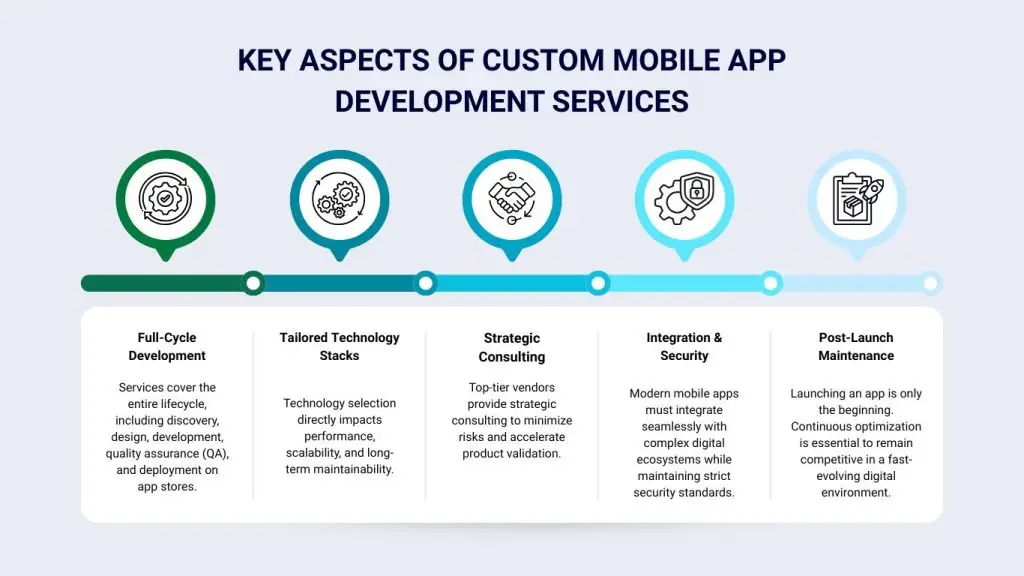
Custom mobile app development services are not limited to coding—they encompass a full-stack ecosystem that integrates product strategy, engineering excellence, and continuous optimization. Businesses that adopt a structured and data-driven approach to mobile development are significantly more likely to achieve scalability, user retention, and ROI.
Full-Cycle Development
Services cover the entire lifecycle, including discovery, design, development, quality assurance (QA), and deployment on app stores.
A high-quality service provider delivers end-to-end mobile app development, ensuring alignment across all stages—from ideation to post-launch optimization.
This typically includes:
- Product discovery and requirement analysis
- UI/UX design and prototyping
- Frontend and backend development
- Quality assurance (QA) and testing
- Deployment to app stores
- Continuous monitoring and iteration
According to Statista, mobile apps generated over $475 billion in revenue in 2022, and this figure is expected to exceed $600 billion by 2027. This highlights the importance of a structured, full-cycle approach to maximize product-market fit and revenue potential.
A fragmented development process often leads to inconsistencies and technical debt, while full-cycle delivery ensures faster time-to-market and better product coherence.
Tailored Technology Stacks
Technology selection directly impacts performance, scalability, and long-term maintainability. Custom mobile app development focuses on building tailored architectures rather than relying on generic stacks.
Common approaches include:
- Native development (Swift, Kotlin): Best for performance-critical applications
- Cross-platform frameworks (Flutter, React Native): Reduce development time by up to 30–40%
- Cloud-native infrastructure: Enables elastic scalability and high availability
- Microservices & API-first design: Improves modularity and future extensibility
Additionally, Gartner reports that over 85% of organizations will adopt a cloud-first principle by 2025, reinforcing the importance of scalable backend architecture in mobile applications.
Strategic Consulting
Top-tier vendors provide strategic consulting to minimize risks and accelerate product validation. This includes:
- MVP (Minimum Viable Product) development
- Market and competitor analysis
- Product roadmap definition
- Monetization strategy design
Research from CB Insights shows that 35% of startups fail due to a lack of market need, emphasizing the importance of validating ideas early through MVPs. By launching a lean MVP, businesses can gather real user feedback, reduce development costs, and iterate faster—ultimately improving success rates.
Integration & Security
Modern mobile apps must integrate seamlessly with complex digital ecosystems while maintaining strict security standards.
Integration capabilities include:
- CRM and ERP systems
- Payment gateways and fintech APIs
- Third-party services (analytics, messaging, social platforms)
Security practices include:
- End-to-end encryption
- Secure authentication (OAuth, MFA, biometrics)
- Compliance with GDPR, HIPAA, and ISO standards
Recent findings indicate that breach costs hover around $4.4–$4.9 million globally, depending on factors such as AI adoption and the speed of incident response.
Post-Launch Maintenance
Launching an app is only the beginning. Continuous optimization is essential to remain competitive in a fast-evolving digital environment.
Key activities include:
- Performance monitoring and crash analytics
- Bug fixing and system optimization
- Feature updates based on user feedback
- OS compatibility updates
- Infrastructure scaling
Data from Localytics indicates that 21% of users abandon an app after just one use, highlighting the importance of continuous improvement and user engagement strategies.
Organizations that adopt CI/CD pipelines and DevOps practices can release updates faster and maintain higher app quality over time.
>>> Read more:
- How to Choose the Best Mobile App Design Agency 2026
- Top 15 IT Outsourcing Companies in Vietnam [Updated 2026]
Types of Custom Mobile App Development Services
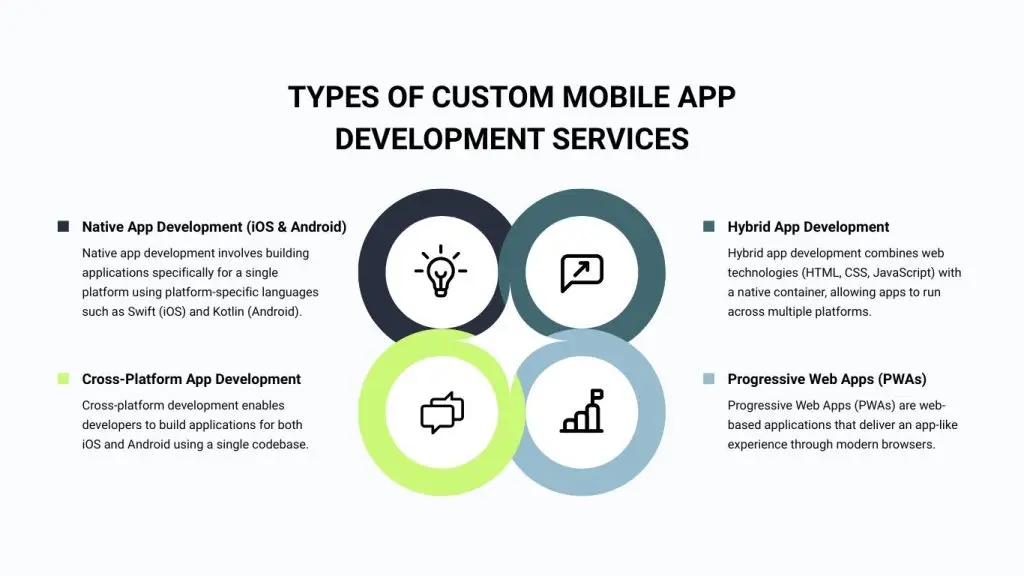
Choosing the right type of mobile app development is a strategic decision that directly impacts performance, scalability, user experience, and overall cost. Each approach comes with distinct advantages and limitations, so businesses must align their choice with specific product goals and technical requirements.
Native App Development (iOS & Android)
Native app development involves building applications specifically for a single platform using platform-specific languages such as Swift (iOS) and Kotlin (Android).
Key advantages:
- Optimal performance and responsiveness
- Full access to device features (e.g., camera, GPS, biometrics)
- User experience aligned with platform guidelines
- Enhanced security and system stability
According to recent industry data, mobile devices account for over 62–64% of global web traffic in 2025, confirming the dominance of mobile-first user behavior.
Additionally, more than 96% of internet users access the web via mobile devices, making mobile applications a critical channel for digital engagement and business growth.
This shift highlights why high-performance native applications remain essential for delivering seamless user experiences, especially in competitive industries.
Limitations:
- Higher development costs due to separate codebases
- Longer development timelines
Best use cases:
- Fintech and banking applications
- Mobile gaming and real-time applications
- Large-scale consumer platforms with high performance demands
Cross-Platform App Development
Cross-platform development enables developers to build applications for both iOS and Android using a single codebase. Popular frameworks include Flutter and React Native.
Key advantages:
- Faster development and time-to-market
- Lower costs due to shared code
- Simplified maintenance and updates
According to the Stack Overflow Developer Survey 2024, over 40% of developers use cross-platform frameworks, indicating strong adoption across the industry.
Additionally, Google reports that Flutter can reduce development time by up to 30–40%, making it a practical choice for rapid product development.
Limitations:
- Slightly lower performance compared to native apps
- Limited access to certain low-level device features
Best use cases:
- Startups building MVPs
- Business applications with moderate complexity
- Products requiring fast market entry
Hybrid App Development
Hybrid app development combines web technologies (HTML, CSS, JavaScript) with a native container, allowing apps to run across multiple platforms.
Key advantages:
- Lower development costs
- Single codebase for multiple platforms
- Faster initial deployment
However, hybrid apps may face:
- Performance limitations
- Reduced responsiveness in complex interactions
Best use cases:
- Internal enterprise applications
- Content-driven apps
- Projects with limited budgets
Progressive Web Apps (PWAs)
Progressive Web Apps (PWAs) are web-based applications that deliver an app-like experience through modern browsers.
They offer features such as:
- Offline functionality via service workers
- Push notifications
- Fast loading speeds
- Cross-device compatibility
According to Google, PWAs can increase user engagement by up to 137% and significantly improve load performance.
For example, X (formerly Twitter) reported that its PWA (“Twitter Lite”) led to:
- A 65% increase in pages per session
- A 75% increase in Tweets sent
- Reduced data consumption
Limitations:
- Limited access to advanced native device features
- Dependence on browser capabilities
Best use cases:
- E-commerce platforms
- Content-focused applications
- Markets with limited internet bandwidth
>>> See more:
- 6 Basic Steps of Software Development Process Explained
- 15 Key Software Development Methodologies: Types and Guidelines
Custom Mobile App Development Process
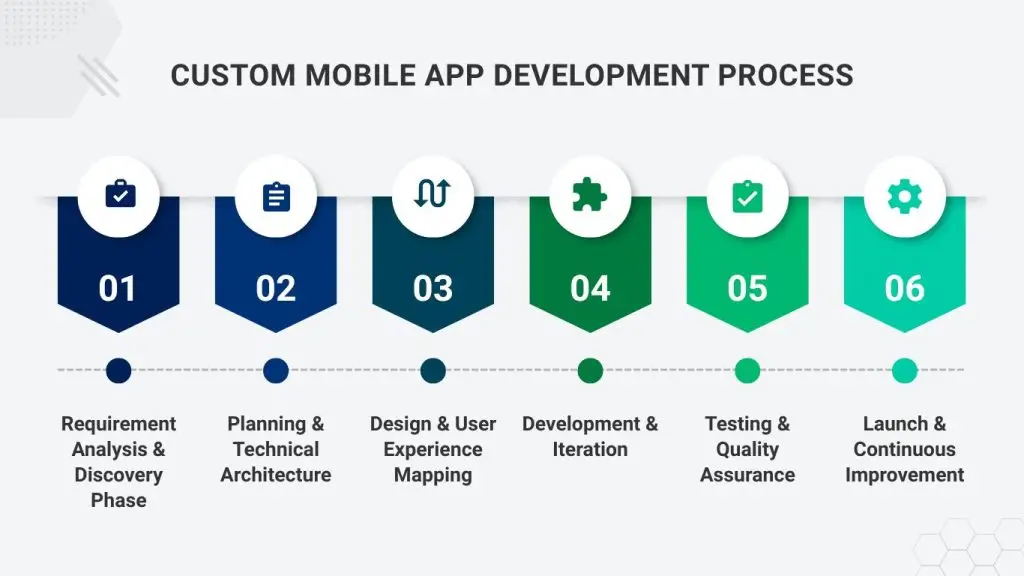
Building a custom mobile application is a structured and iterative process that combines strategic planning, technical execution, and continuous optimization. Each phase plays a critical role in ensuring that the final product aligns with business objectives, delivers a seamless user experience, and remains scalable over time.
Requirement Analysis & Discovery Phase
The discovery phase lays the foundation for the entire project. At this stage, development teams work closely with stakeholders to clearly define the product vision, business goals, and user expectations.
This phase typically includes:
- Stakeholder interviews to understand objectives and constraints
- Market and competitor analysis to identify opportunities and differentiation
- User persona development to define target audiences
- Feature prioritization to determine core functionalities
- Technical feasibility assessment to evaluate risks and constraints
A well-executed discovery phase reduces ambiguity, aligns all stakeholders, and prevents costly changes later in the development cycle.
Planning & Technical Architecture
Once requirements are clearly defined, the next step is to translate them into a structured technical plan.
This involves:
- Designing the system architecture (monolithic vs microservices, API-first approach)
- Selecting the technology stack (native, cross-platform, backend frameworks)
- Defining data flow and database structure
- Establishing security protocols and compliance requirements
- Creating a development roadmap with milestones and deliverables
A solid architecture ensures that the application can scale efficiently, handle increasing user loads, and integrate with other systems without major refactoring.
Design & User Experience Mapping
User experience is a key differentiator in mobile applications. This phase focuses on designing intuitive, engaging, and user-friendly interfaces.
Key activities include:
- User journey mapping to visualize how users interact with the app
- Wireframing and prototyping to outline layouts and functionality
- UI design aligned with platform guidelines (iOS Human Interface, Material Design)
- Usability testing to validate design decisions early
The goal is to create a seamless experience that minimizes friction and maximizes user engagement and retention.
Development & Iteration
During this phase, developers begin building the application based on the approved designs and architecture.
Most modern teams follow Agile methodologies, which divide the development process into smaller iterations or sprints. This allows for:
- Continuous feedback and adjustments
- Faster delivery of functional features
- Early detection of issues
Development typically includes:
- Frontend (mobile interface) implementation
- Backend development (APIs, databases, business logic)
- Integration with third-party services
- Version control and code reviews
This iterative approach ensures flexibility and enables teams to adapt quickly to changing requirements.
Testing & Quality Assurance
Quality assurance is essential to ensure that the application performs reliably under different conditions.
Testing processes include:
- Functional testing to verify all features work as expected
- Performance testing to assess speed, responsiveness, and scalability
- Security testing to identify vulnerabilities
- Usability testing to ensure a smooth user experience
- Device and OS compatibility testing across multiple environments
A rigorous QA process minimizes bugs, improves app stability, and enhances overall user satisfaction.
Launch & Continuous Improvement
After thorough testing, the application is deployed to app stores such as the Apple App Store and Google Play.
However, launch is not the end of the process—it marks the beginning of continuous improvement.
Post-launch activities include:
- Monitoring app performance and crash reports
- Analyzing user behavior and engagement metrics
- Collecting and responding to user feedback
- Releasing regular updates and new features
- Ensuring compatibility with new OS versions and devices
Successful mobile applications evolve. Continuous optimization helps maintain competitiveness, improve user retention, and support long-term business growth.
>>> Read more:
- Top 20 Custom Healthcare Software Development Services Companies
- TOP 20 Offshore Software Development Companies (2026)
Top Custom Mobile App Development Companies (2026)
1. TOT
- Year Founded: 2019
- Hourly Rate: $25 – $49
- Average Project Size: $10,000+
- Key Technologies: AI/ML, Flutter, React Native, Node.js, AWS, Azure
- Headquarters: Ho Chi Minh City, Vietnam
TOT is a Vietnam-based technology company specializing in custom mobile app development and end-to-end software solutions for startups, SMEs, and enterprises. The company focuses on building scalable, secure, and high-performance applications tailored to specific business needs, with strong capabilities in both native and cross-platform development.
In addition to development, TOT provides full-cycle services, including product consulting, UI/UX design, system integration, testing, and post-launch support. By leveraging modern technologies such as cloud computing and AI, TOT helps businesses accelerate digital transformation and deliver future-ready mobile solutions.
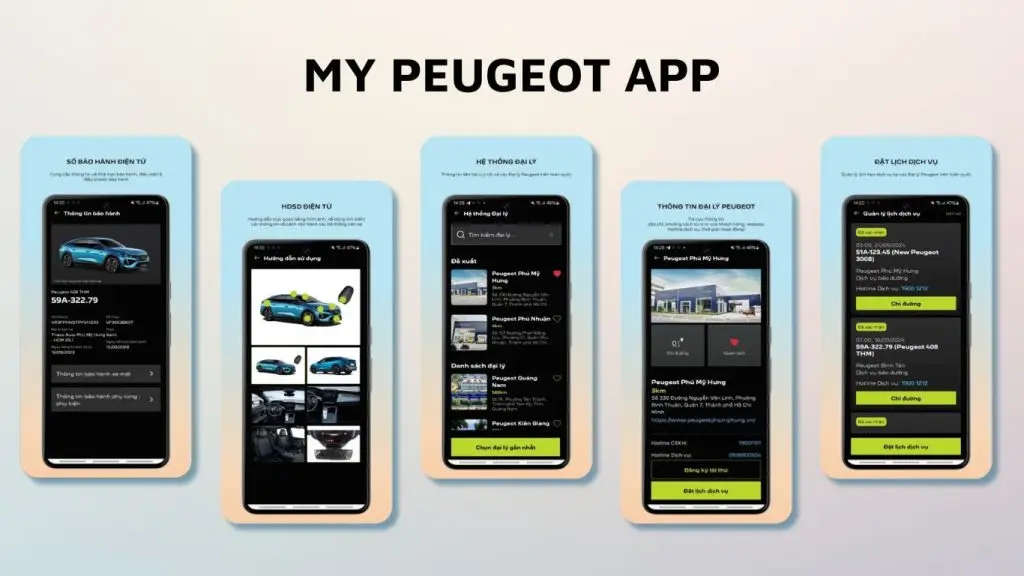
A notable example of TOT’s capabilities is its collaboration with Peugeot Vietnam in developing the My Peugeot App, a multifunctional mobile application designed to support customers throughout their vehicle ownership journey. The app allows users to explore vehicle models, book test drives, manage maintenance schedules, track vehicle status, and receive real-time updates—positioning it as a comprehensive digital companion for Peugeot users.
Before TOT’s involvement, the existing application faced several challenges, including inconsistent UI/UX design, limited functionality, and suboptimal user experience. TOT addressed these issues by conducting in-depth user research, redesigning the interface to align with Peugeot’s brand identity, and integrating backend systems for real-time data synchronization.
Within a 4-month development cycle, the upgraded app delivered a more intuitive, seamless, and feature-rich experience—enhancing customer engagement, improving service efficiency, and strengthening long-term user relationships.
2. Goji Labs
- Year Founded: 2014
- Hourly Rate: $100 – $149
- Average Project Size: $25,000+
- Key Technologies: React Native, Flutter, Firebase, AWS
- Headquarters: Los Angeles, USA
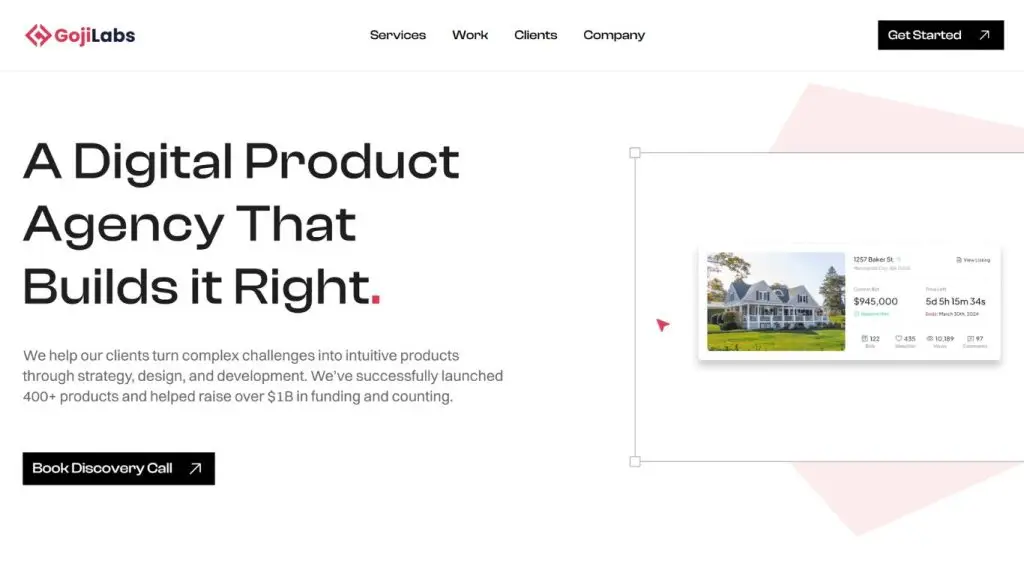
Goji Labs is a product-focused digital agency known for delivering high-quality mobile applications with a strong emphasis on UX design and product strategy. The company works closely with startups and enterprises to transform ideas into scalable digital products.
Beyond development, Goji Labs provides product discovery, user research, and iterative prototyping, helping clients validate ideas before full-scale implementation. Their approach ensures that applications are not only technically sound but also aligned with real user needs.
>>> See more:
- Top 15 Best Web Design Companies in Ho Chi Minh City (2026)
- Top 10 Best Web Agency Offshore for Web Development (2026)
3. Utility
- Year Founded: 2013
- Hourly Rate: $150 – $199
- Average Project Size: $50,000+
- Key Technologies: Swift, Kotlin, React Native, Node.js
- Headquarters: New York, USA
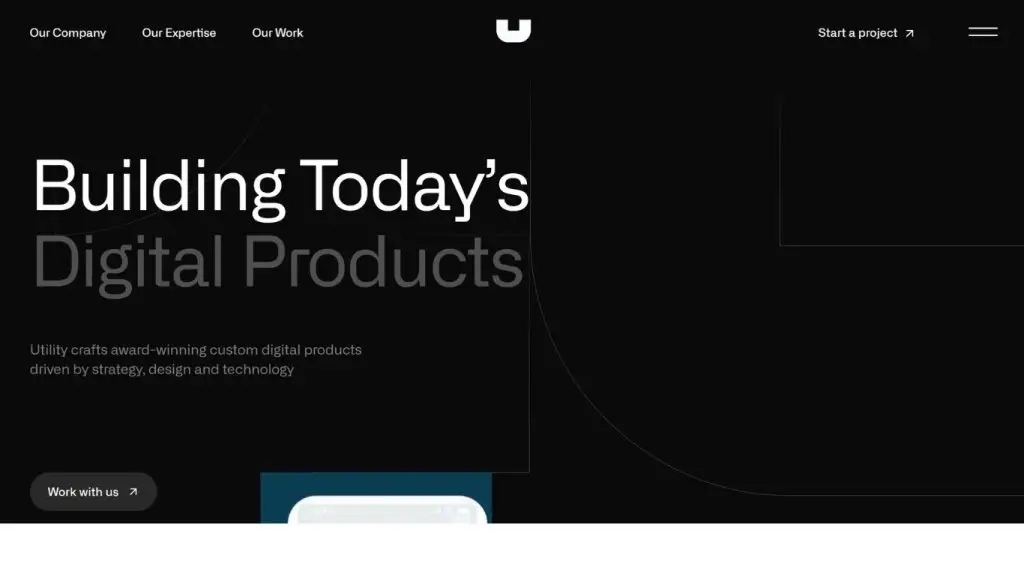
Utility is a premium digital product agency that delivers high-end mobile applications for startups, enterprises, and Fortune 500 companies. The company is recognized for combining strong engineering capabilities with advanced design and branding expertise.
Utility’s team specializes in building feature-rich, visually polished applications that support complex user interactions and large-scale user bases. Their services often include branding, product strategy, and post-launch growth support.
>>> Explore more:
- Top 15 Construction Web Design Agency for Builders & Contractors
- Web Application Development Company in Vietnam: Top 20 Trusted
4. Mercury Development
- Year Founded: 1999
- Hourly Rate: $50 – $99
- Average Project Size: $25,000+
- Key Technologies: iOS, Android, Xamarin, .NET, AWS
- Headquarters: Florida, USA
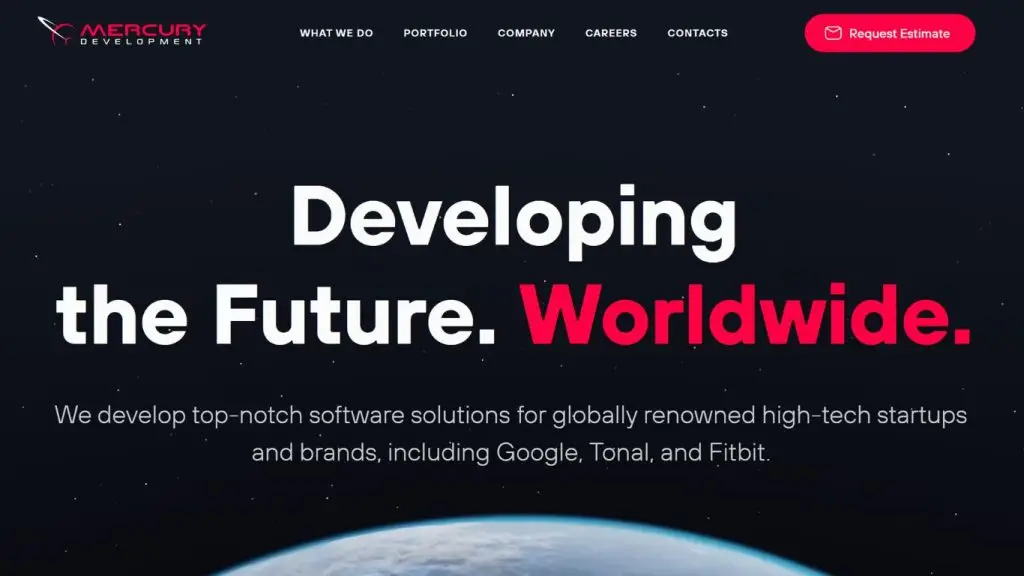
Mercury Development is a well-established software development company offering full-cycle mobile app development services across multiple industries, including healthcare, finance, and e-commerce.
With decades of experience, the company has built a reputation for delivering robust, scalable, and secure applications. Their engineering-driven approach ensures high performance and reliability, particularly for enterprise-level systems.
>>> See more:
- Top 10 Types of Custom Enterprise Software Development in 2026
- Website Design Cost: SEO-Ready E-Commerce Sites, Full Package
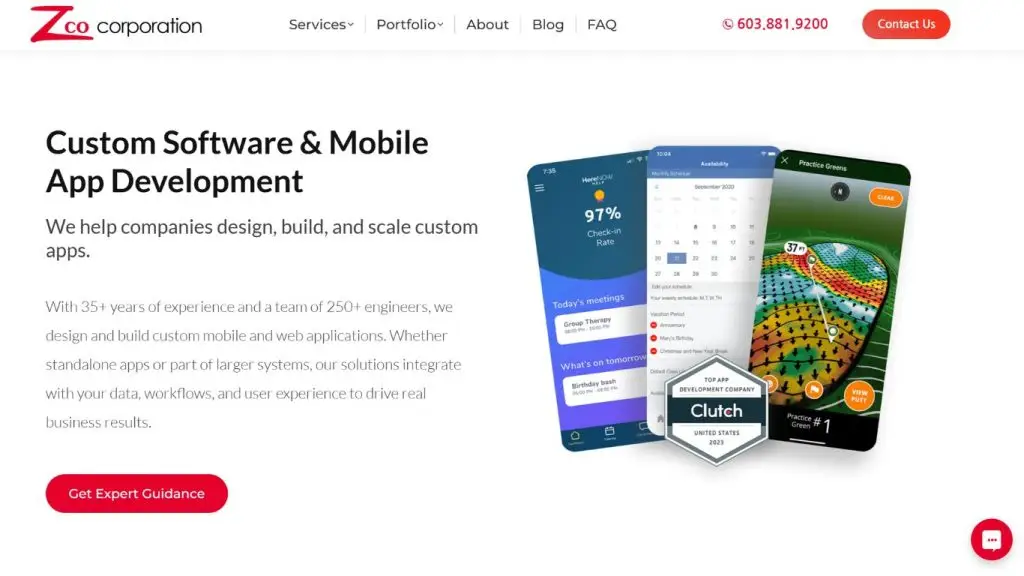
5. ZCO Corporation
- Year Founded: 1989
- Hourly Rate: $25 – $49
- Average Project Size: $10,000+
- Key Technologies: Swift, Kotlin, Unity, React Native
- Headquarters: New Hampshire, USA
ZCO Corporation is one of the most experienced software development firms, providing custom mobile app development, enterprise software, and AR/VR solutions.
The company is known for its broad technical capabilities and long-standing industry presence, having worked with clients ranging from startups to large enterprises. ZCO emphasizes reliability, scalability, and cross-industry expertise.
6. Saigon Technology
- Year Founded: 2012
- Hourly Rate: $25 – $49
- Average Project Size: $10,000+
- Key Technologies: React Native, Flutter, .NET, Java, AWS
- Headquarters: Ho Chi Minh City, Vietnam
Saigon Technology is a leading outsourcing company in Vietnam, offering cost-effective yet high-quality custom mobile app development services for global clients.
The company follows Agile methodologies and international development standards, enabling efficient collaboration with offshore teams. It has strong expertise in both cross-platform and enterprise application development.
>>> See more: Top 20 Best Software Outsourcing Companies in Vietnam (2026)
7. Nalashaa
- Year Founded: 2012
- Hourly Rate: $25 – $49
- Average Project Size: $10,000+
- Key Technologies: .NET, Azure, React Native, Xamarin
- Headquarters: New Jersey, USA
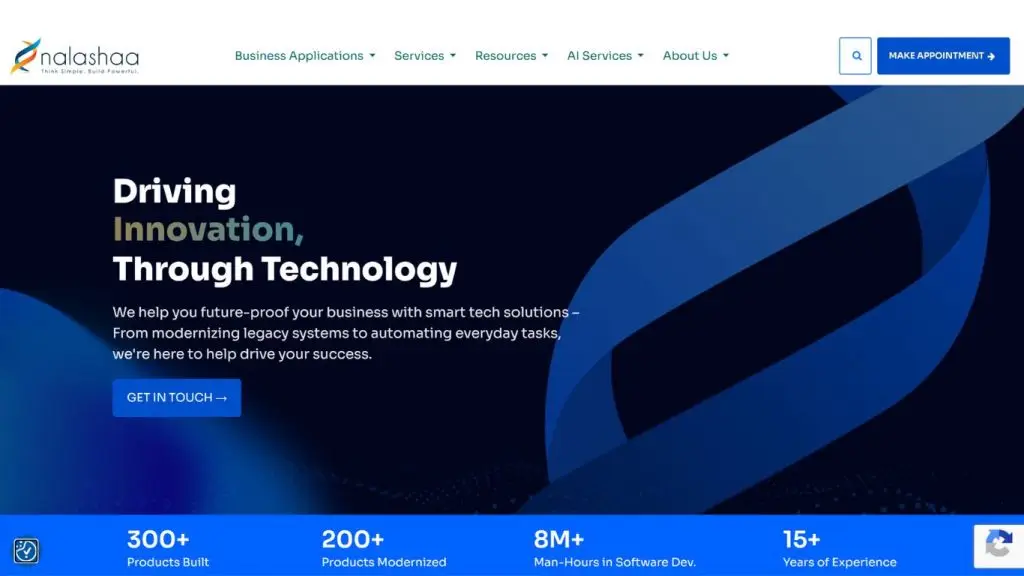
Nalashaa specializes in enterprise mobile app development and digital transformation solutions, with a strong focus on system integration.
The company excels in building applications that seamlessly connect with CRM, ERP, and cloud platforms, making it a preferred partner for enterprise clients with complex infrastructure.
8. Infinum
- Year Founded: 2005
- Hourly Rate: $100 – $149
- Average Project Size: $50,000+
- Key Technologies: Swift, Kotlin, Flutter, React Native
- Headquarters: Zagreb, Croatia
Infinum is a European digital agency known for delivering high-quality, design-driven mobile applications with a strong focus on user experience and product excellence.
The company works with global clients to build complex digital products that require both technical sophistication and design precision. Their approach emphasizes long-term scalability and product quality.
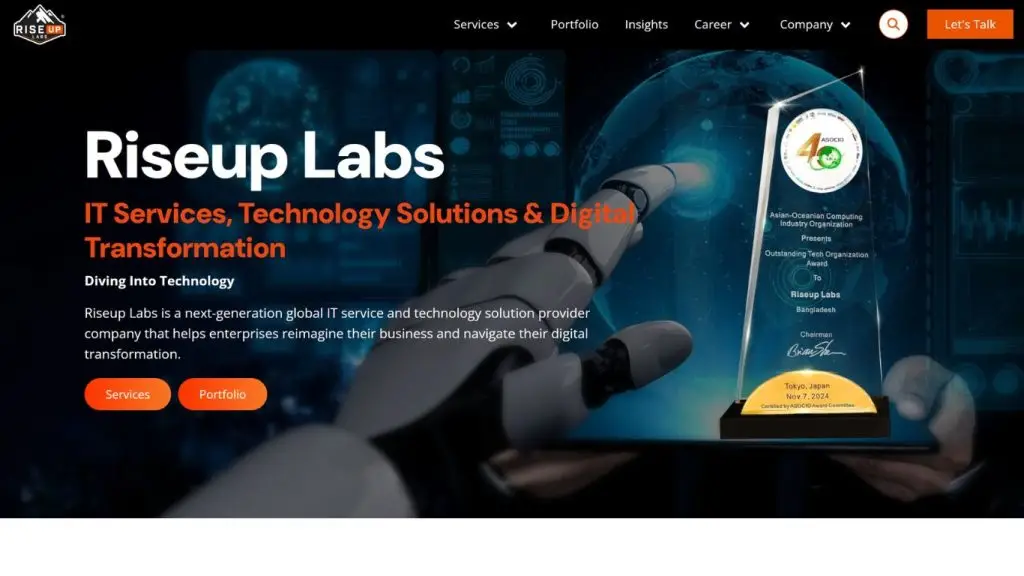
9. RiseUp Labs
- Year Founded: 2009
- Hourly Rate: $25 – $49
- Average Project Size: $10,000+
- Key Technologies: Unity, Flutter, React Native, Node.js
- Headquarters: Dhaka, Bangladesh
RiseUp Labs is a global software development company delivering innovative and scalable mobile applications across multiple industries, including gaming, education, and enterprise solutions.
The company is particularly known for its expertise in interactive applications and gamification, as well as its ability to deliver cost-effective solutions without compromising quality.
>>> Read more: Create a Free Online Store Website: Detailed, and Effective Guide
10. Sigma Software
- Year Founded: 2002
- Hourly Rate: $50 – $99
- Average Project Size: $50,000+
- Key Technologies: iOS, Android, Flutter, React Native, .NET, Java, AWS
- Headquarters: Lviv, Ukraine
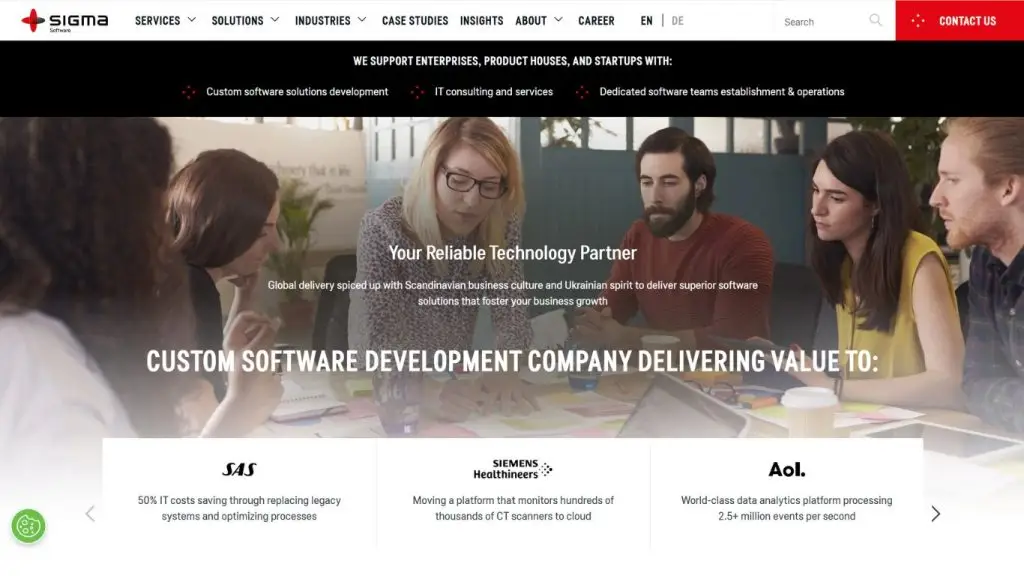
Sigma Software is a global IT consulting and software development company known for delivering high-quality custom mobile and enterprise solutions across a wide range of industries, including automotive, healthcare, fintech, and gaming.
With a strong engineering culture and extensive international experience, Sigma Software focuses on building scalable, secure, and performance-driven applications tailored to complex business environments. The company is particularly recognized for its expertise in large-scale projects, system integration, and long-term digital transformation initiatives.
How to Choose the Right Custom Mobile App Development Company
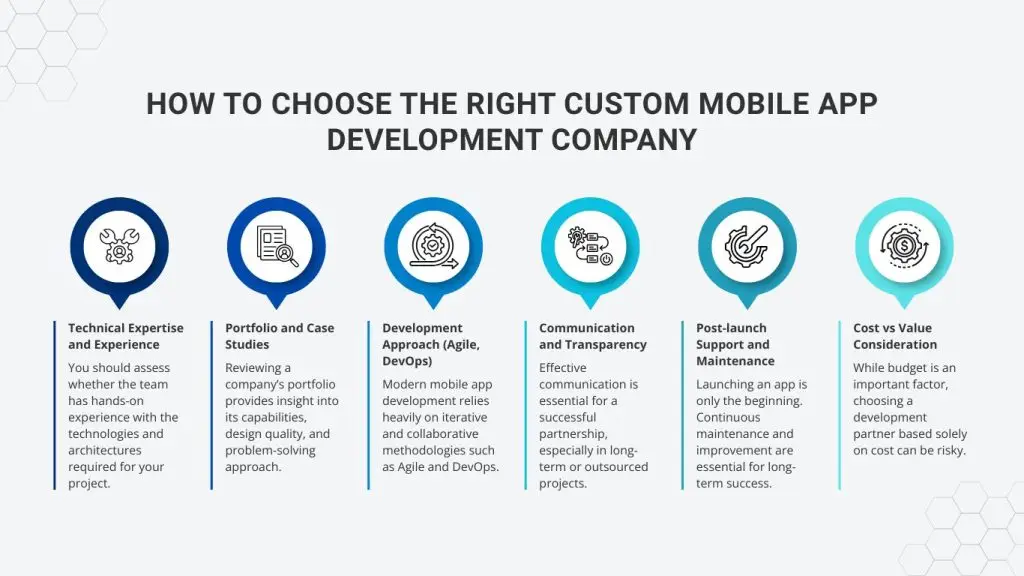
Selecting the right custom mobile app development company is a critical decision that can significantly impact the success of your product. Beyond technical execution, a reliable partner should demonstrate strategic thinking, transparent communication, and the ability to deliver scalable, high-quality solutions aligned with your business goals.
Below are the key factors to consider when evaluating potential development partners.
Technical Expertise and Experience
A company’s technical expertise is one of the most important evaluation criteria. You should assess whether the team has hands-on experience with the technologies and architectures required for your project.
This includes:
- Proficiency in native and cross-platform frameworks (Swift, Kotlin, Flutter, React Native)
- Experience with backend systems, APIs, and cloud infrastructure
- Knowledge of security best practices and compliance standards
- Familiarity with scalable architectures such as microservices or serverless
In addition, industry-specific experience can be a major advantage. For example, developing a fintech or healthcare app requires domain knowledge, regulatory awareness, and a strong focus on security.
A technically strong team not only builds the product correctly but also ensures it remains maintainable and scalable over time.
Portfolio and Case Studies
Reviewing a company’s portfolio provides insight into its capabilities, design quality, and problem-solving approach.
When evaluating portfolios, consider:
- The complexity and diversity of past projects
- The industries they have worked in
- The user experience and interface design quality
- Evidence of measurable results (e.g., improved engagement, performance, or business outcomes)
Case studies are particularly valuable because they show how the company approaches real-world challenges, including constraints, timelines, and technical decisions.
A strong portfolio indicates not only technical competence but also the ability to deliver solutions that align with business objectives.
Development Approach (Agile, DevOps)
Modern mobile app development relies heavily on iterative and collaborative methodologies such as Agile and DevOps.
An Agile approach enables:
- Faster delivery through incremental releases
- Continuous feedback and improvement
- Greater flexibility to adapt to changing requirements
DevOps practices further enhance this by:
- Automating testing and deployment (CI/CD pipelines)
- Improving collaboration between development and operations teams
- Ensuring faster and more reliable releases
A company that follows Agile and DevOps methodologies is more likely to deliver a product efficiently while maintaining high quality.
Communication and Transparency
Effective communication is essential for a successful partnership, especially in long-term or outsourced projects.
Key aspects to evaluate include:
- Clarity and responsiveness in communication
- Regular progress updates and reporting
- Transparency in timelines, risks, and deliverables
- Use of collaboration tools (e.g., Jira, Slack, Trello)
A transparent development process ensures that stakeholders remain aligned and can make informed decisions throughout the project lifecycle.
Poor communication, on the other hand, often leads to misunderstandings, delays, and increased costs.
Post-launch Support and Maintenance
Launching an app is only the beginning. Continuous maintenance and improvement are essential for long-term success.
A reliable development partner should offer:
- Ongoing technical support and bug fixes
- Performance monitoring and optimization
- Regular updates for OS compatibility and security patches
- Feature enhancements based on user feedback
Without proper post-launch support, even a well-built app can quickly become outdated or unstable.
Cost vs Value Consideration
While budget is an important factor, choosing a development partner based solely on cost can be risky.
Instead of focusing on the lowest price, consider the overall value, including:
- Quality of development and code maintainability
- Long-term scalability and performance
- Strategic input and consulting capabilities
- Post-launch support and reliability
A lower upfront cost may lead to higher long-term expenses due to technical debt, poor performance, or the need for redevelopment.
Investing in a high-quality development partner ensures better outcomes and a stronger return on investment.
Latest Trends in Custom Mobile App Development
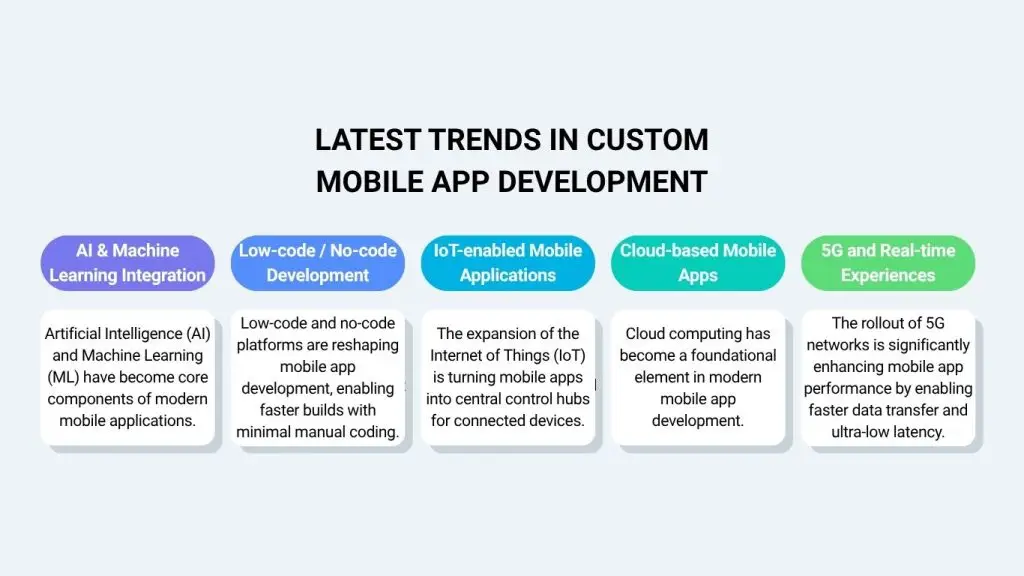
The mobile app development landscape is rapidly evolving, driven by emerging technologies and increasing user expectations. Businesses today are not only building applications but also creating intelligent, scalable, and connected digital ecosystems. Staying aligned with the latest trends is essential for delivering competitive and future-ready mobile solutions.
AI & Machine Learning Integration
Artificial Intelligence (AI) and Machine Learning (ML) have become core components of modern mobile applications. Instead of being optional features, AI capabilities are now embedded into both user-facing functionalities and development workflows.
Applications include:
- Personalized recommendations and content delivery
- AI-powered chatbots and virtual assistants
- Predictive analytics and behavior forecasting
- Voice and image recognition
According to industry data, the global AI market is expected to reach over $126 billion by 2025, highlighting its growing importance in digital products. In addition, AI is increasingly used in the development process itself—automating testing, improving code quality, and accelerating time-to-market.
Low-code / No-code Development
Low-code and no-code platforms are transforming how mobile applications are built, enabling faster development with minimal manual coding.
These platforms offer:
- Visual development environments
- Pre-built components and templates
- Faster prototyping and MVP delivery
- Reduced dependency on large engineering teams
This trend is gaining traction as businesses seek to shorten development cycles and reduce costs while maintaining flexibility. Many organizations now combine low-code tools with traditional development to balance speed and customization.
IoT-enabled Mobile Applications
The expansion of the Internet of Things (IoT) is turning mobile apps into central control hubs for connected devices.
Mobile applications now support:
- Smart home systems and connected vehicles
- Wearable health monitoring devices
- Industrial automation and logistics tracking
- Real-time device communication
By 2025, the number of IoT-connected devices is expected to exceed 30 billion globally, demonstrating the rapid growth of this ecosystem. As a result, mobile apps are evolving beyond standalone tools into interfaces that manage complex device networks.
Cloud-based Mobile Apps
Cloud computing has become a foundational element in modern mobile app development. Instead of relying solely on device storage and processing power, applications now leverage cloud infrastructure for scalability and performance.
Key benefits include:
- Real-time data synchronization across devices
- Improved performance and reliability
- Reduced infrastructure costs
- Enhanced scalability for growing user bases
Cloud-based architectures also enable advanced capabilities such as AI processing, real-time collaboration, and big data analytics, making them essential for enterprise-grade applications.
5G and Real-time Experiences
The rollout of 5G networks is significantly enhancing mobile app performance by enabling faster data transfer and ultra-low latency.
By 2025, there are expected to be around 1.9 billion 5G subscriptions worldwide, reflecting rapid global adoption.
With 5G, developers can build applications that support:
- Real-time streaming and communication
- AR/VR and immersive experiences
- Cloud gaming and high-performance apps
- Instant data synchronization
This shift allows mobile apps to deliver richer, more interactive experiences that were previously limited by network constraints.
FAQs About Custom Mobile App Development Services
How long does it take to develop a custom mobile app?
Development time typically ranges from 2 to 12+ months, depending on complexity. Simple apps take a few months, while enterprise-level solutions with advanced features require longer timelines.
How much does a custom mobile app cost?
Costs usually range from $20,000 to $300,000+, depending on features, platforms, integrations, and team expertise. More complex apps require higher investment.
How to ensure app security and scalability?
Use secure coding practices, data encryption, and strong authentication for security. For scalability, adopt cloud infrastructure, modular architecture, and performance monitoring to support future growth.
Custom mobile app development services are no longer just a technical choice—they are a strategic investment that enables businesses to deliver tailored user experiences, improve operational efficiency, and stay competitive in an increasingly mobile-first landscape. By selecting the right development partner, adopting modern technologies, and focusing on long-term scalability and continuous improvement, organizations can build high-impact mobile applications that not only meet current needs but also support sustainable growth and innovation.
If you’re looking for a reliable partner to turn your ideas into high-performance mobile solutions, TOT is here to help. With expertise in custom mobile app development, AI integration, and scalable architectures, TOT delivers tailored applications that align with your business goals.
Contact TOT today to discuss your project and start building a future-ready mobile app that drives real business impact.
TOT is a pioneer in the digital transformation journey, delivering website design, mobile app development, AI software development, and custom software development solutions with flexible services tailored to each business’s exact needs.
Inspired by the philosophy of “Technology for People,” TOT empowers businesses to operate more efficiently, elevate customer experiences, and build a lasting brand impression.