
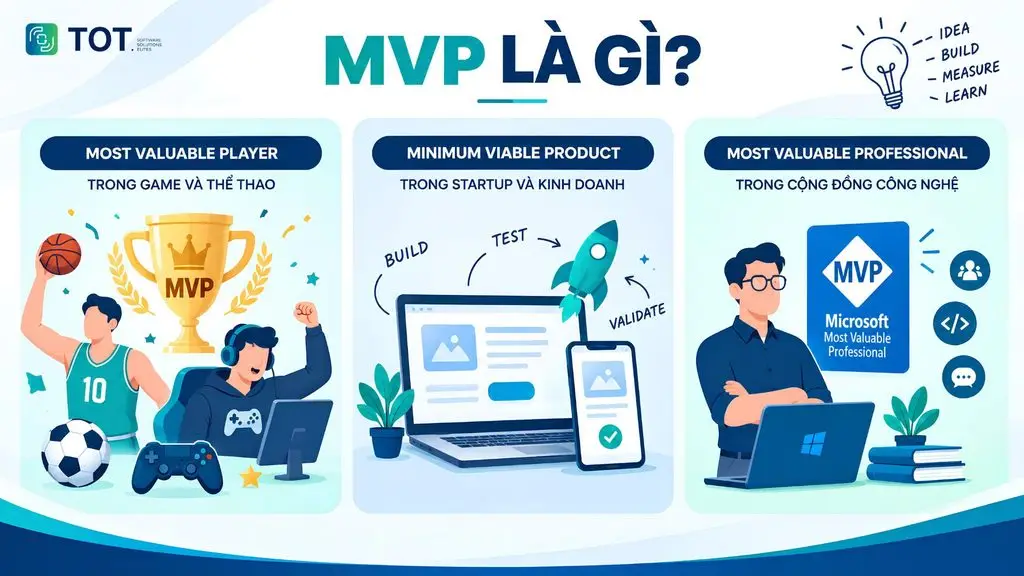
What is an MVP is a common question when learning about gaming, sports, startups and technology product development. Depending on the field, MVP can stand for Most Valuable Player, Minimum Viable Product, or Most Valuable Professional. In software development in particular, an MVP helps businesses quickly validate an idea, gather real-world feedback and optimize resources before investing in a fully finished product. In this article, TOT explains what MVP means, how it is applied and real examples so you can easily tell each concept apart.
>>> Read more articles:
- TOP 18 largest software companies in Vietnam
- Top 20 free warehouse management software, great for businesses
- What is application software? Common types of application software
Quick summary
- What is an MVP? MVP can stand for Most Valuable Player, Minimum Viable Product or Most Valuable Professional, depending on the field.
- MVP in gaming and sports: Most Valuable Player, referring to the player or athlete who makes the most outstanding contribution.
- MVP in startups and business: Minimum Viable Product, a minimum viable version of a product used to validate an idea and market demand.
- MVP in technology: Focusing on core features to get the software to users early, gather feedback and keep improving.
- Microsoft MVP: Most Valuable Professional, a title recognizing experts who make outstanding contributions to the Microsoft community and ecosystem.
What is an MVP?
What is an MVP? MVP is an abbreviation with several different meanings depending on the field in which it is used. In gaming and sports, MVP is usually understood as Most Valuable Player, meaning the player or athlete who makes the most outstanding contribution in a match, tournament or season. This title does not necessarily go to whoever scores the most points or racks up the most takedowns; it is usually based on overall performance and impact on the final result. As a result, a player who provides support, controls objectives or creates advantages for teammates can still be recognized as MVP even without leading in points.
In the fields of startups, business and technology development, MVP usually means Minimum Viable Product, that is, a minimum viable product. This is the first version of a product built with the essential core features needed to solve a specific problem, put it in front of real users and validate product hypotheses. An MVP does not mean a shoddy or bug-ridden product. The goal is to use resources sensibly to create enough value, then gather feedback and determine the next direction of development.
Beyond the two interpretations above, MVP can also stand for Most Valuable Professional, a prime example being the Microsoft MVP title awarded to experts who make outstanding contributions to the Microsoft community and technology ecosystem.
| MVP stands for | Meaning | Common field | Core meaning |
|---|---|---|---|
| Most Valuable Player | The most valuable player | Gaming, sports | The person who makes the most outstanding contribution in a match, tournament or season |
| Minimum Viable Product | Minimum viable product | Startups, business, technology | A product version with core features to create value and validate an idea |
| Most Valuable Professional | An expert of outstanding value | Technology, professional communities | A title recognizing experts who make significant contributions to a community or technology ecosystem |
>>> See also:
- Top 20+ best free AI image design software
- What is CRM software? Top 15 CRM tools for businesses
What is MVP in gaming?
In gaming, MVP usually stands for Most Valuable Player, referring to the player who makes the most outstanding contribution in a match. This title commonly appears in MOBA, FPS, battle royale or fighting games that have a post-match scoring system. MVP does not simply reflect individual skill; it also shows the extent to which a player creates advantages and helps the team achieve its shared objective.
What does MVP mean in gaming?
MVP in gaming is the player whom the system rates as having the best performance and the most outstanding contribution in the match. Depending on the game, the algorithm that determines the MVP may draw on many different metrics such as kills, assists, damage dealt, number of deaths, objective control or contribution to team fights.
For example, in a PUBG match, the MVP is determined based on the player’s overall performance, not just the number of kills. The system evaluates many factors such as survival time, kills, damage dealt, items collected, ability to support teammates and final placement. The player with the highest overall score is honored as the MVP.
>>> See also:
- Top 17 leading professional graphic design apps
- TOP 15+ effective, super-easy AI app-building tools

Criteria for earning MVP in gaming
There is no single formula that applies to every game. However, some criteria commonly used to evaluate the MVP include:
- KDA: The ratio between kills, assists and deaths.
- Damage: The amount of damage dealt to opponents or objectives.
- Kills: The ability to directly eliminate opponents.
- Assists: The level of involvement in teammates’ kills.
- Objective: Contribution to important objectives such as towers, dragons, Baron or equivalent targets.
- Map control: Controlling areas, vision and strategic positions, and applying pressure across the map.
- Contribution to the team: The ability to initiate fights, protect teammates, create advantages or help the team win.

Is the MVP the player with the most kills?
Not necessarily. MVP evaluates overall contribution rather than relying solely on the number of kills. A player in a support role can be awarded MVP thanks to the ability to protect teammates, set up plays and control fights, even with low kill numbers. How MVP points are calculated depends on each game’s mechanics, so the player with the most kills is not necessarily the most valuable player in the match.
What is MVP in sports?
In sports, MVP is the title given to the player or athlete with the most outstanding performance and contribution in a match, tournament or season.
What does MVP mean in sports?
MVP stands for Most Valuable Player, meaning the most valuable player/athlete. This title goes to the person with the most outstanding performance and contribution in a match, tournament or season. The MVP is not necessarily the one who scores the most points or goals; performance and influence are also taken into account. In football, for instance, a player can be chosen as MVP thanks to their ability to create chances, orchestrate play and have a decisive impact on the win, even without scoring directly.
Criteria for selecting the MVP in sports
The criteria for choosing an MVP vary by sport but usually revolve around overall value of contribution. Factors that are often considered include:
- Individual achievements: Points, goals, assists or other professional statistics.
- Contribution to the team’s results: How much the player helps the team win or achieve strong results.
- Competitive performance: The ability to maintain form and fulfill the assigned role well.
- Influence: The degree of impact on the flow and outcome of the match.
- Consistency: The ability to sustain effective performances across many matches or throughout the season.
>>> See also:
- 9+ easiest-to-use free mobile app design tools
- Top 19 free task organization apps for personal planning
- Top 15 effective free production warehouse management software

How is the MVP different from the top scorer?
The MVP differs from the top scorer in that it reflects overall value rather than just scoring statistics. A player can lead in points yet not be chosen as MVP if the team does not succeed or if their contribution in other areas is limited. Conversely, a defensive player, a playmaker or a leader on the pitch can still win MVP thanks to an influence that spans the entire team.
What is MVP in startups and business?
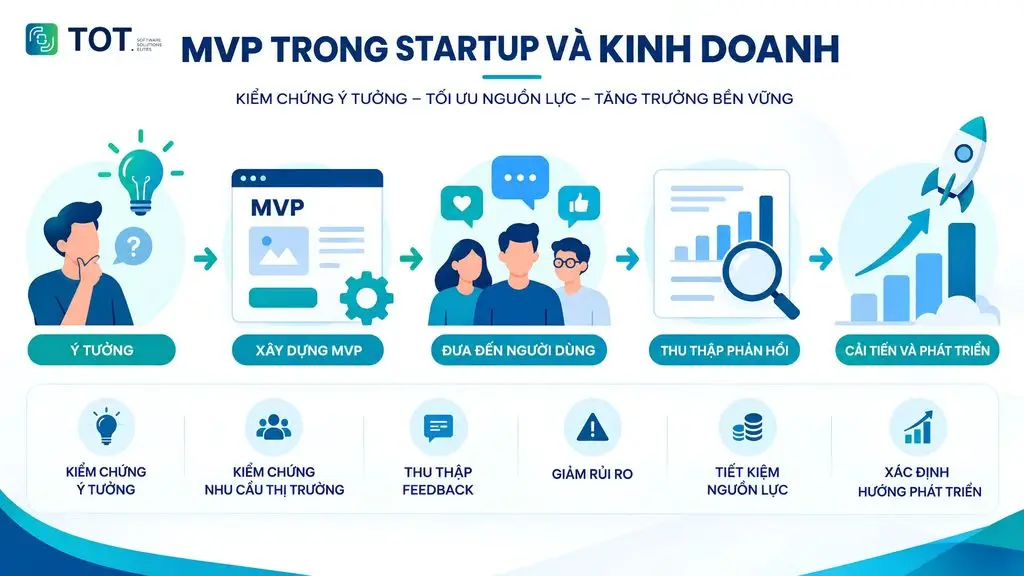
In startups and business, an MVP is an approach that helps a company bring an idea to market quickly at the lowest cost and risk, through a lean version that still carries enough value to validate real demand.
What does MVP – Minimum Viable Product mean?
Minimum Viable Product (MVP) means a minimum viable product. It is a product version with the essential features and core value needed to solve a specific problem for a target customer group, while helping the business validate its product hypotheses.
An MVP is not a product built just for the sake of it, a shoddy product or a bug-ridden one. “Minimum” here refers to the scope of features, but the product must still be usable enough to deliver real value to users. After launch, the business can gather feedback, analyze behavior and keep improving the product based on real-world data.
What is an MVP used for?
An MVP helps startups and businesses validate a product with a reasonable initial investment. Some of the main goals include:
- Validating the idea: Determining whether the solution truly addresses the problem at hand.
- Validating market demand: Assessing whether customers have a need and are willing to use the product.
- Gathering feedback: Receiving direct feedback to spot areas that need improvement.
- Reducing risk: Limiting large investments in an unvalidated idea.
- Saving resources: Focusing budget, time and people on the features that matter most.
- Defining the development direction: Using real-world data to decide whether to improve, expand or change the product.
Examples of MVPs in startups
Many famous startups began with a simple version before growing into large-scale products:
- Airbnb: At first, the founders tested the idea with a simple website that let guests book short-term stays in their apartment. This approach helped validate demand before scaling the platform.
- Facebook: The initial version focused on a specific user group at Harvard, with the core function of connecting people and viewing student information, before expanding to other schools and markets.
- Dropbox: Instead of building a complete system right away, the development team used a demo video to illustrate how the file-syncing product worked and to gauge user interest.
- Twitter: It started as a simple internal messaging service, then grew into a social network based on real-world needs and usage behavior.
What the cases above have in common is starting with core value, getting the product or solution to the right audience, and learning from real feedback before scaling up.
>>> See also:
- TOP 8 effective location-based warehouse management software
- Top 10 best car maintenance scheduling systems
What is MVP in technology and software development?
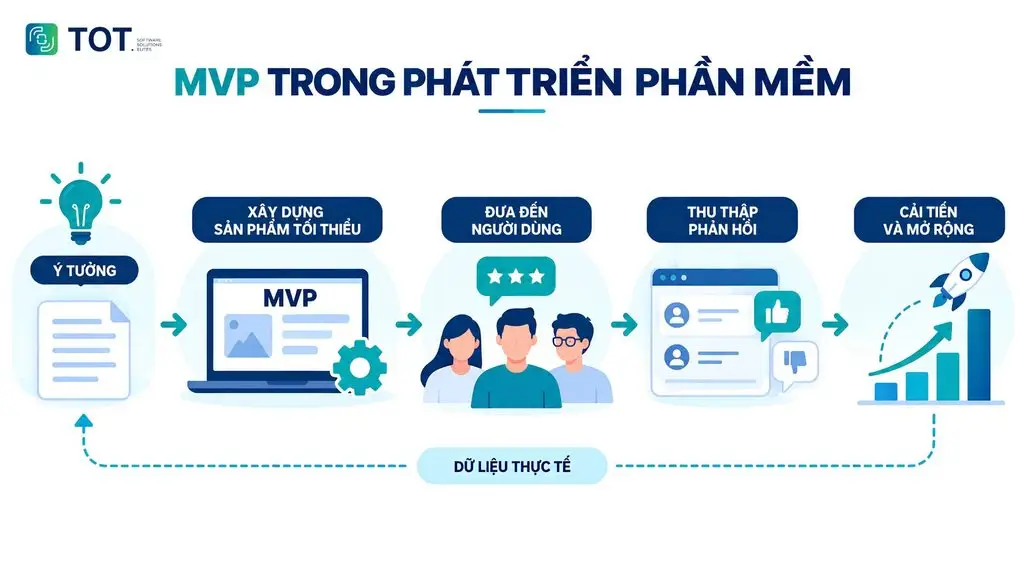
In technology and software development, an MVP is the first software version that focuses on a set of core features in order to solve a specific need and collect data from real users. Instead of building all the features from the start, the development team prioritizes the most valuable part, launches early and then improves based on feedback.
MVP in software development
An MVP in software development is the first runnable build that delivers value to users, even without a full feature set. This approach helps the technical team validate the architecture, measure user behavior and detect wrong assumptions early. As a result, the business avoids spending months investing in features the market does not really need, while creating a foundation to expand gradually based on the data collected.
>>> Learn more:
- 15+ free, easy-to-use Android app design software
- 17 free 3D home design software for phones and computers
What is an MVP in a mobile app?
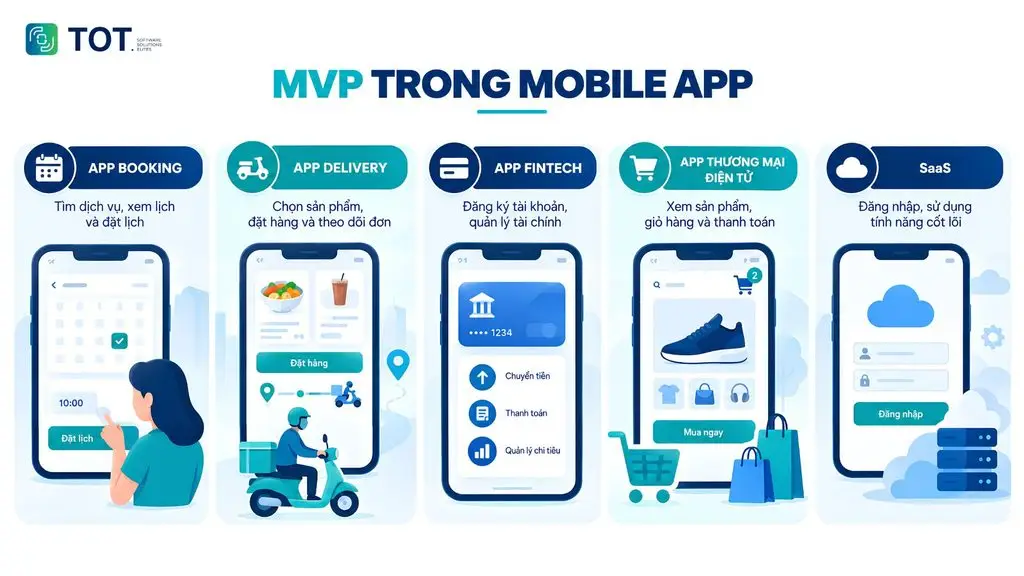
An MVP in a mobile app is an app version that includes only the core feature flow, enough for users to complete the main task. This approach suits many different types of apps, for example:
- Booking apps: Finding services, viewing schedules and booking appointments.
- Delivery apps: Selecting products, placing orders and tracking them.
- Fintech apps: Registering an account, managing finances and carrying out basic transactions.
- E-commerce apps: Browsing products, using the cart, placing orders and paying.
- Software as a service (SaaS): Logging in, using core features and managing data.
>>> See also:
- Best CRM software for construction companies
- TOP 15 best AI code-writing tools
How does an MVP website/SaaS differ from a finished product?
An MVP website or SaaS differs from a finished product in scope of features and goals. An MVP deploys only the core feature set to validate hypotheses and collect user data, whereas a finished product aims for a full experience, scalability and a high level of polish. An MVP prioritizes speed to launch and learning, while the finished version prioritizes depth, performance and stability at large scale.
Does an MVP need the fewest features possible?
No. An MVP needs the fewest features, but still enough to create value and validate a hypothesis. If you cut back so far that the product cannot solve the user’s problem, the data you collect will be skewed and the point of the MVP is lost. The right principle is therefore to minimize the number of features while maximizing the core value those features deliver.
What is a Microsoft MVP?
In the Microsoft ecosystem, MVP carries a different meaning from Minimum Viable Product. It is a title awarded to experts with outstanding knowledge and contributions to the technology community.
What does Microsoft MVP mean?
Microsoft MVP (Microsoft Most Valuable Professional) is a program that recognizes experts who make active contributions to the Microsoft community and technology ecosystem. These contributions can come from sharing knowledge, writing content, developing solutions, supporting the community or taking part in professional activities.
The Microsoft MVP title focuses on professional value and contribution to the community, not on a product or a software development method.
>>> See also:
- Top 10 best free, high-quality home design apps
- Top 10 car showroom management software for businesses

How does Microsoft MVP differ from Minimum Viable Product?
Although both are abbreviated as MVP, the two concepts have completely different meanings and purposes:
| Criterion | Microsoft MVP | Minimum Viable Product |
|---|---|---|
| Full name | Microsoft Most Valuable Professional | Minimum Viable Product |
| Meaning | An expert who makes outstanding contributions | Minimum viable product |
| Field | Technology, the Microsoft community | Startups, business, product development |
| Subject | An expert/community | A product or product version |
| Goal | Recognizing professional contributions | Validating an idea and market demand |
Benefits of an MVP for businesses
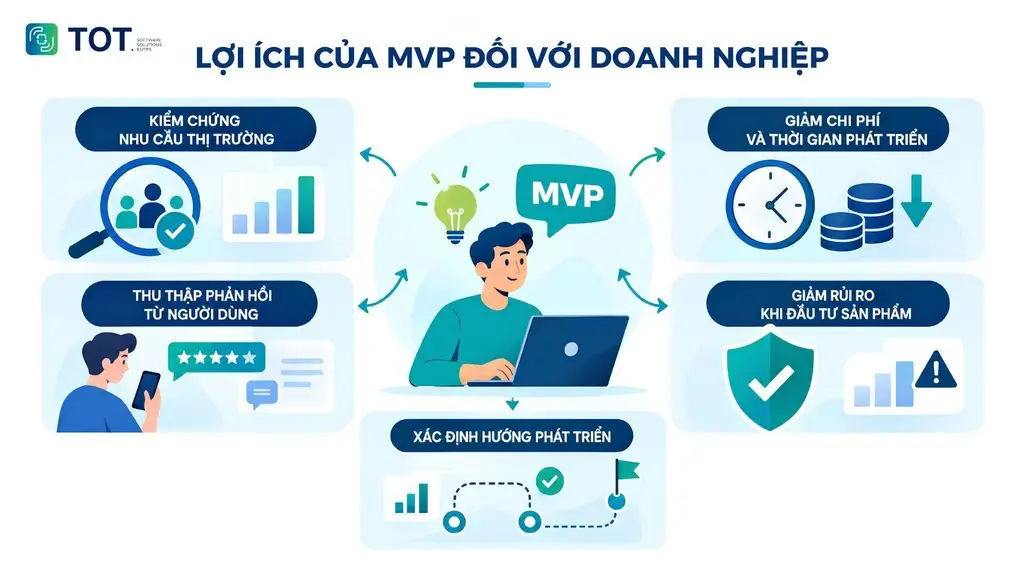
In this section, MVP is understood as Minimum Viable Product, not MVP in gaming or sports. With this approach, a business can validate an idea with a real product before committing significant resources to full development.
Validating market demand
An MVP helps a business confirm whether the market truly needs the product before making a large investment. By putting a minimal version in front of the first group of users and observing how it is received, the business obtains real evidence of demand. If the signals are positive, that is the basis for scaling up; if the signals are weak, the business can adjust or stop in time before spending too many resources.
Reducing development cost and time
An MVP shortens development time and saves costs by focusing only on core features. Instead of pouring months and a large budget into completing every feature from the start, the business launches early with a lean scope. This helps cash flow be used more efficiently, while enabling feedback and value to be recouped early and reinvested in the next development cycles.
Gathering feedback from users
An MVP creates a direct feedback channel from real users as soon as the product is still in its early stage. This feedback reflects actual behavior and needs, helping the team understand which features are preferred and which points cause difficulty. The data collected becomes a reliable basis for prioritizing development work, rather than relying on intuition or unvalidated internal assumptions.
Reducing risk when investing in a product
An MVP reduces financial and strategic risk by breaking the investment into validated steps. The business does not bet all its resources on a product the market has not yet confirmed. Each MVP iteration is an opportunity to validate hypotheses, spot mistakes early and adjust course, thereby limiting the chance of failure at large scale.
Defining the product development direction
An MVP helps a business map out a development roadmap based on real-world data. From feedback and usage metrics, the team recognizes which features to prioritize, which can be dropped and where the opportunities to expand lie. This iterative approach turns product development into a series of well-grounded decisions, helping the product evolve to match user needs rather than following the initial guesswork.
>>> See also:
- How to build an app with AI – free, detailed and simple
- TOP 50+ most popular free AI tools today
- Top 10 free online poster design software for computers
How to build an effective MVP
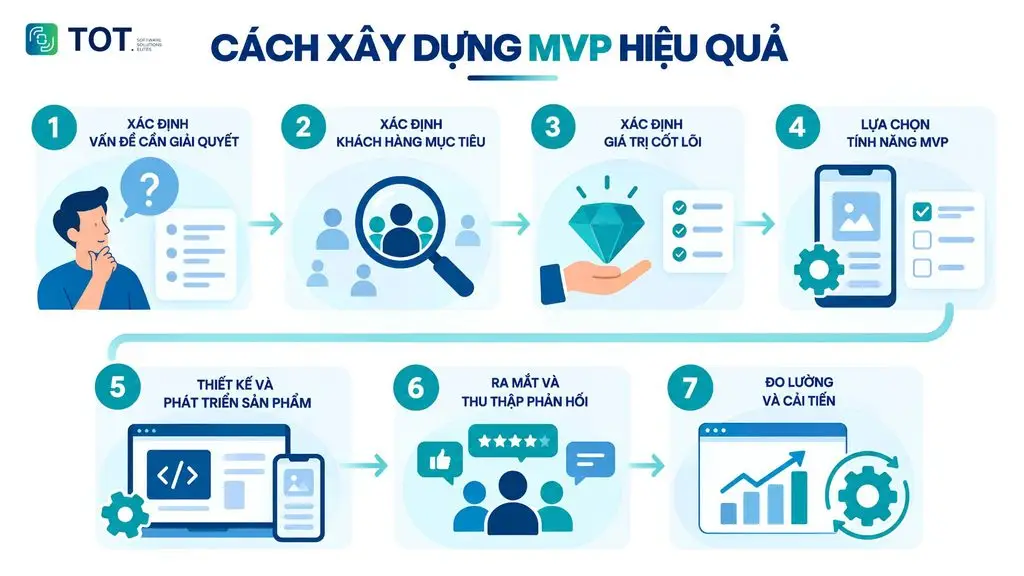
Building an effective MVP is a process that moves from the customer’s problem to a minimum valuable product through clear steps. The seven steps below form a closed loop that helps the business focus resources on the right core part and continuously improve based on real-world feedback.
Step 1: Identify the problem to solve
The starting point of every MVP is a specific problem that is important enough to users. The business needs to clearly answer which pain point the MVP solves, for whom, and why that problem deserves priority. Identifying the right problem keeps the entire development process on track and avoids building a complete product that is not tied to any real need.
Step 2: Identify the target customer
Once the problem is defined, the business needs to narrow down the target customer group that will be the first to use the MVP. Clearly describing the user persona, the usage context and their expectations helps the team choose the right features and approach. The more specific the customer group, the more accurate the feedback, providing a solid basis for validating the product hypothesis.
Step 3: Define the core value
The core value is the main benefit the MVP delivers and the reason users choose the product. At this step, the business clarifies its value proposition: what the MVP helps customers achieve that current solutions do not do well. Identifying the right core value helps distinguish must-have features from features that can be left for later versions.
Step 4: Select the MVP features
This step determines the scope of the MVP by selecting features according to priority. The principle is to keep only the features that are truly necessary to realize the core value and help users complete the main task. Secondary features, however appealing, should be placed on a later roadmap to keep the MVP lean, quick to launch and easy to measure.
Step 5: Design and develop the product
At this step, the team turns the feature list into a real product through experience design and technical development. The focus is on building a smooth usage flow for the core feature set, ensuring the product runs stably and delivers clear value. The architecture should be flexible enough to expand later, but should not be made more complex than the MVP stage requires.
Step 6: Launch and gather feedback
The MVP is put in front of the target user group to begin the process of learning from reality. The business tracks how users interact, records both qualitative and quantitative feedback and observes key metrics. This is the stage of validating the initial hypotheses with real data, thereby confirming whether the product is heading in the right direction or needs adjustment.
Step 7: Measure and improve
The final step closes the loop by analyzing data to improve the product. The business evaluates which features are effective, which points create obstacles and where the opportunities for further development lie. The results of this step shape the next version, turning the MVP into a process of continuous evolution rather than a single one-off launch.
>>> Learn more:
- How is AI in software development applied?
- A guide to building an iOS app for people who cannot code
- Top 10+ best free mobile sales management apps
Defining the right MVP scope is an important step, but to turn an idea into a product that can actually be used, a business still needs a team capable of designing and developing software suited to the specific problem. Instead of investing in building every feature from the start, a business can begin with an MVP version focused on core value, then keep expanding based on feedback and real-world needs.
With its custom software development capabilities, TOT can accompany you from analyzing the idea, defining the MVP scope and designing the UI/UX to programming and deploying the product. The goal is to create a version that is just enough to validate the idea while providing a suitable foundation for long-term development.
If your business has a product idea and wants to turn it into a real MVP, talk to TOT to start from the version that fits best.
Distinguishing MVP from Prototype and PoC
MVP, Prototype and PoC are three easily confused concepts that serve different validation goals in product development. Understanding the role of each helps a business choose the right tool for each stage and avoid wasting resources.
What is an MVP?
An MVP is a minimum viable product used to validate the product and the market with real users. Unlike internal test builds, an MVP is a runnable product that delivers real value and is brought to market to gather feedback. The goal of an MVP is to confirm whether the product solves the right problem and whether there is real demand.
What is a Prototype?
A prototype is a model used to validate an idea, experience and design before real development. A prototype usually simulates the interface and interaction flow so that stakeholders can visualize the product, but it does not yet have fully working functionality behind it. It is a useful tool for testing design ideas and gathering early feedback at low cost, before starting to build the product.
What is a PoC?
A PoC (Proof of Concept) is proof of a concept, used to validate the technical feasibility of an idea. A PoC answers whether a solution or technology can be implemented, usually at a small scale and in a test environment. A PoC is not aimed at end users but serves the technical team, helping confirm the technology direction before investing in development.
Comparison table of MVP, Prototype and PoC
| Criterion | MVP | Prototype | PoC |
|---|---|---|---|
| Goal | Validate the product and market demand | Validate the idea and experience | Validate technical feasibility |
| What is validated | User needs, behavior and feedback | The idea, interface and experience flow | Technology, architecture or technical solution |
| Level of completeness | Has core features and is usable | Simulates part or all of the experience | May focus on only one function or technology |
| Users | Real users or the target customer group | Test users, customers or the internal team | Mainly the technical team |
| Desired outcome | Real-world data to improve and develop the product | Determine whether the idea or design is suitable | Determine whether the technical solution is feasible |
Put simply: a Prototype answers “How should the product work?”, a PoC answers “Can this solution be implemented?”, and an MVP answers “Do users really need and use this product?”. The three methods can be used independently or combined, depending on the goal and stage of product development.
>>> See also:
- Professional custom software development in Hanoi
- Get professional, well-priced custom software development in HCMC
Famous MVP examples
Many major technology products started from a very simple version, focusing on core value instead of building everything from the start. The examples below show how an MVP (Minimum Viable Product) can help a business validate an idea, user demand and the product’s development direction.
Airbnb’s MVP
Airbnb started with a simple website that let users find and book short-term stays in other people’s homes. The initial version focused on a very specific need: connecting people with spare space to people who needed a place to stay. Instead of building a complete booking platform right away, the founders used an MVP to validate whether customers really wanted this type of accommodation. After confirming the demand, the product was then expanded in features and scale.
Facebook’s MVP
Facebook was initially developed for a limited user group at Harvard University, with the core function of connecting students and sharing personal information. The product scope at that time was fairly simple but enough to validate the need for online connection within a specific community. After gaining user interest, Facebook gradually expanded to other universities and then to more user groups. This is a classic example of starting with a small market before scaling up.
Dropbox’s MVP
Instead of building a complete file-syncing system right away, Dropbox once used a demo video to simulate how the product worked and to introduce the intended experience to users. This approach helped the team validate the level of interest in the idea of syncing data across multiple devices without having to invest the full development cost from the start. The Dropbox case shows that an MVP does not necessarily have to be a complete product; what matters is a validation method suited to the hypothesis that needs to be confirmed.
X’s MVP
X (formerly Twitter) started from a simple idea: letting users post and share short messages with others. The initial version focused on the core function of quick status updates, rather than building out a full set of social network features. When it saw users actively sharing and interacting, the platform kept adding more features based on real-world needs. This is an example showing that a simple MVP can still create value and lay the foundation for a large product.
Common lessons from successful MVPs
The cases above share one thing in common: they did not try to build a complete product from the start. Instead, the teams focused on the most important problem, identified the right user group and chose the fastest way to validate their hypothesis.
From this, businesses can draw three principles when building an MVP: focus on core value, validate with real users and develop based on data and feedback. A successful MVP is not about having the fewest features, but about the ability to create enough value for the business to learn something important before continuing to invest.
Conclusion
Based on the analysis above, what an MVP is will be understood differently depending on context: in gaming and sports it is Most Valuable Player, in startups and product development it is Minimum Viable Product, and in the Microsoft ecosystem it can be Most Valuable Professional. For technology businesses in particular, an MVP is an approach that helps turn an idea into a usable product, validate real demand and gather feedback before scaling up investment. Understanding the MVP correctly and implementing it the right way helps a business focus resources on core value, reduce risk and build a foundation to develop a product that fits the market better.
If your business has an idea but is not sure where to start, or needs to build an MVP suited to a real-world problem, TOT can accompany you with custom software development, from requirement analysis and defining core features to designing and programming the product.
Frequently asked questions
What is MVP in gaming?
MVP in gaming stands for Most Valuable Player, referring to the player who makes the most outstanding contribution in a match. The game system usually awards this title automatically based on many metrics such as KDA, damage, assists and objective contribution, rather than kills alone. As a result, the MVP reflects the player’s overall value to the team’s victory, depending on the scoring mechanics of each specific game.
What is MVP in football?
MVP in football is Most Valuable Player, meaning the most valuable player, given to the person with the most outstanding contribution and influence. This title can be awarded for a match, a tournament or an entire season, and does not necessarily go to the player who scores the most goals. A player who creates chances, defends or leads the play can still win MVP thanks to an influence that spans the team’s overall result.
What is MVP in Arena of Valor?
MVP in Arena of Valor is the Most Valuable Player title awarded to the player with the best performance after each match. The system evaluates a combination of many factors such as KDA, damage dealt, ability to carry the team and objective contribution to select the most deserving player. The MVP can belong to either the winning team or a standout player on the losing team, and it is not simply based on kills, but also reflects the player’s overall value in the game.
What is MVP in IT?
MVP in IT is Minimum Viable Product – a minimum viable product. It is the first software version that includes only the core feature set, enough to solve a specific need and collect data from real users. This approach helps the technology team launch early, validate hypotheses and improve gradually based on feedback, instead of spending months investing in features the market may not need.
What is MVP in code?
MVP in code is also Minimum Viable Product; it is simply the first software build that focuses on core functionality and is runnable. In a programming context, an MVP does not mean writing the fewest lines of code possible, but building just enough to realize the main value and validate the idea with users. The source code is usually kept lean and easy to extend so the team can keep developing based on the data collected.
What is MVP in business?
MVP in business is Minimum Viable Product – a minimum viable product used to validate an idea and market demand. The business brings a lean version with core value to market to gather real feedback, thereby reducing risk and saving resources before making a large investment. It is a tool for making decisions based on data instead of guesswork, and for shaping the product’s later development direction.
What is MVP in a project?
MVP in a project is the minimum viable version of a product developed within the scope of the project, including the core features that are enough to deliver value and validate a hypothesis. Instead of delivering all features at once, the project team prioritizes the most important part to launch early, gather feedback and adjust with each iteration. This approach helps control risk, optimize resources and ensure the project stays close to real-world needs.