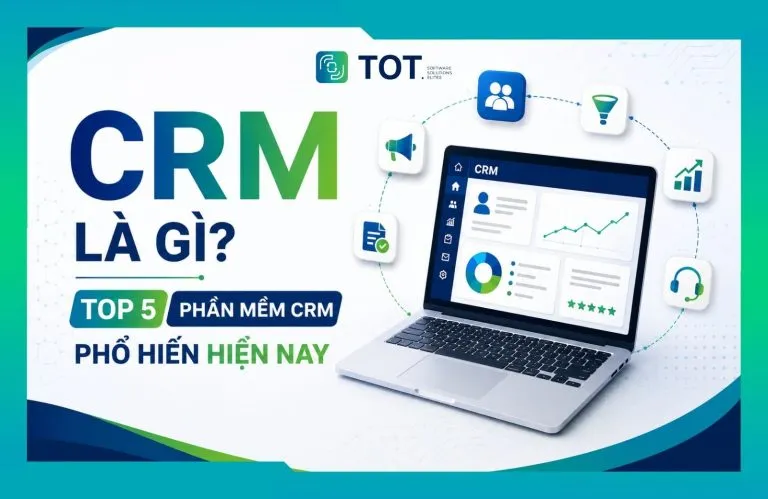
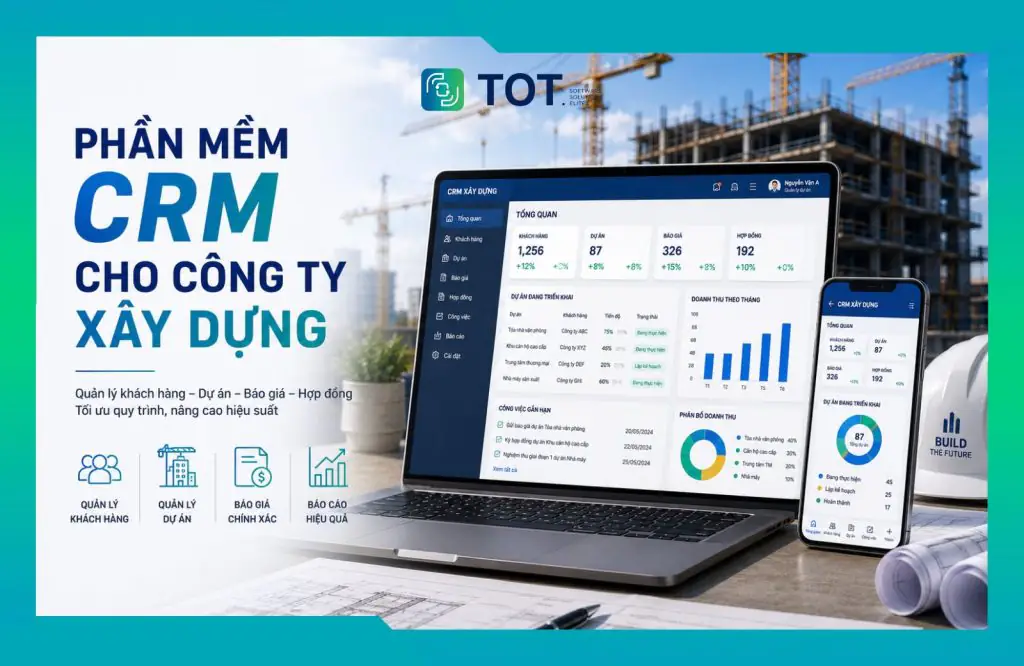
A CRM for construction companies is a solution that helps businesses centrally manage customers, investors and sales opportunities on a single platform. With long sales cycles, multiple stakeholders and high-value contracts, managing data in Excel or scattered tools makes it easy to overlook customers and lose control of the sales process. The right CRM software helps standardize the process, improve customer care and increase the contract close rate. In this article, TOT introduces the Top 10 CRM software for construction companies worth considering in 2026, along with selection criteria and the trend of applying AI CRM software.
>>> Read more:
- Top 15+ large, reputable software companies in Vietnam
- 9+ easiest-to-use, free mobile app design tools
Quick summary
- Construction CRM focuses on customers, investors and the sales pipeline, unlike ERP or project management software.
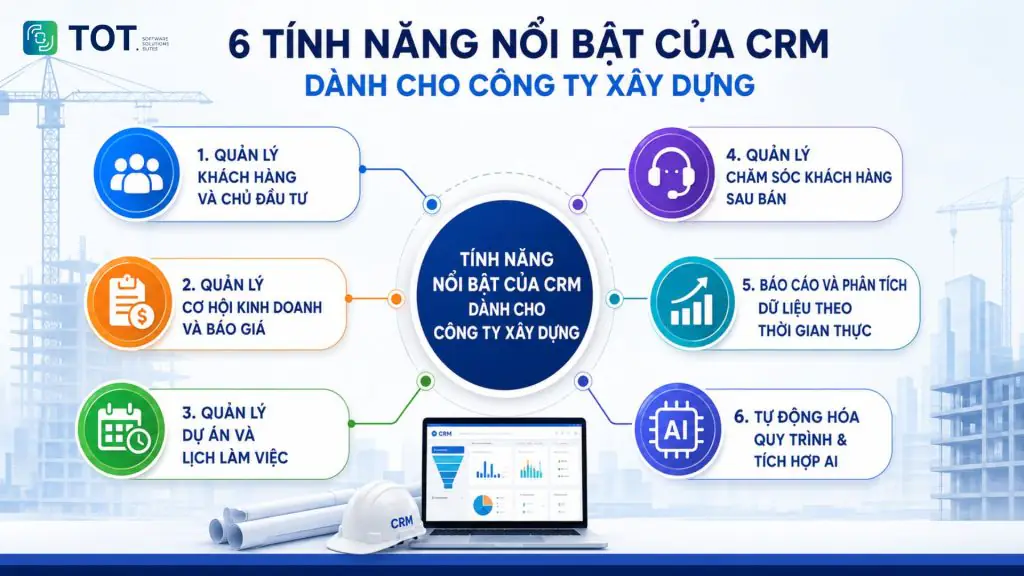
- Six core feature groups: customer management, opportunities and quotes, work scheduling, after-sales care, real-time reporting, automation and AI.
- Quick comparison table of 10 software products: Salesforce, HubSpot, Microsoft Dynamics 365, Zoho CRM, Monday CRM, Pipedrive, Creatio, Odoo CRM, MISA AMIS CRM, Bitrix24.
- AI is shaping CRM in 2026 with lead scoring, sales forecasting, chatbots, automated email and meeting summaries.
- TOT advises on and designs custom CRM, integrating AI and ERP to fit the specifics of each contractor.
Quick overview table of 10 CRM software products for construction companies
The overview table below helps businesses quickly see the strengths, AI capabilities, target audience and starting price of the 10 products before reading the detailed analysis. The criteria focus on customer management, sales and customer care rather than functions that fall within the scope of ERP.
| Software | Key strength | AI feature | Best suited for | Starting price (reference) |
|---|---|---|---|---|
| Salesforce | Powerful CRM platform, large extension ecosystem | Einstein, Agentforce | Large enterprises, corporations | From USD 25/user/month |
| HubSpot | Unifies marketing, sales and service; easy to use | Breeze AI | SMEs, small and medium contractors | Free; paid from USD 20/user/month |
| Microsoft Dynamics 365 | Deep integration with the Microsoft 365 ecosystem | Copilot for Sales | Medium and large enterprises | From about USD 65/user/month |
| Zoho CRM | Feature-rich, reasonable cost | Zia AI | Startups, SMEs, medium contractors | Free for 3 users; from about USD 14/user/month |
| Monday CRM | Intuitive interface, drag-and-drop customization | AI Sales Agent | SMEs needing a flexible tool | From USD 12/user/month (minimum 3 users) |
| Pipedrive | Focused on the sales pipeline, easy to deploy | AI Sales Assistant | Small and medium contractors | From USD 14/user/month |
| Creatio | No-code platform with strong process customization | Agentic AI, Studio | Enterprises with complex processes | From about USD 25/user/month; minimum commitment |
| Odoo CRM | Open source, seamless CRM and ERP integration | Lead suggestions, expanding AI | Businesses wanting CRM tied to ERP, with an IT team | Community free; Standard about USD 31/user/month |
| MISA AMIS CRM | Vietnamese solution, integrates CRM and DMS | AI Agent | Vietnamese construction businesses | From VND 80,000/user/month |
| Bitrix24 | All-in-one, free with unlimited users | CoPilot | Startups, versatile SMEs on a tight budget | Free; paid plans priced per organization |
What is a CRM for construction companies?
A CRM for construction companies is customer relationship management (CRM) software designed to help businesses centrally manage customers, investors, sales opportunities and the entire sales process on a single platform.
The construction industry is characterized by long sales cycles, high-value contracts and many parties involved, such as investors, consultants, project management boards and subcontractors. When data is stored in scattered places across Excel, email or messaging apps, businesses easily overlook potential customers, struggle to track the status of quotes, and lack the information needed to make timely decisions.
CRM software solves these problems by centrally storing all customer information, communication history, quotes, contracts and the progress of each sales opportunity. As a result, sales staff can easily track the status of each deal, while managers can monitor the sales pipeline in real time and allocate resources more effectively.
It is important to note that CRM focuses on customer management, sales and customer care; it does not replace ERP or project management software. Operations such as materials management, construction progress, cost estimation or accounting still fall within the scope of ERP. Therefore, many construction businesses choose to deploy CRM first for the sales department, then integrate it with ERP to synchronize data and optimize operational processes.
For construction businesses, the right CRM management software not only helps standardize the sales process and shorten investor response time but also increases the rate of converting opportunities into contracts, creating a foundation for sustainable growth.
>>> Read more:
- What is a CRM for car showrooms? A comprehensive customer management solution
- Top 15 production management software for businesses
Key features of CRM for construction companies
CRM software for construction companies revolves around six core feature groups serving the sales function. These groups help businesses centrally manage customers, sales opportunities and the sales process on one platform, thereby improving customer care and increasing the contract close rate.
Managing customers and investors
Managing customers and investors is the core feature of a CRM, helping businesses store all customer information centrally in one system. Each profile can include contact information, company details, the person in charge, communication history, needs and related projects.
Through CRM management software, the sales team can easily look up work history and track meetings, calls or emails without depending on any single individual. This helps businesses maintain customer relationships, reduce data loss when personnel change, and improve the quality of investor care.
Managing sales opportunities and quotes
CRM helps businesses track every sales opportunity from the moment a potential customer is received until a contract is signed. Each opportunity is managed by stage, such as outreach, consulting, sending quotes, negotiation and closing.
In addition, the system stores quotes, related documents and customer communication history within the same profile. As a result, sales staff always know the status of each deal, while managers can monitor the sales pipeline to make timely decisions and improve the conversion rate.
Managing projects and work schedules
In a CRM, this feature focuses on managing sales activities before a project is carried out, not construction progress management. The system allows you to track customer appointments, plans to meet investors, site survey schedules or tasks that need to be carried out during the sales process.
In addition, CRM software supports task reminders, assigning tasks and synchronizing work schedules among team members. As a result, the sales team collaborates more effectively, avoids missing important milestones and ensures that customer care runs continuously.
Managing after-sales customer care
CRM not only supports the stage before a contract is signed but also helps businesses maintain relationships with customers after the sale. The system stores the history of support, feedback, warranty requests or periodic care sessions so that every customer is followed up on consistently.
Centralized management helps businesses proactively reach out at the right time, improve the customer experience and create opportunities to expand cooperation on future projects or additional services.
Real-time reporting and data analytics
CRM aggregates sales data into reports and dashboards updated in real time. Leaders can quickly view pipeline value, conversion rate, the performance of each employee and sales forecasts.
Instead of waiting for a manually compiled Excel report at the end of the month, managers grasp the business picture at any moment. Visual data helps detect early signs of stalling opportunities, weak sales regions or investors showing signs of leaving. Resource allocation decisions are therefore based on data rather than intuition.
Process automation and AI integration
The shift toward AI-powered CRM software is helping businesses automate many repetitive tasks in the sales process. The system can automatically classify potential customers (Lead Scoring), suggest customers with a high likelihood of converting, send care reminders or send emails based on preset scenarios.
In addition, AI supports chatbots that respond to customers, analyzes behavior, aggregates interaction history and forecasts sales based on real data. These features help the sales team save time, focus on high-value opportunities and improve customer management.
>>> Read more:
- What is Predictive AI? Benefits and how AI prediction works
- How businesses build AI Agents
- Top 15+ effective, super-easy AI app-building tools
Benefits of a CRM system for construction companies
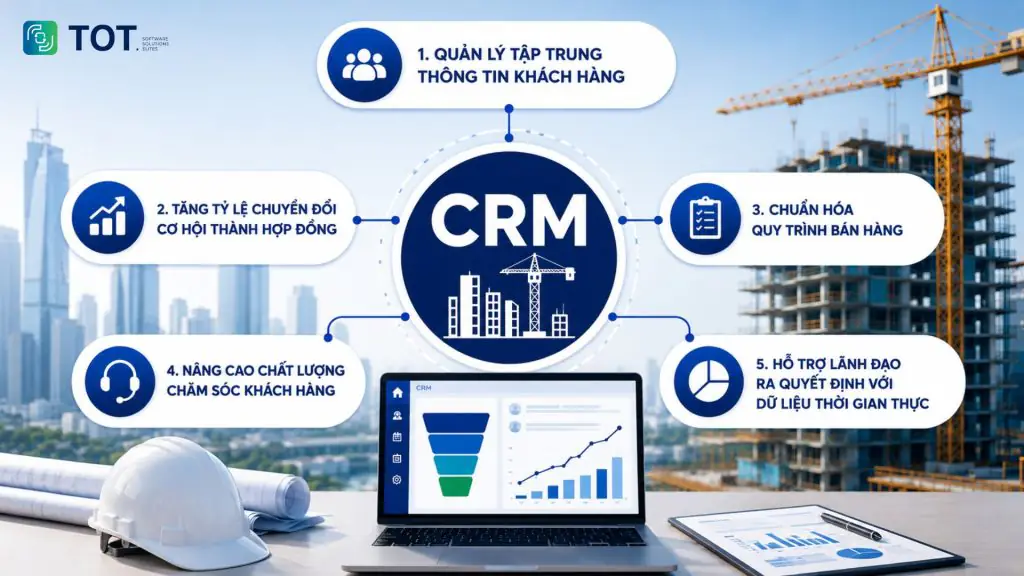
A CRM system helps construction businesses manage customers centrally, standardize the sales process and increase the ability to convert opportunities into contracts. The five benefits below reflect direct value for a contractor’s sales function.
Centralized management of customer information
CRM gathers all customer and investor information in a single place. Contractors managing many investors and many sales staff will avoid data being scattered across personal computers.
When an employee leaves, the entire interaction history with the investor stays with the business. Whoever takes over immediately understands the context and continues customer care without interruption. The risk of losing customers when staff leave is therefore significantly reduced.
Increasing the rate of converting opportunities into contracts
CRM helps the sales team follow each opportunity closely, so the contract close rate improves. The system reminds you of the next step and flags opportunities that have had no activity for a long time.
With the long sales cycle of the construction industry, forgetting to follow up with an investor for a few weeks can cause a contract to fall into a competitor’s hands. CRM ensures that every opportunity is nurtured on the right cadence. Contractors convert more opportunities into signed contracts from the same volume of incoming leads.
Standardizing the sales process
CRM turns the company’s sales process into clear steps that every employee follows. From receiving leads, surveying and quoting to negotiating and signing contracts, every stage follows a defined standard.
A standardized process helps new employees quickly work the way the best performers do. Care quality is consistent across team members. Businesses can also easily measure at which stage opportunities tend to drop off so they can improve the right bottleneck.
Improving the quality of customer care
CRM helps businesses track transaction history, feedback and after-sales customer care sessions within the same system. The system can also remind you of periodic contact schedules, helping employees proactively maintain connections with customers.
For construction businesses, good care after signing a contract not only improves satisfaction but also creates opportunities to develop future projects, increases the rate of returning customers and builds long-term cooperation with investors.
Supporting leaders in decision-making with real-time data
CRM provides intuitive dashboards with metrics such as the number of potential customers, pipeline value, conversion rate, and sales by employee or by customer source. All data is updated in real time, helping leadership monitor business performance at any time.
Instead of making decisions based on intuition or manual reports, businesses can use data to evaluate the effectiveness of the sales team, allocate resources appropriately and adjust the sales strategy in time, thereby improving operational efficiency and competitiveness in the market.
>>> Learn more:
- Top 15 popular auto garage management software products
- AI customer recognition at showrooms solution
Criteria for choosing the right CRM software for a construction company
Choosing CRM software should not be based only on features but should also consider how well it fits the sales process, its integration capabilities and the deployment cost. Below are the important criteria businesses should consider.
- Fit with the sales process: The CRM needs to support managing customers, investors, quotes and opportunity tracking in the way the business currently operates.
- Complete management of customers and sales opportunities: The software should support centralized storage of customer information, interaction history, sales pipeline, quotes and contracts.
- System integration capability: Prioritize a CRM that can connect with ERP, accounting software, project management software, Email or Zalo OA to synchronize data.
- Automation and AI support: Choose a solution with lead classification, care reminders, an AI chatbot, data analysis and sales forecasting.
- Easy-to-use interface: The CRM needs an intuitive interface on both desktop and mobile devices so employees can use it easily.
- Security and access control: The system must ensure data safety and support role-based access control within the business.
- Cost and scalability: Businesses should weigh the total investment cost, scalability and the quality of vendor support before deployment.
Businesses with unique processes should test the software with real data before deploying it broadly. Contractors managing many investors and distributed staff need to pay special attention to access control and system integration. You can also refer to a digitalization approach in the article on contractor management software.
>>> Read more:
- What is an ERP system in manufacturing? Benefits, features and how to use it
- What is an MES system? Role, functions and how to apply it effectively
Top 10 best CRM software products for construction companies in 2026
The list below includes 10 CRM software products worth considering for construction businesses in 2026, arranged by market popularity. Each solution is analyzed by features, AI capabilities, pros and cons, target audience and publicly available reference prices.
1. Salesforce CRM software
Salesforce is a long-established cloud-based CRM platform with a large market share worldwide. Its Sales Cloud sales module, now paired with the Agentforce AI layer, serves businesses that need to manage customer relationships at large scale.
Key features:
- Manages leads, opportunities and a multi-stage sales pipeline
- Manages products, price books and quotes (from the Professional plan and up)
- Sales forecasting, sales territory management and workflow processes
- The AppExchange app marketplace for almost unlimited extension and customization
AI and automation capabilities: The Einstein and Agentforce AI layer provides lead and opportunity scoring, sales forecasting, opportunity summaries and an AI assistant that executes sales tasks.
- Pros: Rich features, very high scalability and customization, a large integration ecosystem.
- Cons: Among the higher-priced options, complex to deploy and often requiring configuration experts.
- Best suited for: Large construction enterprises, corporations with many branches and large sales teams.
- Reference price: The Starter Suite plan starts at USD 25/user/month; the Pro, Enterprise and Unlimited plans rise gradually to hundreds of USD/user/month.
>>> Read more:
- Top 20+ best free AI image design software
- Top 17 leading professional graphic design apps
>>> Read more:
2. HubSpot CRM software
HubSpot CRM is the CRM solution from HubSpot (USA), notable for combining customer management, marketing and sales. The software supports managing leads, pipeline, quotes and customer care on a single platform. HubSpot’s AI helps generate content, summarize emails and automate the sales process.
Key features:
- Unlimited contact management, deal tracking and sales pipeline
- Email open tracking, meeting scheduling and Gmail, Outlook integration
- Forms, landing pages and marketing tools that connect seamlessly with sales data
- A basic free CRM for an unlimited number of users
AI and automation capabilities: The Breeze AI suite is available even on the free plan, helping draft emails, summarize and suggest actions for sales staff.
- Pros: Easy-to-use interface, a full-featured free version, fast onboarding for the sales team.
- Cons: Costs rise quickly on the Professional and Enterprise plans, along with mandatory onboarding fees.
- Best suited for: SMEs and small to medium contractors wanting to connect marketing with sales.
- Reference price: Basic CRM free; Sales Hub Starter from USD 20/user/month; the Professional and Enterprise plans are higher and include deployment fees.
>>> Read more:
- Guide to building a landing page with AI that converts well, no code needed
- 15 ways to apply AI in online sales to boost revenue
3. Microsoft Dynamics 365 CRM software
Microsoft Dynamics 365 CRM is Microsoft’s CRM solution, suitable for businesses that need to manage customers and sales at large scale. The system supports managing customers, sales opportunities and quotes, and integrates tightly with Microsoft 365. The Copilot AI helps with sales forecasting, data analysis and task automation.
Key features:
- Manages leads, opportunities and the sales pipeline
- Direct integration with Outlook, Teams and the Office suite
- Customizes processes and apps with Power Apps, automation with Power Automate
- Sales analysis and forecasting based on CRM data
AI and automation capabilities: Copilot for Sales summarizes opportunities, drafts emails based on CRM data, and supports lead scoring and call analysis.
- Pros: Strong integration with the Microsoft ecosystem, suitable for businesses already using Microsoft 365.
- Cons: Requires configuration and a learning curve; the license cost plus the Copilot add-on can be high.
- Best suited for: Medium and large businesses operating on the Microsoft platform.
- Reference price: The Sales Professional plan starts at about USD 65/user/month; the Sales Enterprise plan is higher; Copilot for Sales is a separate add-on at about USD 50/user/month.
>>> Read more:
- 10 free 3D home design software products for phone and computer
- Top 30 best free, popular AI tools today
4. Zoho CRM software
Zoho CRM is the CRM software from Zoho Corporation, providing full features for customer management, sales pipeline, quotes and customer care. The Zia AI supports sales forecasting, data analysis and action suggestions for sales staff.
Key features:
- Manages leads, deals and a multi-stage sales pipeline
- Standardized sales process with the Blueprint tool and quote management
- Multi-channel connection: email, phone, social media, chat
- High customization and deep integration with other apps in the Zoho suite
AI and automation capabilities: The Zia assistant scores leads and deals, detects anomalies, analyzes sentiment, scans business cards with Zia Vision and builds AI agents with Zia Agent Studio on higher plans.
- Pros: Reasonable cost, many features, good integration within the Zoho ecosystem.
- Cons: Zia AI is only available on the Enterprise and Ultimate plans; the feature-rich interface can overwhelm new users.
- Best suited for: Startups, SMEs and medium contractors needing a cost-balanced solution.
- Reference price: Free for 3 users; the Standard plan from about USD 14/user/month; Enterprise about USD 40; Ultimate about USD 52.
>>> Read more:
- Top 10 best auto maintenance scheduling systems
- How to build an app with AI for free, detailed and simple
5. Monday CRM software
Monday CRM is the intuitive CRM platform from Monday.com, notable for managing the pipeline, customers and sales process with a drag-and-drop interface. The software supports workflow automation and AI integration to automate repetitive tasks.
Key features:
- A sales pipeline customizable to the business’s own process
- Contact management, web lead-capture forms and two-way email sync
- Task automation, dashboards and intuitive reports
- Sales forecasting and advanced reporting on the Pro plan
AI and automation capabilities: It offers AI Sales Agent, AI Lead Agent, AI email drafting, automatic column filling and sentiment analysis; the AI features are billed by credit.
- Pros: Intuitive, easy-to-use interface, flexible for unique processes.
- Cons: No free version (only a 14-day trial), a minimum of 3 users, AI billed extra by credit.
- Best suited for: SMEs and sales teams wanting an intuitive, easily customizable tool.
- Reference price: Basic plan USD 12, Standard USD 17, Pro USD 28/user/month (billed annually), minimum 3 users; the Enterprise plan is quoted separately.
>>> Read more:
- AI agents in financial services: How they work & real-world applications
- AI Agents in healthcare and life sciences: How to build them & applications
6. Pipedrive software
Pipedrive is CRM software focused on sales pipeline management, helping businesses track sales opportunities and the performance of the sales team. AI helps suggest which potential customers to prioritize and automates the sales process.
Key features:
- An intuitive drag-and-drop pipeline by sales stage
- Manages deals, activities and scheduled reminders
- Email tracking and workflow automation
- Revenue forecasting and sales performance reporting
AI and automation capabilities: The AI Sales Assistant predicts win likelihood, flags stalled deals and suggests actions; it comes with an AI email writer and AI email summarizer.
- Pros: Easy to deploy, affordable cost, focused on sales.
- Cons: Sales-oriented, lacking comprehensive marketing and service modules; some AI features are billed by credit.
- Best suited for: Small and medium contractors with a lean sales team.
- Reference price: Lite plan USD 14, Growth USD 39, Premium USD 59, Ultimate USD 79/user/month (billed annually).
>>> Read more:
7. Creatio CRM software
Creatio CRM is a CRM platform that combines no-code technology, allowing businesses to customize the sales process without programming. The system integrates AI and workflow automation to optimize business operations.
Key features:
- Three modules, Sales, Marketing and Service, used separately or together
- The Freedom UI interface and the no-code Studio tool
- Over 700 prebuilt process templates for lead routing, approvals and SLAs
- Manages opportunities, quotes and multi-level sales processes
AI and automation capabilities: The agentic AI platform together with Creatio Studio lets you build AI agents using natural language; it uses a separate AI Tokens package.
- Pros: Strong process customization, a flexible no-code foundation, suitable for unique processes.
- Cons: Has a minimum spend commitment (about USD 10,000 per year), high cost and requires deployment time.
- Best suited for: Medium and large enterprises with complex sales processes.
- Reference price: From about USD 25/user/month, with modules from USD 15/user/month; a minimum commitment applies, so contact the vendor for a quote.
>>> Read more:
- Top 15 best low-code platforms
- Comparing Low-Code and No-Code: The differences & real-world applications
8. Odoo CRM software
Odoo CRM is a module within the Odoo ERP ecosystem, supporting customer management, sales opportunities, quotes and integration with many other modules such as accounting, inventory and purchasing. AI supports scoring potential customers and automating processes.
Key features:
- An intuitive pipeline, lead and sales opportunity management
- One-click quotes, e-signature and online payment
- Built-in integration with the accounting, sales and project modules within the same Odoo suite
- The open-source Community edition allows customization and self-hosting
AI and automation capabilities: Odoo offers lead suggestions and AI features that are being expanded, leveraged through its built-in integrated app ecosystem.
- Pros: Open source, deep customization, seamless CRM and ERP integration, flexible cost.
- Cons: Requires technical resources to customize or self-host; the free cloud version is limited to one app.
- Best suited for: Businesses that want CRM tied to ERP and have an IT team or deployment partner.
- Reference price: The open-source Community edition is free; one app on the cloud is free; the Standard plan is about USD 31/user/month.
9. MISA AMIS CRM software
MISA AMIS CRM is CRM software developed by MISA, suitable for Vietnamese businesses. The system supports managing customers, quotes, contracts and customer care, and connects with the accounting and HR solutions in the MISA ecosystem.
Key features:
- A 360-degree customer profile with contact information, roles and transaction history
- Classifies customers by campaign, region, industry and care process
- Pipeline management, quotes and route management on both web and mobile
- Multi-channel Marketing Automation via email, SMS and connection to MISA accounting software
AI and automation capabilities: MISA AMIS CRM integrates an AI Agent that supports automated operations, providing a digital workforce for care and sales tasks.
- Pros: Well localized, Vietnamese-language support, connects to the MISA ecosystem including accounting, priced in VND.
- Cons: Most effective when used together with MISA products; deep customization is more limited than with large international platforms.
- Best suited for: Vietnamese construction businesses and SMEs that prioritize a local solution.
- Reference price: Standard plan VND 80,000, Professional VND 100,000, Enterprise VND 120,000/user/month.
>>> Read more:
- Free computer vision software: Easy-to-use platforms
- Top 20 most reputable No. 1 app design companies in Vietnam
10. Bitrix24 software
Bitrix24 is a business management platform that integrates CRM, task management and internal collaboration. The software supports customer management, sales pipeline, process automation and an AI chatbot, suitable for businesses that need to manage sales on a single unified platform.
Key features:
- Manages leads, deals and the sales pipeline
- A multi-channel contact center connecting email, social media and phone
- Process automation, along with tasks, kanban and document management
- Internal chat and video calls for distributed teams
AI and automation capabilities: The CoPilot assistant automatically fills in lead and deal information, transcribes calls, and helps draft messages and summarize conversations.
- Pros: A free version with unlimited users, many integrated tools, paid plans priced per organization.
- Cons: The many features can be complex for new users; some functions are limited in the free version.
- Best suited for: Startups, SMEs and contractors wanting a versatile platform on a tight budget.
- Reference price: A free version with unlimited users; paid plans priced per organization (for example, Standard about USD 87/month for up to 50 users, billed annually).
Applying AI in CRM software for construction companies
AI is changing how construction businesses manage customers and sales. Instead of merely storing data, AI CRM software can analyze customer behavior, automate processes and support data-driven decision-making. As a result, the sales team saves time, improves customer care and increases the contract conversion rate.
- AI Lead Scoring
AI analyzes customer data to score and rank the potential of each lead. The system prioritizes customers with a high likelihood of converting, helping the sales team focus on valuable opportunities instead of processing them manually.
- AI Sales Forecast
AI forecasts sales based on historical data, pipeline value and the progress of each sales opportunity. Leadership has a basis for planning sales, allocating resources and forecasting revenue more accurately.
- AI Chatbot
An AI Chatbot supports 24/7 customer consultation on the website or online channels. The chatbot can answer common questions, collect project information and automatically hand potential customers over to the sales team.
- AI Email Automation
AI helps create and personalize emails for each stage of the sales process. Businesses maintain timely connections with investors while significantly reducing employees’ repetitive workload.
- AI Meeting Summary
AI automatically summarizes meeting content and updates the information into the customer profile in the CRM. Tasks, commitments and upcoming appointments are fully stored, helping the sales team collaborate effectively and avoid missing information.
- AI Customer Insight
AI analyzes interaction history and customer behavior to detect sales opportunities as well as warn of the risk of losing customers. Businesses can build appropriate care strategies, improve the customer experience and increase the retention rate.
AI is effective when deployed on a CRM platform with complete data and a clear sales process. This is also a trend that helps construction businesses strengthen their competitiveness and drive digital transformation in 2026 and the years ahead.
>>> Read more:
- 7 ways to apply AI to optimize the customer experience
- 18 highly effective ways to apply AI to ecommerce
Designing custom CRM software for construction companies with TOT
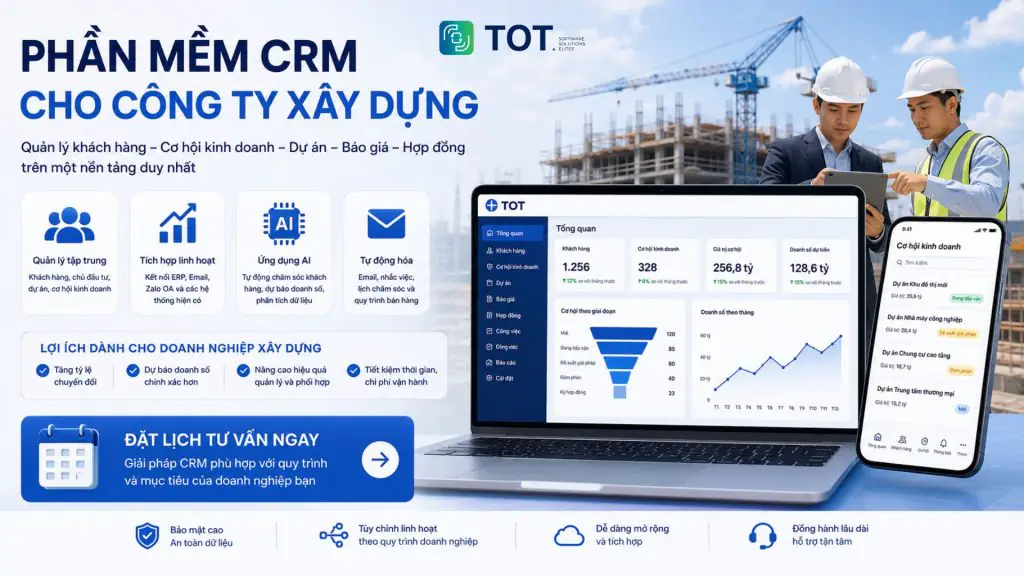
Every construction business has a different sales process, customer management model and way of coordinating between the sales, bidding and project management departments. Therefore, a custom CRM will meet those needs better than packaged solutions, especially when a business needs to manage many investors, many projects and a sales team operating across multiple regions.
TOT designs CRM software for construction companies based on the actual process of each business, from managing customers, investors, sales opportunities and quotes to after-sales customer care. The system can integrate with ERP, Email, Zalo OA and existing software to synchronize data across departments, reduce manual data entry and improve operational efficiency.
In addition, TOT integrates AI into the CRM to automatically classify potential customers, send care reminders, analyze sales data, forecast sales and help the sales team make decisions faster. Thanks to flexible customization, businesses can scale the system as they grow without having to change their existing operational processes.
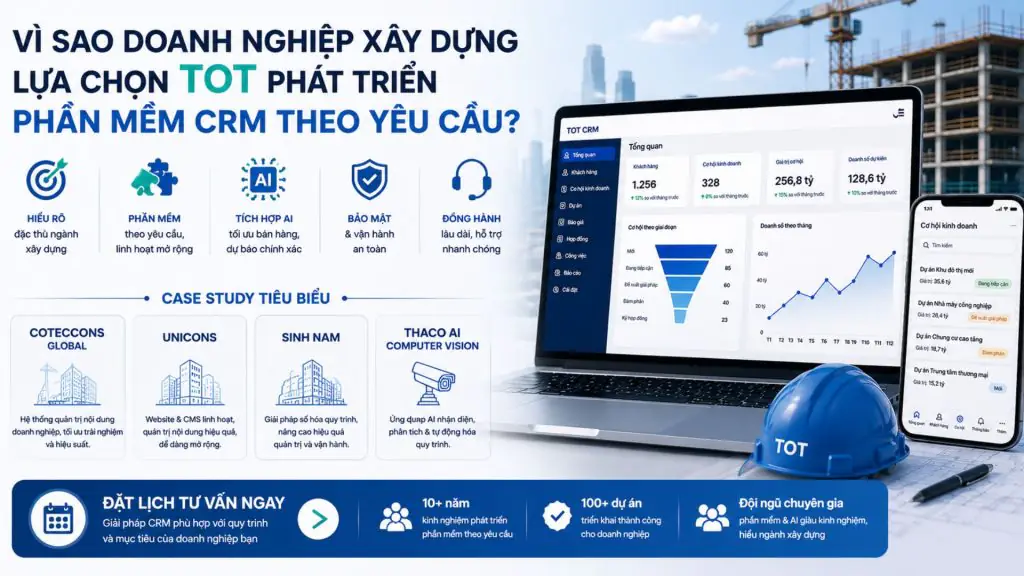
Why do construction businesses choose TOT to develop custom CRM software?
Developing CRM software for construction companies is not just about building a customer management system; it must also ensure the ability to integrate with existing software, scale with the business and match its exact sales process. With experience in custom software development, enterprise platforms and AI solutions, TOT is able to build CRM systems suited to the specifics of each construction business.
While delivering projects for businesses such as Coteccons Global, Unicons and Sinh Nam, TOT not only developed digital platforms but also took part in designing system architecture, optimizing the user experience, building the CMS, integrating data and ensuring scalability. This experience helps TOT understand how to build systems that serve business operations and corporate management, making it easy to develop custom CRM solutions.
In addition, TOT has successfully deployed an AI Computer Vision solution for THACO, applying AI to recognize vehicles, synchronize data and process information in real time. This AI development capability can be extended to CRM with features such as scoring potential customers, sales forecasting, data analysis and sales process automation, helping construction businesses improve customer management and increase the contract conversion rate.
With a team of software engineers, AI experts and experience deploying custom software systems, TOT is ready to advise on, design and develop CRM solutions suited to the sales process, technology infrastructure and digital transformation direction of each construction business.
>>> Explore TOT’s custom software development services:
- Professional, well-priced custom software development in HCMC
- Professional custom software development in Hanoi service
Conclusion
A CRM for construction companies is a foundational tool that helps contractors manage customers centrally, standardize the sales process and increase the rate of converting opportunities into contracts. International CRM software such as Salesforce, HubSpot, Microsoft Dynamics 365, Zoho CRM, Monday CRM, Pipedrive, Creatio, Odoo and Bitrix24, as well as the Vietnamese solution MISA AMIS CRM, each have their own strengths. Choosing the right solution depends on the scale, sales process and integration needs of the business. For organizations with unique processes, designing a custom CRM and integrating AI is a direction worth considering. TOT is ready to accompany construction businesses on this journey.
Frequently asked questions about CRM for construction companies
Which construction businesses should use a CRM?
Most construction businesses with a sales department and many investors benefit from a CRM. The need is clearest for contractors managing many opportunities at once, many sales staff or long sales cycles. When customer data is scattered across Excel and individuals, businesses easily overlook opportunities and lose customers when staff leave. Small contractors can start with an affordable or free CRM, then upgrade as they scale. The common thread is that businesses want to manage sales systematically instead of relying on memory.
How is a CRM for the construction industry different from a regular CRM?
A CRM for the construction industry is tailored to the characteristics of long sales cycles and the many stakeholders in a project. General CRM customer management software focuses on short-term leads and deals, whereas contractors need to track opportunities that span many months, manage investors, bid documents and multiple versions of quotes. Construction CRM also emphasizes access control for distributed teams and the ability to integrate with cost-estimation systems and ERP. The underlying technology is the same; the difference lies in how the process and data fields are configured for the business operations.
How do CRM and ERP differ in the construction industry?
CRM focuses on customers and sales, while ERP manages all resources and internal operations. CRM helps contractors find and nurture investors and close contracts. ERP manages materials, construction progress, personnel, accounting and finance after a contract is signed. In other words, CRM handles the pre-contract phase while ERP handles project execution. Many businesses use both and integrate them so that data flows smoothly. For a clearer picture of where each system’s scope ends, businesses can read the article on ERP systems for the construction industry.
Can a CRM integrate with ERP?
Yes, most CRM software today supports integration with ERP via API or built-in connections. Integration keeps contract, receivables and progress information synchronized between the sales function and the operations function, avoiding double data entry. For example, when an opportunity is closed in the CRM, the system transfers the contract data to ERP for construction execution and payment tracking. The degree of integration depends on the platform and the openness of both systems. For unique processes, businesses should choose a solution with flexible integration or one designed to order.
Should you choose a custom CRM?
A custom CRM is worth considering when a business has unique processes that packaged software does not serve well. A bespoke solution closely follows the actual way of operating, integrates deeply with existing systems and scales along the business’s roadmap. In return, the initial cost and deployment time are usually higher than with off-the-shelf software. Small-scale contractors with simple processes can start with packaged software. Large businesses or those with complex operations are usually a better fit for a custom CRM. TOT can advise on the optimal direction based on your specific needs and budget.
About how much does it cost to deploy a CRM for a construction company?
CRM costs vary widely depending on the software, the number of users and the level of customization. Some platforms have a free version or a starting plan from a few hundred thousand VND per user per month, suitable for small contractors. High-end international solutions for large enterprises can reach hundreds of USD per user per month, not counting deployment and training fees. A custom-designed CRM is priced by project scope. Businesses should calculate the total cost of ownership including license, deployment, integration and operation, rather than looking only at the list price. Contact the vendor for a quote that matches your actual needs.
TOT is a companion on the digital transformation journey, providing website design, mobile app, custom software and artificial intelligence software solutions tailored to each business need.
With practical consulting and deployment experience, TOT helps construction businesses build a digital transformation roadmap, apply AI and automate processes to optimize operations and create a sustainable competitive advantage.
TOT contact information:
🌐 TOT Website
📞 Hotline/WhatsApp/Zalo: 0906 712 137
✉️ Email: long.bui@toponseek.com
🏢 Address: 31 Hoang Dieu Street, Xom Chieu Ward, Ho Chi Minh City, Vietnam