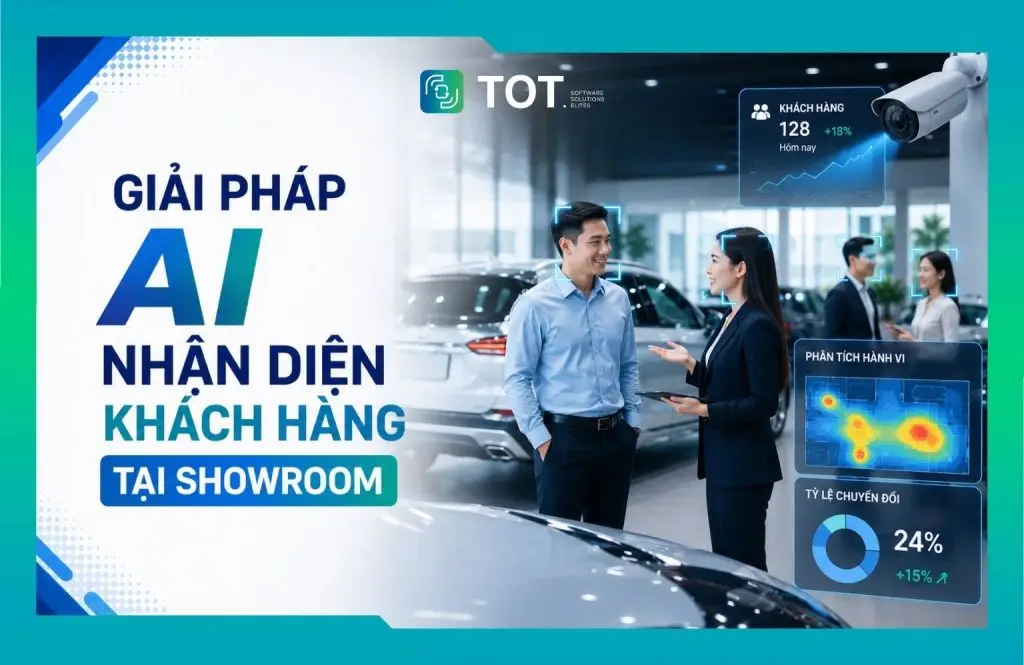
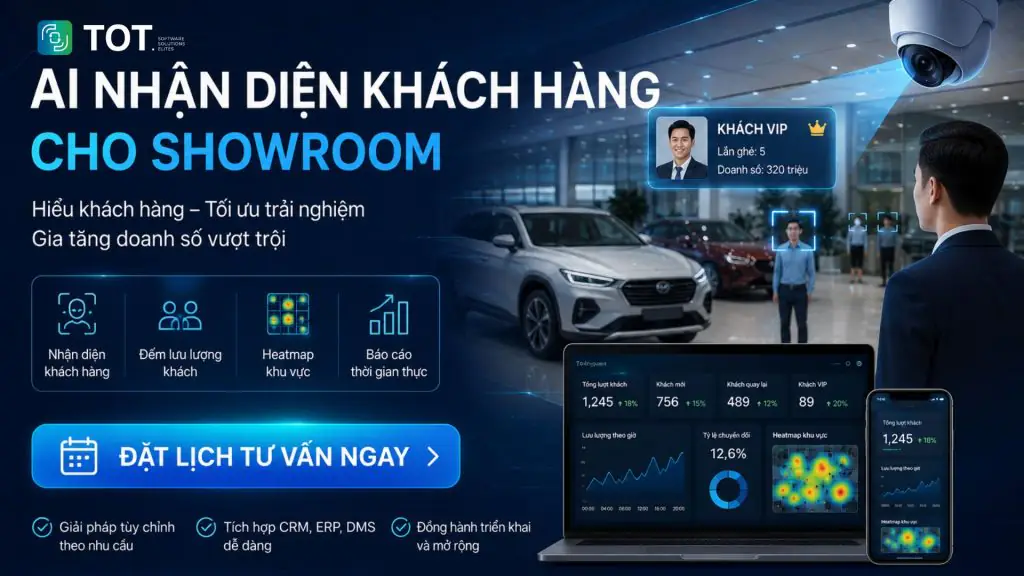
AI customer recognition in showrooms is becoming a go-to solution for retail and automotive businesses looking to enhance the customer experience, streamline the consultation process, and increase conversion rates. With AI technology, businesses can recognize regular customers, analyze behavior, and help staff approach the right customers at the right moment. In this article, TOT walks you through what AI customer recognition in showrooms is, how it works, its standout features, the benefits it delivers, and custom-built solutions tailored to each business.
What is AI customer recognition in showrooms?
AI customer recognition in showrooms is a solution that applies artificial intelligence and Computer Vision to automatically identify, classify, and analyze customers visiting a showroom in real time through cameras. The system can distinguish new, returning, and VIP customers, while also analyzing behavior and movement journeys to help the sales team serve customers more effectively.
How does AI customer recognition work?
The system works by capturing images from cameras, then using AI models to analyze faces and identifying features in real time. The AI extracts features, matches them against the customer database, and returns a recognition result in a split second. If the person is a regular customer, the system displays their profile to staff; if they are a new customer, the system records them to track their journey. The entire process runs automatically and continuously without disrupting the customer’s experience.
How is AI customer recognition different from traditional surveillance cameras?
| Surveillance cameras (CCTV) | AI customer recognition cameras |
|---|---|
| Only record and store video | Analyze images in real time |
| Mainly serve security purposes | Support both security and business |
| Do not recognize customers | Recognize regular or VIP customers (when data is available) |
| Do not analyze behavior | Track the customer journey, dwell time, and level of interest in products |
| Do not make recommendations | Send alerts or help sales consultants step in at the right time |
As the comparison shows, AI cameras do not just “see” customers but also “understand” their behavior, helping businesses put data to work to enhance the experience and increase conversion rates.
The technologies behind an AI customer recognition system
An AI customer recognition system for showrooms is typically built from multiple AI and computer vision technologies working together to ensure accurate analysis.
- AI Computer Vision: Analyzes images and video from cameras to detect people, zones, and objects in the showroom.
- Face Recognition: Recognizes faces to identify past customers and VIP customers, or matches them against CRM data when authorized by the business.
- OCR (Optical Character Recognition): Extracts information from documents, invoices, membership cards, or text visible in images.
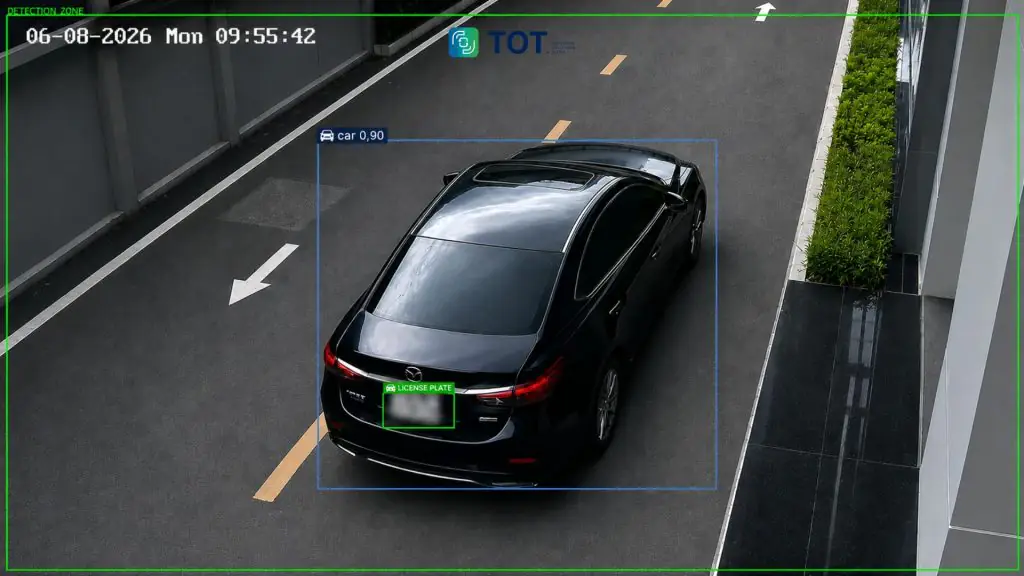
- License Plate Recognition (LPR): Recognizes license plates as customers enter and leave the showroom, supporting parking management and linking vehicles to customer information.
- Person Re-identification (Re-ID): Tracks the same customer as they move across multiple cameras without requiring continuous facial recognition.
- Edge AI: Processes data directly on the device or AI camera, reducing latency, saving bandwidth, and strengthening data security.
The problems showrooms face before applying AI
Despite investing in display spaces and consulting teams, many showrooms still struggle to make use of customer data. Without real-time information, businesses find it hard to evaluate sales performance, optimize the experience, and make accurate decisions.
Below are the most common problems showrooms face before applying AI.
No way to tell who is a new, returning, or VIP customer
Customer information is usually recorded only after someone signs up for a consultation or makes a transaction. While customers are browsing the showroom, businesses have virtually no way to distinguish new, returning, or VIP customers.
Limitations:
- The experience cannot be personalized.
- It is hard to prioritize high-value customers.
- The risk of missing sales opportunities increases.
No way to measure the conversion rate of showroom visitors
Many showrooms only count how many visitors come in and out, without tracking how many people received a consultation, how many made a purchase, or how many left without a transaction.
Limitations:
- There is no solid basis for evaluating sales performance.
- Staff productivity is hard to measure.
- Areas for improvement in the consultation process remain unidentified.
Staff do not greet the right person at the right time
When foot traffic surges, greeting customers relies mainly on staff experience or observation. Customers with strong purchase intent, or even VIP customers, may still have to wait just like ordinary browsers.
Limitations:
- The customer experience is inconsistent.
- The chances of closing a sale drop.
- Service quality suffers.
A lack of data to optimize showroom layout
Businesses do not know which areas attract the most customers, which products draw interest, or which spots get little engagement. As a result, space planning relies mainly on the business’s own experience.
Limitations:
- Display positions are hard to optimize.
- Showroom floor space is not used effectively.
- There is not enough data to improve the shopping experience.
Customer data is not connected to the CRM
Information from cameras, sales consultants, and the CRM system is often stored separately. Customer profiles lack consistency, making it difficult to track the entire shopping journey.
Limitations:
- Complete customer profiles cannot be built.
- Customer care and remarketing are hard to carry out.
- Data is used less effectively to drive sales.
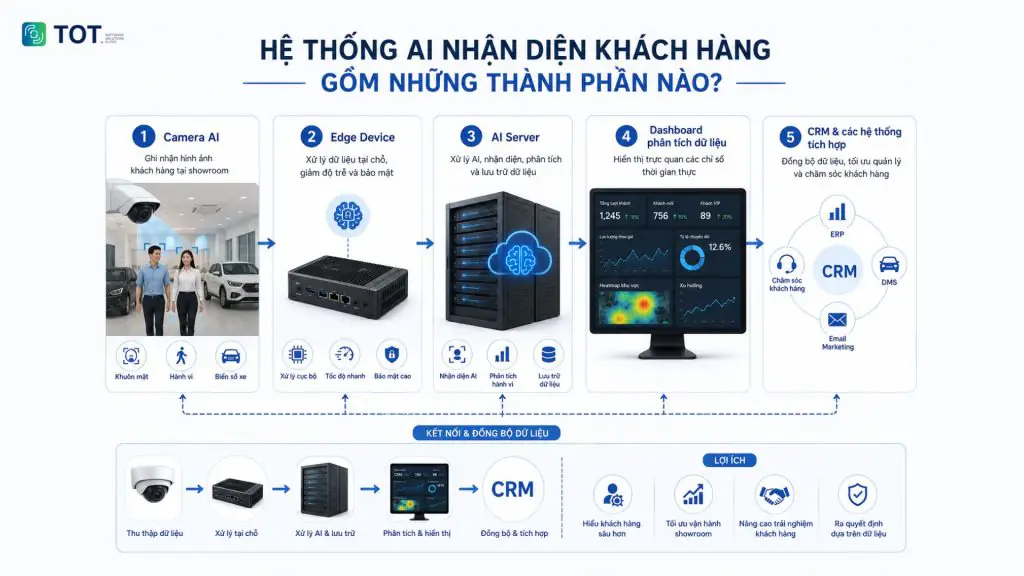
What components make up an AI customer recognition system?
An AI customer recognition system for showrooms consists of multiple components that work together to collect, process, and analyze data in real time. Depending on the size of the business, the system can be deployed on-premise, in the cloud, or as a hybrid of both.
AI cameras
AI cameras are the input devices, responsible for capturing images of customers at locations such as the entrance, display areas, or service areas. The image data is sent to the system to recognize faces, behavior, license plates, and other relevant information.
Edge device
An edge device processes data right at the showroom before sending it to the server. Thanks to local processing, the system reduces latency, speeds up recognition, and limits data transmission over the Internet, improving both performance and security.
AI server
The AI server is the processing hub of the entire system, where AI models run facial recognition, behavior analysis, data matching, and reporting. This component can be deployed on in-house servers or on a cloud platform, depending on the business’s needs.
Data analytics dashboard
The dashboard visually displays metrics such as foot traffic, new customers, returning customers, VIP customers, heatmaps, and conversion rates. Managers can monitor showroom activity in real time and make fast, data-driven decisions.
CRM and integrated systems
The AI system can connect to CRM, ERP, DMS, or other management software to sync customer data. This integration lets businesses retrieve transaction history, update information automatically, and run customer care or remarketing activities more effectively.
How does AI customer recognition in showrooms work?
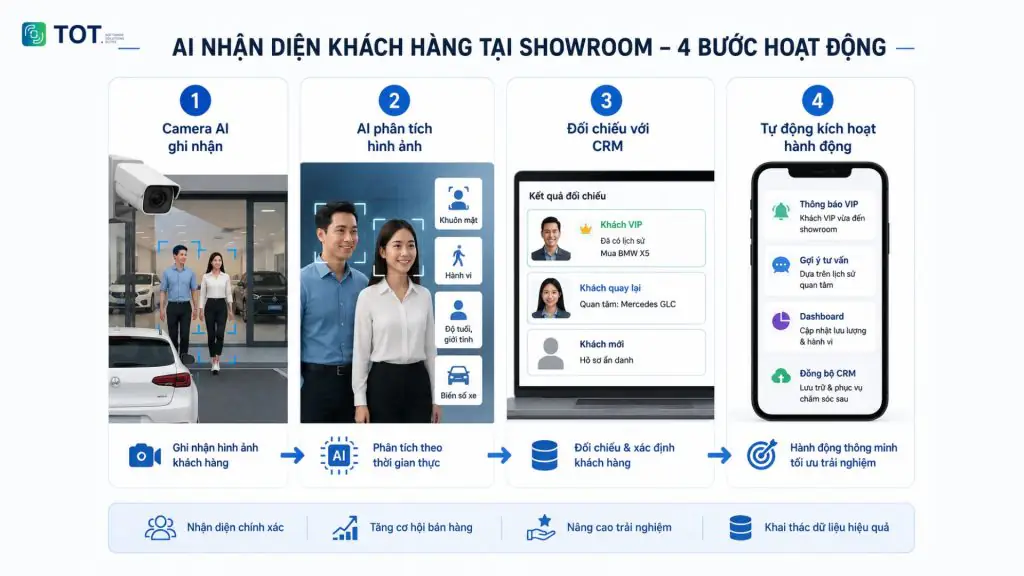
AI customer recognition in showrooms follows an automated process, from capturing images to analyzing data and supporting sales consultants. The entire process takes just a few seconds, helping businesses quickly recognize customers and choose the right way to serve them.
Step 1. AI cameras capture customer images
When a customer walks into the showroom or drives up, the AI camera system installed at locations such as the entrance, display areas, and service areas automatically captures images. The cameras run continuously, collecting high-quality data and sending it to the AI system for real-time processing.
The system will:
- Detect when a customer appears.
- Capture images or video from multiple viewing angles.
- Collect data as input for the subsequent analysis steps.
This first step gives the system the data it needs to recognize customers and analyze their behavior.
Step 2. AI analyzes faces, behavior, and identifying features
After receiving data from the cameras, the AI processes the images in real time using technologies such as Computer Vision, Face Recognition, Person Re-identification, and Edge AI.
The AI can analyze:
- Customers’ faces and identifying features.
- Movement paths and dwell time in each area.
- Estimated demographic information such as age and gender.
- Level of interest in each product.
- License plates, if customers arrive by car.
All analysis is processed directly on the device or AI camera thanks to Edge AI technology, which reduces latency, speeds up response times, and limits data transmission to the server.
Step 3. Matching against the CRM or database
Once the analysis is complete, the AI matches the identifying features against the customer database or the CRM system the business has integrated.
The system can identify:
- New customers
- Returning customers
- VIP or loyal customers
- Interaction and transaction history, as well as products or car models they have shown interest in
If a match is found, the system retrieves all related information to help sales consultants approach the customer more appropriately. For new customers, the AI creates an anonymous profile to record their movement journey and behavior in the showroom. This profile helps businesses analyze customer trends while still protecting privacy until customers choose to share their personal information.
Step 4. Automatically triggering smart actions
Once recognition is complete, the AI system automatically runs preconfigured scenarios to support staff and optimize the sales process.
The system can automatically:
- Send a notification when a VIP customer arrives, along with their profile, so staff can prioritize greeting them.
- Suggest consultation content for returning customers based on their history of interests.
- Sync data and interaction history to the CRM.
- Update the dashboard in real time with metrics on foot traffic, movement paths, and areas of interest.
With real-time processing, every showroom visit is put to better use, helping businesses enhance the customer experience and increase sales opportunities.
Standout features of AI customer recognition in showrooms
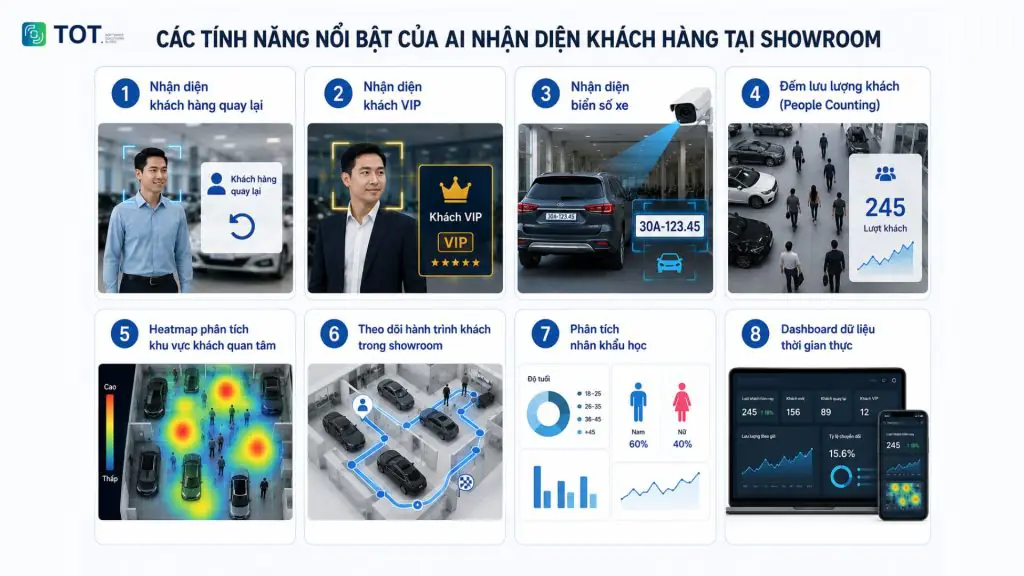
An AI customer recognition system for showrooms integrates many features that help businesses recognize customers, analyze behavior, and leverage data in real time. Below are the solution’s standout features:
- Returning customer recognition
The system automatically recognizes customers who have visited the showroom before and matches them against CRM data. Staff can view their interaction history and the products they were interested in to tailor consultations and personalize the experience.
- VIP customer recognition
The AI detects VIP customers the moment they arrive and sends a notification to the staff member in charge. The customer profile is displayed instantly, helping staff prioritize greeting them and raise service quality.
- License plate recognition (LPR)
License Plate Recognition (LPR) technology automatically recognizes license plates as customers enter and leave the showroom, making it easy to look up customer information, transaction history, or maintenance history.
- Foot traffic counting (People Counting)
The AI counts visitors by hour, day, or month, helping businesses evaluate foot traffic, calculate conversion rates, and allocate staff more effectively.
- Heatmap analysis of areas customers are interested in
The heatmap shows where customers gather most, how long they linger, and their level of interest in each product, helping optimize the display space.
- In-showroom customer journey tracking
The system records each customer’s full movement path through the showroom, helping businesses clearly understand shopping behavior and optimize the consultation process.
- Demographic analysis
The AI can estimate customers’ age and gender to analyze the target customer base and help build a suitable sales strategy.
- Real-time data dashboard
All data is displayed on an intuitive real-time dashboard, allowing managers to quickly track foot traffic, VIP customers, conversion rates, and operational metrics.
Benefits of deploying AI customer recognition in showrooms
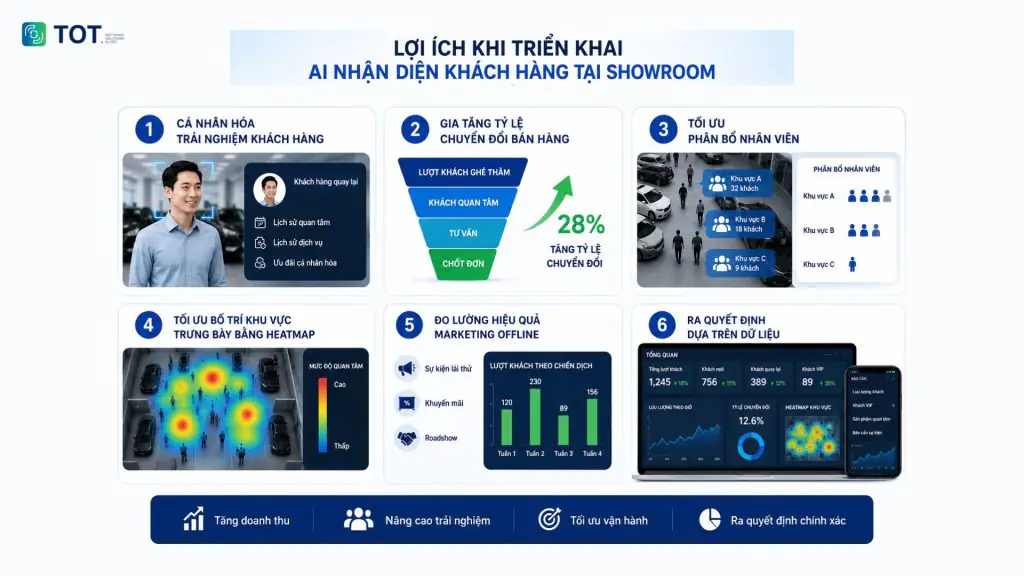
Applying AI customer recognition in showrooms does more than automate the greeting process; it also delivers real value across sales, operations, and management. Below are the key benefits businesses can achieve.
- Personalize the customer experience
AI recognizes returning and VIP customers and retrieves their interaction history so sales consultants can advise them appropriately. The shopping experience becomes personalized, which raises satisfaction and makes customers more likely to come back.
- Increase the sales conversion rate
By recognizing the right customers and supporting consultations at the right moment, businesses can reach high-intent buyers faster, lifting the conversion rate and growing revenue.
- Optimize staff allocation
The system analyzes foot traffic by time slot and area, helping businesses schedule staff sensibly, cut waiting times, and improve service quality.
- Optimize the display layout with a Heatmap
A Heatmap shows which areas attract the most customers and which get little attention. Based on this data, businesses can adjust product placement and the display space to sell more effectively.
- Measure offline marketing effectiveness
AI accurately counts how many customers visit the showroom for each campaign or event. This data helps businesses evaluate the effectiveness of their offline marketing activities and optimize their investment budget.
- Make data-driven decisions
All data on customers, behavior, and operational performance is consolidated on a real-time dashboard. Managers can track key metrics and make faster, more accurate decisions.
Which businesses should deploy AI customer recognition?
AI customer recognition suits any business that has a physical space for welcoming customers and values both the customer experience and customer data. Sectors that benefit most clearly include:
- Car showrooms
Recognize returning and VIP customers, track each visitor’s journey through the showroom, support consultations, and measure the showroom’s conversion rate.
- Motorcycle dealers
Manage foot traffic, recognize license plates, support sales consultations, and improve after-sales service quality.
- Retail chains
Analyze shopping behavior, count foot traffic, optimize store layouts, and evaluate the effectiveness of promotions.
- Furniture
Track the areas customers are interested in and how long they linger at each product, and optimize the layout of the display space.
- Electronics
Analyze customer behavior, help staff approach customers at the right moment, and measure sales performance.
- Real estate
Recognize returning customers at model homes or sales floors, support personalized consultations, and manage customer history.
- Banking
Recognize priority customers, shorten waiting times, and improve the transaction experience at the counter.
- Shopping malls
Count foot traffic, analyze heatmaps, track movement patterns, and evaluate the performance of each zone or store.
- Spa & Clinic
Recognize loyal customers, manage service usage history, and support care, promotion, or remarketing programs.
Overall, any business with a physical point of sale that wants to use customer data to enhance the experience, optimize operations, and grow revenue can deploy AI customer recognition in its showrooms or stores.
TOT’s AI customer recognition solution for showrooms
Every business has its own operating processes, sales model, and business goals. That is why TOT does not offer a fixed, one-size-fits-all AI solution; instead, TOT focuses on developing AI customer recognition systems for showrooms that match each business’s specific challenges and real-world needs.
A solution designed around the business challenge
TOT surveys operating processes, existing infrastructure, and business goals to build the right solution. The system can be deployed for car showrooms, motorcycle dealers, retail chains, banks, shopping malls, or any business that needs to analyze customer behavior at the point of sale.
Custom AI development
The TOT team develops AI models for specific business functions such as facial recognition, license plate recognition, People Counting, Heatmap, Person Re-identification, and customer behavior analysis. The solution is optimized to meet requirements for processing speed, accuracy, and future scalability.
CRM, ERP, and DMS integration
The AI system can connect to a business’s existing CRM, ERP, or DMS platforms or other management software. Synchronizing data helps businesses build complete customer profiles, streamline the sales process, and deliver more effective after-sales care.
Support through deployment and scaling
TOT does more than develop software: TOT supports the entire deployment process, from solution consulting, installation, and system integration to training and maintenance. As expansion needs arise, businesses can add features, increase the number of cameras, or roll out to multiple showrooms on the same platform.
If your business is looking for a custom-developed AI customer recognition solution for showrooms, TOT is ready to advise and build a system that fits your real-world operating processes. Beyond AI customer recognition, TOT also provides custom software development and system integration solutions for businesses.
Case study: Deploying AI cameras for customer recognition across the THACO AUTO showroom network
The business challenge
Before deploying an AI solution, many showrooms still relied on a manual greeting process, which made it difficult to recognize and serve customers. Businesses commonly faced problems such as:
- Returning or VIP customers could not be recognized as soon as they arrived at the showroom.
- There was no way to distinguish customers with appointments from walk-in customers.
- Staff had to look up information manually, which increased waiting times and hurt the customer experience.
- Customer data was scattered across multiple systems, making it hard to synchronize and use effectively.
TOT’s solution
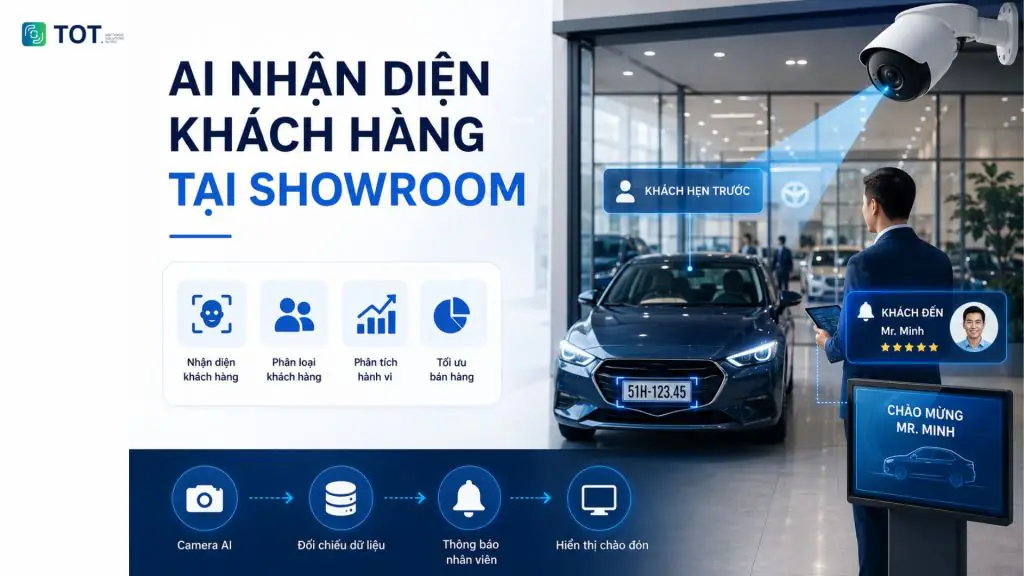
TOT developed an AI Computer Vision system combined with custom software to automate customer greeting and management at the showroom.
The solution includes:
- AI cameras that recognize license plates as soon as a vehicle enters the showroom.
- Matching the data against the DDMS/CMS system to identify customer information and appointments.
- Automatically notifying the assigned staff member so they can greet the customer proactively.
- Displaying a welcome message for the customer on the LED screen in the showroom.
- Synchronizing data in real time for management and operational analysis.
Value delivered
After deployment, the business can standardize its greeting process and improve service quality at the showroom.
Key benefits include:
- Automating the greeting process and reducing manual work for staff.
- Personalizing the experience through customer recognition and transaction history.
- Synchronizing data between AI cameras and existing management systems.
- Providing real-time data that helps managers monitor showroom activity and make quick decisions.
- Building an open platform that makes it easy to add more AI Computer Vision features as the business grows.
Conclusion
AI customer recognition in showrooms helps businesses recognize customers, analyze behavior, and make effective use of data to optimize sales, enhance the experience, and make data-driven decisions. If your business is looking for an AI solution that fits its real-world operating processes, TOT is ready to support you with consulting, deployment, and development of a custom AI Computer Vision system that meets current needs and scales easily in the future.
Frequently asked questions
Does AI customer recognition require facial recognition?
Not necessarily. Facial recognition (Face Recognition) is one of many technologies and among the most effective at distinguishing regular and VIP customers, but the system can still operate with other methods such as foot traffic counting, anonymous behavior analysis, license plate recognition, or Person Re-identification. Depending on their needs and privacy requirements, businesses can choose a suitable combination of technologies while ensuring compliance with personal data laws.
Can the system recognize license plates?
Yes. License plate recognition (License Plate Recognition) is a common feature and especially useful for car showrooms. When a customer drives in, the AI camera automatically reads the plate and matches it against the database to identify the vehicle owner and retrieve their service and transaction history. This enables faster greeting, personalized service, and automated check-in at the maintenance and repair area.
How much does it cost to deploy AI customer recognition?
The cost depends on the number of cameras, the scope of features, the number of locations/branches, the degree of AI customization, and integration with existing systems. Beyond software, there are costs for hardware (AI cameras, edge devices, servers), deployment, training, and maintenance. Because every business faces a different challenge, the exact cost should be determined after an on-site survey. TOT provides consulting and quotes tailored to each business’s needs and budget.
Can it be deployed across multiple showrooms at once?
Yes. The AI customer recognition system is designed to scale across multiple showrooms and branches on a single centralized management platform. Data from all branches is synchronized, allowing leadership to view consolidated reports for the entire chain or detailed reports for each location. With a custom-designed solution, TOT can build an architecture suited to a simultaneous rollout or a phased expansion that follows the business’s roadmap.
TOT is a partner on the digital transformation journey, providing website design, mobile app, custom software, and artificial intelligence software solutions tailored to each business need.
Drawing on hands-on consulting and deployment experience, TOT helps businesses build a digital transformation roadmap, apply AI, and automate processes to optimize operations and create a sustainable competitive advantage.
TOT contact information:
🌐 Website: topon.tech
📞 Hotline/WhatsApp/Zalo: 0906 712 137
✉️ Email: long.bui@toponseek.com
🏢 Address: 31 Hoàng Diệu Street, Xóm Chiếu Ward, Ho Chi Minh City, Vietnam
References
- Intel – Edge AI & Computer Vision
- NVIDIA – AI for Retail & Intelligent Video Analytics