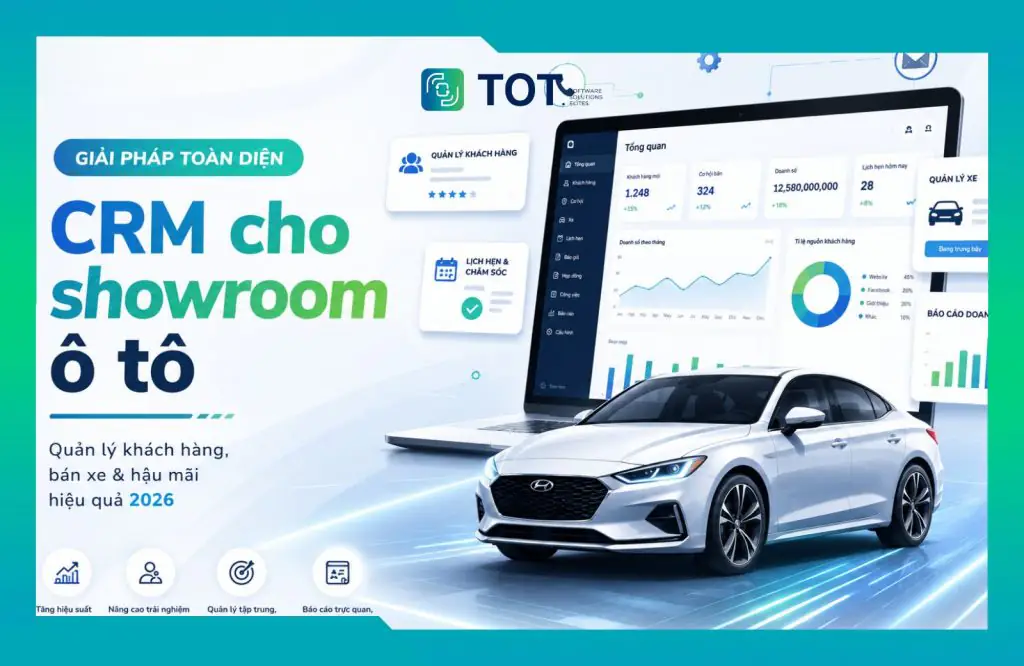
CRM for car dealerships is a solution that helps dealers and showrooms digitize the entire customer journey, from lead capture, sales consultation, test drives and contract signing to after-sales care and maintenance. According to the Foureyes Automotive Dealer Benchmarks Report 2025, 65% of customers who return to a dealership website receive no response within 24 hours, while 40% of deals are closed more than 3 days after the first contact. This shows that managing customers with Excel or scattered data can easily cause a showroom to miss out on many sales opportunities. The article below analyzes what CRM for car dealerships is, its core features and benefits, the Top 5 popular CRM platforms in 2026, AI adoption trends and the custom-built CRM solution from TOT for businesses with distinctive operating processes.
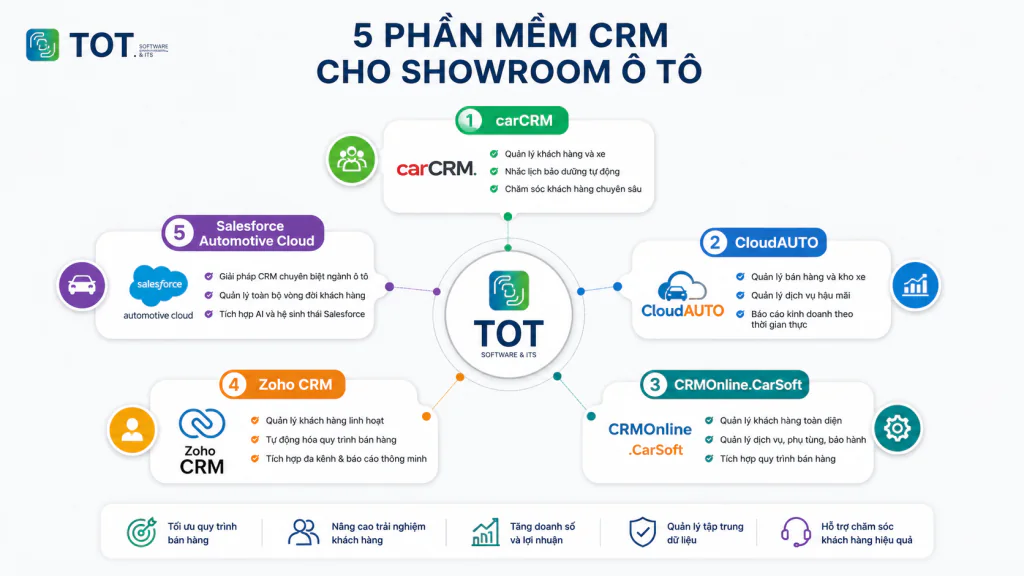
Quick summary of 5 CRM platforms for car dealerships
| Software | Key features | Best-fit business |
|---|---|---|
| carCRM | Automotive-specific CRM, customer care | Showrooms and garages in Vietnam |
| CloudAUTO | Car sales, customer and after-sales management | Car dealers in Vietnam |
| CRMOnline.CarSoft | CRM + garage and service management | Showrooms with a service center |
| Zoho CRM | Multi-industry, customizable CRM, Zoho ecosystem | SMEs that want flexibility |
| Salesforce Automotive Cloud | In-depth automotive CRM, Einstein AI | Large dealers, showroom chains |
What is CRM for car dealerships?
CRM for car dealerships (Automotive CRM) is customer relationship management software designed specifically for the automotive business, helping showrooms and dealers manage the entire customer lifecycle on one unified platform – from prospects and the car sales process to after-sales service. It is a specialized variant of the traditional CRM (Customer Relationship Management) system, adding industry-specific functions such as test-drive management, vehicle inventory and maintenance.
According to CRM research from organizations such as Salesforce and Gartner, businesses that apply CRM effectively can significantly improve their conversion and customer-retention rates. In the automotive industry – where the value of each transaction is high and customers often come back for maintenance services or to buy a new car – a good CRM system helps a showroom avoid missing opportunities, personalize consulting and build long-term relationships, thereby maximizing Customer Lifetime Value.
>>> See also:
- AI customer recognition at the showroom: A solution to boost sales and enhance the experience
- Top 15 comprehensive production management software solutions for businesses
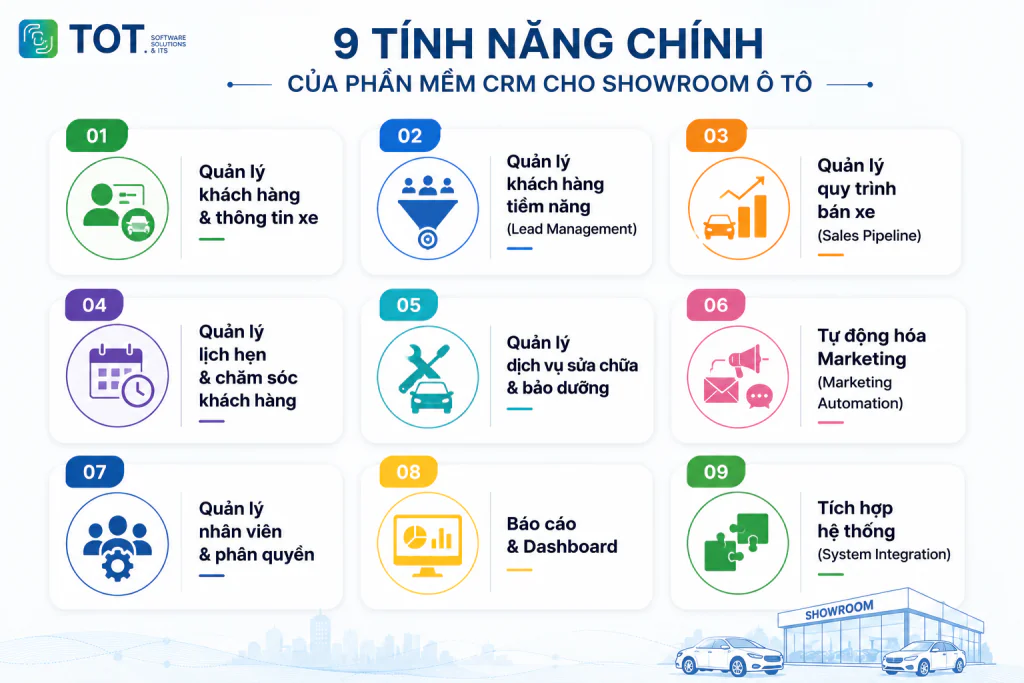
9 key features of CRM software for car dealerships
A comprehensive CRM software for car dealerships integrates many features that fully serve the sales process and customer care. Below are the core feature groups.
1. Customer profile and dedicated vehicle information management (Customer Management)
Centralized customer information management is the foundational feature of a CRM for automotive and motorcycle businesses. The system not only stores contact information but also links all data to the vehicle the customer owns, allowing the business to keep full track of everything in a single profile. A customer profile typically includes:
- Personal information: Full name, phone number, email, date of birth, address and acquisition source (website, Facebook, showroom, etc.).
- Vehicle information: Make, model, model year, color, chassis number, engine number, and delivery or purchase date.
- Interaction history: Maintenance and repair visits, appointments, feedback, requests and any special customer notes.
Centralizing all data on one platform lets staff look up information quickly, personalize the care experience, improve service quality and reduce errors during work.
2. Lead Management
Lead management is one of the most important features of a CRM, helping a business gather all data from multiple channels in one system and track it throughout the sales process. As a result, the sales team can follow up with customers promptly and avoid missing sales opportunities. Essential features include:
- Capture leads from multiple sources such as website, landing page, hotline, Facebook, Zalo, events or advertising campaigns.
- Store complete information such as needs, the car model of interest, budget, region and acquisition source.
- Classify customers by source, level of potential or car-buying needs to prioritize care.
- Automatically assign customers to sales staff by region, branch or configured rules.
- Track the status of each sales opportunity from intake, consulting, test drive, quotation and deposit to signing the contract.
- Set up call-back or follow-up reminders for customers who have not yet made a decision.
- Measure the performance of each customer source to evaluate conversion rates and optimize marketing costs.
3. Sales Pipeline management
The car sales process usually spans many steps, from customer intake to vehicle handover. The CRM software must allow this entire process to be tracked so that staff do not miss any customer and managers can easily control the status of each deal.
- Track each sales opportunity through stages such as customer intake, consulting, test drive, quotation, negotiation, deposit, contract signing and vehicle handover.
- Update the status of each deal in real time.
- Assign customers and track who is responsible at each stage.
- Set reminders to make calls, send quotations, schedule test drives or complete other tasks.
- Track the conversion rate between stages to evaluate sales performance.
- Forecast sales based on the number of deals in progress.
4. Appointment and care management (Customer Service & Follow-up)
A CRM helps a business manage all appointments and customer-care activities before, during and after a car sale, ensuring no interaction opportunity is missed. A CRM should support:
- Scheduling appointments for consulting, test drives, contract signing, vehicle handover and maintenance.
- Automatically reminding customers and staff of appointments via SMS, email or in-system notifications.
- Tracking the care history and the entire interaction process with the customer.
- Creating call-back or periodic follow-up schedules for customers who have not yet decided.
- Managing after-sales activities such as warranty, maintenance, satisfaction surveys and maintenance reminders.
- Recording feedback, complaints or support requests for timely handling.
- Assigning and tracking the processing progress of each responsible staff member.
Vehicle inventory and product management (Inventory Management)
5. Repair & maintenance service management (Service Management)
For showrooms with a service workshop or garage, managing after-sales operations plays an important role in enhancing the customer experience and increasing the return rate.
- Manage the maintenance, repair and warranty schedule of each vehicle.
- Create and track service orders from vehicle intake to completed handover.
- Automatically send periodic maintenance reminders based on time or kilometers driven.
- Store the complete history of maintenance, repairs and parts replacement.
- Link service information to customer and vehicle profiles for easy lookup.
- Track the processing progress and status of each service order.
6. Marketing automation
Marketing Automation helps a business maintain engagement with customers throughout the car-buying and service journey while reducing the volume of manual care work.
- Send email, SMS or Zalo OA messages based on pre-configured scenarios.
- Automatically care for customers at each stage such as consultation registration, test drive, quotation, deposit or after vehicle handover.
- Send notifications reminding customers of maintenance, warranty or inspection at the right time.
- Roll out promotional programs on occasions such as customer birthdays, purchase anniversaries or promotional events.
- Segment customers by car model, needs, transaction history or region to personalize outreach content.
- Track campaign performance through metrics such as open rate, click rate, response rate and conversion rate.
7. Staff management and access control (Sales Team Management)
As the number of staff and customers keeps growing, managing access rights and tracking performance becomes important to ensure the sales process runs efficiently.
- Assign access rights by role, department or branch.
- Assign customers and delegate tasks to each salesperson.
- Track the sales, KPIs and conversion rate of each individual or team.
- Monitor customer handling progress in real time.
- Evaluate performance by each staff member, department or branch.
- Keep a log of actions in the system for easy auditing and data control.
8. Reports and dashboards (Analytics & Reporting)
A visual reporting system helps managers track business performance and make decisions quickly.
- Sales reports by time period, staff member or branch.
- Statistics on the conversion rate of each sales stage.
- Analysis of the effectiveness of each lead source.
- Tracking revenue by car model, product or service.
- Displaying data on a real-time dashboard.
9. Integration with other systems (System Integration): Connecting with ERP, DMS, call center, website and social networks so data flows end to end.
The ability to connect with the systems already in use helps a business synchronize data across departments, reduce manual data entry and ensure information is always kept up to date end to end.
- Synchronize data with ERP and DMS systems.
- Connect the call center to store call history and track the customer-care process.
- Integrate websites, landing pages and registration forms to automatically capture leads.
- Connect Facebook, Zalo and social platforms to manage customer information centrally.
- Interconnect with Email Marketing, SMS and other management software to optimize operations.
Benefits of using CRM for car dealerships
Using a CRM delivers practical benefits, helping a car showroom increase sales, streamline operations and enhance the customer experience. Below are the key benefits.
1. Enhance the customer experience and increase the return rate
In the automotive and motorcycle industry, revenue comes not only from selling vehicles but also from after-sales services such as maintenance, repairs, warranty and parts replacement. A CRM helps a business maintain relationships with customers after the sale through well-timed care. With a CRM, a business can:
- Automatically remind customers of maintenance, warranty and periodic inspections.
- Store the complete vehicle usage and repair history.
- Personalize promotional programs based on each customer’s needs and vehicle condition.
- Maintain a professional, consistent care experience across every touchpoint.
As a result, customers tend to return for services more often, contributing to higher after-sales revenue and greater brand loyalty.
2. Optimize your team’s productivity
A CRM automates many customer-management tasks, reduces manual work and helps staff work more efficiently. A business can:
- Quickly look up customer profiles and vehicle information.
- Track the entire consulting, maintenance and repair history.
- Clearly delegate work among the sales team, service advisors and technicians.
- Reduce errors, missed appointments or duplicated information.
When all data is synchronized on one platform, the workflow becomes faster, more accurate and more professional.
3. Grow sales from existing customers
A CRM not only supports finding new customers but also helps a business effectively tap into its existing customer base – the group most likely to return and generate high revenue. The system supports:
- Sending notifications, promotions and care programs at the right time.
- Suggesting services, parts or maintenance packages suited to each vehicle.
- Running upsell and cross-sell programs.
- Collecting feedback and reviews to enhance brand reputation.
In addition, customer data is the foundation for building more accurate marketing campaigns, optimizing advertising costs and expanding the pool of potential customers.
4. Centralized management and effective operational control
A CRM helps a business consolidate all customer, vehicle and care-process data in a single system, replacing fragmented management across multiple files or different software. A business can:
- Quickly look up customer, vehicle and service-history information.
- Track the performance of each staff member or branch.
- Assign access rights and manage data securely.
- Standardize the customer-care process across the whole system.
- Protect data and limit losses when personnel change.
Thanks to real-time data tracking, managers can make faster decisions and control all business operations from a single platform.
Top 5 popular automotive CRM platforms in the Vietnamese market
Below are 5 CRM platforms chosen by many automotive businesses, showrooms and garages in Vietnam. Each solution has its own strengths, suited to different scales and customer-management needs.
1. carCRM
carCRM is a CRM developed specifically for the automotive industry in Vietnam, helping showrooms, dealers and garages manage all customer information throughout the vehicle’s lifecycle. The system focuses on digitizing the customer-care process, managing maintenance history and automating after-sales activities to increase the rate of customers returning for services.
Besides customer-management functions, carCRM also supports storing vehicle information, tracking repair history, sending periodic maintenance reminders and running multi-channel customer-care campaigns. Its Vietnamese interface and workflows designed to fit showroom and garage operations make it easy for businesses to deploy and use.
Some standout features of carCRM:
| Feature | Description |
|---|---|
| Centralized customer management | Store customer information, transaction history, care history and the entire interaction process in one system. |
| Vehicle information management | Track vehicle details such as make, model, license plate, VIN, delivery date and usage status. |
| Service history management | Store the complete history of maintenance, repairs, parts replacement and warranty for each vehicle. |
| Maintenance reminders | Automatically send reminders for maintenance, oil changes, warranty or periodic inspections based on time or kilometers. |
| Automated customer care | Support sending SMS, Email or Zalo to care for customers after the sale, wish them a happy birthday and announce promotions. |
| Appointment management | Track maintenance and repair appointments and assign the responsible staff. |
| Marketing & Remarketing | Segment customers to run promotions and care programs tailored to each audience. |
| Activity reporting | Report on the number of customers, service revenue, return rate and the effectiveness of care campaigns. |
| User access control | Assign access rights by role to control the data and activities of each staff member. |
Overall assessment:
carCRM suits car showrooms, repair garages and service centers that want to improve the quality of after-sales customer care. The software’s strength lies in managing vehicle history and automatically sending maintenance reminders, helping a business maintain customer relationships and increase revenue from after-sales services. However, if a business needs to manage the entire car sales process, finances or complex logistics, it may need to integrate additional management systems.
Pricing:
Currently, carCRM has not published an official price list on its website. Businesses need to contact the provider directly for advice on service packages and a quote suited to their scale of use.
2. CloudAUTO
CloudAUTO is management software for car dealers and showrooms in Vietnam, integrating CRM with car sales, inventory management and after-sales service on the same platform. The solution was developed to help businesses digitize their operations, from lead management to after-sales customer care.
Beyond customer management, CloudAUTO also supports many functions specific to car showrooms such as managing the car sales process, vehicle inventory, warranty, maintenance and after-sales activities. As a result, a business can run everything end to end on a single system instead of using several separate pieces of software.
Some standout features of CloudAUTO:
| Feature | Description |
|---|---|
| Customer management (CRM) | Store customer information, transaction history, car-buying needs and the entire care process in one system. |
| Lead management | Collect leads from multiple sources, classify them, assign them to sales staff and track the handling status. |
| Car sales process management | Track each sales opportunity from consulting, test drive, quotation and deposit to contract signing and vehicle handover. |
| Vehicle inventory management | Track stock by individual vehicle, version, color, VIN and vehicle status. |
| After-sales service management | Manage maintenance, warranty and repair schedules and store the service history of each vehicle. |
| Parts management | Track parts intake, issuance and stock, supporting material control during repairs. |
| Reports and dashboards | Provide sales, inventory, sales-performance and service-activity reports as intuitive charts. |
| User access control | Assign access rights by role, department or branch to ensure data security. |
| Multi-branch management | Synchronize data across multiple showrooms or dealers on the same system. |
Overall assessment:
CloudAUTO suits car dealers and showrooms that want to manage sales, vehicle inventory and after-sales service in sync. The software’s strength is that it closely follows the real operating processes of automotive businesses in Vietnam, supporting centralized management and real-time data tracking. However, its customization or integration with international systems may not be as extensive as some global CRM platforms.
Pricing:
CloudAUTO currently has not published an official price list on its website. Businesses need to contact the provider directly for advice on the solution and a quote suited to their deployment scale.
3. CRMOnline.CarSoft
CRMOnline.CarSoft is a CRM solution that combines sales and service management for car showrooms, garages and maintenance centers. The software helps a business manage customer information, the car sales process and after-sales activities in sync on the same system, improving the quality of customer care and streamlining operations.
Beyond customer management, CRMOnline.CarSoft also supports repair-order management, warranty, parts inventory and activity reporting. Centralizing all data on one platform helps showrooms and garages easily track each vehicle’s service history while improving coordination between the sales and technical teams.
Some standout features of CRMOnline.CarSoft:
| Feature | Detailed description |
|---|---|
| Customer management | Store customer information, transaction history and the entire care process in one system. |
| Car sales management | Track the sales process from customer intake, quotation and contract signing to vehicle handover. |
| Service management | Receive vehicles, create repair orders, track progress and manage the maintenance history of each vehicle. |
| Parts management | Control parts intake, issuance and stock to support repair and maintenance work. |
| Warranty management | Track warranty periods, warranty history and customer warranty requests. |
| Service appointments | Schedule maintenance and repairs and automatically remind customers. |
| Activity reporting | Consolidate car sales, service revenue and the performance of each department. |
| User access control | Manage access rights by role to ensure data security. |
Overall assessment:
CRMOnline.CarSoft suits showrooms with a service center or repair garage that need to manage both car sales and after-sales activities at the same time. The software covers the automotive industry’s specific functions fairly comprehensively; however, its interface and user experience may not be as modern as some international CRM platforms.
Pricing:
CRMOnline.CarSoft has not published an official price list. Businesses need to contact the provider directly for advice on the solution and a suitable quote.
4. Zoho CRM
Zoho CRM is a customer relationship management platform used widely around the world. Although not developed specifically for the automotive industry, the software can still be customized to meet the car sales, customer-care and service-management processes of a showroom or dealer.
Zoho CRM’s strength lies in its ability to automate processes and integrate with the Zoho ecosystem and many third-party applications. This lets a business build a flexible sales process, manage data centrally and run marketing campaigns on the same platform.
Some standout features of Zoho CRM:
| Feature | Detailed description |
|---|---|
| Lead management | Capture leads from websites, email, social networks and registration forms. |
| Sales process management | Track each sales opportunity through multiple stages and forecast sales. |
| Workflow Automation | Automate tasks such as sending emails, assigning work, updating statuses and setting reminders. |
| Marketing Automation | Segment customers and run scenario-based Email Marketing campaigns. |
| AI Zia | Support sales forecasting, suggest the best time to contact customers and analyze business data. |
| Dashboard & Reporting | Provide an intuitive, real-time reporting and dashboard system. |
| Multi-platform integration | Connect with Zoho Books, Zoho Desk, Microsoft 365, Google Workspace and many other applications. |
| Mobile App | Manage customers and track business activity on mobile devices. |
Overall assessment:
Zoho CRM suits small and medium-sized businesses or showrooms that need a flexible, easily scalable CRM platform with strong integration capabilities. However, because it is not a solution dedicated to the automotive industry, a business may need additional customization to meet functions such as VIN management, vehicle inventory or maintenance services.
Pricing:
Zoho CRM offers a free plan for a limited number of users and several paid plans billed monthly or annually. The cost varies depending on the number of users and the features a business chooses.
5. Salesforce Automotive Cloud
Salesforce Automotive Cloud is a CRM solution dedicated to the automotive industry, built on the Salesforce platform. The software helps automakers, dealers and showroom chains manage the entire customer lifecycle, from car sales, financing and after-sales service to long-term care programs.
Alongside customer management, Salesforce Automotive Cloud also integrates Einstein AI, real-time data analytics and connectivity to the Salesforce ecosystem to build a seamless customer experience across many channels.
Some standout features of Salesforce Automotive Cloud:
| Feature | Detailed description |
|---|---|
| Customer lifecycle management | Track the entire journey from prospect, car purchase to using after-sales services. |
| Vehicle Relationship | Manage vehicle information, ownership, usage history and the service record of each vehicle. |
| Dealer Management | Manage the operations of the dealer and showroom network on the same platform. |
| Einstein AI | Forecast sales, analyze customer behavior and recommend sales opportunities. |
| Marketing Cloud Integration | Personalize marketing campaigns across Email, SMS and digital channels. |
| Service Cloud Integration | Manage support requests, warranty and after-sales customer care. |
| Dashboard & Analytics | Analyze business data in real time with an intuitive reporting system. |
| API & Integration | Integrate with ERP, DMS, financial systems and other enterprise applications. |
Overall assessment:
Salesforce Automotive Cloud is a fitting solution for automakers, corporations or large dealer chains with complex management requirements. The platform offers powerful scalability and integrates AI and the Salesforce ecosystem, but the investment cost is also considerably higher than other popular CRM solutions.
Pricing:
Salesforce Automotive Cloud does not publish a fixed price. The deployment cost depends on the number of users, the accompanying Salesforce products and the actual scope of deployment. Businesses need to contact Salesforce directly for a quote and advice on a suitable solution.
Applying AI in CRM software for car dealerships
Artificial intelligence is taking CRM for car dealerships to a new level, turning the system from a storage tool into an intelligent assistant that predicts and personalizes. Below are the standout AI applications in 2026.
- AI lead scoring: automatically evaluates and ranks leads by buying likelihood, helping staff focus on the most promising prospects.
- AI deal-closing prediction: analyzes behavior and data to forecast which opportunities are easiest to close, helping prioritize resources.
- AI personalized car consulting: suggests the car model and version that suit each customer’s needs and budget.
- AI license-plate recognition: Computer Vision automatically recognizes license plates and pulls up the customer profile when a vehicle enters the showroom or garage.
- AI Chatbot and Voicebot 24/7: answer customers, provide advice and book appointments any time, so no after-hours customer is missed.
- AI care automation: sends the right message to the right person at the right time along the customer journey.
- AI customer-behavior analysis: identifies trends and needs to optimize marketing campaigns.
- AI sales-staff support: suggests the next action, drafts emails and quickly summarizes customer information.
- AI data analysis and business forecasting: forecasts sales and market demand, supporting vehicle procurement and sales planning.
Limitations of using off-the-shelf CRM software for car dealerships
Packaged CRM software is a fitting choice for many businesses thanks to its fast deployment time and reasonable initial cost. However, for car showrooms or dealers with their own sales, service-management and customer-care processes, off-the-shelf solutions sometimes cannot fully meet real operational needs.
1. Hard to meet each showroom’s specific processes
Each showroom usually has different processes for selling cars, managing customers, after-sales care and running the service workshop. Meanwhile, off-the-shelf CRM software is often designed around generic processes, forcing a business to adjust the way it works to fit the system rather than the other way around.
2. Limited customization
Many software packages only allow changes to a few data fields or basic processes. When a business needs to add new features, change an approval process or build custom reports, customization can face many limitations or incur additional costs.
3. Hard to integrate with existing systems
Car showrooms often run several pieces of software at once, such as ERP, DMS, accounting software, call center, website or marketing platforms. If the CRM does not support integration or has limited connectivity, a business will have to enter data multiple times, which can easily cause data discrepancies between systems.
4. Scaling costs can rise over time
Although the initial cost is not too high, as a business scales up, adds more users or needs additional advanced features, the total cost of licensing, upgrades and maintenance can rise considerably.
5. Dependence on the vendor
With SaaS or packaged CRM software, a business usually depends on the vendor’s development roadmap. If it needs to add new features or make changes to fit business needs, the deployment time can be lengthy, or it may not be supported at all if it is not part of the product roadmap.
6. Hard to create a competitive advantage
When many businesses use the same software with identical processes, there is limited room to build a distinctive customer experience or deploy specialized processes. This makes it hard for a showroom to optimize operations around its own business model.
When should you build custom CRM software for a car dealership?
Off-the-shelf CRM software suits many businesses, but as scale and operating processes become increasingly complex, building a custom CRM becomes the better choice. A business should consider it if it encounters one or more of the following cases:
- The showroom has its own sales process and needs a system built exactly around its internal workflow.
- Managing multiple branches or dealers, needing to synchronize customer data and business activity on one platform.
- Wanting to integrate with existing systems such as ERP, DMS, accounting software, call center, website or mobile app.
- Needing to manage customer and vehicle data centrally, from car sales and warranty to maintenance and after-sales care.
- Wanting to automate processes such as lead assignment, maintenance reminders, sending quotations or customer care.
- Needing custom dashboards and reports instead of only using ready-made report templates.
- Wanting to add features in phases without having to change or replace the entire system.
- Prioritizing data control and long-term scalability to match the company’s growth direction.
In that case, investing in custom-built CRM software will help a business optimize its operations, improve management effectiveness and deliver a better experience for customers.
Custom CRM software solution for car dealerships from TOT
Every car showroom has different sales, customer-care and service-management processes. As a result, packaged CRM software can rarely fully meet operational needs or support future expansion.
TOT develops custom CRM software, giving a business a system designed to fit its business model instead of having to change its processes to fit the software. When choosing TOT, a business gets:
- Designed around your exact operating process: Build the CRM around the business’s car sales, lead management, test drive, quotation, delivery and after-sales care processes.
- Connecting the entire ecosystem: Integrate the CRM with ERP, DMS, Website, Call Center, Facebook, Zalo, Email, SMS and more so data is synchronized on one platform.
- Applying AI to operations
- AI lead scoring.
- AI chatbot supporting customers 24/7.
- Sales forecasting and sales-performance analysis.
- AI Computer Vision recognizing license plates and vehicles.
- Flexible scaling as your business grows: Easily add new features, expand branches or integrate additional systems without replacing the entire software.
- End-to-end delivery:
- Business process survey.
- UI/UX design.
- Software development.
- User training.
- Long-term maintenance and upgrades.
Beyond developing software, TOT accompanies businesses through their digital transformation, from process consulting and system design to deployment and post-launch optimization.
This capability is proven through projects such as the THACO AUTO Services app and the AI Computer Vision solution. The table below describes reference solution packages; the specific cost is quoted after a survey.
| Solution package | Best fit | Scope | Cost |
|---|---|---|---|
| Basic CRM | Small & medium showrooms | Lead, customer, pipeline and report management | Contact for a quote |
| Professional CRM | Dealers, showroom chains | Adds vehicle inventory, after-sales service, automation, ERP integration | Contact for a quote |
| AI CRM | Businesses pursuing full digitalization | Comprehensive + AI scoring, chatbot, Computer Vision, forecasting | Contact for a quote |
The deployment cost is built around each business’s actual requirements. TOT will survey your operating processes and advise on a suitable solution before providing a quote.
If your business needs CRM software for car dealerships designed around its real operating processes, TOT is ready to advise on and build a system to your specifications. With experience delivering automotive projects such as THACO AUTO Services along with AI Computer Vision solutions, TOT can build a management platform integrating AI, CRM and ERP, helping a business fully digitize its operations and be ready to scale in the future. Learn more about TOT’s custom software development service.
>>> See more standout services at TOT:
- Professional, GEO-standard, AI-powered website design
- Professional, trustworthy custom mobile app design
- Artificial Intelligence (AI) software development
- AI-powered custom software development service
Conclusion
CRM for car dealerships is a strategic tool that helps dealers and showrooms comprehensively manage the customer journey, increase conversion rates, streamline operations and build loyalty. From domestic solutions such as carCRM and CloudAUTO to international platforms such as Zoho CRM and Salesforce Automotive Cloud, each option suits a different scale and set of needs. In particular, the trend of integrating AI is opening up major opportunities for personalization and forecasting. If your business has distinctive processes, a custom, AI-integrated CRM solution for car dealerships from TOT will be an investment that delivers a sustainable competitive advantage.
Frequently asked questions
What is CRM software for car dealerships?
CRM software for car dealerships is a customer relationship management system specialized for the automotive industry, helping showrooms and dealers manage the entire customer lifecycle — from lead, consulting, test drive and car sale to after-sales care and maintenance – on one unified platform. Compared with an ordinary CRM, it adds industry-specific functions such as vehicle inventory management, test-drive scheduling and service, helping maximize Customer Lifetime Value.
What common mistakes should you avoid when using an automotive CRM?
Common mistakes include: incomplete or inconsistent data entry that makes the data low-value; choosing software that does not match your real processes; a lack of training so staff do not use all the features; and failing to integrate the CRM with other systems, causing data fragmentation. For a CRM to be effective, a business needs to standardize its data-entry process, train staff thoroughly and choose a solution that fits the way it operates.
Who should use an automotive CRM?
An automotive CRM suits showrooms, car dealers, distribution chains, garages and service centers with a large customer base and complex sales and care processes. Even small and medium-sized businesses should use a CRM when they want to manage leads professionally, increase the closing rate and retain customers. In general, any automotive business that treats customers as a long-term asset benefits from a CRM.
Does a CRM help increase car sales?
Yes. A CRM helps increase sales through tight lead management so no opportunity is missed, well-timed customer care to raise the closing rate, and personalized consulting to enhance the experience. In addition, a CRM taps into the existing customer base for after-sales services and new car sales, increasing Customer Lifetime Value. Many studies show that businesses applying CRM well significantly improve their conversion rates and revenue.
How much does it cost to deploy a CRM for a car dealership?
The cost depends on the type of solution and the scale. Off-the-shelf software is usually billed as a subscription based on the number of users per month. A custom-built solution has a higher initial investment, depending on the scope of features, the level of customization and AI/ERP integration. To get an accurate figure that fits your needs, a showroom should request a specific survey and quote from the provider.
TOT is your partner on the digital transformation journey, providing website design, mobile app, custom software and artificial intelligence software solutions tailored to each business need.
With real-world consulting and delivery experience, TOT helps businesses build a digital transformation roadmap, apply AI and automate processes to optimize operations and create a sustainable competitive advantage.
TOT contact information:
🌐 Website: topon.tech
📞 Hotline/WhatsApp/Zalo: 0906 712 137
✉️ Email: long.bui@toponseek.com
🏢 Address: 31 Hoang Dieu Street, Xom Chieu Ward, Ho Chi Minh City, Vietnam
References
- Vtiger – What is Automotive CRM: Features, Benefits, Real-world Use Cases
- Salesforce – Automotive Cloud
- CRMOnline – CRM for auto garages
- CloudGO – CRM for car showroom management