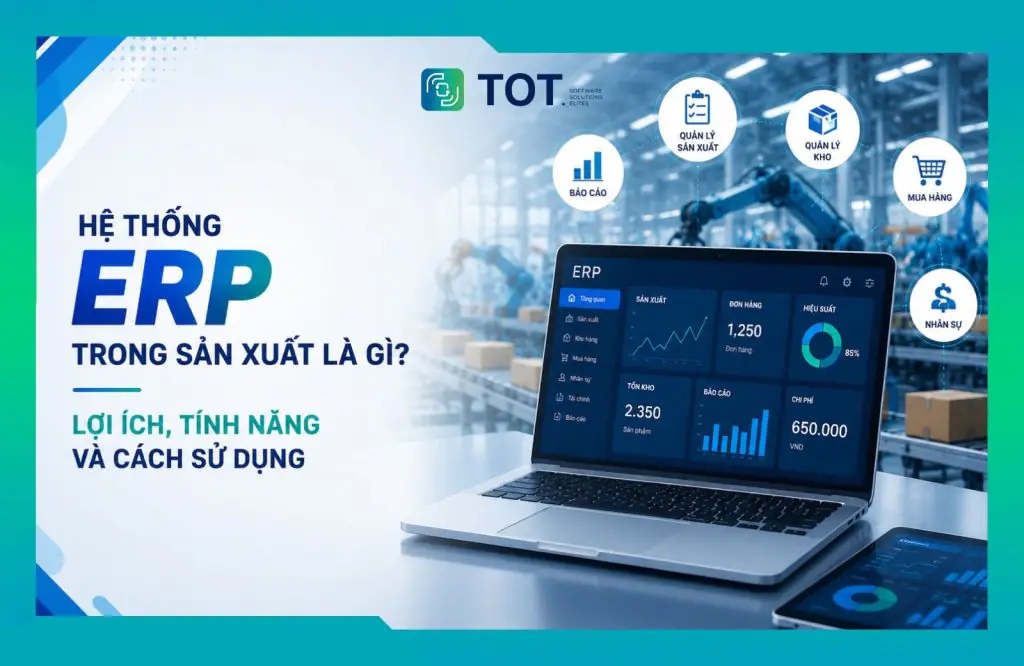
A manufacturing ERP system is an all-in-one management software solution that monitors every core production process in real time and connects it with finance, warehouse, purchasing, and human resources on a single shared data platform. As a factory grows, running operations in a fragmented way across many different tools starts to show its limits, and ERP becomes the backbone that lets a business operate as one. In the article below, join TOT as we break down the concept, features, benefits, core modules, and how to choose the right manufacturing ERP system for your business.
>>> See more articles:
- TOP 15+ leading, reputable software companies in Vietnam
- 15+ free, easy-to-use Android app design tools
- Professional custom software development services in Hanoi
- Custom software development in Ho Chi Minh City: professional design across diverse platforms
What is a manufacturing ERP system?
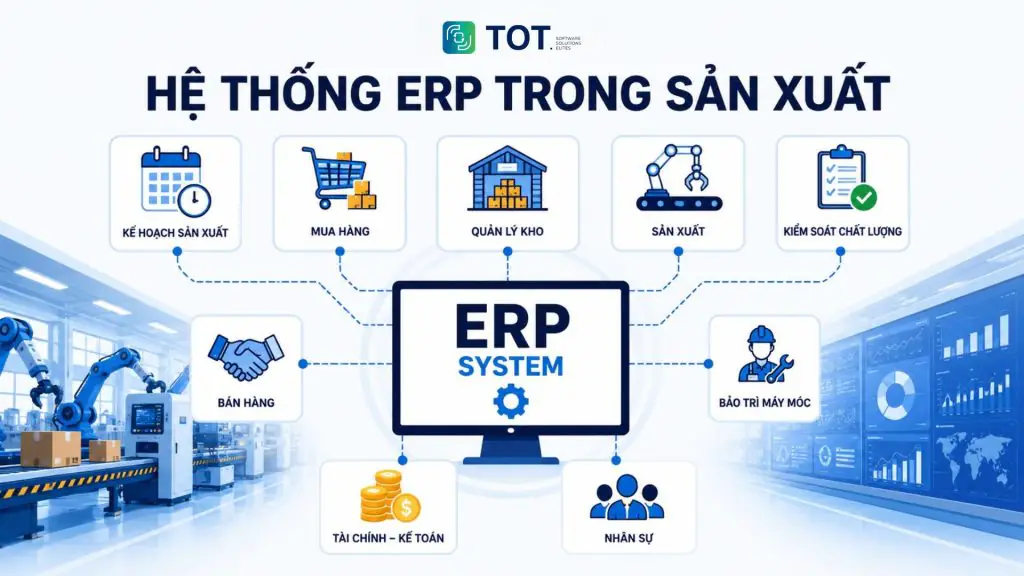
A manufacturing ERP system (Manufacturing ERP – Enterprise Resource Planning) is comprehensive management software that helps manufacturers manage and connect all their core operations on a single platform. The system integrates data from many departments — purchasing, warehouse, production, sales, finance, human resources, and equipment maintenance — to streamline operations and support real-time decision-making.
What sets manufacturing ERP apart from a standard ERP is its factory-focused modules, such as production planning, bill-of-materials management, and shop-floor control. Thanks to real-time data connectivity, leadership can track order progress, inventory, and product costs instantly, enabling faster and more accurate decisions.
Key features of a manufacturing ERP system
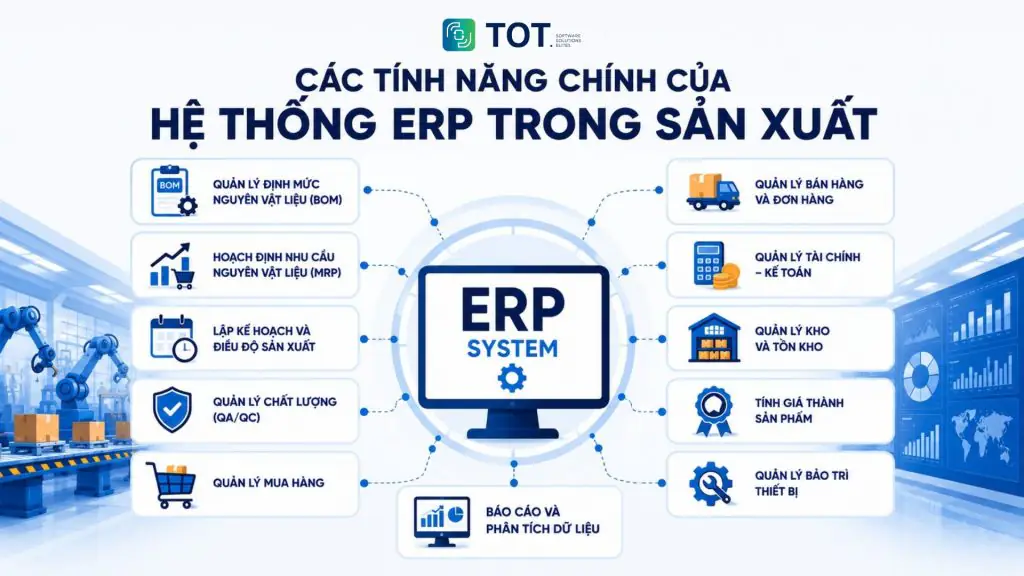
A complete manufacturing ERP system brings together many feature groups to cover the entire lifecycle of an order, from the moment it is received to the delivery of finished goods and the accounting of costs. Below are the important features that ERP software for the manufacturing industry should provide:
- Bill of materials (BOM) management
Defines and manages the detailed list of raw materials, components, and formulas that make up a finished product. This feature supports multi-level hierarchies and updates automatically whenever the engineering design changes.
- Material requirements planning (MRP)
Automatically calculates exactly how much material to buy and when, based on orders and actual inventory levels. This minimizes carrying costs and prevents production stoppages caused by shortages.
- Production planning and scheduling
Arranges the optimal production schedule for each machine, line, and worker. This feature analyzes the factory’s actual capacity to build the schedule, reducing wait times and ensuring on-time delivery.
- Quality management (QA/QC)
Sets up rigorous quality checkpoints from incoming raw materials to work-in-progress on the line and finished goods leaving the factory. It also enables fast product traceability whenever an issue arises.
- Purchasing management
ERP manages the procurement process from purchase requests, quotations, and purchase orders to supplier tracking and delivery progress, helping to control costs effectively.
- Sales and order management
Synchronizes data between sales and production, tracking order status, deliveries, and invoices to improve responsiveness to customer demand.
- Finance and accounting management
Automatically records transactions, tracks production costs, calculates product costs, and generates financial reports, helping the business control its capital effectively.
- Warehouse and inventory management
Tracks goods received, issued, and on hand in real time, managing multiple warehouses, batches, or serial numbers. The system also raises alerts when stock rises above or falls below defined thresholds.
- Product costing
Automatically aggregates the costs of raw materials, direct labor, and overhead (electricity, water, depreciation, and so on). This feature helps the business pinpoint the actual cost and profit margin of each order.
- Equipment maintenance management
Schedules periodic maintenance and manages spare parts for machinery. This feature minimizes the risk of unexpected downtime, extends asset lifespan, and helps ensure workplace safety.
- Reporting and data analytics
ERP provides intuitive dashboards showing output, inventory, costs, and production performance in real time, helping managers make quick decisions.
>>> See more:
- Free computer vision software: easy-to-use platforms
- The cost of rebuilding software with AI tokens and the risks
- 7 ways to apply AI to optimize customer experience
Benefits of using ERP manufacturing management software
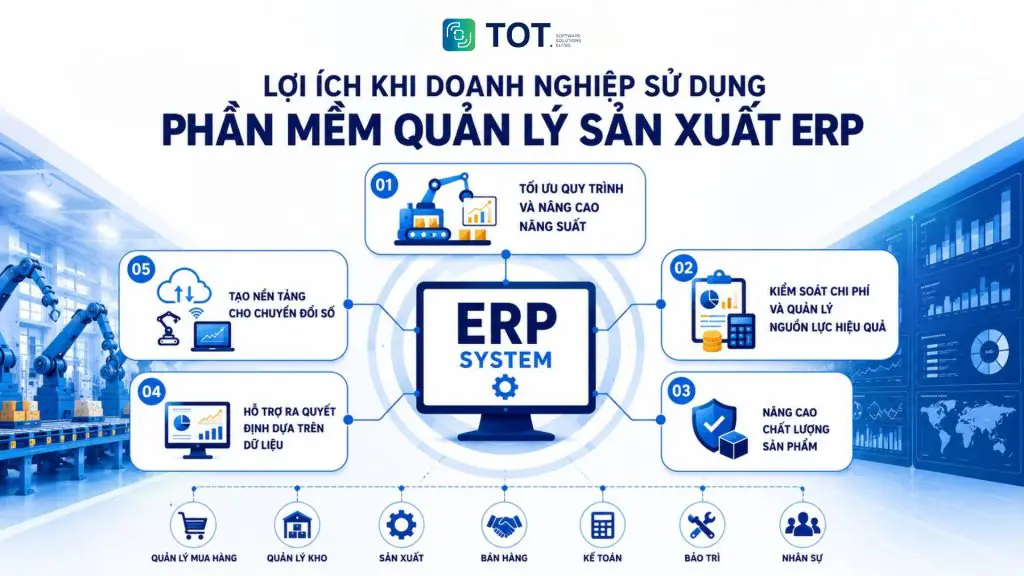
In manufacturing, running many processes across separate systems easily leads to errors and a lack of synchronization. ERP manufacturing management software helps a business connect data across departments, streamline processes, and improve operational efficiency. Below are the standout benefits ERP delivers.
- Streamlined processes and higher productivity
ERP connects activities from purchasing, warehouse management, and production through to sales on a single platform. With synchronized data, businesses reduce manual work, limit errors, and shorten processing times, which in turn boosts operational productivity.
- Cost control and efficient resource management
The system tracks the costs of materials, labor, and machinery in real time. At the same time, ERP helps businesses plan material requirements (MRP), optimize inventory, and reduce costs arising from material shortages or surpluses.
- Improved product quality
ERP supports quality control at every production stage, storing inspection data and enabling traceability by batch or serial number. This helps businesses quickly detect defects, improve processes, and meet quality standards.
- Data-driven decision support
Intuitive reports and dashboards help managers monitor output, progress, inventory, costs, and production performance in real time. As a result, businesses can make faster and more accurate decisions.
- A foundation for digital transformation
ERP integrates easily with systems such as MES, CRM, and WMS, as well as AI and IoT technologies. It is the foundation that helps businesses scale, standardize processes, and gradually build a smart factory model.
>>> See more:
- The cost of building software for small and medium-sized businesses with AI tokens
- The cost of building software with AI tokens for large enterprises — ROI
What are the main modules of a manufacturing ERP?
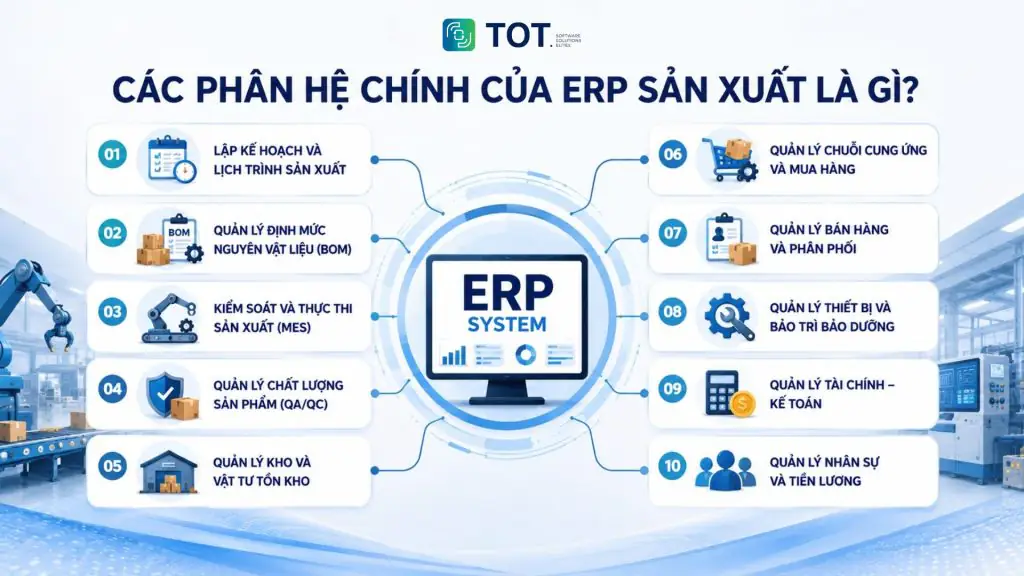
A manufacturing ERP system is made up of many modules, each handling a specific function while remaining tightly connected to the others on the same platform.
Integrating these modules lets a business manage end to end — from planning, production control, and warehouse management through to finance and human resources — while keeping data synchronized in real time.
Production planning and scheduling
The production planning and scheduling module helps a business build a production plan based on orders, machine capacity, staffing, and available materials.
This is a key module for limiting delays, resource shortages, and poor work allocation, thereby improving operational performance.
Key features:
- Plan production by order, demand forecast, or long-term plan.
- Automatically create and manage production orders for each line or workshop.
- Allocate machinery, manpower, and materials in line with production capacity.
- Adjust the production schedule when orders, equipment, or material supply change.
As a result, businesses can optimize factory capacity, reduce wait times, and keep deliveries on schedule.
Bill of materials (BOM) management
The BOM (Bill of Materials) module manages the entire product structure, including the list of raw materials, semi-finished goods, and consumption norms for each stage.
Accurate BOM management helps businesses reduce material waste, control costs, and maintain consistency in production.
Key features:
- Manage multi-level BOMs for different products and versions.
- Set material consumption norms for each product.
- Automatically calculate material requirements to support the production plan (MRP).
- Track and update the BOM when the design or production process changes.
Using the BOM module helps businesses optimize material costs and improve accuracy in production planning.
Manufacturing execution and control (MES)
The MES (Manufacturing Execution System) module helps monitor and direct production activities on the factory floor in real time.
It is an important tool for tracking production progress, detecting issues quickly, and improving operational efficiency.
Key features:
- Track production order status and the progress of each stage.
- Collect data from machines, sensors, or IoT devices in real time.
- Monitor productivity, downtime, and overall equipment effectiveness (OEE).
- Synchronize data with ERP to update production results and inventory.
When integrated with ERP, MES helps businesses control production activities precisely and make timely decisions.
Product quality management (QA/QC)
The QA/QC module supports quality control of raw materials, semi-finished goods, and finished products throughout the production process.
Controlling quality from the very start helps businesses reduce defect rates, save costs, and meet production standards.
Key features:
- Set quality inspection standards for each stage.
- Record inspection results and manage products that pass or fail.
- Track the root causes of defects and support product traceability.
- Generate quality reports to support continuous improvement.
With the QA/QC module, businesses can improve product quality and increase customer satisfaction.
Warehouse and inventory management
The warehouse management module helps businesses track all goods received, issued, and held in stock — raw materials, semi-finished goods, and finished products — on one centralized system.
This is a key module for maintaining reasonable inventory levels and avoiding both material shortages and excess stock that drives up costs.
Key features:
- Manage goods received, issued, and on hand in real time.
- Track multiple warehouses, storage locations, batches, serial numbers, or expiry dates.
- Alert when stock rises above or falls below defined thresholds.
- Support stock counting, reconciliation, and tracing material transaction history.
Using the warehouse management module helps businesses optimize inventory, reduce losses, and ensure materials are always available for production.
Supply chain and procurement management
The supply chain and procurement management module helps businesses control the entire process, from selecting suppliers and purchasing materials to tracking delivery and receipt.
This is a key module for ensuring a stable supply, limiting production disruptions, and optimizing procurement costs.
Key features:
- Manage the list of suppliers, quotations, and purchase contracts.
- Automatically create purchase requests based on the production plan or inventory levels.
- Track delivery progress, lead times, and material quality.
- Analyze supplier performance based on cost, quality, and delivery time.
As a result, businesses stay in control of their material supply, reduce procurement costs, and maintain a stable supply chain.
Sales and distribution management
The sales and distribution management module helps track the entire process, from receiving orders and delivering goods to after-sales customer care.
Synchronizing sales data with production helps businesses fulfill orders faster and improve the customer experience.
Key features:
- Manage quotations, orders, contracts, and sales invoices.
- Track order status and delivery progress in real time.
- Synchronize data with the warehouse to check stock before shipping.
- Manage pricing policies, discounts, and customer transaction history.
This module helps businesses shorten order processing times, raise service quality, and increase business efficiency.
Equipment and maintenance management
The equipment and maintenance management module helps track machine condition, plan maintenance, and manage repair history across the factory.
It is an essential tool for reducing downtime, extending equipment lifespan, and keeping production running continuously.
Key features:
- Schedule periodic maintenance or maintenance based on operating hours.
- Track operating condition, repair history, and parts replacement.
- Alert when maintenance is due or when equipment shows signs of abnormality.
- Track maintenance costs and evaluate equipment utilization.
With proactive maintenance management, businesses can limit unplanned breakdowns and optimize machine performance.
Finance and accounting management
The finance and accounting module helps businesses manage all financial data generated during production on one unified system.
Synchronizing data with the other modules reduces accounting errors and delivers accurate financial reports.
Key features:
- Manage receipts, payments, receivables and payables, the general ledger, and accounting operations.
- Automatically record material, labor, and production costs.
- Track product costs, profit, and cash flow in real time.
- Prepare financial statements and management reports, and support tax finalization.
This module helps businesses control costs effectively and make financial decisions based on accurate data.
Human resources and payroll management
The human resources and payroll module helps businesses manage employee information, time and attendance, payroll, and workforce allocation.
It is the foundation for optimizing labor management, ensuring payroll accuracy, and improving workforce efficiency.
Key features:
- Manage employee records, labor contracts, and work history.
- Track attendance, work shifts, overtime, and leave.
- Automatically calculate salaries, allowances, bonuses, and deductions according to policy.
- Produce HR reports, evaluate performance, and support workforce planning.
Using the HR module helps businesses save management time, reduce payroll errors, and improve team efficiency.
>>> See more:
- Top 20+ best free AI image design tools
- TOP 15+ effective, super-easy AI app-building tools
Factors to consider when choosing a manufacturing ERP system
Choosing the right ERP system depends not only on the number of features but also on the business’s actual needs and growth plans. Below are the important factors to weigh so that the ERP system delivers lasting value.
- Industry-specific requirements
Each industry has different processes and management requirements, so the ERP must fit the business’s specific operations.
Example: An automotive manufacturer needs multi-level BOM management and component traceability, whereas the food industry needs to track expiry dates and batches.
- Business size
The scale of operations determines the scope of the ERP rollout and the number of users. Businesses with multiple factories or branches should prioritize a system with centralized management capabilities.
Example: A manufacturing group with factories across several provinces needs an ERP that can synchronize data across locations in real time.
- Ability to support production processes
The ERP should fully support operations such as production planning, BOM management, MRP, warehousing, and quality. This helps the business avoid heavy customization or changes to its operating processes.
Example: A make-to-order manufacturer should choose an ERP that can plan production flexibly for each order rather than one that only supports mass production.
- Investment and operating costs
Beyond implementation costs, businesses need to factor in maintenance, upgrade, and user training costs to assess the total cost of ownership.
Example: A small or medium-sized business may prefer to deploy ERP on the Cloud to reduce upfront infrastructure investment.
- Integration and scalability
The ERP should integrate easily with systems such as MES, CRM, WMS, or AI to synchronize data and meet future expansion needs.
Example: When a business adds an AI camera-based quality inspection system, the ERP can integrate with it to synchronize inspection data and production reports.
- The ERP vendor’s reputation and capability
A vendor with experience in manufacturing will help shorten implementation time and ensure the system fits real operations.
Example: A provider that has previously deployed ERP for the mechanical or automotive industry has an advantage in building suitable processes and shortening implementation time.
Choosing the right ERP system from the start helps businesses optimize implementation costs, improve management efficiency, and build a solid foundation for digital transformation.
>>> See more:
- Vision language models & object detection: benefits & how to use them
- What is an application? What is application software? Clear and easy to understand
Which businesses should use manufacturing ERP software?
ERP software suits many manufacturing business models, especially those struggling with data management, cost optimization, or scaling up. Choosing and implementing ERP at the right time helps businesses standardize processes, improve operational efficiency, and lay the groundwork for digital transformation.
- Businesses with complex production processes
Businesses with many stages or multiple production lines need ERP to manage progress, materials, and resources on one system.
Example: A furniture manufacturer can track the entire process — from cutting wood and painting to assembly and packaging — on the ERP.
- Businesses with multiple factories or branches
ERP synchronizes production, warehouse, and finance data across multiple sites, enabling leadership to manage centrally and make faster decisions.
Example: An electronics component manufacturer with factories in several provinces can monitor the operations of all its plants in real time.
- Businesses that need to control inventory and costs
ERP supports material management, MRP planning, and product costing, helping reduce excess inventory and limit waste.
Example: A plastics factory can track material consumption for each production order to optimize costs.
- Businesses that require traceability and quality control
Industries such as food, pharmaceuticals, electronics, or automotive need ERP to manage batches, serial numbers, and quality inspection data.
Example: A food business can quickly trace a material batch when a quality issue occurs.
- Businesses undergoing digital transformation or scaling up
ERP is the platform for integrating with MES, CRM, WMS, AI, or IoT, making it easy for businesses to expand their operations in the future.
Example: A mechanical engineering business investing in an automated line can connect its ERP with MES to track production progress in real time.
ERP is especially well suited to businesses that want to improve management efficiency, optimize costs, and build a smart manufacturing foundation for the long term.
>>> See more:
- How businesses build AI Agents
- What is application software? Common types of application software
How is AI applied in manufacturing ERP systems?
AI is becoming a prominent trend in next-generation ERP systems, helping businesses not just manage data but also analyze, forecast, and automatically generate recommendations to optimize production. By 2026, many ERP platforms have integrated AI and Machine Learning to improve operational efficiency, cut costs, and help businesses make faster decisions. Below are common AI applications in manufacturing ERP.
- Demand forecasting and smart production planning
AI analyzes sales data, market trends, and production history to forecast future demand. Based on this, the ERP can recommend suitable production plans and material requirements.
Example: A beverage manufacturer can ramp up output ahead of summer because AI forecasts a surge in consumption.
- Optimizing inventory and supply chain management
AI analyzes material consumption rates, lead times, and inventory levels to issue alerts or recommend replenishment. This helps reduce both stockouts and excess inventory.
Example: An electronics component factory can proactively order parts before supply is disrupted.
- Predictive maintenance
When ERP is combined with IoT, AI can analyze machine data to detect anomalies and predict when maintenance is needed before a breakdown occurs.
Example: AI warns that a motor on the production line is at risk of overheating, allowing the business to carry out maintenance before the machine has to stop.
- AI-powered quality control
AI combined with cameras and Computer Vision automatically detects product defects right on the line, then synchronizes the data into the ERP for tracking and traceability.
Example: In the automotive industry, AI can detect paint surface defects or assembly errors with far greater accuracy than manual inspection.
- Data analysis and decision support
AI processes large volumes of ERP data to generate reports, analyze trends, and recommend optimal options for cost, output, or operational performance.
Example: AI can suggest adjustments to the production schedule to reduce downtime and increase line capacity.
Clearly, AI is transforming ERP from a traditional management system into a smart decision-support platform. This will be a key trend, helping manufacturers build smart factories, strengthen their competitiveness, and drive digital transformation in 2026 and the years ahead.
>>> See more articles:
- How is AI applied in software development?
- The best computer vision tools
- How to compare computer vision models visually
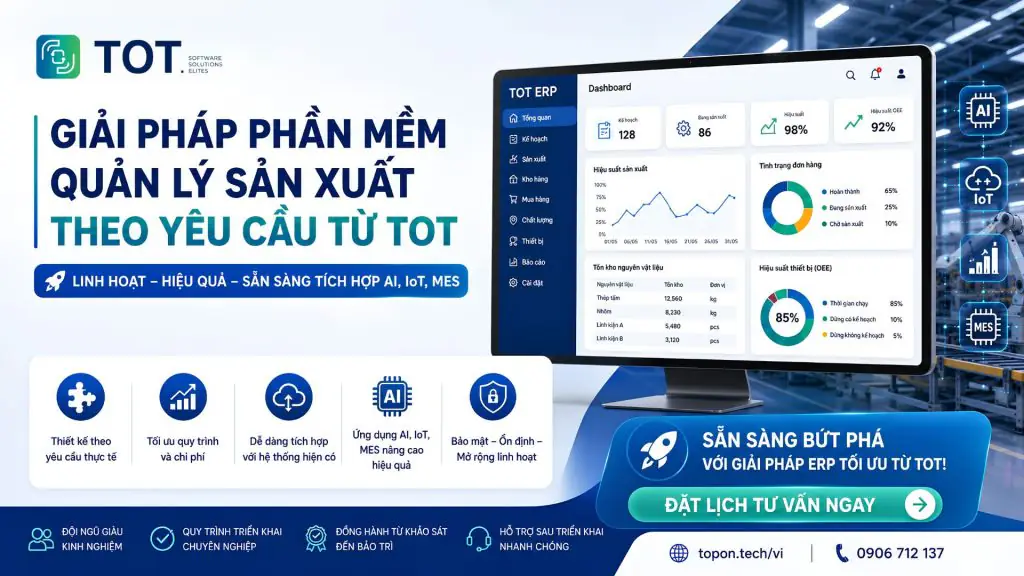
Custom manufacturing management software solutions from TOT
Every manufacturing business has different operating processes, management models, and business goals. That is why an ERP system or manufacturing management software only truly delivers value when it is designed to fit real needs.
With experience in custom software development, TOT works alongside businesses to build manufacturing management solutions that are flexible, easy to scale, and ready to integrate new technologies such as AI, IoT, and MES.
Instead of relying on packaged software padded with unnecessary features, TOT analyzes existing processes to develop a system tailored to each business. The solution can include modules such as production planning, BOM management, materials warehousing, purchasing, QA/QC, equipment maintenance, finance and accounting, and real-time reporting dashboards. The system also integrates easily with ERP, CRM, MES, or the software a business is already using, helping synchronize data and streamline operations.
Beyond traditional management functions, TOT also advises on integrating AI into the production system to improve operational efficiency. Businesses can apply AI to forecast material requirements, optimize production plans, detect product defects with Computer Vision, analyze production data, or perform predictive maintenance on machinery. In this way, businesses gradually build a smart factory model without having to replace their entire existing infrastructure.
With an experienced team and a methodical implementation process, TOT supports businesses every step of the way, from surveying and solution consulting to development, testing, training, and maintenance. Reference pricing for software development packages at TOT is as follows:
| Service package | Best suited for | Reference cost |
|---|---|---|
| Basic package | Businesses that need to quickly digitize core management processes | From VND 60 million |
| Professional package | Businesses that need a customized system with multiple modules and API integration | From VND 100 million |
| Premium package | Corporations and large enterprises integrating multiple systems and applying AI | Depends on the client’s budget |
Note: The actual cost depends on the number of features, the degree of customization, AI integration, and the scale of deployment.
If your business is looking for an ERP or manufacturing management software solution that fits your current processes, TOT is ready to advise on an optimal implementation roadmap. TOT’s experts will assess your existing infrastructure, recommend the modules you need, and build an AI integration plan that fits your budget and long-term growth goals.
Conclusion
A manufacturing ERP system is the foundation that helps businesses operate as one, control costs, and make fast decisions based on real-time data. Understanding the modules, benefits, and selection factors helps businesses invest in the right direction. Combined with AI and implemented by an experienced partner, ERP becomes a sustainable competitive advantage for a factory on its digital transformation journey.
Frequently asked questions about manufacturing ERP systems
What is an ERP system?
ERP (Enterprise Resource Planning) is management software that unifies activities such as finance, warehouse, purchasing, production, and human resources on a shared data platform. As a result, departments work from a single source of information, reducing discrepancies and improving operational efficiency.
How does manufacturing ERP differ from standard ERP?
Manufacturing ERP adds factory-focused modules such as production planning, bill-of-materials (BOM) management, shop-floor control, and per-order costing. A standard ERP focuses on general management without going deep into the operations specific to manufacturing.
Which ERP software is popular on the market today?
The market offers many options by scale and budget. The international tier for large enterprises includes SAP, Oracle, and Microsoft Dynamics 365; the popular domestic and mid-range tier in Vietnam includes MISA AMIS, Bravo, and 3S ERP; the open-source, easily customizable tier includes Odoo and Viindoo. Businesses with specialized processes can also opt for custom ERP development.
How much does a manufacturing ERP system cost?
The cost depends on scale, the number of modules, the degree of customization, and the scope of integration. For a custom-developed solution, the cost typically starts at around VND 60 million for a basic process and rises with complexity. Businesses should speak directly with the implementation provider to get an accurate quote.
How do you build a manufacturing ERP system?
Businesses should start by assessing their current situation and defining objectives, then choose a suitable solution, design the modules and integration flows, and roll out in phases with staff training. Partnering with an experienced provider reduces risk and ensures the system stays aligned with real needs.
TOT is a partner on your digital transformation journey, providing website design, mobile app, custom software, and artificial intelligence software solutions tailored to each business need.
Drawing on hands-on consulting and implementation experience, TOT helps businesses build a digital transformation roadmap, apply AI, and automate processes to optimize operations and create a sustainable competitive advantage.
TOT contact information:
🌐 TOT Website
📞 Hotline/WhatsApp/Zalo: 0906 712 137
✉️ Email: long.bui@toponseek.com
🏢 Address: 31 Hoang Dieu Street, Xom Chieu Ward, Ho Chi Minh City, Vietnam