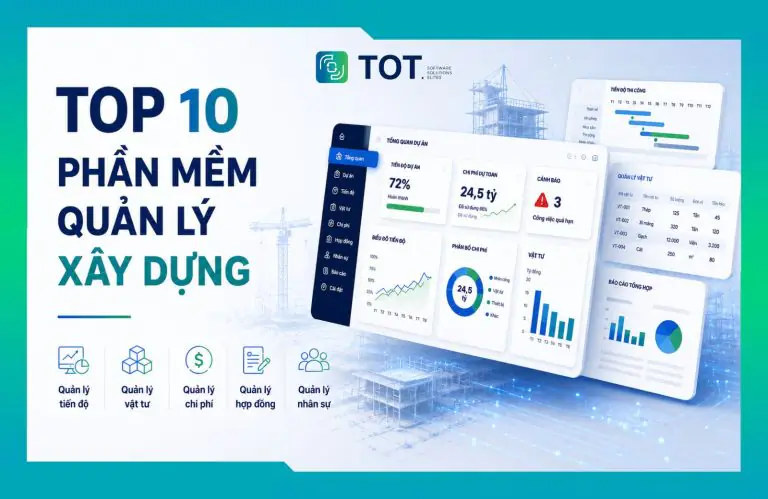
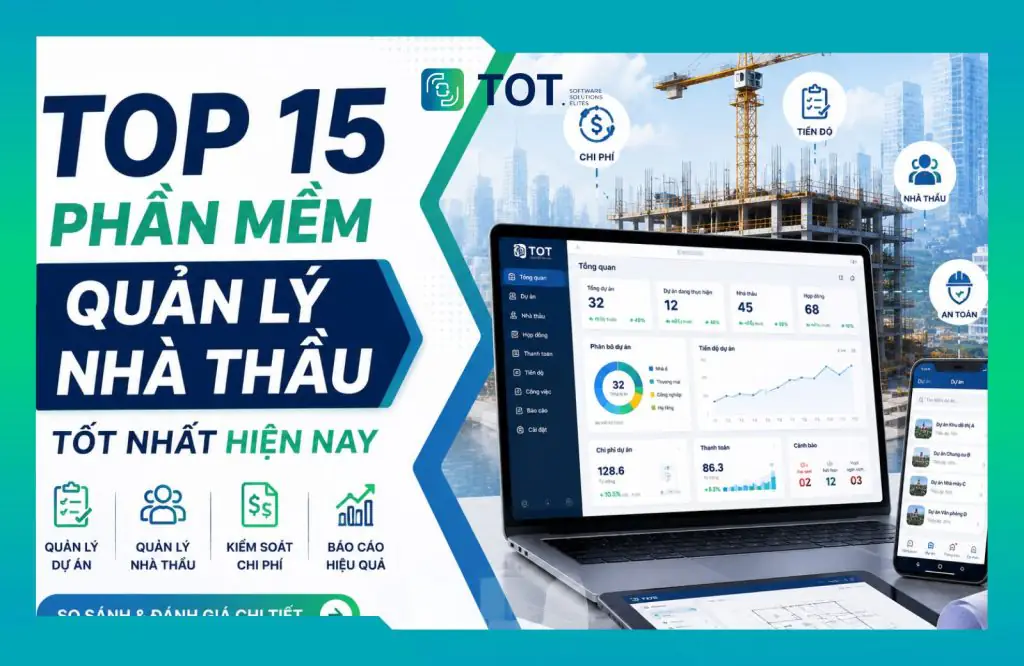
Contractor management software is a tool that helps construction companies digitize and centrally manage all information, contracts, schedules and coordination with contractors and subcontractors on a single platform. As the number of projects and construction partners grows, managing everything in Excel or scattered paperwork easily leads to contract errors, schedule delays and cost leakage. A dedicated platform lets owners and general contractors control data in real time and keep responsibilities transparent among all parties. This article covers the concept, core features, selection criteria and the Top 15 construction contractor management software worth considering in 2026. It closes with guidance on building a tailored solution around your specific processes from TOT.
Quick summary:
- Contractor management software centralizes the records, contracts, schedules and payments of contractors and subcontractors in one system.
- Five core feature groups: partner record management, contracts and payments, construction progress, quality acceptance, and real-time reporting.
- Six criteria for choosing software: process fit, sufficient features, integration capability, an easy-to-use interface, security with role-based permissions, and cost.
- The Top 15 recommendations for 2026 include contractor management tools, construction project management platforms, construction ERP and AI-integrated platforms such as FastCons, Procore, Oracle Primavera Unifier, Autodesk Construction Cloud, CMiC Construction, along with many other solutions suited to each company size.
- AI is being applied to progress tracking, safety alerts and report generation; TOT advises on an integration roadmap that fits your existing infrastructure.
>>> See more articles:
- TOP 15+ large, reputable software companies in Vietnam
- Get custom software development in HCMC at a great, professional rate
- Professional custom software development in Hanoi services
What is contractor management software?
Contractor management software is a digital system that helps construction companies store, track and coordinate every activity involving contractors and subcontractors on a centralized platform. Instead of keeping contracts in a filing cabinet and updating progress in spreadsheets, all data about construction partners is managed online, updated in real time and permissioned by role.
The main users include project owners, project management boards, general contractors and specialized contractors. Each party accesses the same data source, from the contractor list, contract values and completed volumes to acceptance records. This approach reduces discrepancies between the office and the site.
What sets it apart from ordinary project management software is its focus on contractual relationships and responsibility among the parties. The platform ties each work item to its corresponding subcontractor, tracks payment deadlines per contract and records acceptance minutes. As a result, companies can control who is responsible for which item and the corresponding payment progress.
In the course of digital transformation in construction, contractor management software is often a practical and measurable first step. The system connects directly to construction schedule management, helping detect delayed items early and assign clear responsibility to each contractor. This is the foundation for optimizing costs and limiting disputes that arise during construction.
Key features of contractor management software
Contractor management software helps companies digitize and centrally manage all information, contracts, schedules and coordination with contractors on a single platform. The five feature groups below make up the core value of the software, focusing on the management of contractors and construction projects.
1. Contractor and subcontractor record management
This feature digitizes all legal documents and capability records of each contractor and subcontractor. The system stores licenses, construction capabilities, cooperation history and quality ratings for every project they have taken part in.
When a need arises, the management team can quickly look up a list of qualified partners instead of digging through paper files. The value it delivers is shorter contractor selection times, standardized input data, and reduced risk of working with under-qualified partners.
2. Contract and payment management
The software tracks the contract lifecycle from signing to liquidation, tied to the corresponding payment schedule. Each contract records its value, addenda, acceptance milestones and disbursement rounds based on completed volume.
The system automatically flags payment deadlines and reconciles disbursed amounts against actual volume. Companies can therefore control cash flow by contract, avoid overpaying for volume, and reduce debt disputes with subcontractors.
3. Construction progress and work volume tracking
This feature displays the progress of each item using a Gantt chart and a work breakdown structure. Every work item is linked to the subcontractor in charge, the planned volume and the volume already completed.
Site staff update volumes and field photos right on their mobile devices. The management team monitors the gap between plan and actuals in real time, spotting delayed items early to reallocate resources before the whole project is affected.
4. Acceptance and construction quality management
The software digitizes the acceptance and quality control process for each item. Acceptance minutes, field photos and inspection checklists are stored directly in the system and linked to the contractor performing the work.
The parties sign off on acceptance on the platform, creating a transparent trail of when it happened and who was responsible. The value is a complete quality record that supports payment and handover, while also serving as a basis for reassessing contractor capability for future projects.
5. Real-time reporting and monitoring
This feature consolidates data from the field into intuitive reports and dashboards. Key metrics include overall progress, contract value, accepted volume, outstanding debt and alerts for overdue items.
Leaders can see the full picture of many projects on a single screen, anytime and anywhere. With continuously updated data, companies make operational decisions based on real figures rather than manual reports that arrive late.

Criteria for choosing the right contractor management software
Choosing the right contractor management software helps companies improve management efficiency, optimize costs and limit risk during construction. Software with many features is not necessarily a good fit if it exceeds your needs or is hard to deploy. The six criteria below help companies evaluate and choose a solution that matches how they actually operate.
1. Fit with your processes and company size. The software needs to closely match how your company currently manages contractors, from bid selection to acceptance. This criterion matters because a system that is out of step with your process will push staff back to working in Excel. Companies should request a demo that follows their real workflow before deciding.
2. Complete features for managing contractors, contracts and progress. The software must cover subcontractor records, contracts, payments and volume tracking. Missing one link creates data gaps and manual work. Companies should draw up a list of mandatory functions and compare it against the software’s actual features.
3. Ability to integrate with existing systems. The software needs to connect with accounting, a construction ERP system, BIM models or a CRM for construction companies. Good integration lets data flow seamlessly and avoids double entry. Companies should ask clearly about the API and available connectors before signing a contract.
4. A friendly interface that works on mobile. Site staff need to work quickly on their phones, even on a weak connection. A hard-to-use interface lowers the data update rate and makes the system unreliable. Companies should let the construction team test it in real conditions to assess ease of use.
5. Data security and user permissions. Contract data and payment values are sensitive information. Role-based permissions ensure each person sees only the data relevant to them. Companies should review the vendor’s backup, encryption and access-logging policies.
6. Cost, scalability and support services. Cost should be viewed holistically, including licensing, deployment and training. Scalability determines whether the software keeps pace as project scale grows. Companies should prioritize solutions that can be customized to their processes and that come with a responsive support team.
For companies planning to increase their number of projects, a solution that allows scaling and process customization will be more sustainable in the long run. Before investing, companies should carefully assess actual needs, list priority functions and pilot the software on a sample project to measure effectiveness.
>>> See more:
- TOP 15+ effective, super-easy AI app builder tools
- 9+ of the easiest, free mobile app design tools
- 15+ free, easy-to-use Android app design software
Top 15 best contractor management software of 2026
Five software products stand out for contractor management in 2026: FastCons, Procore, Oracle Primavera Unifier, Autodesk Construction Cloud and CMiC Construction. Each solution has its own focus and target audience, from mid-sized Vietnamese contractors to international construction groups. The table below summarizes them so companies can compare quickly before reading the details.
| Software | Developer | Contractor management focus | Best suited for | Reference price |
|---|---|---|---|---|
| 1. FastCons | FastWork (Vietnam) | Construction, subcontractor, schedule and project cost management | Contractors, small and medium construction companies | From 150,000 VND/user/month |
| 2. Faceworks | TIT Technology (Vietnam) | Construction project, materials, HR and debt management | Small and medium construction companies | From 2,000,000 VND/month (30 users), up to 10,000,000 VND/month (300+ users) |
| 3. CoDX Task | CoDX (Vietnam) | Task, progress, checklist and assignment management | Small and medium companies | From 499,000 VND/month |
| 4. IBOM | Intelligent Software Company – ISOFT (Vietnam) | Progress, materials, contract and cost management | Medium and large construction companies | Contact for a quote |
| 5. QLDA GXD | GXD (Vietnam) | Estimating, settlement, progress and quality records | Owners, contractors, supervision consultants | Perpetual license, contact for a quote |
| 6. Procore | Procore Technologies (USA) | Project, subcontractor, records and field collaboration management | General contractors, large-scale owners | Based on Annual Construction Volume (ACV), contact for a quote |
| 7. Oracle Primavera Unifier | Oracle (USA) | Cost, contract and project change control | Corporations, large infrastructure projects | Contact for a quote |
| 8. Autodesk Construction Cloud | Autodesk (USA) | BIM, document management, design and construction collaboration | Companies adopting BIM | From about 1.380 USD/user/year |
| 9. CMiC Construction | CMiC (Canada) | Construction ERP, finance, subcontractor contracts | Large contractors | Contact for a quote |
| 10. Buildertrend | Buildertrend (USA) | Contractor, budget, customer and warranty management | Residential contractors | From about 499 USD/month |
| 11. Fieldwire | Fieldwire (USA) | Field management, checklists, punch list | General contractors, subcontractors | Free or from 39 USD/user/month |
| 12. Viewpoint Vista | Trimble (USA) | Construction ERP, finance, HR, contracts | Medium and large construction companies | Contact for a quote |
| 13. Contractor Foreman | Contractor Foreman (USA) | Project, occupational safety and cost management | Small contractors | From about 49 USD/month |
| 14. RedTeam Flex | RedTeam Software (USA) | Bidding, RFI, change orders, payments | Commercial general contractors | Contact for a quote |
| 15. Smartsheet | Smartsheet Inc. (USA) | Progress, Gantt, dashboard and workflow management | Project teams needing a flexible platform | From 12 USD/user/month (Pro), 24 USD/user/month (Business) |
1. FastCons – Construction contractor management software
FastCons is construction contractor management software developed by FastWork Vietnam, designed specifically for construction firms, general contractors and subcontractors. The solution helps digitize the project management process, from planning, progress tracking and materials and personnel management to cost and cash-flow control. By connecting data between the site and the office in real time, FastCons helps companies reduce leakage, improve operational efficiency and keep projects on schedule.
Key features
- Manage construction progress by item, task and Gantt chart.
- Track materials, equipment, goods receipt/issue slips and on-site inventory.
- Manage subcontractors, site logs, acceptance records and completed volume.
- Track costs, debts, cash flow and the performance of each project on an intuitive dashboard.
- Sync data across web and mobile app to keep information updated in real time.
Strengths
- Built specifically for construction companies in Vietnam.
- Vietnamese interface, easy to deploy and use.
- Supports managing multiple projects at once.
- Can integrate with CRM, HRM and other modules in the FastWork ecosystem.
Limitations
- Better suited to small and medium-sized companies.
- Some advanced features require deploying additional modules.
Reference cost: From 150,000 VND/user/month, depending on the number of users and the modules deployed. Companies can contact FastWork for a detailed quote.

2. Faceworks – Construction management software for small and medium businesses
Faceworks is construction management software developed by TIT Technology and Services Joint Stock Company, helping companies manage everything from construction progress, materials and personnel to project debts and costs on one platform. The solution suits small and medium construction companies that want to digitize their management processes without investing in an overly complex ERP system.
Key features
- Manage construction progress and the status of each project in real time.
- Manage materials, warehouses, suppliers and construction equipment.
- Track contracts, debts, costs and revenue for each project.
- Manage personnel, work assignments and timekeeping.
- Support intuitive reporting and statistics, with data export to Excel.
Strengths
- Intuitive interface, easy to use and deploy.
- Integrates many functions on a single platform.
- Can be customized to the company’s management processes.
- Cost suited to small and medium-sized construction companies.
Limitations
- Does not yet offer deep support for BIM or building modeling.
- Some advanced features need to be customized to the company’s needs.
Reference cost
Faceworks offers several packages by number of users:
- Under 30 users: about 2,000,000 VND/month
- Under 60 users: about 4,000,000 VND/month
- Under 100 users: about 5,000,000 VND/month
- Under 300 users: about 8,000,000 VND/month
- Over 300 users: about 10,000,000 VND/month.

3. CoDX Task – Construction project management software
CoDX Task is construction project management software within the CoDX ecosystem, built to help companies manage task progress, allocate resources and track staff performance. With process automation and online collaboration, CoDX Task suits companies actively driving digital transformation in construction.
Key features
- Manage tasks with Kanban, Timeline and Gantt charts.
- Assign work, track progress and send automatic reminders.
- Build checklists, approval workflows and document management.
- Track staff performance and report progress in real time.
- Integrate with the business management modules in the CoDX ecosystem.
Strengths
- Modern, user-friendly interface.
- Easy to deploy and use on both desktop and mobile devices.
- Supports effective online collaboration across departments.
- Suited to small and medium-sized companies.
Limitations
- Does not focus heavily on construction-specific functions such as estimating or settlement.
- Comprehensive management requires combining it with other modules.
Reference cost: From about 499,000 VND/month, depending on the number of users and the features the company subscribes to.

4. IBOM – Construction project management software
IBOM is construction project management software developed by Intelligent Software Company (ISOFT), helping companies manage the entire project lifecycle, from planning, progress tracking and materials control to contract and cost management. The software suits construction companies that need to manage multiple projects at once on a single unified system.
Key features
- Plan and track construction progress for each project.
- Manage materials, equipment, labor and project resources.
- Manage bid-award contracts, subcontracting and payments.
- Track actual costs against budget.
- Progress reports, site logs and an intuitive dashboard.
Strengths
- Covers many construction management functions on one platform.
- Supports managing multiple projects at the same time.
- Intuitive reports help managers make quick decisions.
- Suited to both medium and large companies.
Limitations
- New users need time to get familiar with the system.
- Pricing is not published on the website.
Reference cost: IBOM currently does not publish its pricing. Companies need to contact the vendor directly for a quote based on deployment scale and number of users.

5. QLDA GXD – In-depth construction project management software
QLDA GXD is construction project management software developed by Gia Xay Dung (GXD) Joint Stock Company, notable for managing cost estimates, quality records, construction progress and settlement in line with Vietnam’s construction regulations. It is a good fit for owners, project management boards and construction units that need in-depth functional management.
Key features
- Manage cost estimates, bill of quantities (BOQ) takeoff and construction norms.
- Create and track construction progress with Gantt charts.
- Manage acceptance records, quality records and legal documents.
- Track contracts, payments and project settlement.
- Link data across the estimating, progress and settlement modules.
Strengths
- Meets Vietnam’s construction regulations and standards well.
- Specialized in estimating and settlement management.
- Widely used by QS engineers, QA/QC teams and project management boards.
- Data is synced across functions, reducing manual entry.
Limitations
- Mainly serves the Vietnamese market.
- The interface leans toward technical functions, so it takes time to get used to.
Reference cost: QLDA GXD does not publish pricing on its website. The software is usually provided under a license model, with the price depending on the modules and the number of licenses used.

6. Procore – International contractor management software
Procore is contractor management software developed by Procore Technologies (USA), renowned for managing the entire construction project lifecycle on a cloud platform. The solution is chosen by many general contractors, owners and consultants worldwide for its ability to connect data between the office and the site, improving collaboration and reducing errors during construction.
Key features
- Manage project progress, construction records and documents centrally.
- Track subcontractors, contracts, RFIs (Request for Information) and Submittals.
- Manage site logs, punch lists and emerging issues.
- Track budget, costs and payment progress in real time.
- Integrate with many ERP, BIM and accounting tools such as Oracle, Autodesk and Sage.
Strengths
- Comprehensive management from planning to project handover.
- Powerful collaboration among owners, general contractors and subcontractors.
- A rich integration ecosystem with many other construction tools.
- Suited to large-scale, multi-site projects.
Limitations
- Deployment cost is relatively high for small and medium-sized companies.
- Training takes time before teams can make full use of its features.
Reference cost: Procore does not publish pricing. Cost is usually based on Annual Construction Volume (ACV), or annual project scale, rather than the number of users. Companies need to get in touch directly for a quote.

7. Oracle Primavera Unifier – Construction project portfolio management software
Oracle Primavera Unifier is construction project management software within the Oracle Primavera ecosystem, designed for corporations and enterprises managing many projects at once. The software focuses on cost, contract and project change control as well as investment portfolio governance, helping companies reduce financial risk and improve management efficiency.
Key features
- Manage budgets, cash flow and project costs.
- Track contracts, payment records and emerging changes.
- Project Portfolio Management.
- Automate approval workflows and document management.
- Integrate with Oracle Primavera P6, Oracle ERP and other enterprise systems.
Strengths
- Effective cost and contract control.
- Strong scalability for large enterprises.
- High security, suited to large-scale infrastructure projects.
- Supports managing many projects on one platform.
Limitations
- High investment and deployment cost.
- Requires a skilled deployment and administration team.
Reference cost: Oracle Primavera Unifier does not publish pricing. Cost is built around company size, number of users and the modules deployed.

8. Autodesk Construction Cloud – BIM construction management software
Autodesk Construction Cloud (ACC) is construction management software that integrates BIM technology, connecting data across design teams, construction teams and owners on a single platform. It is a good fit for construction companies adopting BIM that want to strengthen collaboration throughout the project lifecycle.
Key features
- Manage design documents, drawings and BIM models on the cloud.
- Track construction progress and issues arising on site.
- Manage RFIs, Submittals, Punch Lists and site logs.
- Collaborate online among stakeholders in real time.
- Integrate with AutoCAD, Revit, Civil 3D and many other Autodesk solutions.
Strengths
- Supports the BIM workflow end to end, from design to construction.
- Reduces errors by syncing data across departments.
- Modern interface and easy information sharing.
- A large Autodesk ecosystem, suited to companies undergoing digital transformation.
Limitations
- Subscription cost is relatively high.
- Companies need a BIM workflow in place to get the most out of it.
Reference cost: Autodesk Construction Cloud charges by module and number of users. Reference price from about 1.380 USD/user/year, depending on the service package and deployment region.

9. CMiC Construction – Construction ERP software
CMiC Construction is construction ERP software developed specifically for the construction industry, helping companies manage finance, contracts, personnel, equipment and project progress in sync on a single system. The software suits general contractors and large construction companies that need comprehensive control of operations.
Key features
- Manage finance, accounting and project cash flow.
- Track contracts, subcontractors and payments.
- Manage personnel, equipment and construction materials.
- A consolidated dashboard to track operational performance in real time.
- Integrate with many other BIM and ERP platforms.
Strengths
- An ERP built specifically for the construction industry.
- Syncs data across departments.
- Supports managing many projects and member companies.
- Strong scalability as the company grows.
Limitations
- The deployment process can be lengthy.
- The investment cost is better suited to large companies.
Reference cost: CMiC Construction does not publish pricing. Companies need to contact the vendor for a quote based on deployment scale and number of users.

10. Buildertrend – Residential contractor management software
Buildertrend is contractor management software developed for home building and residential construction companies. The software supports managing schedules, budgets, customers and post-handover warranties, helping contractors optimize their workflow from the quoting stage through project completion.
Key features
- Manage construction progress and work schedules.
- Track estimates, budgets and project costs.
- Manage customers, contracts and quotes.
- Support warranty management after project handover.
- A mobile app to update work right on site.
Strengths
- Designed specifically for home building contractors.
- Intuitive, easy-to-use interface.
- Supports customer management and the sales process on one platform.
- Has a fully featured mobile app.
Limitations
- Primarily aimed at the North American market.
- Some features need to be integrated with accounting software for in-depth financial management.
Reference cost: Buildertrend offers several service packages, with prices from about 499 USD/month for the basic package. Higher-tier packages cost more and add financial management, CRM and advanced reporting features.

11. Fieldwire – Field construction management software
Fieldwire is field construction management software built to help contractors, engineers and supervision teams coordinate work effectively right on the site. The software focuses on task management, technical drawings and communication among parties, helping reduce errors and improve construction productivity.
Key features
- Manage tasks, assign work and track progress in real time.
- Access, mark up and share technical drawings directly on mobile devices.
- Manage the Punch List, site logs and emerging issues.
- Support creating acceptance checklists and quality inspections.
- Sync data between the site and the office on the cloud.
Strengths
- Intuitive interface, easy to use even for construction crews.
- Works well on phones and tablets.
- Helps cut the time spent exchanging information between the site and the office.
- Can integrate with many other construction management platforms.
Limitations
- Mainly focused on field management, not in-depth on finance or ERP.
- Some advanced features are only available on paid plans.
Reference cost: Fieldwire offers a free plan with basic features. Paid plans start from about 39 USD/user/month, depending on the features and deployment scale.

12. Viewpoint Vista – ERP software for construction companies
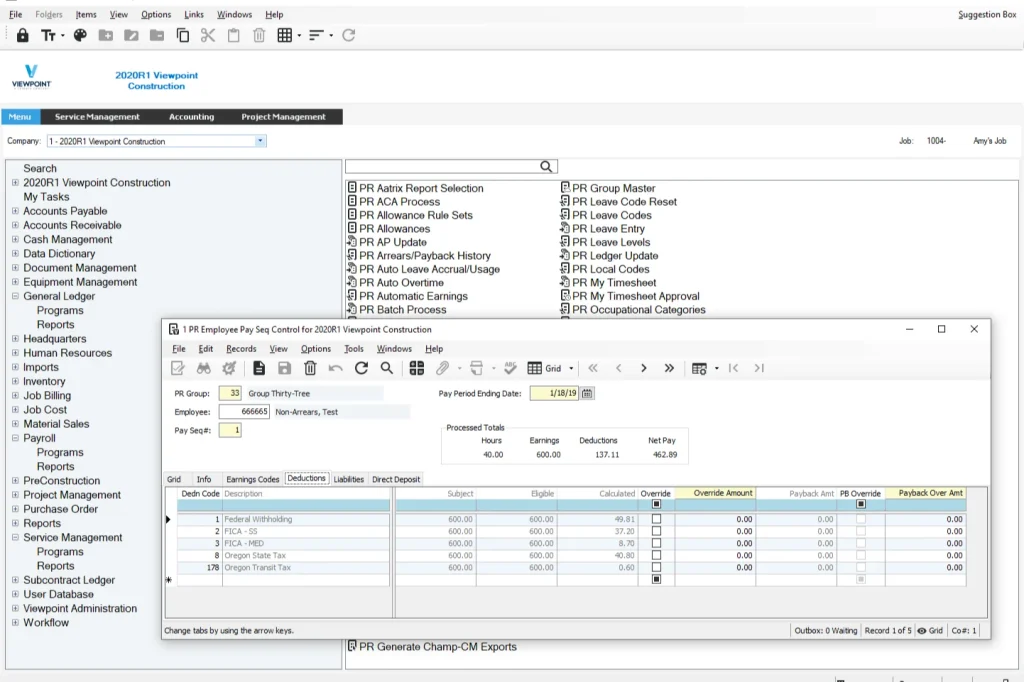
Viewpoint Vista is construction ERP software within the Trimble ecosystem, designed to help companies manage finance, contracts, personnel and project operations on a unified platform. It is a good fit for medium and large construction companies that want to standardize their management processes.
Key features
- Manage finance, accounting and project budgets.
- Track contracts, subcontractors and payment progress.
- Manage personnel, payroll and construction equipment.
- A consolidated dashboard to track operational performance in real time.
- Integrate with Trimble solutions and many BIM tools.
Strengths
- An in-depth ERP built specifically for the construction industry.
- Syncs data across departments and projects.
- Strong scalability as the company grows.
- Supports detailed financial and management reporting.
Limitations
- Investment and deployment cost is relatively high.
- Needs a deployment and training team to run effectively.
Reference cost: Viewpoint Vista does not publish pricing. Cost is built around company size, number of users and the modules deployed.
13. Contractor Foreman – Contractor management software for small businesses
Contractor Foreman is contractor management software developed for small and medium-sized construction companies. The solution supports managing projects, costs, contracts, occupational safety and day-to-day work on one platform, helping companies optimize operations at a reasonable cost.
Key features
- Manage project progress and work schedules.
- Track estimates, costs and project budgets.
- Manage contracts, change orders and project records.
- Support occupational safety inspections and checklist management.
- Track the working hours of employees and subcontractors.
Strengths
- Affordable compared with many other construction management tools.
- Offers many features in a single platform.
- Friendly interface and easy to deploy.
- Suited to small construction companies.
Limitations
- Not yet optimized for very large-scale projects.
- The interface and documentation are mainly in English.
Reference cost: Contractor Foreman is priced from about 49 USD/month, depending on the service package and number of users.

14. RedTeam Flex – General contractor management software
RedTeam Flex is general contractor management software developed for commercial construction companies, supporting the entire process from bidding and contract signing to project delivery and payment. The software helps general contractors control subcontractors effectively and reduce risk while executing a project.
Key features
- Manage bidding, quotes and construction contracts.
- Track RFIs, Submittals and Change Orders.
- Manage project progress, budget and payments.
- Track subcontractor records and related documents.
- An intuitive dashboard to track project performance.
Strengths
- Built specifically for general contractors and commercial construction companies.
- Strong control of the bidding and contracting process.
- Supports effective collaboration among project participants.
- Scales with company size.
Limitations
- Not yet common in the Vietnamese market.
- The deployment cost is better suited to medium and large companies.
Reference cost: RedTeam Flex does not publish pricing. Companies need to contact the vendor directly for a quote based on deployment needs.

15. Smartsheet – Flexible construction project management software
Smartsheet is construction project management software running on the cloud, notable for its familiar spreadsheet-style interface combined with process automation and online collaboration. Thanks to its high flexibility, Smartsheet is used by many construction companies to track progress, manage documents, assign work and build intuitive dashboards without investing in an overly complex system.
Key features
- A spreadsheet-style (Grid) interface that is easy to use and customize to your needs.
- Supports multiple views such as Gantt Chart, Kanban, Calendar and Card View.
- Build intuitive Dashboards to track progress and KPIs in real time.
- Automate workflows such as sending notifications, approvals and reminders.
- Integrate with Microsoft 365, Google Workspace, Jira, Salesforce and many other apps.
Strengths
- Flexible, suited to many different project management processes.
- Easy to pick up for users already familiar with Excel.
- Automation helps reduce manual work.
- A rich integration ecosystem, easy to connect with other software.
Limitations
- Not built specifically for the construction industry.
- Getting the most out of it takes time to set up the right processes and templates.
Reference cost: Smartsheet offers several service packages, including Pro from about 12 USD/user/month, Business from about 24 USD/user/month, and Enterprise with pricing customized to the company’s needs. The software also has a free trial before you subscribe.

Limitations of using off-the-shelf contractor management software
Although the contractor management tools on the market offer many useful features, not every solution suits every company. Each contractor has different operating processes, organizational models and project management styles. Using off-the-shelf software sometimes forces companies to change their processes to fit the software, rather than having the software serve their actual needs.
Some common limitations include:
- Hard to customize to internal processes. Many tools support only standard processes, while each company has its own way of managing records, acceptance, payments or subcontractor control.
- Lack of integration with the systems in use. Companies often run multiple tools such as ERP, accounting, CRM, HRM or BIM. If these systems are not in sync, data has to be entered multiple times, which easily causes errors and wastes time.
- Costs rise as you scale. Most SaaS tools charge by number of users or modules. As a company expands its team or runs many projects at once, costs can increase significantly.
- Hard to meet industry-specific requirements. Some companies need to manage multiple contractor tiers, control legal documents, run phased acceptance or follow their own internal processes. Generic software often does not fully meet these requirements.
- Dependence on the vendor’s development roadmap. If you need new features or process changes, you have to wait for the vendor to update rather than adjusting proactively to your needs.
For this reason, many construction companies, general contractors and owners are beginning to consider developing custom contractor management software that fits their real operating processes more closely.
When should you build custom contractor management software?
Not every company has the same needs when deploying contractor management software. Some companies can operate effectively with off-the-shelf software, while many others need a system designed specifically to fit their workflow, management model and long-term development direction.
In practice, the choice to build custom contractor management software does not depend entirely on company size. A small company with specialized processes, a need to integrate many systems, or a desire to build a platform for long-term growth can still benefit from this approach. Conversely, a large company with simple processes can sometimes still operate well on commercial software.
Companies should consider building custom software when they face one or more of the following situations:
- The management process has many specialized functions, such as managing multiple contractor tiers, a distinct acceptance process, or an internal approval workflow that off-the-shelf software struggles to handle.
- You need to manage many projects, construction crews or subcontractors at once, while tracking progress, costs and resources on the same system.
- You are using many different tools such as ERP, CRM, HRM, accounting or BIM, but the data is not synced, causing time lost to data entry and reconciliation.
- You want to build a centralized management platform that lets leadership track project status in real time and make data-driven decisions.
- You have plans to expand operations or add features in the future, but your current software cannot meet them or the upgrade cost is too high.
- You want to apply AI and automation, such as progress analysis, site monitoring, safety alerts or intelligent report generation.
One advantage of custom contractor management software is that companies do not need to deploy the entire system from the start. The solution can be built in phases, starting with the most important functions, such as progress, contract or subcontractor management, then expanding with modules for materials, finance, reporting or AI as needs grow. This approach helps optimize the investment budget while ensuring the software stays aligned with each stage of the company’s development.
Custom contractor management software design at TOT
TOT provides custom contractor management software design services, helping companies build a system that fits their real operating processes instead of having to change their processes to adapt to off-the-shelf software. The solution can be developed in phases, from progress, contract and subcontractor management to materials, equipment, costs, acceptance records and management reporting.
Beyond developing new software, TOT also supports integration with the ERP, CRM, HRM, accounting software or BIM platforms you already use, helping sync data on a single platform and significantly reducing manual data entry.
Experience delivering solutions in the construction sector
With many years of experience in custom software development, TOT has partnered with companies in the construction and real estate sectors to deploy digital management and operations systems. These projects have helped companies optimize their workflows, improve collaboration across departments and build a technology foundation that scales with their development needs.
- Coteccons and Unicons
TOT has taken part in delivering software solutions for Coteccons and Unicons – two leading companies in Vietnam’s construction industry. These projects focused on developing custom systems to support internal operational management, standardize processes and improve operational efficiency in a large-enterprise environment.
- Sinh Nam Group
For Sinh Nam Group, TOT developed a corporate website platform with flexible content management, optimized performance, security and scalability. The project helped the company build a digital foundation for its business operations and brand communications.
- Custom software development experience
Alongside these notable construction projects, TOT has also deployed many web systems, enterprise applications and custom management platforms across a range of sectors. This experience equips the team to quickly analyze business processes, design system architecture and build scalable solutions that fit each business model.
Integrating AI into contractor management software
Beyond developing custom software, TOT can also integrate AI (Artificial Intelligence) technologies to help companies automate management processes, analyze data and improve decision-making.
Depending on each company’s needs, contractor management software can integrate a range of AI applications such as:
- AI Computer Vision: Analyze camera images to track construction progress, take stock of materials or recognize the current state of the site.
- AI PPE detection: Detect workers not wearing full protective equipment and send real-time alerts.
- AI progress tracking: Compare actual images with the plan or BIM model to estimate completion rates and detect the risk of schedule delays.
- AI safety alerts: Recognize behaviors or areas with safety risks to warn the supervision team early.
- AI report generation: Automatically consolidate site logs, construction progress and operational metrics into intuitive reports in just a few minutes.
By combining custom software development and AI applications, TOT can partner with companies to build a management platform that fits their unique processes, while remaining ready to expand with more features as project scale or management needs change.

TOT’s contractor management software solution packages
| Solution package | Best suited for | Deployment scope | Cost |
|---|---|---|---|
| Basic Contractor Management Software | Small contractors, companies new to digital transformation | Project management, construction progress, tasks, subcontractors, project records and basic reporting | Contact for a quote |
| Professional Contractor Management Software | General contractors, medium and large construction companies | Includes the Basic package + contract, materials, cost, acceptance and payment management, ERP, CRM, HRM and BIM integration, and a management dashboard | Contact for a quote |
| AI-Integrated Contractor Management Software | Construction companies undergoing digital transformation, owners, corporations | Includes all features of the Professional package + AI Computer Vision, AI safety monitoring (PPE), AI progress tracking, AI report generation, AI data analysis and risk alerts | Contact for a quote |
Note: The deployment cost depends on company size, number of users, feature scope and the degree of integration with existing systems. The TOT team will survey your operating processes before proposing a solution and a detailed quote.
If your company needs contractor management software designed around your real operating processes rather than off-the-shelf solutions, TOT is ready to accompany you from the consulting and business analysis stage through system design, development and deployment.
With experience delivering projects in the construction sector such as Coteccons and Unicons, along with its AI Computer Vision capabilities, TOT can build a management platform that integrates systems such as ERP, CRM, HRM, BIM and modern AI technologies. The solution helps companies centrally manage progress, subcontractors, materials, contracts and project data on a unified platform, while staying ready to expand as project scale and management needs grow.
>>> See more of TOT’s standout services:
- Professional, GEO-compliant, AI-powered website design
- Professional, reputable custom mobile app design
- Artificial Intelligence (AI) software development
- AI-powered custom software development services
Conclusion
Contractor management software helps construction companies centralize records, contracts, schedules and payments on one platform, thereby controlling costs and reducing construction risk. Among the Top 15 recommendations for 2026, each solution serves a different segment and set of needs. Companies should start from their actual needs, compare against the six selection criteria and pilot on a sample project before investing. When processes are highly specialized or require deep integration and AI, building custom contractor management software is a direction worth considering. TOT is ready to accompany companies in choosing and deploying the right solution.
Frequently asked questions about contractor management software
What is contractor management software?
Contractor management software is a digital system that helps construction companies centrally manage the records, contracts, schedules and payments related to contractors and subcontractors. Instead of using many scattered files, all data is stored online, updated in real time and permissioned by role. The system ties each work item to the unit performing it, tracks payment deadlines and stores acceptance records. As a result, owners and general contractors know exactly who is responsible for which item and its corresponding progress, reducing errors and disputes during construction.
Which companies should use contractor management software?
Companies that regularly work with many subcontractors and run multiple projects in parallel should use contractor management software. The right fit includes general contractors, owners, project management boards and specialized contractors. As the number of contracts, volumes and payment rounds grows, managing in Excel easily leads to discrepancies and delays. Companies that need transparent responsibility among parties, control of cash flow by contract and real-time progress tracking will gain the clearest value from a dedicated platform.
Can contractor management software replace Excel?
Contractor management software can replace most of the work currently done in Excel and overcome its inherent limitations. Excel is hard to permission, does not update in real time and is error-prone when many people edit at once. Dedicated software ties contract data to progress and payments, logs changes and issues automatic alerts. Some companies start with a simple tool or free contractor management software to get familiar, then move to a full solution as they scale. Excel is still useful for quick calculations, but it is hard to use as the main management system when projects grow complex.
What factors affect the cost of deploying contractor management software?
The cost of deploying contractor management software depends on company size, number of users and feature scope. The main factors include the licensing model, the number of modules used, the degree of process customization and the need to integrate with existing systems. Initial deployment and training costs should also be counted in the total investment, alongside the annual license fee. International platforms usually cost more than domestic solutions, while custom software is priced by project scope. Companies should request a detailed quote for their exact needs before deciding.
How is AI applied in contractor management software?
AI is applied in contractor management software mainly in site monitoring, progress forecasting and report automation. Computer vision analyzes camera images to monitor occupational safety, track materials and estimate completed volume. AI also gives early warning of risky situations and consolidates site logs into easy-to-read reports. Its effectiveness depends on data quality and the degree of integration with existing systems. Companies should start from a problem with clear value, pilot on a small scope and then expand gradually based on real results.
Should a company choose custom contractor management software or an off-the-shelf product?
The choice between custom software and an off-the-shelf product depends on a company’s specific processes and budget. Off-the-shelf software deploys quickly, has predictable upfront costs and suits companies whose processes are close to the common standard. Custom software follows your unique processes closely, integrates deeply with existing systems and scales easily, but requires more development time and a larger investment. Companies with specialized processes, a need for AI integration or a desire to own a long-term platform should consider the custom route. TOT can advise on the right option after surveying your actual needs.
TOT is a partner on your digital transformation journey, providing website design, mobile app, custom software and artificial intelligence software solutions tailored to each business need. Through hands-on consulting and delivery experience, TOT helps companies build a digital transformation roadmap, apply AI and automate processes to optimize operations and create a sustainable competitive advantage.
TOT is a partner on your digital transformation journey, providing website design, mobile app, custom software and artificial intelligence software solutions tailored to each business need.
Through hands-on consulting and delivery experience, TOT helps companies build a digital transformation roadmap, apply AI and automate processes to optimize operations and create a sustainable competitive advantage.
TOT contact information:
🌐 Website: topon.tech
📞 Hotline/WhatsApp/Zalo: 0906 712 137
✉️ Email: long.bui@toponseek.com
🏢 Address: 31 Hoang Dieu Street, Xom Chieu Ward, Ho Chi Minh City, Vietnam
References
- Project Management Institute (PMI) – Construction Project Management
https://www.pmi.org/ - Autodesk Construction Cloud – Construction Management Resources
https://construction.autodesk.com/ - Procore – Construction Management Software & Industry Resources
https://www.procore.com/ - Oracle Primavera – Primavera Unifier Documentation
https://www.oracle.com/construction-engineering/ - McKinsey & Company – Construction & Capital Projects Insights
https://www.mckinsey.com/capabilities/operations/our-insights/construction - Dodge Construction Network – Construction Industry Reports & Trends
https://www.construction.com/