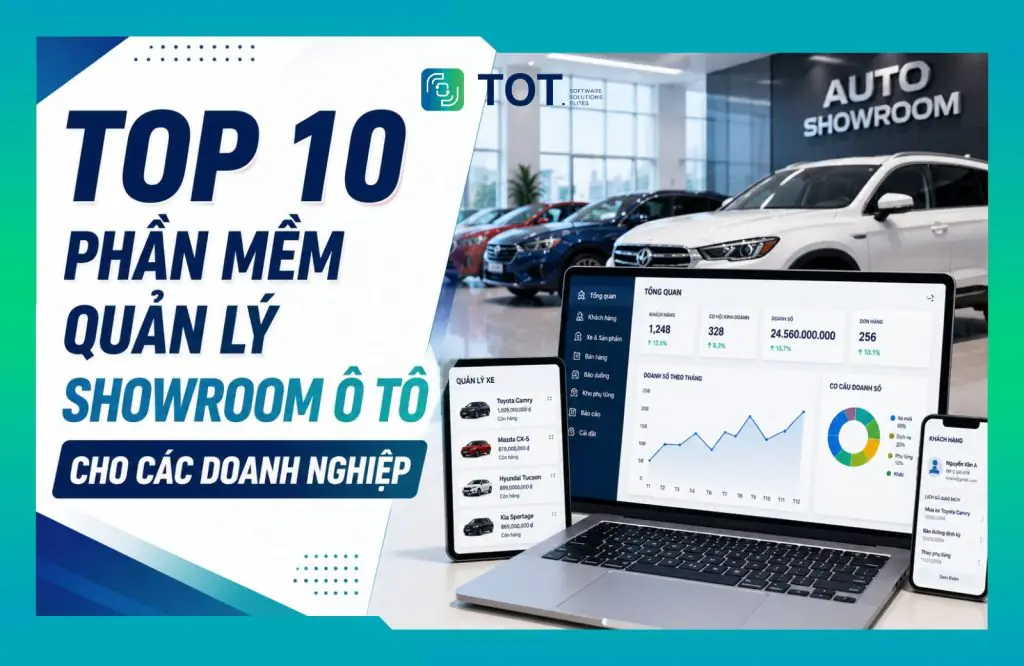
Car dealership management software is a solution that helps businesses digitize their entire operating workflow, from managing customers, vehicle inventory, quotes and contracts to sales and after-sales care. As automotive retail grows increasingly complex, deploying a Dealer Management System (DMS) helps showrooms streamline operations, boost productivity and improve the customer experience. In this article, TOT rounds up the Top 10 car dealership management software platforms most widely used today, along with selection criteria, features, AI applications and implementation costs to help your business find the right solution.
>>> Read more:
- Professional custom software development in Hanoi
- Professional, competitively priced custom software development in HCMC
Quick summary of the 10 car dealership management software platforms
Before diving into the detailed reviews, the table below summarizes the 10 car dealership management software platforms based on key criteria such as standout features and the type of business each suits, giving you an overview to choose the solution that fits your operations.
| Software name | Standout features | Best suited for |
|---|---|---|
| AutoDealer Plus | Comprehensive DMS, CRM, vehicle inventory management, finance, after-sales service, accounting | Mid-size and large car dealerships, multi-branch businesses |
| DealerSocket | CRM, DMS, Digital Retail, Marketing Automation, inventory management | Authorized dealers, showroom chains and large enterprises |
| CDK Global | DMS, CRM, sales management, finance, service, Digital Retail | Automotive distribution groups, authorized dealers, showroom chains |
| CRMOnline (CarSoft) | Customer management, quotations, repairs, parts inventory, receivables | Garages, showrooms and car dealerships in Vietnam |
| Frazer Auto Dealer Software | DMS, vehicle inventory management, sales, accounting, BHPH, 200+ integrations | Used-car dealers, small and mid-size showrooms |
| Faceworks | Vehicle procurement, sales, inventory, cash flow, contracts, reporting | Showrooms and dealers needing customizable operating workflows |
| carCRM (GEN Software) | Automotive-specific CRM, showroom and garage management, parts inventory, customer care | Authorized dealers, used-car showrooms, repair and car-care garages |
| MISA AMIS | CRM, AI Agent, sales management, accounting, KPIs, Mobile App | Small and mid-size showrooms wanting to sync CRM with their business management system |
| ProMax | CRM, DMS, Desking, Credit & Compliance, Data Mining, inventory management | Authorized car dealers and showroom chains needing to fully digitize the sales process |
| CloudAUTO (CloudGO) | 360° CRM, test-drive management, contracts, customer care, dashboards, omnichannel integration | Showrooms, garages and dealer chains in Vietnam undergoing digital transformation |
What is car dealership management software?
Car dealership management software is a system that helps businesses digitize all the operations of a showroom or car dealership on a single unified platform. It supports managing customers, vehicle inventory, sales, quotations, contracts, finance and after-sales service. Internationally, this software is usually called a Dealer Management System (DMS) and can also integrate CRM to manage the entire customer journey.
According to reports from Grand View Research and McKinsey, digital transformation is becoming an inevitable trend in automotive distribution. The reason is that car-buying behavior is increasingly shifting toward digital channels and omnichannel experiences. Instead of managing data across many separate systems, a DMS connects sales, inventory, finance and after-sales service on a single platform. This helps businesses keep tight control of vehicle inventory, streamline operations and improve the customer experience.
>>> Read more: Top 15 most popular car garage management software platforms
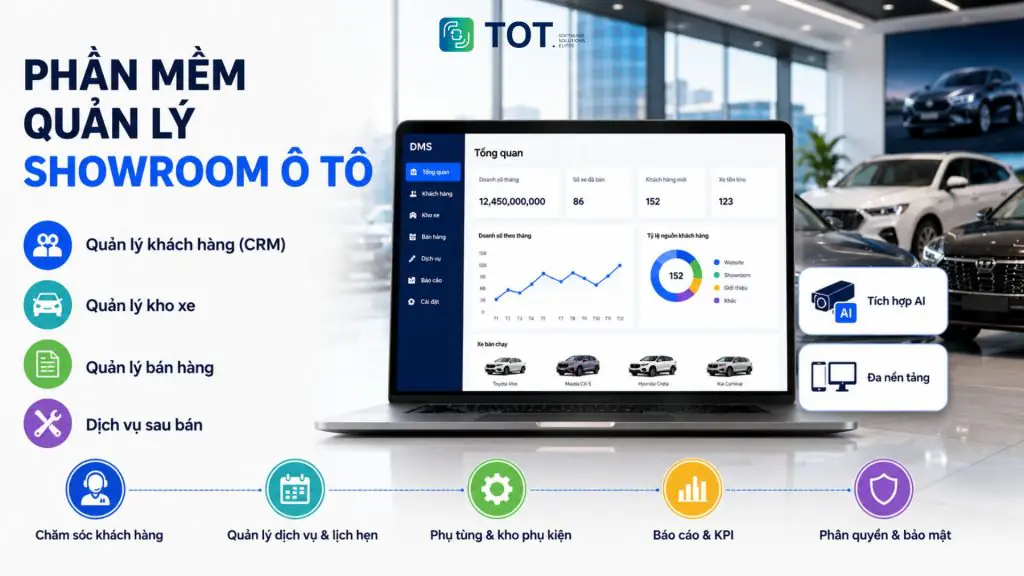
Top 10 most widely used car dealership management software platforms
Showrooms and car dealers increasingly prioritize car dealership management software to digitize their operations and improve business performance. Each solution has its own strengths in managing customers, inventory, sales and after-sales service. Below are the 10 car dealership management software platforms many businesses choose today.
1. AutoDealer Plus
AutoDealer Plus is a car dealership management software (Dealer Management System – DMS) developed by ASN Software that lets businesses centrally manage activities such as sales, vehicle inventory, customers, finance and after-sales service on a single platform. It suits mid-size and large car dealerships or multi-branch businesses that need to synchronize data and streamline their operating workflows.
Key features
- Customer relationship management (CRM) and the full sales process.
- Vehicle inventory management, vehicle appraisal and VIN decoding.
- Electronic contracting (E-Contracting) and digital document storage.
- Real-time finance, accounting and receivables management.
- Service workshop, maintenance and parts management.
- Integration with credit services, vehicle registration and many third-party platforms.
Strengths
- A comprehensive DMS that covers most dealership operations.
- CRM, accounting and service management integrated on one platform.
- Supports multi-branch management and real-time data synchronization.
- Scalable through a wide range of features and industry-specific integrations.
Limitations
- With so many integrated modules, teams need time and training to make the most of every feature.
- The interface and workflows are designed primarily for the North American market.
>>> Read more: Top 10 best car maintenance booking systems
2. DealerSocket
DealerSocket is a car dealership management platform combining DMS, CRM and Digital Retail, developed by Solera. It helps businesses manage the entire customer journey, from lead intake, vehicle sales and marketing to after-sales service, on a unified platform. DealerSocket suits authorized dealers, showroom chains and businesses that want to fully digitize their automotive sales operations.
Key features
- Customer management (CRM) and sales pipeline.
- Inventory management and vehicle pricing.
- Digital Retail for selling vehicles online.
- Marketing Automation and omnichannel customer care.
- Dashboards, reporting and real-time data analytics.
- Integration with many OEMs and automotive-industry systems.
Strengths
- A comprehensive management ecosystem for the automotive industry.
- Automates many sales and marketing processes.
- Strong integration capabilities with third-party platforms.
- Supports managing multiple showrooms and departments on one system.
Limitations
- Implementation and operating costs are relatively high.
- Better suited to the North American market; some workflows need customization when deployed in Vietnam.
3. CDK Global
CDK Global is one of the world’s leading Dealer Management System (DMS) providers, with more than 50 years of experience in automotive technology. The platform delivers end-to-end management of dealership operations, from sales, CRM, vehicle inventory and finance to after-sales service and data analytics. CDK Global suits automotive distribution groups, authorized dealers and large or multi-branch businesses.
Key features
- Dealer Management System (DMS).
- Customer management (CRM).
- Vehicle inventory management and inventory valuation.
- Digital Retail for an omnichannel car-buying experience.
- Finance, insurance and payment management.
- Dashboards, AI and business data analytics.
Strengths
- A comprehensive DMS with a rich ecosystem.
- Scalable, with integrations to more than 1,000 partners.
- Uses AI and data analytics to support decision-making.
- Meets the management needs of large enterprises well.
Limitations
- High investment and implementation costs.
- Its many advanced features require time to train and roll out before they can be used effectively.
4. CRMOnline (CarSoft)
CRMOnline (CarSoft) is garage and car dealership management software developed by CRMOnline, helping businesses digitize the process from customer intake, quotations, repairs, inventory management and receivables to after-sales customer care. It suits garages, showrooms and car dealerships in Vietnam that want to standardize their operations with a reasonable investment.
Key features
- Customer and vehicle-history management.
- Management of quotations, repair orders and settlements.
- Management of supplies, parts and inventory.
- Management of cash flow, receivables and profit.
- Real-time revenue reporting dashboards.
- Supports Cloud deployment or installation on the company’s own servers.
Strengths
- Workflows built around the operations of Vietnamese garages and car showrooms.
- Intuitive, easy-to-use interface.
- Customizable to each business’s needs.
- Offers multiple deployment options and pricing suited to small and mid-size businesses.
Limitations
- Focuses mainly on garage and after-sales management rather than being a comprehensive DMS like international platforms.
- Some advanced features such as AI or deep integrations are delivered on request.
5. Frazer Auto Dealer Software
Frazer Auto Dealer Software is a Dealer Management System (DMS) built for independent car dealers and used-vehicle businesses. It centralizes inventory, sales, finance, contracts and the Buy Here Pay Here (BHPH) process on a single platform. Frazer suits small and mid-size showrooms that need a full DMS that is easy to deploy and reasonably priced.
Key features
- Vehicle inventory management and VIN decoding.
- Management of sales, quotations and contracts.
- Finance and accounting management.
- Support for Buy Here Pay Here (BHPH).
- Electronic payment management with FrazerPay.
- More than 200 integrations with automotive-industry partners.
Strengths
- A DMS purpose-built for automotive businesses.
- Simple, easy-to-use interface.
- Fully integrates vehicle sales, finance and accounting operations.
- Offers a Cloud version for remote management and easy scaling.
Limitations
- Focused mainly on the US market and used-car dealers.
- The interface and workflows are not optimized for the operating needs of businesses in Vietnam.
6. Faceworks
Faceworks is car dealership management software developed for vehicle businesses and car dealers in Vietnam. It manages the entire flow, from vehicle procurement planning, sales, inventory and cash flow to after-sales customer care, on one system. Faceworks suits showrooms and dealers that need to tailor workflows to their real-world operating model.
Key features
- Management of vehicle procurement plans and purchase orders.
- Management of customers, quotations and sales contracts.
- Management of vehicle inventory, accessories and stock movements.
- Management of payments, receivables and cash flow.
- Tracking of pre-sales and after-sales customer care.
- Dashboards and reports on sales, commissions and inventory.
Strengths
- Built around the operations of car showrooms in Vietnam.
- Supports customizing workflows to each business’s needs.
- End-to-end management from sales to accounting.
- Granular access control and data security.
Limitations
- The interface is less modern than some international SaaS platforms.
- Advanced features depend on the customization required at deployment.
7. carCRM (GEN Software)
carCRM is management software built specifically for automotive businesses and part of the Hapycar ecosystem. It standardizes processes from marketing, sales, workshop management and customer care to inventory and finance on a unified platform. carCRM suits authorized dealers, used-car showrooms, repair garages and any business that needs to fully digitize its automotive operations.
Key features
- Customer and vehicle-history management.
- Management of vehicle intake, repair and maintenance.
- Management of parts and supplies inventory.
- Automated maintenance reminders and customer care.
- Omnichannel integration with website, Facebook, Zalo and email.
- Reports on revenue, KPIs and business performance.
Strengths
- Designed specifically for the automotive industry in Vietnam.
- Standardizes processes across showrooms and garages.
- Supports customer-care automation.
- Customizable to each business’s specifics.
Limitations
- Better suited to domestic businesses.
- Some advanced features are delivered on request.
8. MISA AMIS
MISA AMIS is a business management platform that integrates CRM, accounting, sales and many management applications within a single ecosystem. Although not built specifically for the automotive industry, MISA AMIS still meets customer, sales and operations management needs well. It suits small and mid-size car showrooms or businesses that want to sync CRM with accounting and other management systems.
Key features
- 360-degree customer management.
- AI Agent for customer analysis and business forecasting.
- Management of the sales pipeline, KPIs and sales performance.
- Data integration with MISA AMIS Accounting.
- Dashboards and more than 90 analytical reports.
- A mobile app for managing anytime, anywhere.
Strengths
- A comprehensive business management ecosystem.
- Integrated AI for sales support and data analysis.
- Syncs CRM with accounting and other modules.
- Easy to scale as the business grows.
Limitations
- Not a dedicated DMS for car showrooms.
- Some automotive-specific processes require customization or additional integration.
9. ProMax
ProMax is a car dealership management platform that integrates CRM, DMS, credit management and Digital Retail in one unified system. It is designed for car dealers that want to manage the entire process, from customer intake, quotations and vehicle inventory to closing the deal and after-sales care. ProMax suits authorized dealers, showroom chains or businesses that need to automate their vehicle sales and finance workflows.
Key features
- CRM for customer management and the sales pipeline.
- Vehicle and inventory management.
- Desking for quotations and structuring financing options.
- Credit and compliance management (Credit & Compliance).
- Data mining to uncover sales opportunities.
- Customizable real-time dashboards and reports.
Strengths
- Integrates CRM, DMS and finance management on one platform.
- Automated sales processes that shorten deal-processing time.
- Supports integration with many DMS platforms and automotive-industry systems.
- Flexible customization to each dealer’s workflow.
Limitations
- Suited mainly to the North American market.
- Implementation and training costs are relatively high for small businesses.
10. CloudAUTO (CloudGO)
CloudAUTO is a CRM solution built specifically for car showrooms and garages, developed by CloudGO. It lets businesses centrally manage customer data, the vehicle sales process, test-drive schedules, contracts and after-sales care on one platform. CloudAUTO suits showrooms, garages and dealer chains in Vietnam that want to digitalize, boost sales performance and improve the customer experience.
Key features
- 360-degree customer data management.
- Management of vehicles, services and test-drive scheduling.
- Management of quotations, orders and contracts.
- Automated maintenance reminders and customer care.
- Dashboards to track revenue, KPIs and business performance.
- Integration with website, Zalo OA, Facebook, SMS and email.
Strengths
- Designed around the operating workflows of car showrooms and garages in Vietnam.
- Supports multi-branch management and granular access control.
- Automates many customer-care and marketing processes.
- Integrates easily with CloudGO’s CRM ecosystem.
Limitations
- Focused on CRM and operations management rather than being a deep DMS like some international solutions.
- Certain specialized integration or customization needs are delivered on request.
How to choose car dealership management software
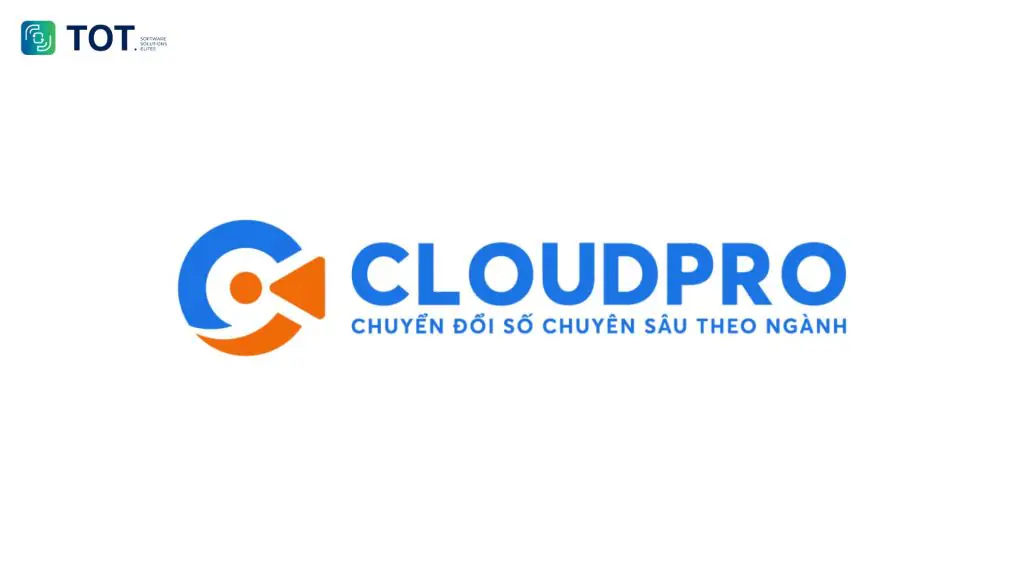
To choose the right car dealership management software, businesses should not rely only on the number of features or the implementation cost. Instead, they should evaluate the whole picture, considering company size, customizability, system integration, scalability and the quality of vendor support. The criteria below will help you choose a solution that fits your current needs and long-term growth plans.
Fit with your company size
Every showroom or car dealership has different management needs. Small showrooms usually only need basic features such as customer, inventory and sales management. Multi-branch businesses, on the other hand, should prioritize a DMS with centralized management, user access control and data synchronization across sales locations.
Customizability
Every business has different sales and customer-care processes. The software should therefore allow you to customize workflows, forms, reports and access rights to match your real-world operating model. This lets a business get the most out of the system without having to change its existing processes.
CRM, ERP and DMS integration
The ability to connect with CRM, ERP and DMS keeps data in sync across departments, from sales and accounting to after-sales service. This reduces manual data entry, limits errors and gives businesses a complete view of operations so they can make faster, more accurate decisions.
Scalability
When a business opens new branches, adds users or rolls out new services, the software must support this growth without disrupting operations. A flexible platform helps a business save costs and maintain operating efficiency over the long term.
Implementation cost
When a business opens new branches, adds users or rolls out new services, the software must support this growth without disrupting operations. A flexible platform helps a business save costs and maintain operating efficiency over the long term.
Post-implementation support
During day-to-day operations, a business will need technical support, feature updates or help resolving issues. It is therefore best to prioritize a vendor with a knowledgeable support team, a clear response process and experience implementing for the automotive industry, so the system always runs reliably.
How does car dealership management software work?
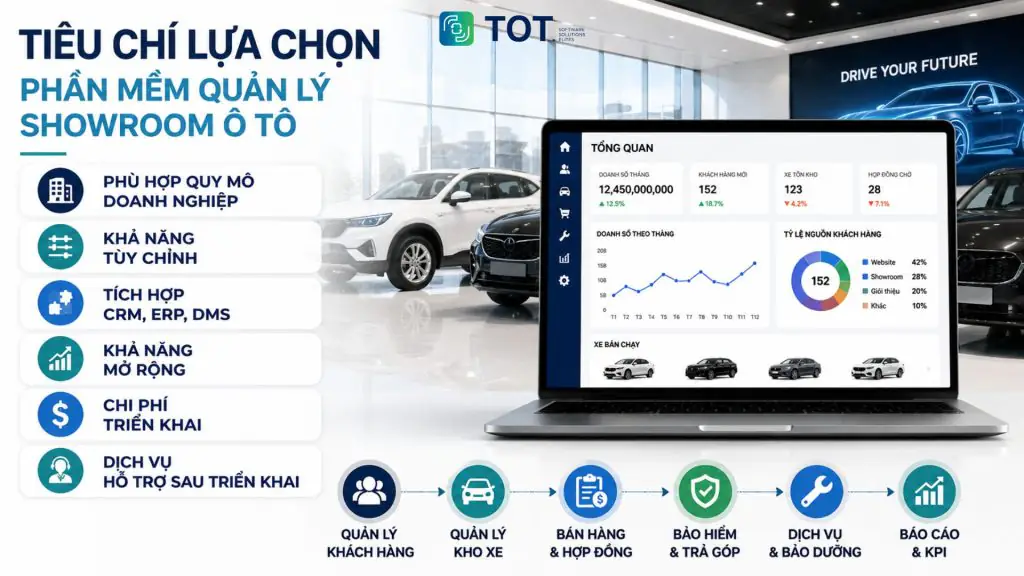
Car dealership management software works by connecting all data and operating processes on a single unified platform. Instead of managing things separately in Excel or across several different tools, a business can follow the entire customer journey, from the moment a buying need arises to after-sales care. Below is the typical operating flow of a modern car dealership management system.
Customer intake
When a customer leaves their details through the website, social media, the hotline or by visiting the showroom in person, the system automatically creates a customer profile and stores the full interaction history. Sales staff can track each customer’s status, schedule consultations or test drives and log every exchange in one system.
Example: A customer signs up for a test drive on the website. The software automatically creates a lead, assigns it to the responsible salesperson and sends appointment reminders, reducing the risk of losing the lead.
Vehicle and inventory management
The software lets you manage every vehicle in detail by VIN, trim, color, condition and storage location. Whenever a vehicle is received or released, the data updates in real time, helping businesses control inventory accurately and limit errors.
Example: When a white SUV is sold, the system automatically updates its status to “Sold,” adjusts the inventory count and displays it accurately on the management dashboard.
Quotation and contract management
Once a customer has chosen a vehicle, staff can create quotations, contracts and related documents directly in the software. The system stores the entire transaction record while tracking payment progress, loan disbursement and any vehicle registration procedures.
Example: For customers buying on installments, the software stores the bank details, payment schedule and related documents, making it easy for staff to track the paperwork’s progress.
Vehicle delivery management
Once the contract is complete, the system manages the entire delivery process, from vehicle inspection and paperwork preparation to handover confirmation. At the same time, the software updates the transaction status and records the transaction history for later management.
Example: Before the delivery date, the system automatically notifies the sales and technical teams to prepare the vehicle, check accessories and finalize the paperwork before handing it over to the customer.
After-sales customer care
After delivery, the software continues to support customer care through features such as maintenance reminders, warranty management, sending promotions and running satisfaction surveys. This helps maintain the customer relationship and increase the rate of repeat service visits.
Example: After 5,000 km or six months of use, the system automatically sends a message reminding the customer to book maintenance at the showroom, helping improve the experience and boost service revenue.
Reporting and data analytics
All data generated during operations is compiled into clear, visual reports. Managers can track sales, conversion rates, inventory status and the performance of each employee or branch to make timely decisions.
Example: If the dashboard shows that the conversion rate from test drives to signed contracts is lower than in previous months, managers can quickly analyze the cause, adjust the sales consultation process or launch a promotion to improve sales performance.
Key features of car dealership management software
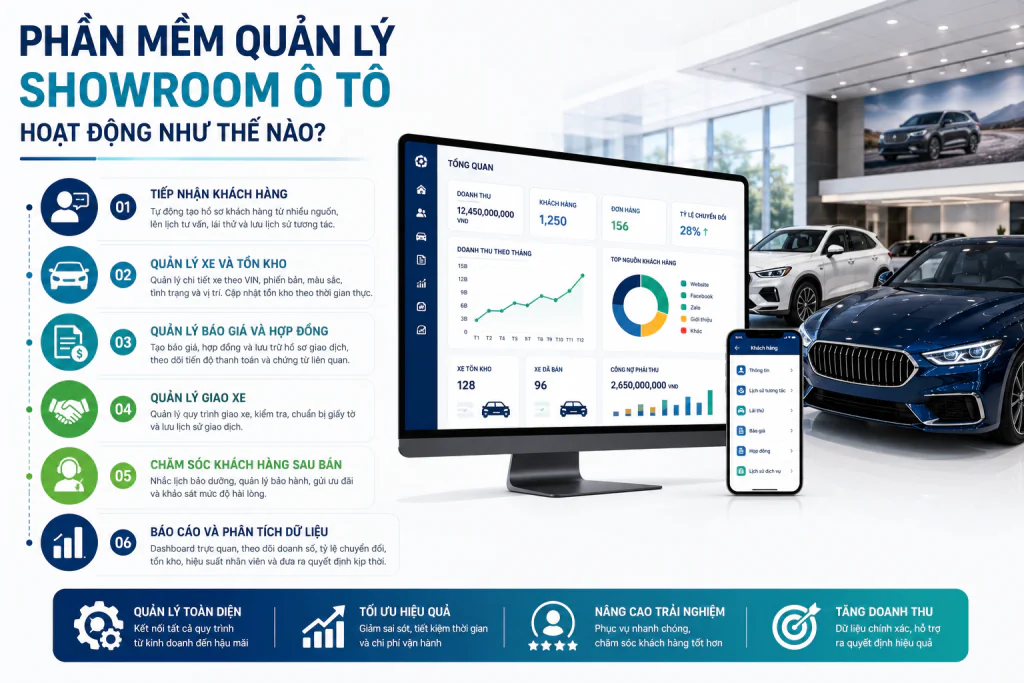
An effective car dealership management software needs to cover every operation, from sales and inventory management to after-sales customer care. Integrating these features on one platform helps a business reduce manual work, keep data in sync across departments and improve operating efficiency.
- Customer management (CRM)
CRM centrally stores all customer information, consultation history, buying needs and interactions. Sales staff can track each customer through every stage of the sales process, allowing them to be proactive and increase conversion rates.
- Vehicle inventory management
The software lets you manage each vehicle in detail by VIN, trim, color, condition and storage location. Data updates in real time as vehicles are received or released, helping businesses control inventory accurately and limit errors.
- Quotation and contract management
Staff can create quotations, contracts and related forms directly in the system. All documents are stored centrally, making it easy to track deal progress, prevent lost paperwork and shorten processing time.
- Sales management
The software tracks the entire vehicle sales process, from customer intake, consultation and test drives to signing contracts and delivery. It also helps manage sales opportunities, conversion rates and each employee’s sales figures.
- Insurance, banking and installment management
For installment purchases, the software tracks loan applications, disbursement progress and information from banks or insurance companies. This helps staff process deals faster and reduce errors when working with partners.
- Warranty and after-sales service management
After delivery, the system keeps managing warranty information, repair history and the services a customer has used. Complete data storage helps showrooms improve customer care and increase opportunities to upsell services.
- Maintenance scheduling
The software can automatically send maintenance reminders based on time or mileage. Notifications sent via email, SMS or Zalo help customers avoid missing important service milestones while increasing repeat service visits.
- Parts and accessory inventory management
Beyond vehicles, the system also tracks the inventory of parts, accessories and supplies. Businesses can monitor incoming, outgoing and on-hand quantities in real time, allowing them to plan purchasing proactively and limit losses.
- Sales and employee KPI management
The software tracks sales, number of contracts, conversion rates and the performance of each salesperson. Managers can assess performance based on real data to build appropriate bonus policies and training plans.
- Real-time dashboards and reporting
Dashboards bring together clear, visual data on sales, inventory, sales performance and overall business status in real time. This lets leadership quickly get a clear picture of operations, spot emerging issues and make decisions based on data rather than intuition.
AI applications in car dealership management software
AI is becoming a major trend in the automotive industry’s digital transformation. Whereas car dealership management software once mainly stored data and automated processes, AI can now analyze data, recognize customers and support decision-making in real time. This helps businesses improve the customer experience, optimize sales performance and increase conversion rates.
AI customer recognition at the showroom
AI Computer Vision can recognize customers the moment they walk into the showroom through the camera system. If a customer has visited before, the system automatically displays information such as their purchase history, needs, assigned salesperson and previous interactions.
Example: A customer who test-drove an SUV two weeks ago returns to the showroom. As soon as they walk in, AI recognizes their face and alerts the salesperson that this customer is interested in that model. The salesperson can then continue the consultation based on the earlier history instead of starting over.
AI license plate recognition
AI can automatically recognize license plates as customers enter or leave a showroom, garage or service center. The data is linked to the customer profile to help track entries and exits, maintenance history and vehicle status.
Example: When a customer brings a vehicle in for maintenance, the system recognizes the license plate at the gate and automatically displays the repair history, scheduled maintenance items and warranty information. The service advisor can check the vehicle in faster without manual data entry.
AI customer behavior analysis
Using data from AI cameras and the CRM system, AI can analyze customer behavior in the showroom, such as how long they linger in each area, which models they are interested in and how often they interact with staff. This data helps businesses optimize the showroom layout and improve the quality of consultations.
Example: The system notes that many customers spend a lot of time in the electric-vehicle area, yet the rate of staff engagement there is low. Based on this data, the showroom can assign more sales staff or adjust the display to increase sales opportunities.
AI automatically assigns customers to sales staff
Instead of assigning customers manually, AI can automatically distribute leads based on criteria such as location, the model the customer is interested in, staff experience and current workload. This distributes sales opportunities more effectively and reduces the chance of leads slipping through the cracks.
Example: A customer signs up for an SUV test drive on the website. AI automatically routes the lead to the salesperson handling the SUV line at the nearest branch with a high conversion rate, and creates a follow-up reminder in the CRM system.
AI predicts purchase likelihood
AI can analyze interaction history, lead source, contact frequency and website behavior to predict how likely each customer is to buy. This lets sales staff prioritize the customers most likely to convert.
Example: The system notices a customer who has downloaded the price list, signed up for a test drive and returned to the website several times in one week. AI rates this as a customer with a high purchase likelihood and suggests that staff reach out immediately to present a suitable promotion.
AI chatbot for 24/7 customer care
An AI chatbot can answer common customer questions at any time, from product information, pricing and promotions to booking test drives or maintenance. For complex requests, the chatbot hands the conversation over to the responsible staff member while preserving the full chat history.
Example: A customer messages on the website in the evening to ask about installment plans and to book a test drive. The AI chatbot provides the necessary information, logs the request and automatically creates an appointment for staff to confirm on the next business day.
Thanks to AI, car dealership management software not only automates processes but also helps businesses make effective use of customer data to raise service quality and grow sales. This is a trend many showrooms and dealers are adopting to build a competitive edge amid rapid digital transformation.
>>> Read more:
- 7 ways to apply AI to optimize the customer experience
- What is Predictive AI? Benefits and how predictive AI works
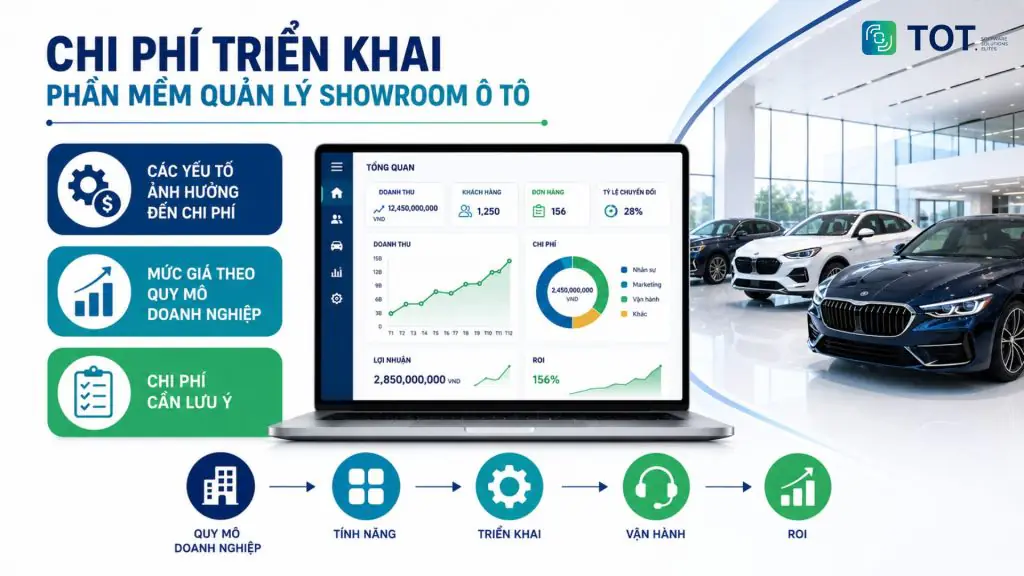
The cost of implementing car dealership management software
The cost of implementing car dealership management software depends on many factors, such as company size, number of users, level of customization and scope of deployment. Small showrooms can opt for subscription-based SaaS software to keep costs down.
Dealer chains or businesses with specialized workflows, meanwhile, tend to prefer custom software development to meet their long-term management needs. Before investing, therefore, a business should assess the total cost of implementation rather than just comparing software prices.
Factors that affect cost
Implementation costs vary with each business’s scope and requirements. The biggest factors include the number of branches, the number of users, the modules to be deployed (CRM, DMS, ERP, accounting, etc.), the level of customization and the ability to integrate with existing systems.
Example: A showroom with a single branch and about 10 staff usually only needs customer, sales and inventory management features. A dealer chain with many branches, by contrast, will also need modules for finance, warranty, access control and centralized reporting, plus integration with a website, mobile app or AI. As the number of features and the scope of deployment grow, so does the investment.
Reference pricing by company size
Today, businesses can choose between two common deployment options: using packaged software (SaaS) or custom software development.
| Company size | Reference cost |
|---|---|
| Small showroom (1 branch) | From a few million to a few tens of millions of VND per year with SaaS software |
| Mid-size showroom (2–5 branches) | From tens to hundreds of millions of VND depending on the number of users and features |
| Dealer chains or large enterprises | Typically from several hundred million VND and up for custom-built solutions |
Note: The costs above are for reference only and may vary depending on the vendor, the scope of deployment and each business’s requirements.
Example: A newly opened showroom might choose SaaS software for fast deployment and lower upfront investment. A business that owns many dealerships, meanwhile, usually prefers to build its own system to integrate CRM, ERP, AI and specialized management processes on one platform.
Implementation costs to keep in mind
Beyond the cost of buying or renting the software, businesses also need to account for costs that arise during deployment and operation. These can include requirements analysis, feature customization, data migration, user training, maintenance, system upgrades and post-implementation technical support.
Example: A business might choose software with a low upfront cost but then pay extra for each add-on feature, for integration with an accounting system or for additional users. A custom-built solution requires a larger upfront investment, but it fits operating workflows closely and reduces future upgrade costs.
Businesses should therefore assess the Total Cost of Ownership (TCO) rather than focusing on the software price alone. It also pays to prioritize vendors with automotive-industry experience, a clear implementation process and long-term support, so the system runs reliably and delivers a sustainable return on investment.
How TOT helps businesses build AI-integrated car dealership management software
Every automotive business has different operating processes, business models and digital transformation goals. So instead of using packaged software with limited customization, many businesses choose custom car dealership management software development to meet their exact real-world needs.
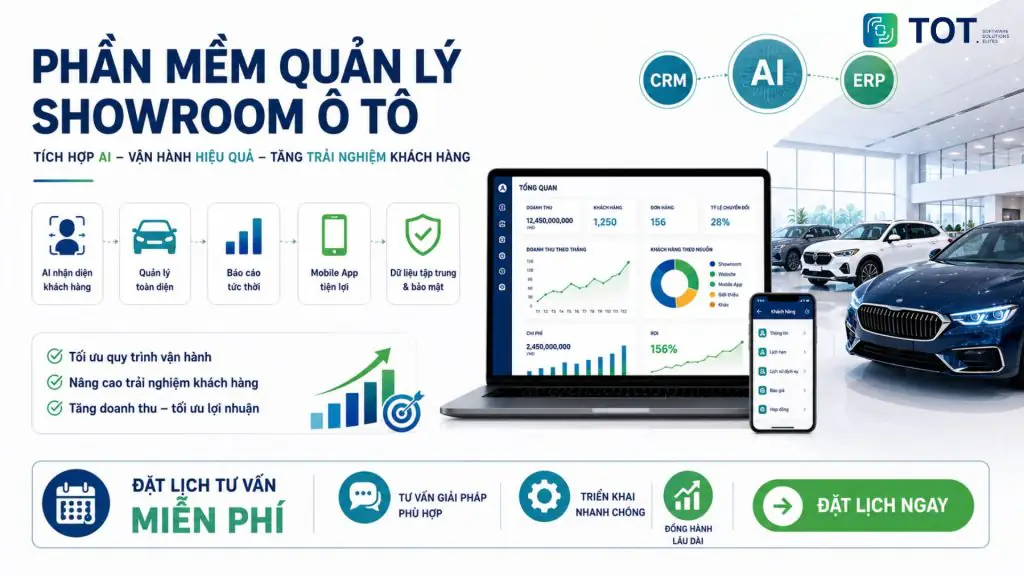
With experience delivering many automotive projects, TOT advises on, designs and builds management systems that integrate AI, CRM, ERP and a mobile app, helping businesses digitize their entire operating workflow and improve the customer experience.
Building software around real operating workflows
TOT does not build one-size-fits-all software. Before deployment, the team studies your real operating processes to build a system tailored to each showroom or car dealership.
The solution can include modules for customer management (CRM), vehicle inventory, quotations, contracts, warranty, maintenance, parts management and real-time reporting dashboards. It also integrates easily with your website, mobile app and the software you already use to create a single unified management platform.
Integrating AI Computer Vision to recognize customers and license plates
TOT develops an AI Computer Vision solution that lets showrooms automatically recognize customers and license plates the moment a vehicle enters the service area. The system uses AI to check appointments, classify vehicles, display welcome messages on LED screens and sync data with the management system. Staff can proactively greet customers, shorten check-in time and personalize the experience from the moment a customer arrives at the showroom.
Syncing CRM, ERP and the mobile app
TOT builds systems that connect CRM, ERP, website, mobile app and AI platforms on a single database. Departments such as sales, accounting, service and customer care always work from one unified source of data, avoiding duplicate data entry and reducing errors in operations.
Customers can also use a mobile app to book maintenance, track service history, look up warranty information, receive offers or sign up for test drives. All data stays continuously updated between the app and the company’s management system.
Real-world case studies for automotive businesses
One of TOT’s flagship projects is the AI Camera E-Service solution for THACO AUTO. The system uses AI Computer Vision to recognize license plates, verify appointments, classify customers and help staff greet visitors as soon as they arrive at the showroom. Data updates in real time, helping the business track visitor traffic and return frequency and optimize its operating workflow.
TOT also developed the THACO AUTO Services app, built on a microservices architecture with iOS and Android versions. The app lets customers book maintenance, manage multiple vehicles, track service history, receive offers and find showrooms nationwide. All data is synced with the management system, helping build a unified digital ecosystem for THACO AUTO.
Partnering with businesses on the digital transformation journey
If your business is looking for car dealership management software designed around your own operating processes and capable of integrating AI, TOT is ready to partner with you from consulting and design to implementation and system maintenance. TOT’s experience delivering real-world automotive projects means it can build solutions that fit each business model, helping businesses optimize operations and lay the foundation for long-term digital transformation.
Conclusion
Car dealership management software helps businesses centrally manage every activity, from sales, inventory and finance to after-sales customer care. Choosing the right software depends on each business’s size, operating processes and growth direction. If you need a custom-built system that integrates AI, CRM, ERP and a mobile app, TOT is ready to partner with you to build the right solution, optimize operations and lay the foundation for sustainable digital transformation.
Frequently asked questions about car dealership management software
How is car dealership management software different from ordinary sales/CRM software?
Car dealership management software (DMS) is designed specifically for the automotive industry and manages the entire process, from vehicle inventory, quotations, contracts and delivery to warranty and after-sales service. Ordinary CRM or sales software, by contrast, mainly focuses on managing customers, sales opportunities and customer care. A DMS is therefore better suited to businesses that need to manage the full operations of a showroom or car dealership.
Can car dealership management software manage multiple branches on one system?
Yes. Most car dealership management software today supports managing multiple branches on one system. Businesses can set access rights per showroom, sync customer, inventory and sales data, and track consolidated or per-branch reports in real time.
Can car dealership management software integrate AI to recognize customers and license plates?
Yes. AI Computer Vision technology can recognize returning customers and read license plates automatically, enabling personalized greetings and quick vehicle-record lookups at service check-in. This is an advanced feature usually delivered through custom-built solutions. TOT has experience integrating AI Computer Vision for the automotive industry and can build this feature to fit your existing infrastructure.
How much does it cost a business to implement car dealership management software?
Yes. Many solutions today can integrate AI Computer Vision to recognize customers, read license plates and sync data with a CRM or DMS system. This technology lets showrooms automatically greet visitors, look up transaction history, check appointments and enhance the customer experience from the moment they arrive at the showroom.
TOT is a partner on your digital transformation journey, providing website design, mobile apps, custom software and artificial intelligence software tailored to every business need.
With hands-on consulting and delivery experience, we help businesses build a digital transformation roadmap, apply AI and automate processes to optimize operations and create a sustainable competitive advantage.
TOT contact information:
🌐 Website: topon.tech
📞 Hotline/WhatsApp/Zalo: 0906 712 137
✉️ Email: long.bui@toponseek.com
🏢 Address: 31 Hoang Dieu Street, Xom Chieu Ward, Ho Chi Minh City, Vietnam