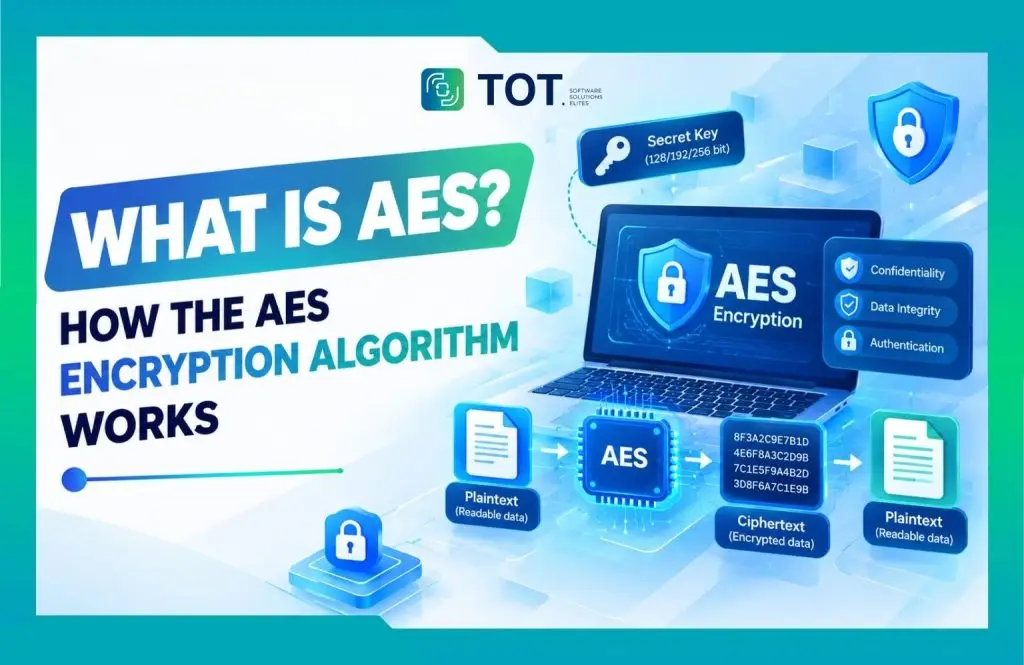
In today’s digital age, data security is a critical priority for every organization. As cyber threats continue to rise, AES (Advanced Encryption Standard) has emerged as one of the leading symmetric encryption algorithms trusted worldwide. So, what is AES, how does it work, and why does it play such a vital role in protecting sensitive information? Let’s explore the answers in this article from TOT.
>>> See more related articles:
- Nearshore Software Outsourcing: Your Ultimate Guide
- Top 20 Software Outsourcing Company in Vietnam: 2026 Update
What Is AES?
AES (Advanced Encryption Standard) is a symmetric block cipher algorithm officially published by the National Institute of Standards and Technology (NIST) in 2001.
Developed to replace the outdated Data Encryption Standard (DES), AES has become the most widely used encryption standard in the world today. It is based on a substitution-permutation network design, enabling the encryption of 128-bit data blocks using keys of 128, 192, or 256 bits in length.

Basic Terms to Know in AES Encryption
To understand the AES algorithm, readers need to grasp about 12 foundational terms, from plaintext, ciphertext and keys to the state matrix and the S-box. The table below explains each concept with an illustrative example.
| Term | Explanation | Example |
| Plaintext | Original, unencrypted data that can be read normally. | 16-byte block 00112233445566778899aabbccddeeff |
| Ciphertext | Data after encryption, unreadable without the key. | 69c4e0d86a7b0430d8cdb78070b4c55a |
| Key | A secret bit string used for encryption and decryption. | An AES-128 key is 16 bytes long; an AES-256 key is 32 bytes long |
| Block | The unit of data AES processes at a time, fixed at 128 bits. | A 1 KB file is split into 64 blocks |
| Word | A group of 4 bytes (32 bits), the unit used in key expansion. | A 128-bit key consists of 4 words |
| State | A 4-row × 4-column matrix in which each cell holds 1 byte. All transformations are performed on this matrix. | The 16 plaintext bytes are filled in column by column |
| Round | A sequence of transformations repeated multiple times. | AES-128 runs 10 rounds |
| Round Key | A 128-bit subkey derived from the original key; each round uses its own round key. | AES-128 needs 11 round keys |
| Key Schedule | The algorithm that generates all round keys from the original key, also called key expansion. | 4 original words are expanded into 44 words |
| S-box | A fixed lookup table of 256 values used to substitute each byte according to a non-linear rule. | Byte 53 is replaced with ED |
| XOR (⊕) | A bit-by-bit comparison: two identical bits give 0, two different bits give 1. XORing twice with the same value returns the original data. | 1010 ⊕ 0110 = 1100 |
| Finite field GF(28) | The set of 256 byte values with its own addition and multiplication, ensuring results always stay within 1 byte. | Used in SubBytes and MixColumns |
| IV / Nonce | A random or unique initial value that makes the same plaintext produce different ciphertexts. | A 16-byte IV in CBC mode |
AES Types by Key Length: AES-128, AES-192 and AES-256
AES comes in 3 versions by key length: AES-128, AES-192 and AES-256. All three process 128-bit blocks and share the same round structure; the differences lie in key length, number of rounds and number of round keys.
- AES-128 is the lightest version yet still extremely secure. A system testing 1018 keys per second would need about 1013 years to exhaust all 2128 keys, roughly 780 times the age of the universe.
- AES-192 runs 12 rounds but is rarely chosen in practice. AES-128 is sufficient for general needs, while systems requiring a higher level usually jump straight to AES-256. A common point of confusion: the 192-bit security mode of WPA3-Enterprise uses AES-256 in the form of GCMP-256, not AES-192. “192-bit” here refers to the overall cryptographic strength of the whole protocol suite.
- AES-256 runs 4 more rounds than AES-128, increasing the computational workload by about 40%. The U.S. National Security Agency’s (NSA) CNSA suite requires AES-256 for national security systems.
| Criteria | AES-128 | AES-192 | AES-256 |
| Key length | 128 bits (16 bytes) | 192 bits (24 bytes) | 256 bits (32 bytes) |
| Original key words (Nk) | 4 | 6 | 8 |
| Number of rounds (Nr) | 10 | 12 | 14 |
| Number of round keys | 11 (44 words) | 13 (52 words) | 15 (60 words) |
| Key space | 2128 ≈ 3.4 × 1038 | 2192 ≈ 6.3 × 1057 | 2256 ≈ 1.2 × 1077 |
| Security level | 128 bits, sufficient for most commercial systems | 192 bits | 256 bits, the highest safety margin of the three |
| Use cases | TLS 1.3, Wi-Fi WPA2 and WPA3-Personal, BitLocker default | Less common; used when internal policy requires an intermediate level | Cloud storage, Android file encryption, national classified information |
For most websites and business applications, AES-128 meets security requirements well. AES-256 is suitable when a system stores sensitive data for many years or must comply with strict standards. When designing a website that stores customer information, the development team should decide on the key length right from the architecture stage.
How Does AES Work?
To fully understand what AES is, it’s important to grasp how the algorithm functions. AES encryption operates through two main processes: encryption, which transforms plaintext into ciphertext, and decryption, which recovers plaintext from the encrypted data. Both processes use the same shared secret key.
Key Expansion
AES requires the generation of a set of round keys derived from the original key, used in both encryption and decryption. The number of rounds and round keys depends on the key length:
- 128-bit key: 10 rounds
- 192-bit key: 12 rounds
- 256-bit key: 14 rounds
Each round uses a unique subkey generated through a complex key expansion algorithm from the original encryption key.
In each encryption round (except the final round), the data block undergoes four main transformations:
Step 1: SubBytes
This nonlinear substitution step replaces each byte in the data block using a fixed lookup table called the S-box. The goal of SubBytes is to introduce confusion, making the relationship between the plaintext and ciphertext more complex, and helping defend against statistical attacks.
Step 2: ShiftRows
This step performs a circular left shift on each row of the state matrix. The first row remains unchanged, the second row shifts 1 byte to the left, the third row shifts 2 bytes, and the fourth row shifts 3 bytes. ShiftRows increases diffusion by spreading bytes across columns.
Step 3: MixColumns
MixColumns applies a linear transformation to each column of the state matrix. Each column is multiplied by a fixed matrix in the Galois Field GF(2^8), ensuring that every output byte is affected by all input bytes in that column. This enhances diffusion. The final round omits the MixColumns step.
Step 4: AddRoundKey
In the final step of each round, a bitwise XOR operation is performed between the current state and the round subkey. This is where the encryption key directly influences the transformation, adding non-linearity and security to the process.
>>> See more:
- What is SAML SSO? How single sign-on authentication works (2025)
- What is PKI? Common Public Key Infrastructure applications
- What is WCAG? How to improve your website’s accessibility
Decryption
The AES decryption process essentially reverses the steps of encryption, applying inverse transformations and using the round keys in reverse order. Understanding this mechanism further clarifies what AES is and why it is highly regarded for its integrity and efficiency. The decryption process includes the following steps:
Step 1: AddRoundKey
Similar to the encryption step, this operation performs a bitwise XOR with the corresponding round key. However, in decryption, the round keys are applied in the reverse order compared to the encryption process.
Step 2: Inverse MixColumns
This is the inverse of the MixColumns transformation, using an inverse matrix to restore the original columns. The first round of decryption (which corresponds to the last encryption round) skips this step.
Step 3: Inverse ShiftRows
This reverses the ShiftRows operation by shifting the rows in the opposite direction, using the same number of bytes as in the original step.
Step 4: Inverse SubBytes
This step is the inverse of SubBytes, applying the inverse S-box lookup to restore each byte to its original value.

Advantages and Limitations of the AES Algorithm
After understanding what AES is and its critical role in data protection, organizations should carefully consider both its strengths and limitations before implementation.
Advantages
- High security: AES encryption is designed to resist common cryptographic attacks such as brute-force attacks, statistical attacks, and differential analysis. To date, no known attack has succeeded in fully breaking AES.
- Strong performance: AES is optimized to perform efficiently across a wide range of hardware and software platforms, from compact embedded devices to high-performance servers.
- Flexibility: AES supports multiple key lengths (128, 192, and 256 bits), allowing users to choose the level of security that best fits their specific needs.
- International standard: Recognized by NIST as a U.S. federal encryption standard, AES has become the global go-to solution for secure applications and systems.

Limitations
- Complexity: Compared to some simpler encryption algorithms, AES has a more intricate structure, and implementing it or fully understanding its internal workings requires advanced technical knowledge.
- Key management: Like all symmetric encryption algorithms, AES requires secure key management and distribution. If the encryption key is exposed, the security of the entire system is compromised.
- Implementation vulnerabilities: Although the AES algorithm itself is robust, vulnerabilities may arise from improper implementation or insecure integration into systems, leading to potential security risks.
- Cost: Implementing AES at scale may involve significant investment in both hardware and software to ensure maximum data protection. The larger and more complex the data protection infrastructure, the higher the cost of deployment and maintenance.
Applications of the AES Symmetric Encryption Algorithm
Thanks to its strong security and high performance, AES encryption is widely used across various industries:
- Personal devices: AES is used to protect sensitive information on personal computers, smartphones, and storage devices. Protocols such as SSL/TLS (for secure web browsing), VPNs (virtual private networks), and WPA2/WPA3 (Wi-Fi security) all rely on AES to encrypt transmitted data.
- Financial sector: Online banking transactions, electronic payments, and other financial systems depend on AES symmetric encryption to ensure data integrity and confidentiality, minimizing the risk of duplication or unauthorized access to financial software.
- Cloud storage: Major cloud storage providers like Google Drive, Dropbox, and OneDrive use AES encryption to secure user data, enhancing protection during both storage and transmission.
- Government and defense: Due to its exceptional security capabilities, AES is deployed in high-level security systems within government agencies and military organizations.
These applications highlight the essential role of the Advanced Encryption Standard in modern data protection. Understanding what AES is helps individuals and organizations choose the right encryption solutions to meet information security requirements across different sectors.

Frequently Asked Questions About AES
Is AES symmetric or asymmetric encryption?
AES is symmetric encryption. The sender and receiver share the same secret key for encryption and decryption. Asymmetric algorithms such as RSA use a public/private key pair and run much more slowly, so they are usually used only to exchange AES keys.
What is AES in audio?
In the audio field, AES stands for the Audio Engineering Society. The most common related term is the AES3 standard (also called AES/EBU), published in 1985. AES3 carries 2 channels of digital audio over 110-ohm balanced cable with XLR connectors. AES3 has nothing to do with the encryption algorithm.
What are AES and TKIP?
AES and TKIP are two encryption mechanisms used in Wi-Fi networks; AES is secure while TKIP is obsolete. TKIP uses the RC4 stream cipher for the original WPA standard. AES is used via the CCMP protocol in WPA2 and WPA3.
What is AES-128?
AES-128 is the version of AES that uses a 128-bit key and runs 10 transformation rounds. Its key space of 2128 keys makes brute-force attacks infeasible. AES-128 is a mandatory cipher in TLS 1.3 and the BitLocker default.
What is AES in import and export?
In import and export, AES refers to the Automated Export System, the U.S. electronic export filing system. According to the U.S. International Trade Administration, exporters file Electronic Export Information (EEI) through AESDirect on the ACE portal. The data is used by the U.S. Census Bureau and U.S. Customs for statistics and export control.
Is the AES algorithm secure?
Yes, AES is considered secure when implemented correctly. No practical attack has broken full AES. NIST considers AES-128 to remain secure for decades, even against quantum computers. Real-world risks come from key exposure, nonce reuse or choosing the wrong mode of operation.
Should I choose AES-128 or AES-256?
AES-128 is secure enough for most web, mobile and Wi-Fi applications. AES-256 is appropriate when compliance regulations require it or when data needs long-term protection. AES-256 runs 14 rounds instead of 10, taking about 40% more processing time. This difference is small on CPUs with AES-NI.
Can AES encryption be decrypted?
Yes, but only with the correct secret key. AES is two-way encryption, unlike SHA hash functions, which are one-way only. Without the key, an attacker would have to try at least 2128 possibilities, a computational workload that is infeasible with current technology.
Should Wi-Fi use AES or TKIP?
Wi-Fi should use AES. The recommended configuration is WPA3-Personal, or WPA2-Personal (AES) if older devices do not yet support WPA3. TKIP has known vulnerabilities, has been deprecated by the Wi-Fi Alliance and limits network speed to older-standard levels.
AES is one of the most powerful and reliable encryption algorithms available today, playing a vital role in protecting data in the digital era. This article has explained what AES is, how it works, and why it is essential to modern cybersecurity. By understanding the foundations of AES encryption, users and organizations can operate more confidently in today’s digital environment with stronger data protection.
TOT is a pioneer in the digital transformation journey. We deliver website design, mobile app development, and custom software solutions with flexible services tailored to each business’s exact needs.
Inspired by the philosophy of “Technology for People,” TOT empowers businesses to operate more efficiently, elevate customer experiences, and build a lasting brand impression.